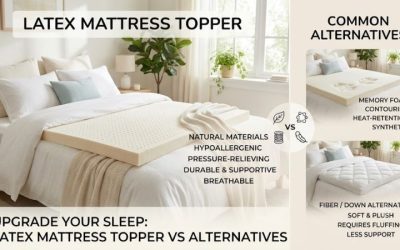
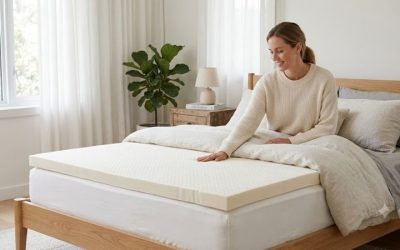
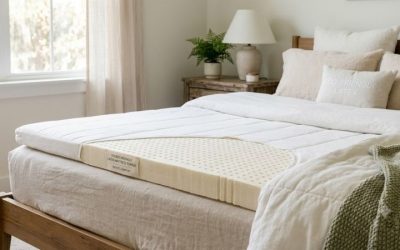
Choosing a wool mattress topper vs alternatives depends on your comfort needs, sleeping temperature, and mattress condition. Wool offers moisture management and gentle cushioning, while latex, memory foam, cotton, and down provide different benefits. This comparison helps you choose the right material for your sleeping style and budget.
Wool Mattress Topper vs Alternatives: Quick Comparison
Wool mattress toppers are particularly attractive to sleepers who want natural fiber cushioning, moisture management, and a less foam-like sleeping surface. However, they are not necessarily the best option for deep pressure relief or significantly changing mattress firmness.
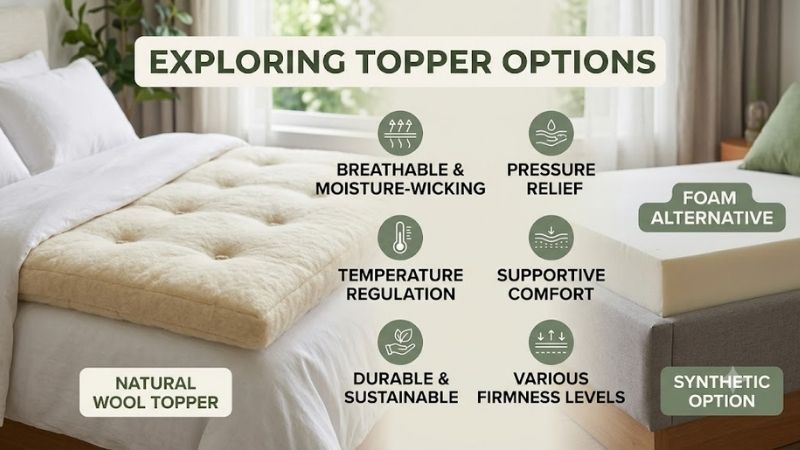
Quick Comparison Table
| Material | Sleeping Feel | Pressure Relief | Temperature Characteristics | Main Drawback |
|---|---|---|---|---|
| Wool | Soft, resilient fiber cushioning | Moderate to limited | Absorbs and releases moisture vapor | Compresses with use |
| Natural latex | Buoyant and responsive | Good, depending on firmness | Generally breathable | Expensive and heavy |
| Memory foam | Slow-moving, body-hugging | Strong contouring potential | Traditional foam may retain heat | Can restrict movement |
| Conventional polyfoam | Varies from soft to firm | Depends on construction | Varies by foam and cover | Quality varies widely |
| Down and feather | Fluffy, plush | Limited structural cushioning | Insulating, construction-dependent | Requires fluffing |
| Down alternative | Soft, pillow-like | Limited deep pressure relief | Varies by fill and cover | Can flatten |
| Cotton | Soft to relatively firm after compression | Usually modest | Absorbent and breathable | Can compact over time |
These are general material comparisons rather than laboratory performance measurements. Thickness, fill weight, construction, surrounding bedding, and the underlying mattress all influence comfort and thermal performance.
Quick Verdict
Choose wool if you want moisture management, moderate surface cushioning, and a natural fiber feel.
Choose latex if you need more substantial pressure relief with responsive support.
Choose memory foam if you prefer deeper body contouring or stronger motion isolation.
Choose cotton if you want a plant-based, relatively simple cushioning material and accept that it may compress.
Choose down or down alternative if you primarily want a plush, pillow-like surface rather than substantial foam cushioning.
Choose conventional polyfoam if upfront affordability and a wide range of firmness choices are priorities.
What Makes a Wool Mattress Topper Different?
Unlike latex and memory foam, wool toppers use fibers rather than a continuous foam structure. This difference affects cushioning, moisture movement, maintenance, and how the topper responds to body weight.
Wool Fiber Construction
A wool topper usually contains layers or chambers of wool batting enclosed within a fabric cover, commonly made with cotton or another textile.
The wool fibers contain natural crimp, which gives the batting loft and resilience. Their structure also allows them to absorb and release moisture vapor.
The feel varies according to fill weight, fiber preparation, quilting, topper thickness, and how tightly the wool is packed.
A thick, densely filled wool topper may feel relatively substantial, while a loosely filled construction may initially feel fluffy and soft.
Moisture Management
Wool fibers are hygroscopic, meaning they can absorb moisture vapor from the surrounding environment and release it as conditions change.
This can help moderate humidity within the immediate sleeping environment.
For sleepers who experience a clammy feeling in bed, this characteristic may be useful.
However, moisture regulation is not the same as actively cooling the body. Wool also provides thermal insulation, and a thick wool topper can feel warm under certain conditions.
Compression and Settling
Wool batting gradually compresses under repeated pressure.
This is a normal characteristic of loose fiber-filled bedding, although the degree of compression depends on construction and use.
Some wool toppers can be fluffed, rotated, or aired to help manage settling. Others have densely quilted construction that cannot be restored to its original loft through fluffing.
Wool should not be expected to maintain the same thickness or cushioning characteristics as a resilient latex foam layer.
Wool Topper vs Wool Mattress Pad
A mattress pad generally provides a thinner comfort or protective layer, while a topper is intended to create a more noticeable change in the sleeping surface.
However, manufacturers do not always use these terms consistently.
An advertised wool topper may contain only a modest amount of filling, whereas another product may contain substantially more wool.
Check the actual construction and fill specifications rather than relying on the product category name.
Wool vs Latex Mattress Toppers
Wool and latex both appeal to shoppers interested in alternatives to conventional polyurethane foam. However, their sleeping characteristics differ considerably.
Cushioning and Pressure Relief
Latex foam compresses elastically under weight and recovers when the load is removed.
Wool relies on the loft and compression of individual fibers to create cushioning.
A latex topper can offer more substantial and consistent pressure redistribution, particularly when the sleeper needs cushioning beneath the hips or shoulders.
Wool is better suited to adding a gentler comfort layer over a mattress that already provides sufficient pressure relief.
Best choice: Latex for significant pressure-related discomfort from a firm mattress; wool for modest surface softening.
Responsiveness and Support
Latex has a distinctive buoyant feel. When sleepers move, the material adjusts and returns toward its original shape relatively quickly.
Wool feels less springy and tends to provide a more textile-like sleeping surface.
Neither material replaces the underlying mattress support system.
However, a sufficiently thick latex layer can change the way body weight is distributed more noticeably than a wool topper.
Best choice: Latex for responsive foam cushioning; wool for a less elastic, fiber-based feel.
Temperature and Moisture Control
Wool can absorb and release moisture vapor, while latex relies primarily on material structure, ventilation, and the surrounding bedding for airflow.
Latex may be preferable for someone who dislikes thick insulating bedding.
Wool may be preferable for someone who experiences changes in humidity or wants moisture-buffering fibers near the sleeping surface.
Neither material guarantees lower nighttime body temperature.
Best choice: Wool for moisture management; latex for sleepers prioritizing ventilated, responsive foam.
Durability and Maintenance
High-quality latex generally offers strong material resilience and resistance to permanent compression.
Wool can remain useful for a long time, but its fill may settle and become denser with use.
Maintenance requirements also differ.
Wool may require airing or specialized cleaning, whereas latex foam generally requires protection against excessive moisture, inappropriate heat, and unsuitable cleaning methods.
Wool vs Latex Comparison Table
| Feature | Wool | Latex |
|---|---|---|
| Main construction | Natural fiber batting | Elastic foam |
| Comfort feel | Cushioned and textile-like | Buoyant and responsive |
| Deep contouring | Limited | More substantial |
| Moisture buffering | Strong material characteristic | Not a primary foam property |
| Shape retention | Fill gradually settles | Generally strong elastic recovery |
| Handling | Depends on fill weight | Often heavy |
| Maintenance | Airing and care-specific cleaning | Usually spot cleaning of core |
| Best for | Surface comfort and moisture management | Pressure relief and responsive cushioning |
Wool vs Memory Foam Mattress Toppers
Memory foam provides a substantially different sleeping experience from wool because it responds slowly to pressure and conforms around the body.
Body Contouring
Memory foam is designed to deform in response to pressure, with its response also affected by temperature in many formulations.
This creates a body-hugging sensation that can be useful when a firm mattress produces concentrated pressure.
Wool does not generally create the same deep impressions around the shoulders and hips.
As a result, memory foam is often more appropriate when significant contouring is needed.
A wool topper may still feel more comfortable to sleepers who dislike the sensation of sinking into foam.
Motion Isolation
Memory foam tends to absorb movement effectively because of its slow-response characteristics.
Wool also has cushioning properties, but a wool topper should not be expected to provide the same movement-damping behavior as a substantial memory foam layer.
For couples sharing a responsive mattress, memory foam may offer a more noticeable reduction in surface movement.
The mattress and foundation beneath the topper still influence overall motion transfer.
Sleeping Temperature
Traditional dense memory foam can restrict airflow and create a warm sleeping sensation for some people.
Wool’s moisture-buffering ability may help manage humidity near the sleeper, but wool also insulates.
A thick wool topper combined with warm bedding may not be comfortable in every bedroom climate.
The cover, protector, sheets, and room temperature remain important.
Maintenance and Long-Term Comfort
Memory foam does not require fluffing, but its comfort and resistance to permanent impressions depend on foam quality, density, and use.
Wool may settle and compact but can remain functional as a surface comfort layer.
Both materials require appropriate cleaning methods, and neither should automatically be machine washed.
Best choice: Memory foam for deeper contouring and motion isolation; wool for a less body-hugging feel and moisture management.
Wool vs Cotton Mattress Toppers
Wool and cotton are natural fiber options, but their structure and behavior differ.
Cushioning and Loft
Wool fibers have natural crimp that contributes to bulk and resilience.
Cotton fibers do not behave identically and can pack together as the topper experiences repeated pressure.
A cotton-filled topper may gradually become flatter and denser, especially with heavy use.
Wool can also compress, but its fiber structure can help retain some cushioning characteristics.
Actual performance depends on fill amount, construction, and maintenance.
Moisture and Breathability
Both cotton and wool can absorb moisture.
Cotton is widely used in breathable bedding textiles, while wool has particularly notable moisture vapor absorption and release characteristics.
However, neither material actively removes heat from the body.
A thick cotton or wool filling can also provide insulation.
Cleaning and Household Use
Some cotton-filled pads are machine washable, but this cannot be assumed for thick cotton toppers.
Wool frequently requires more careful cleaning, especially when the filling is not designed for immersion or mechanical washing.
Buyers should check whether the cover is removable and whether the entire topper is washable.
Best choice: Wool for loft and moisture buffering; cotton for shoppers preferring plant-based fibers and simpler constructions, provided the chosen product meets their cleaning needs.
Wool vs Down and Feather Mattress Toppers
Down and feather toppers share some of wool’s characteristics because they rely on natural filling rather than foam. However, the two materials differ in loft, insulation, and maintenance.
Softness and Surface Comfort
Down creates a fluffy, pillowy sensation, while feathers add structure and can make the filling feel more substantial.
Wool tends to feel more compact and less cloud-like, particularly after the fibers settle.
Someone seeking a luxurious, plush surface may prefer down, while someone seeking gentle cushioning without excessive fluffiness may prefer wool.
Neither option reliably provides the same deep pressure redistribution as a substantial foam topper.
Temperature and Insulation
Both wool and down are insulating materials.
Wool has notable moisture vapor absorption characteristics, which can help moderate humidity close to the body.
Down primarily provides insulation through air trapped between its clusters. Its warmth depends on fill quantity, loft, shell fabric, and surrounding bedding.
A thick down topper may feel too warm for some sleepers, but wool is not guaranteed to be cooler in every construction.
Fill Migration and Maintenance
Down and feather fillings can move within a topper, particularly when the construction lacks effective internal chambers.
Baffle boxes and quilted compartments help control distribution, although regular fluffing may still be required.
Wool batting can also compress and settle, but well-constructed quilted layers may limit movement.
Cleaning requirements are product-specific, and some natural-filled toppers require professional care.
Best choice: Wool for modest cushioning and moisture management; down for a fluffier, softer sleeping surface.
Wool vs Down Alternative Mattress Toppers
Down alternative toppers generally use synthetic fiberfill, commonly polyester, to imitate the fluffy feel of natural down.
They are often more affordable than premium wool-filled designs.
Initial Comfort
Down alternative toppers can provide immediate surface softness without the heavier feel of dense wool batting.
However, synthetic fibers may compress or clump depending on their quality and construction.
Wool typically feels more substantial and less pillow-like.
Neither is the ideal first choice when the underlying mattress requires significant pressure redistribution.
Temperature and Moisture
Wool fibers can absorb moisture vapor within their structure.
Polyester fibers are comparatively hydrophobic, although synthetic bedding can be engineered to move moisture through fabric and fill construction.
This means wool has a useful material-level moisture-buffering advantage, but the finished product’s performance depends on the complete design.
Maintenance and Affordability
Some down alternative toppers are machine washable, which can make them convenient for guest rooms and family households.
Wool toppers commonly require more careful handling.
Synthetic-filled designs are also frequently available at lower purchase prices.
Best choice: Wool for natural fiber properties and moisture buffering; down alternative for budget-friendly plushness and potentially easier care.
Wool vs Conventional Polyfoam Mattress Toppers
Conventional polyurethane foam provides another alternative when buyers want to adjust mattress comfort without purchasing an entirely new bed.
Pressure Distribution
Polyfoam is manufactured in different firmness levels and densities.
A sufficiently thick polyfoam topper can alter surface cushioning and distribute pressure more substantially than a thin wool layer.
Wool primarily adds fiber cushioning rather than creating a continuous foam comfort system.
If a mattress feels extremely hard, polyfoam may offer a more noticeable improvement.
Responsiveness and Sleeping Feel
Conventional polyfoam usually recovers more quickly than traditional memory foam.
Depending on the formulation, it may feel springy, soft, or relatively firm.
Wool provides a softer textile-based sensation without the same elastic foam response.
The preferred feel is largely personal.
Cost and Durability
Basic polyfoam toppers are often less expensive than wool products.
However, foam quality varies widely, and low-density formulations may develop impressions or lose comfort over time.
Wool does not experience foam breakdown, but its fill can become compressed and less lofty.
Neither material should be assumed to last longer without examining product construction and credible durability evidence.
Best choice: Polyfoam for a lower-cost, more substantial firmness adjustment; wool for natural fiber cushioning and moisture management.
Performance Comparison: Which Material Wins?
Different materials serve different purposes. Evaluating them using consistent criteria helps prevent spending more on features that may not improve your sleep.
| Performance Priority | Strongest Material Candidates | Important Qualification |
|---|---|---|
| Moisture buffering | Wool | Construction and cover affect performance |
| Deep contouring | Memory foam | Depends on foam firmness and thickness |
| Responsive cushioning | Latex | Some sleepers dislike its bounce |
| Initial plushness | Down, down alternative | Fill may compress or shift |
| Lower upfront cost | Conventional polyfoam | Quality and durability vary |
| Natural plant-based filling | Cotton | Can become compact |
| Motion isolation | Memory foam | Underlying mattress still matters |
| Elastic resilience | High-quality latex | Not all latex products perform identically |
| Modest surface softening | Wool, cotton, fiberfill | Limited ability to correct excessive firmness |
| Easy repositioning | Latex, responsive polyfoam | Depends on overall construction |
Which Material Offers the Best Pressure Relief?
Memory foam and appropriately selected latex are generally better suited to substantial pressure redistribution than wool, down, or cotton fiberfill.
This is especially relevant when the existing mattress feels too hard around the shoulders or hips.
However, thickness and firmness matter. An excessively soft topper can create uncomfortable sinking or alignment problems.
Wool remains useful when the mattress is already supportive and the sleeper wants a smaller change in surface feel.
Which Material Is Best for Temperature Regulation?
Wool is particularly interesting because of its ability to absorb and release moisture vapor.
Latex is another strong candidate because many latex topper designs allow airflow through the foam.
Traditional dense memory foam can feel warmer, particularly when closely surrounding the body.
However, no topper material alone determines sleeping temperature. The mattress, sheets, comforter, protector, room humidity, and ventilation all contribute.
Which Material Is Most Durable?
High-quality latex generally has strong resistance to permanent compression.
Wool can maintain useful cushioning over time, but its fill may settle and become denser.
Memory foam and polyfoam durability depend on formulation, density, and manufacturing quality.
A simple material ranking is therefore less useful than evaluating actual construction and the expected degree of compression.
Which Material Offers the Best Value?
Value depends on purchase price, comfort suitability, maintenance requirements, and useful life.
A premium wool topper may be worthwhile if its moisture-management properties address the sleeper’s main concern.
If the real problem is an overly firm mattress, purchasing wool instead of a suitable foam topper may provide poor value.
For occasional use, an affordable polyfoam or down alternative topper may be sufficient.
Choosing a Wool Mattress Topper by Sleeping Position
Wool can suit multiple sleeping positions, but its limited deep contouring makes the condition of the underlying mattress particularly important.
Side Sleepers
Side sleepers place concentrated pressure around the shoulders and hips.
If the existing mattress is already supportive and adequately cushioned, a wool topper can add comfortable surface softness.
However, a very firm mattress may require more substantial contouring than wool alone can provide.
A soft latex or memory foam topper may be more appropriate when pressure relief is the main objective.
Recommendation: Choose wool for modest softness; consider foam when pronounced shoulder or hip pressure is the problem.
Back Sleepers
Back sleepers generally need a sleeping surface that accommodates body contours without allowing excessive pelvic sinking.
A moderately filled wool topper can make a firm mattress feel more comfortable without producing the deep body-hugging effect of some foams.
Still, the mattress must provide adequate support underneath.
Recommendation: Wool is worth considering when the mattress already maintains comfortable alignment but feels slightly too firm at the surface.
Stomach Sleepers
Stomach sleepers often benefit from minimizing excessive sink around the midsection.
A thin or moderately filled wool topper may soften the surface without changing mattress behavior as dramatically as a thick, soft foam topper.
However, heavily padded wool constructions may still compress unevenly.
Recommendation: Consider a thinner wool design when only mild cushioning is needed.
Combination Sleepers
Combination sleepers change positions during the night.
Wool does not have the pronounced slow-response behavior associated with traditional memory foam, so it may appeal to those who dislike feeling surrounded by foam.
Latex is another option because of its quick elastic recovery.
Recommendation: Wool for a textile-like comfort layer; latex when more responsive cushioning and pressure redistribution are needed.
How to Choose the Right Wool Mattress Topper
Wool topper selection requires more than choosing a mattress size and checking a softness description.
Fill quantity, construction, cover materials, maintenance, and compatibility determine whether the product meets your needs.
Evaluate Wool Fill Weight and Thickness
A thicker wool topper does not automatically provide better support.
Some products are loosely filled and initially fluffy, while others contain denser, more compact batting.
If fill weight is disclosed, compare it alongside topper dimensions and construction.
For example, total fill weight alone is not useful when comparing a Twin topper with a King topper.
A more meaningful comparison considers wool weight relative to the covered area, while recognizing that fiber processing and quilting also influence feel.
Examine the Cover Material
Cotton covers are common on wool toppers because they provide a textile surface and can allow moisture vapor to move through the cover.
Other materials may also be used.
Check whether the cover is removable and whether it contains additional synthetic batting, waterproof layers, or coatings.
These components can influence breathability, cleaning, and the sensation of the finished topper.
Understand Wool Certifications
Certification claims should be checked against the actual scope of the standard.
For example, an organic textile certification may address specific material sourcing and processing requirements, while another certification may focus on chemical emissions or substances.
A certification for one component does not automatically establish that the entire topper meets the same standard.
Likewise, a product described as natural wool is not necessarily certified organic.
Consider Wool Odor and Sensitivity
Wool products may have a noticeable natural fiber odor when first unpacked.
Its intensity varies with wool processing, cleaning, packaging, and other materials.
An odor should not automatically be interpreted as harmful or harmless.
If the product has a strong or persistent unusual smell, follow the manufacturer’s guidance and contact the seller when appropriate.
People with known material sensitivities should examine the complete product composition rather than relying on labels such as hypoallergenic.
Check Mattress Size and Bed Height
Measure the mattress instead of assuming every topper sold under the same size label has identical dimensions.
A wool topper should lie flat without excessive overhang or bunching.
Also consider its thickness when choosing fitted sheets and mattress protectors.
Corner straps or another suitable retention system can be useful when the sleeper changes positions frequently.
Review Cleaning Instructions
Many wool toppers are not designed for standard machine washing.
Improper washing can cause shrinkage, felting, distortion, or damage to the filling.
Check whether the manufacturer recommends spot cleaning, periodic airing, professional cleaning, or specific other methods.
A washable protective layer can reduce direct exposure to moisture and dirt, but it should not unnecessarily undermine the topper’s desired breathability.
Compare Trial and Return Policies
Natural fiber toppers may feel different after the filling settles.
Before purchasing, confirm whether the retailer permits returns after opening or sleeping on the topper.
Check any conditions related to cleanliness, packaging, shipping costs, and return periods.
A trial period can be particularly valuable when moving from foam to wool for the first time.
Practical Buyer Scenarios
The following examples illustrate when wool may be preferable and when another topper is likely to make more sense.
Scenario 1: Your Mattress Feels Slightly Too Firm
A mattress that provides adequate support but lacks surface comfort may benefit from a wool topper.
The added fiber cushioning can reduce the harshness of the immediate sleeping surface.
However, if the mattress produces pronounced pressure discomfort, latex or memory foam may create a more substantial improvement.
Recommended starting point: Wool for mild discomfort; latex or memory foam for deeper cushioning.
Scenario 2: You Frequently Wake Up Feeling Clammy
Wool may be worth considering because of its moisture vapor absorption and release properties.
This can help manage humidity in the bedding microclimate.
However, it will not correct a bedroom that is excessively hot or humid.
A breathable protector, lighter bedding, and appropriate room conditions may be equally important.
Recommended starting point: Wool, combined with attention to the entire bedding system.
Scenario 3: You Share a Bed With a Restless Partner
If partner movement disrupts sleep, memory foam may be a more suitable choice.
Its slow-response structure generally limits how movement spreads across the immediate sleeping surface.
Wool is not specifically designed for strong motion isolation.
Recommended starting point: Memory foam, assuming its contouring and temperature characteristics are acceptable.
Scenario 4: You Want a Natural Fiber Sleeping Surface
Wool and cotton are both candidates when natural fiber construction is a priority.
Wool offers distinctive loft and moisture-buffering characteristics, while cotton provides a plant-based alternative.
Inspect the actual fill and cover materials.
A topper may contain natural fibers alongside synthetic backing, thread, or other components.
Recommended starting point: Wool for moisture buffering; cotton for a plant-based fill preference.
Scenario 5: You Need to Improve an Older Mattress
If the mattress remains structurally sound and only feels somewhat uncomfortable, a topper can be useful.
However, wool is not designed to repair broken support components, major depressions, or severe sagging.
The same limitation applies to latex, memory foam, and other topper materials.
A failing mattress may need replacement rather than additional padding.
Recommended starting point: Evaluate the mattress condition before purchasing any topper.
Common Mistakes When Comparing Wool Mattress Toppers
Assuming Wool Is Always Cooling
Wool manages moisture and provides insulation.
These characteristics can support thermal comfort, but they do not guarantee a cool sleeping surface in every climate or bedding arrangement.
A thick wool topper may feel warm beneath an insulating comforter.
Expecting Wool to Fix Poor Mattress Support
Wool adds cushioning, not a replacement support system.
Significant mattress sagging or uneven structural support cannot reliably be corrected with fiber filling.
If the underlying mattress is failing, replacing it is generally more appropriate.
Ignoring Natural Compression
Wool topper thickness may decrease after use because fibers settle under repeated pressure.
This does not necessarily indicate a manufacturing defect.
However, shoppers should understand how the construction is expected to settle and whether the manufacturer provides care guidance.
Confusing Wool Fill With a Wool Cover
A topper containing a thin wool layer over a latex or foam core is not equivalent to a wool-filled topper.
The foam core may dominate the sleeping feel and pressure-relief characteristics.
Read the complete construction details before comparing products.
Assuming Natural Materials Require No Special Care
Natural fibers can be sensitive to moisture, mechanical washing, and inappropriate drying methods.
Wool in particular may shrink or felt under unsuitable conditions.
Care requirements should be treated as part of the purchasing decision.
Frequently Asked Questions
Is a Wool Mattress Topper Better Than Memory Foam?
Wool is generally better suited to sleepers seeking moisture management, gentle cushioning, and a less body-hugging feel. Memory foam is more suitable when deep contouring and motion isolation are priorities. Neither is universally better because they serve different comfort needs.
Do Wool Mattress Toppers Keep You Cool in Summer?
Wool can absorb and release moisture vapor, helping manage humidity near the sleeping surface. However, wool also insulates, so its cooling suitability depends on thickness, cover materials, room temperature, and surrounding bedding. It should not be considered an active cooling product.
Can a Wool Mattress Topper Make a Firm Mattress Softer?
Yes, a wool topper can add surface cushioning to a firm mattress. However, its effect is usually less substantial than that of a thick, soft latex or memory foam topper. Wool is generally more suitable for mild comfort adjustments than major changes in pressure relief.
How Long Does a Wool Mattress Topper Last?
There is no reliable universal lifespan for every wool topper. Longevity depends on wool quality, fill quantity, quilting, frequency of use, care, and the sleeper’s expectations. Wool can remain functional after settling, but its initial loft and softness may change over time.
Are Wool Mattress Toppers Good for Side Sleepers?
They can be suitable when the underlying mattress already provides enough cushioning for the shoulders and hips. If side sleeping creates significant pressure discomfort, a soft latex or memory foam topper may offer more substantial contouring than wool alone.
Are Wool Mattress Toppers Worth the Money?
A wool topper can be worthwhile when natural fiber cushioning and moisture management are the main priorities. However, wool is often more expensive than basic synthetic alternatives and may require additional care. Its value depends on whether those characteristics address your actual sleep needs.
Conclusion
When comparing a wool mattress topper vs alternatives, wool is a compelling choice for gentle cushioning, moisture management, and a natural fiber sleeping surface. Latex is generally better for responsive pressure relief, memory foam for deep contouring and motion isolation, and down alternative or polyfoam for lower-cost comfort adjustments. If your existing mattress is supportive and you mainly want better surface comfort, wool deserves consideration. If significant pressure relief or firmness correction is needed, a suitable foam topper may be the better investment.