Bed rail for adults vs alternatives is an important comparison when choosing equipment for safer bed transfers, repositioning, or fall-risk management. Portable rails, transfer poles, bed trapezes, and low beds serve different purposes, and each introduces specific limitations. This guide explains how to evaluate support, compatibility, entrapment risk, and practical alternatives before buying.
Quick Verdict: Should You Buy an Adult Bed Rail?
An adult portable bed rail may be appropriate for someone who can understand and use a stable handhold and whose bed and mattress meet the manufacturer’s compatibility requirements. A short transfer-oriented rail may help certain users move between lying, sitting, and standing. A longer rail may address a different concern but can interfere with getting out of bed or create additional hazards.
A transfer pole may be more suitable when the main problem is standing up, while a bed trapeze can provide overhead assistance with repositioning for selected users. A lower bed can reduce fall distance but may make standing more difficult. None of these devices should be selected based on appearance or an assumed ability to prevent all falls.
| Option | Primary purpose | Potential advantage | Major limitation |
|---|---|---|---|
| Adult portable bed rail | Transfers, repositioning, or edge support | Bedside handhold | Entrapment and compatibility hazards |
| Bed cane or short assist handle | Targeted handhold | Less edge coverage | Also subject to rail safety concerns |
| Transfer pole | Standing and transfers | Support outside mattress edge | Requires secure installation |
| Bed trapeze | Repositioning in bed | Overhead grasping point | Requires strength and compatible mounting |
| Low-profile bed | Reduce distance to floor | No rail barrier | May complicate standing |
| Bedside floor mat | Cushion certain fall impacts | Does not create mattress gap | Can obstruct walking or transfers |
| Professionally selected roll guard | Positional boundary | Different contact arrangement | Still requires individual assessment |
| Caregiver assistance and environmental changes | Address specific functional risks | Adaptable to actual needs | May require ongoing help or resources |
The most important decision is not which product offers the largest structure. It is which intervention addresses the individual’s actual difficulty without introducing disproportionate hazards.
How Adult Bed Rails Differ From Other Mobility Aids
Adult bed rails are often grouped together with ordinary bedroom accessories, but they are better understood as support equipment that interacts with a person’s mobility and sleeping environment.
The difference is significant. A bedside lamp or storage organizer generally does not change a person’s ability to move out of bed. A rail or support pole can influence how someone stands, turns, or responds to a loss of balance.
A support that is helpful in one situation can become hazardous in another. A rail that gives an independently mobile adult a convenient handhold might create a trapping or climbing hazard for someone who is confused or cannot reposition independently.
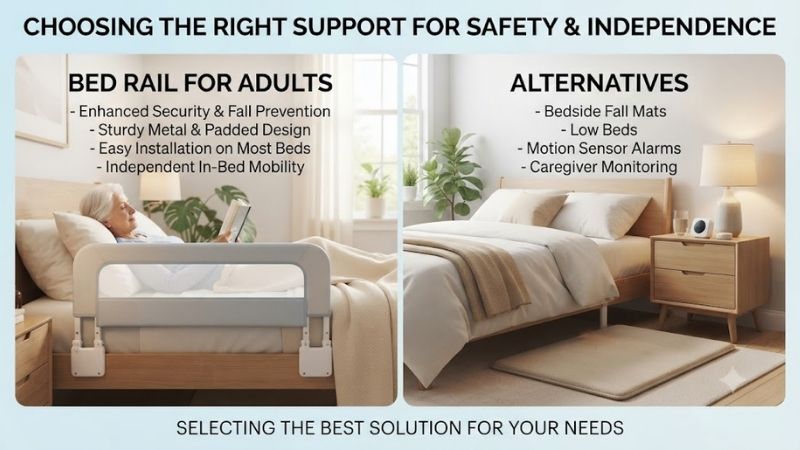
Bed Rails Provide Support at the Mattress Edge
Portable bed rails commonly use an under-mattress support structure, retention system, or other approved installation method. Their grasping area sits beside the mattress, making it accessible during certain movements.
This arrangement can help when the user is able to reach the handle and perform most of the movement independently. For example, someone who can roll onto one side but needs a stable point of contact while sitting up may find an appropriately selected handle useful.
However, that arrangement creates potential gaps within the rail and between the mattress and rail. The mattress may compress under the user’s weight, changing those gaps during the night.
Consequently, mattress compatibility and proper installation are fundamental safety questions, not secondary product features.
Transfer Poles Provide Support Outside the Mattress
A transfer pole usually extends vertically near the bed and provides grasping points for supported movement. Some use floor-and-ceiling tension systems, while others require different anchoring arrangements.
Its key distinction is that the support may be positioned outside the mattress edge rather than functioning as a barrier along it.
That can make it relevant for someone whose principal difficulty is rising to stand. However, ceiling structure, floor surface, installation method, and user ability must all be considered.
A tension-mounted pole is not universally compatible with every ceiling. Improvised installation can create a serious fall hazard.
Low Beds Address Fall Distance Rather Than Transfer Leverage
A lower bed changes the height from which a person might fall. It does not provide the handhold that a portable rail or transfer pole offers.
For someone at risk of rolling from bed, reducing bed height may be worth considering as part of a professional fall-prevention plan.
Yet the same lower height can make transfers more difficult for someone with limited leg strength. A person may need to exert more effort to stand from a low surface.
This illustrates why a strategy that reduces one hazard can create another. Bed height should be selected according to both fall risk and transfer ability.
Understanding the Most Serious Bed Rail Risk: Entrapment
Entrapment occurs when part of a person’s body becomes caught in a space from which they cannot escape safely.
For adult portable bed rails, potential trapping areas include openings within the rail and gaps between the rail and mattress. The consequences can include severe injury and asphyxiation.
This risk is not hypothetical, and it is not limited to very old or visibly damaged products.
US consumer adult portable bed rails manufactured after August 21, 2023 are subject to the mandatory requirements codified in 16 CFR Part 1270. The regulation incorporates ASTM F3186-17 with modifications for covered consumer products.
Why Mattress Compression Matters
An empty bed may appear to have no visible gap between its mattress and rail.
However, a person’s body weight can compress the mattress near its edge. A soft mattress may deform differently from a firmer one, and added toppers can change the overall geometry.
If a rail shifts away from the mattress or creates an opening during use, a dangerous trapping space can develop.
Buyers should never assume that pushing a rail tightly against the mattress is sufficient. The complete manufacturer-specified retention system is essential.
Why User Ability Changes the Risk
A person who can move freely may be able to respond to an uncomfortable position. Someone with reduced muscle control, confusion, or substantial weakness may be unable to escape.
Cognitive impairment, sedating medications, neurological conditions, and other functional limitations may increase concern.
A bed rail must never be used as a restraint to keep a person in bed. When the user cannot move or communicate reliably, professional assessment is particularly important.
Why a Short Bed Cane Is Not Automatically Safer
It can be tempting to assume a small handle eliminates the hazards associated with longer barriers.
However, covered consumer adult portable bed rails include certain bed canes, assist bars, and transfer aids. Smaller dimensions do not automatically remove the possibility of hazardous gaps or improper retention.
Compare the exact product’s safety documentation and suitability rather than assuming that a compact design is exempt from relevant requirements.
Bed Rail vs Transfer Pole: Which Helps With Standing?
These products may assist similar movements, but the direction of support and installation conditions differ.
A bedside rail provides a grasping area attached or positioned near the bed. A transfer pole offers a vertical support that may extend farther above the mattress and can potentially be grasped while transitioning toward standing.
When a Bed Rail May Be Appropriate
Consider an adult who can move from lying to sitting independently but appreciates an additional handhold for stabilization. A properly installed transfer-oriented rail may be useful if the person’s bed and mattress are compatible.
The user still needs sufficient balance and strength to complete the transfer.
A rail should not be treated as a lifting device for someone who cannot support their own movement unless the exact product is intended for that function and the transfer has been professionally assessed.
When a Transfer Pole May Be More Appropriate
A person whose main difficulty occurs after reaching a seated position may benefit from a vertical grasping point near the floor-to-standing transition.
The appropriate pole position depends on the person’s transfer technique and available floor space.
A pole installed too far away may encourage overreaching. One placed in a narrow walkway may become an obstacle.
Installation should follow the manufacturer’s specific structural requirements. Ceiling material and height can determine whether a tension-mounted model is suitable.
The Better Choice Depends on Movement, Not Product Strength
A product’s published weight capacity does not establish that it is appropriate for every type of transfer.
The direction of pulling, balance requirements, grip strength, and surrounding furniture all affect real-world use.
When transfer safety is uncertain, a physical or occupational therapist can help identify the movement being assisted and select an appropriate device.
Bed Rail vs Bed Trapeze: Which Helps With Repositioning?
A bed trapeze provides an overhead or elevated grasping point that may help selected users change position or move toward the head of the bed.
This differs from a rail positioned at the mattress edge.
How a Bed Trapeze Works
A user reaches toward the suspended or elevated handle and uses available upper-body strength to assist movement.
Depending on the equipment, the system may attach to a compatible bed structure or use a separately supported frame.
The exact installation and intended movements are product-specific.
A trapeze is not suitable simply because the person has difficulty moving in bed. It may require considerable arm, shoulder, and grip function.
Potential Advantages Over a Side Rail
A trapeze may provide a grasping point without extending along the mattress edge in the same way as a portable rail.
For a suitable user, it can support selected repositioning movements.
However, it introduces its own concerns, including overhead structure, reach, loading, and installation.
An incorrectly mounted trapeze is not a safer alternative.
When Neither Is Appropriate
A person who lacks the strength or coordination to use the device may need caregiver assistance or a different professionally selected bed-mobility system.
Adding more grasping equipment cannot compensate for an unsafe movement strategy.
Choose according to the user’s demonstrated abilities rather than a generic promise of independence.
Bed Rail vs Low Bed and Floor Mat
A low bed and floor mat address the environment rather than providing a handhold.
This can make them worth considering when the main concern is the consequence of falling from the mattress.
However, they are not direct replacements for equipment intended to help the person stand.
A Low Bed May Reduce Fall Distance
Lowering the sleeping surface reduces the vertical distance between the mattress and floor.
That can be relevant when evaluating certain fall risks.
However, a low mattress may create additional difficulty with standing transfers. The user’s knees, hips, and leg strength determine whether the height is manageable.
An extremely low bed is not automatically appropriate for an adult with limited mobility.
Floor Mats Have Practical Limitations
A suitably selected floor mat may cushion some impacts, but it can also occupy valuable floor space.
In a small bedroom, a raised or soft mat may interfere with a walker, wheelchair, or ordinary foot placement.
The mat should be selected as part of the room’s complete movement plan.
When Professional Assessment Matters
If a person repeatedly falls from bed, determining the underlying cause is more important than immediately adding a barrier.
Potential contributing factors include medication effects, confusion, poor mobility, unsuitable bed height, or environmental obstacles.
The appropriate response may involve several changes rather than one product.
Mattress Compatibility: A Major Difference Between Alternatives
A portable bed rail interacts directly with the mattress edge. That makes mattress thickness and compression particularly important.
A transfer pole or separate environmental intervention may avoid some of those interactions, although it introduces its own installation requirements.
Thick Mattresses and Toppers
A thick mattress can alter the effective height of a portable rail. A soft topper can change edge compression and the relationship between the mattress and support structure.
A rail that worked with the original mattress should be reassessed after adding a topper or replacing the mattress.
Never improvise with foam padding to fill a gap between the rail and bed.
Adjustable Beds
An adjustable bed changes its shape during head or foot elevation.
A portable rail intended for a fixed bed may not remain correctly aligned when the mattress moves.
Use only equipment specifically approved for the relevant adjustable-bed configuration.
Similarly, a transfer pole placed near an adjustable bed must not interfere with the bed’s movement or user transfers.
Platform and Storage Beds
Platform beds and bed frames with built-in drawers can obstruct retention straps or other installation components.
The inability to install the required retention system should rule out that particular rail configuration.
Do not drill into unsupported frames or substitute household straps to make an incompatible product fit.
Comparing the Options for Different Users
| User situation | Option worth assessing first | Main reason |
|---|---|---|
| Independently mobile adult needing a bedside grasp | Compliant transfer-oriented rail | Targeted assistance near mattress |
| Difficulty rising from sitting | Suitable transfer pole or transfer assessment | Vertical support may better match movement |
| Difficulty repositioning while lying | Professionally selected rail or trapeze | Depends on upper-body strength and technique |
| Repeated rolling from mattress | Environmental and fall-risk assessment | Need to identify actual hazard |
| Significant cognitive impairment | Professional assessment of non-restrictive options | Rail entrapment and climbing concerns |
| Very high bed | Bed-height adjustment assessment | Transfers and fall distance both matter |
| Small room with obstructed bedside | Layout changes or alternative equipment | Maintain safe access and movement |
This table identifies topics for assessment rather than prescribing equipment for a particular medical condition.
What to Check Before Purchasing Any Alternative
Begin by describing the movement that is difficult: turning in bed, sitting up, standing, or avoiding a fall.
Next, examine the bed and room. Record the mattress dimensions, height, frame construction, available floor space, and any nearby furniture.
Then review the intended user’s ability to understand and operate the device. A support that requires substantial grip strength will not necessarily help someone who lacks that ability.
For portable bed rails, check compliance, exact mattress and bed-frame compatibility, complete retention components, placement requirements, and recall status. CPSC guidance also recommends a minimum 12.5-inch separation between an adult portable bed rail and the headboard or footboard, together with keeping nearby furniture away from the rail.
For transfer poles and trapezes, verify the exact mounting conditions, load requirements, and compatible structures. Equipment must not be improvised or adapted beyond the manufacturer’s permitted configuration.
Common Comparison Mistakes
Buying a Long Rail Because It Appears More Protective
A longer barrier may cover more of the mattress edge, but it can also obstruct entry or exit and encourage certain users to climb over it.
If the main need is a grasping point, an extended rail may add unnecessary restrictions. Identify the functional problem before choosing the amount of coverage.
Assuming a Transfer Pole Has No Risks
Transfer poles avoid some of the mattress-edge geometry associated with portable rails, but they require secure installation and appropriate use.
An unstable ceiling-mounted pole or poorly positioned handle can create a serious fall hazard. The device must match both the building structure and the user’s transfer technique.
Treating a Low Bed as a Universal Solution
A lower sleeping surface may reduce fall distance but make standing much harder.
For a person with limited leg strength, the change could introduce additional transfer difficulties.
Select height according to the entire movement sequence, not one isolated risk.
Ignoring Changes to the Mattress
A new mattress or topper can invalidate an existing rail configuration.
Repeat the compatibility review whenever the sleeping system changes.
Frequently Asked Questions
Is a Transfer Pole Safer Than an Adult Bed Rail?
Not universally. A properly selected transfer pole may avoid certain mattress-edge hazards, but it introduces structural mounting and transfer-positioning requirements. A portable bed rail has its own compliance and entrapment considerations. The best choice depends on the user’s abilities, installation environment, and intended movement.
Can a Bed Rail Prevent an Older Adult From Falling?
A properly selected rail may reduce particular risks, but it cannot prevent every fall. Some users attempt to climb over barriers or become trapped between the rail and mattress. Repeated falls require a broader assessment of mobility, cognition, bed height, medication effects, and the bedroom environment.
Is a Bed Cane Different From a Bed Rail?
A bed cane generally refers to a compact grasping device intended for transfers or repositioning. It can still fall within adult portable bed-rail safety requirements. Its smaller size does not automatically make it safer or compatible with every mattress.
Are Low Beds a Better Alternative for People With Dementia?
They may be considered as part of an individualized fall-risk plan, but there is no universal answer. Lowering the bed changes fall distance and transfer difficulty. People with cognitive impairment often require assessment of behavior, mobility, supervision, and the whole environment.
Can I Install a Bed Trapeze on Any Bed?
No. Bed trapezes have specific mounting, loading, and structural requirements. A device intended for one frame or support configuration should not be installed on another without manufacturer approval. The user must also have the physical ability to use it safely.
Should I Buy a Bed Rail Without a Professional Assessment?
A portable rail may be suitable for some independently mobile adults, but assessment is particularly important when the person has frequent falls, impaired cognition, significant weakness, or difficulty moving independently. Proper product compliance does not establish suitability for every individual.
Conclusion
An adult bed rail is worth considering when a compliant, correctly installed handhold matches the user’s specific mobility needs. Transfer poles may be better for certain standing movements, bed trapezes for selected repositioning tasks, and low beds or environmental changes for particular fall risks. No option is universally safest. Prioritize individual ability, mattress and structural compatibility, entrapment prevention, and professional assessment when risk is elevated.