A wedge pillow provides inclined support for part of the body, but it is not the only way to change resting position or improve comfort in bed. Adjustable bed bases, under-mattress wedges, conventional pillows, reading backrests, and specialized leg-elevation cushions can all serve different purposes. The correct choice depends on whether you want upper-body elevation during sleep, comfortable support while sitting upright, or a particular resting position.
This comparison explains how wedge pillows differ from these alternatives, including their geometry, comfort, stability, maintenance, and cost. It also examines why elevating the upper torso is different from simply adding more pillows beneath the head, particularly for adults considering positional relief from nighttime acid reflux.
Quick Verdict: Wedge Pillow or Another Support Option?
A conventional upper-body wedge is a practical starting choice for adults who want a stable inclined surface without purchasing an adjustable bed. Its greatest advantage is providing a relatively consistent slope beneath the torso. However, it must be appropriately sized and comfortable, and the user may experience sliding or pressure from an unsuitable angle.
An adjustable bed base provides greater flexibility and may be worth considering when the user frequently changes positions. An under-mattress wedge offers an alternative that raises the mattress rather than adding a large cushion above it. A reading backrest is more appropriate for sitting upright, while a knee or leg-elevation cushion serves a separate purpose.
| Support option | Primary purpose | Main advantage | Main drawback | Best starting use | |—|—|—|—|—| | Upper-body wedge pillow | Inclined torso support | Simple, portable positioning | Fixed angle and mattress footprint | Nighttime upper-body elevation | | Under-mattress wedge | Elevates part of the mattress | Integrated resting surface | Mattress and frame compatibility | | Adjustable bed base | Changes mattress position | Adjustable head and foot elevation | Higher cost and installation | | Stacked regular pillows | Head and upper-back cushioning | Uses existing bedding | Unstable and inconsistent incline | | Reading backrest pillow | Upright seated support | Comfortable for reading | Often too steep for overnight sleep | | Cervical neck pillow | Head and neck support | Targeted contour | Does not elevate the torso | | Leg-elevation wedge | Supports knees or legs | Targeted lower-body positioning | Not interchangeable with torso wedge | | Bed risers | Raise part of a compatible bed frame | Elevates the bed structure | Stability and frame restrictions |
These products are alternatives only in the broad sense that they modify resting comfort or positioning. They are not interchangeable for every use.
What Makes a Wedge Pillow Different?
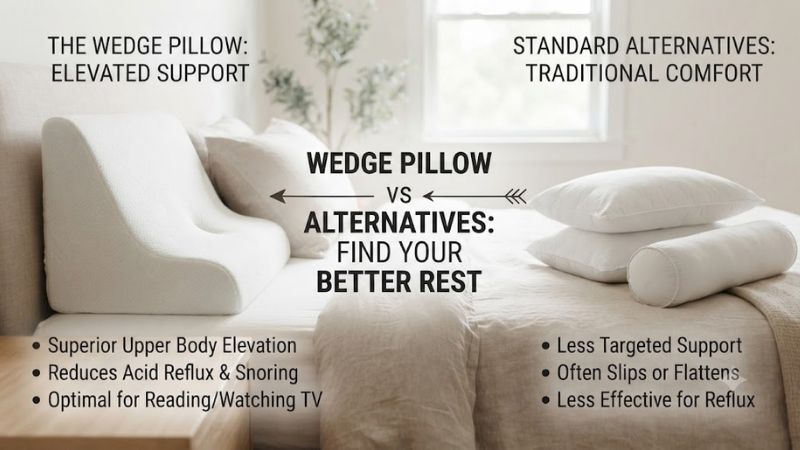
A wedge pillow is designed around an incline rather than a flat cushioning surface.
Its geometry determines where the body is supported and how elevation changes across the resting area.
A traditional wedge has a relatively low front edge and a higher rear section. Some designs use a straight slope, while others incorporate curves or multiple foam sections.
The important purchasing characteristics are incline length, maximum height, width, firmness, and intended use.
Why Incline Geometry Matters
Consider two simplified wedges that both rise 8 inches.
One has a horizontal run of 24 inches, while the other extends 36 inches.
Using straight-ramp geometry, the first has an approximate incline angle of 18.4 degrees, while the second has an angle of about 12.5 degrees.
The difference can be noticeable.
The shorter wedge creates a steeper rise over a smaller distance. The longer wedge distributes the elevation more gradually across the torso.
However, these calculations describe idealized straight surfaces. Real products may have curved profiles and compress differently under body weight.
The lesson is that maximum height alone cannot establish which wedge will feel comfortable.
Why Firmness Also Matters
A very soft wedge may compress substantially beneath the shoulders or upper back, reducing its intended elevation.
A particularly firm wedge may maintain shape but create uncomfortable pressure against the body.
Some products combine a firmer support core with a softer comfort layer.
This construction can balance shape retention with cushioning, but the correct firmness remains individual.
Do not assume the product described as medical-grade foam is automatically suitable. Clear dimensions and realistic support characteristics are more useful than broad marketing language.
Wedge Pillow vs Under-Mattress Wedge
These two arrangements can appear similar because both create a sloping sleeping surface. However, they support the body differently.
An above-mattress wedge rests directly beneath the sleeper. An under-mattress wedge raises part of the mattress itself.
The difference affects comfort, bedding fit, and compatibility.
How the Support Surface Changes
An above-mattress wedge adds a separate foam shape on top of the mattress.
The user rests on that cushion, which may have different firmness and surface characteristics from the underlying mattress.
An under-mattress wedge changes the mattress’s position while leaving the sleeper in direct contact with their usual mattress surface.
Someone who strongly prefers the feel of their mattress may find under-mattress elevation more familiar.
However, the mattress must be suitable for the resulting shape.
Mattress Compatibility
Not every mattress is intended to bend or rest over an inclined support.
Certain mattress designs may have restrictions on flexing, foundation support, or use with adjustable positioning systems.
An under-mattress wedge should therefore be selected only after reviewing the mattress and bed manufacturer’s instructions.
Improvised supports that create uneven structural loading can damage the mattress or introduce instability.
Setup and Removal
An above-mattress wedge can usually be removed without changing the mattress foundation.
That is useful for temporary use or travel.
An under-mattress wedge may require lifting the mattress and adjusting the support beneath it. This can be more cumbersome, especially with a heavy mattress.
Which Is Better?
Choose an above-mattress wedge when portability, easy removal, and direct foam cushioning are priorities.
Consider a compatible under-mattress wedge when you want the regular mattress surface to remain between your body and the incline.
For either design, suitable upper-body support is more important than the product’s marketing category.
Wedge Pillow vs Adjustable Bed Base
An adjustable bed base offers greater positioning flexibility than a fixed wedge.
Many adjustable bases allow the head section to rise, and some also provide foot elevation.
This can be useful for people who prefer different resting positions during reading, relaxation, and sleep.
However, the additional flexibility comes with cost, mechanical complexity, and compatibility requirements.
Adjustability
A conventional wedge provides a particular slope that cannot be substantially changed without adding or removing other cushions.
An adjustable base can change head elevation within its supported range.
For someone who regularly alternates between upright reading and a gentler sleeping incline, this flexibility may be valuable.
However, more adjustability does not automatically create better comfort. Users still need to select appropriate positions.
Pressure Distribution
An adjustable base changes the position of the mattress itself.
The mattress bends or articulates according to the base’s movement.
This can distribute support differently from a separate foam wedge resting on a flat mattress.
Actual comfort depends on the mattress and base system.
Cost and Installation
A wedge pillow is generally a less substantial purchase than replacing or upgrading a bed base.
An adjustable base may require electrical access, compatible mattress construction, sufficient frame space, and delivery or assembly.
These requirements can outweigh its advantages for someone who needs only occasional elevation.
Power and Maintenance
Motorized bases contain moving mechanisms and electrical components.
A wedge pillow does not require power.
For someone prioritizing simplicity and portability, the wedge may be preferable.
Which Is Better?
Choose a wedge for straightforward, fixed upper-body elevation.
Choose an adjustable base when frequent positioning changes justify the additional cost and the mattress is compatible.
Wedge Pillow vs Stacking Regular Pillows
Stacking ordinary pillows is a common attempt to create an incline without purchasing a wedge.
It may feel convenient because the pillows are already available.
However, the resulting arrangement is usually less consistent than a continuous sloped surface.
Why Stacked Pillows Behave Differently
Ordinary pillows deform under pressure and can shift relative to one another.
Several pillows placed beneath the head may raise the head and neck without adequately elevating the upper torso.
This can produce uncomfortable forward neck flexion.
A continuous wedge distributes support across a broader area, although its comfort still depends on dimensions and firmness.
Nighttime Reflux Considerations
For adults with nighttime GERD symptoms, the American College of Gastroenterology suggests head-of-bed elevation as a potential lifestyle measure.
This is a conditional recommendation based on limited evidence.
The relevant positioning principle is upper-body elevation rather than merely stacking height beneath the head.
Regular pillows should not be treated as equivalent to a suitable torso-elevation arrangement.
When Regular Pillows Remain Useful
Ordinary pillows are useful for head and neck comfort, seated cushioning, and many other purposes.
They may also be combined with a wedge when the resulting position is comfortable and appropriate.
However, adding a thick head pillow on top of a steep wedge may create excessive head elevation.
Which Is Better?
Choose a proper wedge when consistent inclined torso support is the objective.
Use ordinary pillows when flexible cushioning, rather than a sustained incline, is the main requirement.
Wedge Pillow vs Reading Backrest Pillow
A reading backrest is commonly designed to hold the upper body relatively upright.
It may include arms, a broad back section, or substantial cushioning for seated use.
A sleeping wedge usually provides a shallower, more continuous incline.
Reading Comfort
A reading backrest can support the back while the person sits up in bed.
Some designs reduce the need to stack multiple ordinary pillows.
This may be useful for reading, watching television, or using a tablet.
However, the product should not force the shoulders into an uncomfortable position.
Overnight Sleeping
A steep backrest may be unsuitable for overnight sleeping because it creates a relatively upright seated posture.
The user may slide downward or experience pressure around the hips and lower back.
A gentle sleeping wedge is generally a more appropriate category when sustained upper-body elevation is needed.
Size and Storage
Reading backrests often have substantial bulk, especially when equipped with arm supports.
A simple wedge may be easier to store.
However, some folding wedge systems can serve both activities.
Which Is Better?
Choose a reading backrest for comfortable seated activities.
Choose a sleeping wedge for inclined resting when the product is designed for that use.
Avoid assuming one category performs every function equally well.
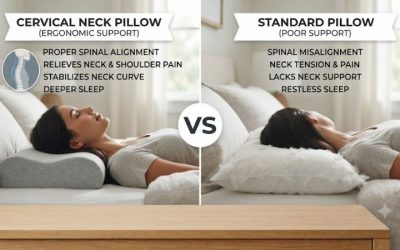
Wedge Pillow vs Cervical Neck Pillow
A cervical pillow and a wedge pillow address different body areas.
A cervical pillow focuses on head and neck support. A wedge changes the elevation of a larger body region.
Although both may be described as orthopedic, their intended functions should not be confused.
Neck Support
A cervical pillow may have a raised neck roll and recessed head area.
Its purpose is to provide a particular head and neck support arrangement.
It does not necessarily elevate the upper torso.
Upper-Body Elevation
A wedge supports a larger part of the body along a slope.
It may require an additional appropriately sized head pillow depending on the user’s comfort and position.
However, combining a tall cervical contour with a steep wedge can create excessive elevation.
Which One Should You Choose?
If the primary issue is finding comfortable head and neck support, compare cervical or conventional pillows.
If the goal is upper-body elevation, consider a suitable wedge or compatible adjustable-bed arrangement.
Persistent pain or reflux symptoms should be evaluated appropriately rather than treated solely through product selection.
Wedge Pillow vs Leg-Elevation Pillow
Leg-elevation cushions may look like wedge pillows, but their shape and intended positioning differ.
Some use a broad sloped platform. Others support the knees and calves in a stepped or curved arrangement.
These products should not automatically be substituted for upper-body wedges.
Lower-Body Positioning
A leg-elevation pillow may support the calves, knees, or lower legs.
The appropriate position depends on the intended use.
For general relaxation, comfort is the main consideration.
For medical recovery, the required position may be prescribed.
Postoperative and Circulation Claims
Retail descriptions sometimes claim that leg wedges improve circulation or reduce swelling.
However, medical positioning requirements vary.
Someone recovering from surgery or managing a circulatory condition should follow individualized clinical guidance.
Why Shape Matters
A leg wedge may have a steep edge or recessed section that is unsuitable beneath the upper back.
Similarly, a conventional upper-body wedge may not support the legs in the prescribed way.
Which Is Better?
Choose the product designed for the body region you intend to support.
Do not rely on the generic word wedge to establish interchangeable use.
Wedge Pillow vs Bed Risers
Bed risers can change the height of a bed frame.
Some people consider raising the head end of a bed to create upper-body elevation.
However, this is fundamentally different from placing a foam wedge on the mattress.
Structural Compatibility
Not every bed frame is designed to be raised unevenly.
Bed risers must be compatible with the frame and used according to their instructions.
Improvised risers can create instability.
Whole-Bed Incline
Raising the head end changes the orientation of the entire bed.
This differs from a foam wedge that supports only part of the body.
The resulting experience depends on the degree of elevation and frame design.
Why Improvisation Is Risky
Stacked household objects, unsecured blocks, or incompatible risers should not be used to tilt a bed.
A bed that shifts or becomes unstable can cause injury.
Which Is Better?
A properly compatible elevation system may be worth discussing when whole-bed positioning is required.
A wedge pillow is simpler when removable upper-body support is sufficient.
Which Option Is Best for Nighttime Acid Reflux?
Adults seeking positional relief from GERD should distinguish between head-only cushioning and elevation of the upper body.
The American College of Gastroenterology suggests elevating the head of the bed for nighttime GERD symptoms, but the recommendation is conditional.
That means the potential benefit is worth considering without assuming every person will respond.
Practical Comparison
| Option | Relevance to upper-body elevation | Main qualification |
|---|---|---|
| Appropriate upper-body wedge | Direct inclined torso support | Fit and comfort matter |
| Compatible under-mattress wedge | Raises mattress surface | Must suit mattress and frame |
| Adjustable bed base | Adjustable upper-body elevation | Requires compatible mattress |
| Stacked head pillows | Primarily elevates head and neck | Not equivalent to consistent torso elevation |
| Reading backrest | Upright seated support | May not suit overnight sleeping |
| Cervical pillow | Local neck support | Does not provide general torso elevation |
Do Not Treat a Wedge as a Complete Treatment
A wedge may be one element of managing nighttime reflux.
Persistent symptoms, difficulty swallowing, gastrointestinal bleeding, unexplained weight loss, or other concerning symptoms require medical evaluation.
Product selection should not replace indicated treatment.
Which Support Is Best for Different Sleeping Positions?
Back Sleepers
A conventional upper-body wedge may provide relatively even contact when lying on the back.
However, slope length and foam firmness matter.
A wedge that ends abruptly beneath the shoulders can create uncomfortable pressure.
Side Sleepers
Side sleepers may require a wider wedge with sufficient cushioning around the shoulder.
A narrow product can allow the upper body to shift toward the edge.
The height of any additional head pillow should be considered carefully.
Combination Sleepers
A person who changes position frequently may prefer a wider wedge or adjustable-bed arrangement.
However, a strongly fixed contour can feel restrictive.
The best option allows comfortable movement without excessive shifting.
Stomach Sleepers
Conventional upper-body wedges may be unsuitable for stomach sleeping.
The incline can alter neck and torso position in uncomfortable ways.
Do not force a wedge arrangement when the body position is clearly uncomfortable.
Cost and Long-Term Value Comparison
A wedge pillow is generally less expensive and easier to relocate than an adjustable bed base.
However, it may offer less flexibility.
A reading backrest or ordinary pillow stack may cost little when those items are already owned, but they serve different functions.
| Purchasing priority | Most practical starting point |
|---|---|
| Low-cost fixed incline | Suitable foam wedge |
| Familiar mattress surface | Compatible under-mattress wedge |
| Multiple daily positions | Adjustable bed base |
| Upright reading | Reading backrest |
| Neck support | Cervical or appropriate conventional pillow |
| Leg positioning | Purpose-designed leg cushion |
| Temporary or travel use | Portable or folding wedge |
A product offers good value only when its design matches the intended function.
Paying more for a sophisticated positioning system is unnecessary when a simple wedge provides comfortable support.
Conversely, purchasing several inexpensive wedges that do not fit can cost more than selecting an appropriate solution initially.
Common Buying Mistakes
Comparing Maximum Height Without Length
Two wedges of the same height may have different incline angles.
Compare the complete geometry and intended support area.
Assuming Stacked Pillows Provide the Same Incline
Ordinary pillows compress and shift.
They may elevate the head without creating consistent torso elevation.
Buying a Reading Wedge for Overnight Use
A steep seated backrest may be uncomfortable for sustained sleeping.
Check the manufacturer’s intended use.
Ignoring Mattress Compatibility
Under-mattress supports and adjustable bases require suitable mattress and frame construction.
Do not improvise unsupported configurations.
Assuming an Adult Wedge Is Safe for an Infant
Adult positioning recommendations do not apply to infant sleep.
Infants should sleep on their backs on a firm, flat, non-inclined approved sleep surface without wedges or other positioning objects.
Frequently Asked Questions
Is a Wedge Pillow Better Than an Adjustable Bed?
A wedge is simpler, portable, and usually less expensive. An adjustable bed provides more flexibility and may be preferable when a person regularly changes head and foot elevation. The best choice depends on positioning needs, mattress compatibility, and budget.
Is a Wedge Pillow Better Than Stacking Pillows for Reflux?
For adults seeking consistent upper-body elevation, an appropriate wedge or compatible elevated-bed arrangement is generally more relevant than stacking pillows only beneath the head. However, reflux management should follow appropriate medical guidance.
Can a Wedge Pillow Replace a Cervical Pillow?
Not necessarily. A cervical pillow supports the head and neck, while a wedge elevates a larger portion of the body. Some sleepers use a suitable head pillow with a wedge, but excessive combined height can create discomfort.
Is an Under-Mattress Wedge More Comfortable?
It may be for someone who prefers direct contact with their usual mattress. However, mattress and frame compatibility are essential. An above-mattress wedge may be more practical when portability and easy removal matter.
Can Side Sleepers Use a Wedge Pillow?
Some can, provided the wedge is sufficiently wide and supports the shoulder and torso comfortably. A narrow or very firm wedge may be less suitable. The entire head and upper-body arrangement should be evaluated.
Are Wedge Pillows Appropriate After Surgery?
Only when the chosen positioning matches the clinician’s recovery instructions. Different procedures may require different angles or body positions. A retail wedge’s medical marketing should not replace postoperative guidance.
Conclusion
A wedge pillow is the better choice when simple, removable upper-body elevation is the main objective. Adjustable beds provide more positioning flexibility, compatible under-mattress wedges preserve the usual mattress surface, and reading backrests are better suited to upright activities. Cervical pillows and leg-elevation cushions support different body regions and should not be treated as interchangeable. Choose according to the intended position, mattress compatibility, body support, and realistic comfort rather than maximum advertised height.