Key takeaways
- A cervical pillow may be worth considering when you want a more structured separation between head and neck support and can identify a contour that suits your body proportions. Dual-height models are particularly relevant when you are uncertain which neck-roll height will feel comfortable.
Compare cervical neck pillows with regular, memory foam, latex, adjustable, and orthopedic alternatives for neck support, sleeping position, comfort, and value.
A cervical neck pillow uses a contoured shape, neck roll, or specialized support zone intended to influence head and neck positioning during sleep. However, a sculpted orthopedic design is not automatically more comfortable or effective than a traditional pillow. Some sleepers benefit from a defined neck contour, while others find that a correctly sized regular pillow, adjustable shredded-fill model, or responsive latex pillow provides better support without restricting movement.
Quick Verdict: Is a Cervical Pillow Better Than a Regular Pillow?
A cervical pillow may be worth considering when you want a more structured separation between head and neck support and can identify a contour that suits your body proportions. Dual-height models are particularly relevant when you are uncertain which neck-roll height will feel comfortable.
A regular pillow is often the better choice when you sleep comfortably with conventional cushioning, move frequently, or dislike a fixed contour. Adjustable shredded-fill pillows provide more control over loft, while molded latex models offer resilient support without the slow-response sensation of some memory foams.
If you experience persistent neck pain, a pillow should be considered one part of the overall sleeping arrangement rather than a guaranteed treatment.
| Pillow type | Main support characteristic | Potential advantage | Main limitation |
|---|---|---|---|
| Cervical contour pillow | Raised neck roll and head recess | Defined support zones | Fixed geometry may not fit |
| Traditional rectangular pillow | Relatively uniform cushioning | Familiar, flexible positioning | Can flatten or provide inconsistent support |
| Adjustable shredded-fill pillow | Removable or movable filling | Customizable loft | Requires periodic adjustment |
| Molded memory-foam pillow | Slow-response contouring | Consistent shape | Restricted height adjustment |
| Latex pillow | Resilient, responsive cushioning | Easier repositioning | May feel too firm or buoyant |
| Cervical roll | Localized neck support | Small, targeted design | Does not independently support the entire head |
| Butterfly-shaped orthopedic pillow | Multiple contoured zones | May accommodate selected positions | More complicated geometry |
| Down or down-alternative pillow | Soft, compressible cushioning | Moldability and familiar feel | May compress excessively |
What Makes a Cervical Neck Pillow Different?
The primary difference is the distribution of support.
A conventional pillow generally offers cushioning across a continuous surface. A cervical contour pillow may use a raised section beneath the neck and a recessed area beneath the head.
This construction is intended to accommodate the different shapes and contact requirements of those body regions.
However, the design is useful only when its dimensions fit the person using it.
Why Neck-Roll Geometry Matters
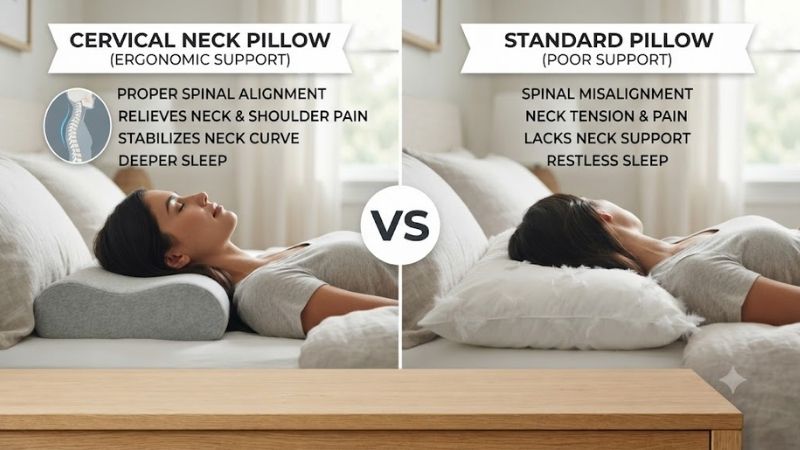
A raised neck roll can provide contact beneath the cervical region while the head rests on a lower section.
For some back sleepers, this arrangement may feel more supportive than an ordinary pillow that compresses unevenly.
However, a roll that is too high may push the head forward or create concentrated pressure beneath the neck.
A lower contour may feel more comfortable on a soft mattress or for a person with particular head and neck proportions.
The correct height cannot be determined solely from product marketing.
Cervical Support Is Not the Same as Medical Correction
Terms such as orthopedic, ergonomic, and cervical support describe intended product characteristics, but they do not establish that the pillow corrects a medical condition.
Neck discomfort can involve muscles, joints, nerves, sleeping position, posture, or other factors.
A pillow may improve comfort by changing how the head and neck are supported. It cannot reliably treat every cause of pain.
If symptoms include persistent worsening pain, weakness, numbness, or radiating arm discomfort, professional evaluation is appropriate.
Cervical Pillow vs Regular Pillow
This is the most important comparison for someone deciding whether to replace a conventional pillow with an orthopedic design.
A regular pillow can provide appropriate support when its height, firmness, and compression match the sleeper.
A cervical pillow offers more defined geometry, but that structure can be either an advantage or a limitation.
Support Distribution
A conventional rectangular pillow often supports both the head and neck through its filling.
Its shape changes under pressure.
A cervical pillow uses predetermined contours intended to create distinct contact areas.
Someone who enjoys a stable neck roll may prefer the cervical design.
Another sleeper may prefer being able to reshape a conventional pillow into a comfortable position.
Freedom of Movement
A regular pillow generally allows the sleeper to move across its surface without encountering dramatically different heights.
A cervical pillow may contain raised side regions, a recessed center, or pronounced contours.
These features can be helpful when the sleeper naturally uses the intended zones.
They can become uncomfortable when a person frequently moves into positions the designer did not anticipate.
Consistency Throughout the Night
Some conventional pillows flatten as filling shifts or compresses.
A molded cervical pillow can maintain a more consistent profile.
However, that consistency is not beneficial when the profile is unsuitable.
A fixed contour that repeatedly creates discomfort may be less useful than a conventional pillow that can be adjusted.
Which Is Better?
Choose a cervical pillow when a defined neck-support profile matches your preferences.
Choose a regular pillow when flexible positioning, familiar softness, and unrestricted movement are more important.
Neither category guarantees better neck health.
Cervical Pillow vs Adjustable Shredded-Fill Pillow
Adjustable pillows solve a different problem from many fixed cervical designs.
Rather than determining the support zones entirely through molded geometry, they let the user alter the amount or distribution of filling.
This can be especially important when finding the correct loft has been difficult.
Why Loft Adjustability Matters
The ideal pillow height depends on shoulder width, head and neck proportions, mattress firmness, and sleeping position.
A side sleeper with broad shoulders on a firm mattress may need more loft than a back sleeper on a plush mattress.
An adjustable pillow allows gradual changes without purchasing a completely different product.
For first-time buyers uncertain about pillow height, this flexibility can reduce fit-related risk.
The Limitation of Loose Filling
Shredded foam and similar fillings can shift during sleep.
A pillow that feels adequately supported immediately after fluffing may change as the material settles.
Some sleepers enjoy this moldability. Others prefer a fixed contour.
Adjustment can also require experimentation and storage for removed filling.
When a Fixed Cervical Pillow Is Better
A molded cervical pillow may be more practical when you already know which contour height feels comfortable.
It requires less day-to-day reshaping.
However, choosing a fixed design without knowing your preferred height can lead to an expensive mismatch.
When Adjustable Filling Wins
An adjustable pillow may be better when your sleeping positions vary, you frequently change mattresses, or conventional fixed-height pillows have been uncomfortable.
The right purchase depends on whether precise contouring or customizable loft matters more.
Cervical Pillow vs Memory-Foam Pillow
Many cervical pillows are made from memory foam, but not every memory-foam pillow is cervical or orthopedic.
This distinction matters because material and shape are separate purchasing variables.
Contour Shape Versus Foam Material
A regular rectangular memory-foam pillow can provide slow-response cushioning without a raised cervical roll.
A molded cervical memory-foam pillow combines that material with specialized geometry.
If you enjoy memory foam but dislike pronounced contours, a conventional shape may provide better comfort.
Conversely, if you want a particular neck-support profile, the contour can matter more than the foam’s branding.
Pressure and Compression
Memory foam responds to pressure and temperature, generally conforming gradually beneath the head.
This can create a cradling sensation.
However, two memory-foam pillows with the same unloaded height may compress differently.
Foam firmness and density are not interchangeable measurements, and neither independently establishes the ideal support level.
Temperature Comfort
Some memory-foam pillows feel warm because of their density or contact characteristics.
Ventilation holes, cooling covers, and different foam formulations can influence the sensation.
However, a gel-infused cervical pillow is not automatically cooler than a well-ventilated conventional model.
Which Is Better?
Choose based on shape and effective loft first.
Then evaluate whether slow-response memory foam is the material you prefer.
A premium memory-foam composition cannot compensate for a neck roll that is too tall.
Cervical Pillow vs Latex Pillow
Latex pillows generally provide a more responsive sensation than conventional slow-response memory foam.
They tend to rebound promptly after pressure is removed.
This characteristic may appeal to sleepers who frequently move or dislike sinking gradually into the pillow.
However, both conventional latex and cervical-contour latex designs are available, so the comparison must distinguish material from shape.
Responsive Support
Latex can maintain a buoyant surface that changes quickly as the user repositions.
For combination sleepers, this may feel easier to move across than a strongly conforming memory-foam contour.
However, a latex pillow can still have inappropriate height or firmness.
The correct dimensions matter regardless of material.
Neck Support
A molded latex cervical pillow may offer defined support zones similar to those found in memory foam.
A conventional latex pillow may offer more uniform cushioning.
Someone who wants a neck roll can therefore choose between multiple materials rather than assuming only memory foam provides orthopedic shapes.
Weight and Care
Some latex pillows are relatively heavy and have specific cleaning restrictions.
Natural rubber latex also warrants caution for people with known latex allergies.
A removable, washable fabric cover is useful, but it does not necessarily make the latex core washable.
Which Is Better?
Choose latex when responsive cushioning and shape recovery are priorities.
Choose a cervical contour when the specialized support geometry is more important than material feel.
The two characteristics can coexist in one product.
Cervical Pillow vs Cervical Roll
A cervical roll is a cylindrical or similarly shaped support intended to contact the neck.
Some people use it inside an ordinary pillowcase or alongside another pillow.
This creates a more targeted arrangement than a full contoured cervical pillow.
Targeted Support
A small roll can provide contact beneath the neck without replacing the entire head pillow.
That may be useful for someone who enjoys the main pillow’s cushioning but wants to experiment with additional cervical support.
However, positioning is important. An excessively firm or high roll may create uncomfortable pressure.
A roll should not be assumed appropriate for every sleeper.
Portability and Storage
Cervical rolls are generally smaller than full-size orthopedic pillows.
This can make them convenient for travel or limited storage.
However, their smaller size does not mean they independently provide the complete support required for sleeping.
Stability
A separate roll may shift within the pillowcase or move during sleep.
Some users find that inconvenient.
A full cervical pillow keeps its support zones integrated into one structure, although the fixed geometry may be less adjustable.
Which Is Better?
Choose a cervical roll when you want localized support and already have a comfortable head pillow.
Choose a full cervical pillow when integrated head and neck support is the priority.
Avoid either arrangement if it creates discomfort or unnatural positioning.
Cervical Pillow vs Butterfly-Shaped Orthopedic Pillow
Butterfly-shaped pillows use a more complex outline, often with extended side sections or cutouts intended to accommodate arms and shoulders.
These designs are commonly marketed to combination sleepers.
However, additional contouring is not automatically better.
Multiple Support Zones
A butterfly pillow may provide a central area for back sleeping and raised side sections for side sleeping.
This can be useful if those regions match the user’s body proportions.
However, when the head moves into an unintended zone, the height difference may become uncomfortable.
Arm and Shoulder Positioning
Some designs include cutouts or extended wings intended to provide space for an arm.
These may appeal to certain side sleepers.
Others may find the shape restrictive, particularly when turning frequently.
Pillowcase Compatibility
Specialty shapes may require proprietary covers.
This can increase long-term ownership cost and complicate laundering.
Which Is Better?
Choose a butterfly-style pillow when its geometry genuinely matches your sleeping habits and you can evaluate the fit.
Choose a simpler cervical contour when additional wings and cutouts do not address a specific comfort issue.
Cervical Pillow vs Down or Down-Alternative Pillow
Down and down-alternative pillows generally provide soft, compressible support rather than a fixed molded contour.
They may suit sleepers who strongly dislike rigid foam or prefer a traditional bedding feel.
Softness and Moldability
Down can be reshaped and compressed.
This allows a sleeper to create a preferred head-resting area.
However, the effective loft may change as filling settles.
A person requiring consistent neck support may find a lightly filled pillow too compressible.
Down-Alternative Filling
Synthetic down-alternative products can provide a similar general softness, although their performance depends on fiber type, fill amount, and construction.
Some flatten over time.
Others retain a more substantial shape.
Maintenance
Cleaning requirements vary between products.
Some down-alternative pillows permit machine washing, while foam cervical pillows often have removable covers but nonwashable cores.
A product’s care requirements should be considered before purchase.
Which Is Better?
Choose down or down alternative when soft, moldable cushioning matters most.
Choose a cervical contour when defined support geometry is desirable and comfortable.
The Mattress Changes Which Pillow Is Better
A pillow should never be evaluated independently of the mattress.
The mattress determines how far the shoulders and upper torso sink, which changes the distance the pillow must fill.
Firm Mattresses
On a firmer mattress, a side sleeper’s shoulder may remain relatively elevated.
This can increase the gap between the head and mattress.
A higher pillow may be appropriate for that person, but the actual requirement depends on anatomy and positioning.
Plush Mattresses
On a softer mattress, the shoulder may sink more deeply.
This can reduce the necessary pillow height.
A cervical contour that feels appropriate on a firm mattress may become too high after moving to a plush one.
Mattress Toppers
Adding a topper changes how the body rests on the mattress.
A person may experience a different pillow fit after installing a thick memory-foam topper.
Reevaluate the pillow if the mattress arrangement changes rather than assuming the original height remains suitable.
Which Pillow Is Better for Each Sleeping Position?
| Sleeping position | Strong starting option | Main fit requirement |
|---|---|---|
| Back | Appropriate cervical contour or conventional supportive pillow | Avoid excessive forward head elevation |
| Side | Suitable-height contour, latex, or adjustable pillow | Fill head-to-mattress gap comfortably |
| Stomach | Very low-profile pillow or an alternative arrangement | Avoid excessive neck extension or rotation |
| Combination | Adjustable or responsive pillow | Allow comfortable movement between positions |
| Uncertain fit | Dual-height or adjustable design | Reduce risk of choosing wrong loft |
Back Sleepers
A contoured cervical pillow may feel comfortable when the neck roll supports the intended area without pushing the head forward.
However, some back sleepers prefer a lower conventional pillow.
The best choice is the one that provides comfortable positioning in the actual sleeping environment.
Side Sleepers
Side sleepers need sufficient loft beneath the head.
A cervical pillow with suitable raised side regions may work well.
An adjustable shredded-fill pillow may offer greater flexibility if shoulder width or mattress softness makes the ideal height uncertain.
Combination Sleepers
Combination sleepers may benefit from responsive latex or adjustable designs.
A strongly sculpted cervical pillow can work when its support zones are appropriately positioned, but it can also become restrictive.
Ease of movement is an important practical criterion.
What Does Research Say About Cervical Pillows and Neck Pain?
Research has explored whether particular pillow designs influence neck pain, sleep quality, and related outcomes.
Some studies suggest that selected ergonomic or supportive pillows may improve comfort for particular groups.
However, findings vary, and the available evidence does not establish one universally superior material or pillow shape.
Why Studies Can Produce Different Results
Participants may have different causes of pain, mattresses, sleeping positions, and baseline pillow preferences.
Studies also use different pillow designs and outcome measurements.
A result involving one contoured pillow cannot automatically be generalized to every cervical pillow on the market.
Comfort Is Not a Diagnosis
A person may feel better after changing pillows because the new design provides more suitable support.
That does not establish that the pillow corrected a structural neck condition.
Persistent pain, radiating symptoms, numbness, weakness, or other concerning signs warrant professional evaluation.
Avoid Claims of Perfect Alignment
A pillow marketed as producing perfect spinal alignment for everyone should be viewed skeptically.
Body proportions and mattress behavior differ.
A suitable pillow can support a comfortable position but cannot guarantee identical anatomical outcomes across users.
How to Compare Long-Term Value
Premium cervical pillows may cost more because of molded foam, unusual geometry, proprietary covers, or specialized materials.
However, a higher price does not establish superior pain relief.
Return Policies Matter
Pillow fit can be difficult to judge from photographs and measurements alone.
A reasonable return arrangement is valuable when trying a strong contour for the first time.
Replacement Covers
Some cervical designs require specially shaped covers.
Confirm their availability and cost.
A pillow with unavailable replacement covers may be inconvenient to maintain.
Durability
Foam, latex, and fiberfill change with use.
A molded contour may eventually soften or deform, while conventional filling can compress or shift.
Replace a pillow when it no longer provides appropriate comfort or becomes damaged.
Common Comparison Mistakes
Assuming a Cervical Pillow Is Automatically Medical Treatment
Orthopedic marketing does not guarantee treatment of neck pain.
Fit and individual circumstances matter.
Choosing the Highest Neck Roll
A taller roll can create excessive elevation or pressure.
Compare contour height with sleeping position and mattress firmness.
Ignoring Compression
Unloaded dimensions do not reveal how far a pillow will compress beneath the head.
Material response matters.
Buying a Complex Shape Without Considering Movement
Extended wings and deep recesses may feel restrictive to some combination sleepers.
Choose geometry according to actual habits.
Frequently Asked Questions
Are Cervical Pillows Better Than Regular Pillows?
Not necessarily. A cervical pillow may provide useful defined support when its contours fit the sleeper. A properly sized regular pillow can also offer comfortable support. The better choice depends on sleeping position, anatomy, mattress, and personal preference.
Is a Cervical Pillow Better Than Memory Foam?
These categories overlap. Cervical describes support design, while memory foam describes material. A cervical pillow may contain memory foam, latex, or other filling. Compare shape and height first, then material response.
Is Latex Better for Neck Support?
Latex provides responsive cushioning and can maintain a consistent shape, but it is not universally better. A suitable latex pillow may work well for someone who dislikes slow-response memory foam, while another person may prefer the contouring feel of memory foam.
Are Cervical Rolls Better Than Full Contour Pillows?
Cervical rolls offer localized neck support and may work alongside an existing head pillow. Full contour pillows integrate head and neck support into one product. The better option depends on whether the user wants targeted adjustment or a more structured complete pillow.
Can Cervical Pillows Cure Neck Pain?
No pillow should be regarded as a guaranteed cure. A suitable pillow may improve positional comfort for some people, but neck pain can have multiple causes. Persistent or worsening symptoms require appropriate assessment.
Which Pillow Is Best for Someone Who Sleeps on Their Side and Back?
An adjustable pillow or a contoured model with appropriately designed back- and side-sleeping regions can be worth considering. The most important requirement is comfortable support in both positions without forcing the head into an unnatural tilt.
Conclusion
A cervical neck pillow is most worthwhile when its defined support zones match your anatomy, mattress, and normal sleeping position. Traditional pillows offer flexible comfort, adjustable shredded-fill models help when loft is uncertain, latex provides responsive cushioning, and cervical rolls offer localized support. Choose a full contoured design only when its geometry feels appropriate, and prioritize fit, movement, and realistic expectations over orthopedic marketing or promises of guaranteed pain relief.