Choosing a cooling mattress pad vs alternatives comes down to how much heat you experience, whether your mattress needs extra cushioning, and how much maintenance you can tolerate. Passive pads can improve the feel of your sleep surface, while breathable protectors, mattress toppers, and powered systems solve different problems.
Quick Verdict: Which Cooling Solution Should You Choose?
A cooling mattress pad is a reasonable first step when your mattress is comfortable but its surface feels warm. It adds a relatively thin comfort layer without substantially changing mattress support, although results depend on its materials and construction.
Other solutions may be more appropriate depending on your primary concern:
-
Cooling mattress pad: Best for modest surface comfort changes without significantly changing mattress feel.
-
Breathable mattress protector: Best when spill protection and minimal added cushioning are priorities.
-
Cooling mattress topper: Best when you need extra pressure relief or a noticeable change in mattress feel.
-
Breathable sheets: Best when your main problem is heat or moisture trapped directly against your skin.
-
Active bed cooling system: Best when passive bedding changes have been insufficient and adjustable temperature control is important.
-
More breathable mattress: Worth considering when the mattress itself is uncomfortable, worn, or persistently retains heat despite bedding adjustments.
No passive bedding accessory can guarantee a cooler sleeping temperature. Room conditions, humidity, body heat, bedding layers, and the mattress underneath all influence the result.
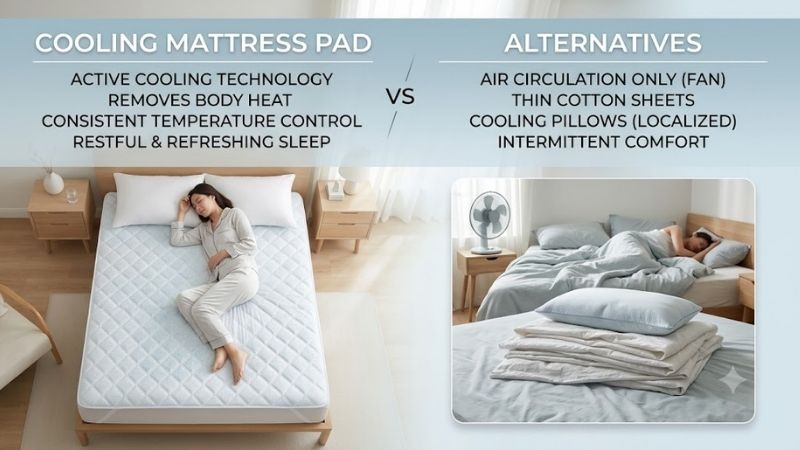
Cooling Mattress Pad vs Alternatives: Quick Comparison Table
| Cooling solution | Main function | Mattress feel | Cooling mechanism | Main limitation |
|---|---|---|---|---|
| Cooling mattress pad | Surface comfort and light cushioning | Small to moderate change | Breathability, moisture management, or initial cool touch | Passive cooling varies by construction |
| Breathable mattress protector | Mattress protection | Usually minimal change | Allows varying levels of airflow and vapor movement | Waterproof barriers can affect breathability |
| Cooling mattress topper | Extra comfort and pressure relief | Moderate to substantial change | Material airflow, thermal properties, or moisture movement | Additional thickness may retain heat |
| Breathable sheets | Skin-level comfort | Minimal change | Air and moisture movement | Cannot fix heat buildup inside a mattress |
| Active cooling system | Adjustable bed temperature | Depends on system | Powered air or liquid heat transfer | Expense, noise, electricity, and maintenance |
| Breathable mattress | Long-term sleep-surface construction | Major change | Internal ventilation and material selection | Highest replacement commitment |
Important distinction: A cooling label does not establish a specific reduction in sleeping temperature. Comparison requires knowing the materials, construction, ambient conditions, and whether any cooling performance has been independently measured.
Verified Construction Principles and Technical Differences
What Makes a Cooling Mattress Pad Different?
A mattress pad typically fits over the mattress like a fitted sheet or uses an elastic skirt. Its primary role is to add a relatively thin layer between the mattress and fitted sheet.
Depending on construction, a cooling pad may use cotton, lyocell, polyester blends, specialty fibers, quilted fill, or a temperature-responsive surface treatment. Each design has a different combination of airflow, moisture handling, durability, and cushioning.
Some pads are marketed as cooling because they feel cool immediately upon contact. Others focus on breathability or moisture management.
Those mechanisms are not interchangeable.
A cool-touch surface may initially draw heat from your skin, but that sensation can diminish as the material warms. A breathable pad instead aims to reduce the obstruction of air and moisture movement between bedding layers.
Neither approach actively removes heat from the bed in the same way as a powered cooling system.
Passive Cooling vs Active Cooling
Passive bedding relies on material characteristics and the surrounding environment. It can influence how heat and moisture move, but it does not have an independent means of continuously controlling temperature.
Active systems use powered mechanisms, typically circulating temperature-controlled water or moving air through components designed for the bed.
The practical difference is adjustability.
A passive pad has no thermostat. A compatible active system may allow the user to select operating settings, although actual cooling capacity varies by design, room temperature, and installation.
Active cooling also introduces requirements that passive bedding does not have, including electrical access, cleaning, and additional components near the bed.
Breathability vs Moisture Wicking
Breathability describes how readily air or water vapor can move through a material or construction.
Moisture wicking describes the movement of liquid moisture away from a surface, usually through fabric structure or capillary action.
A moisture-wicking fabric can help spread perspiration for evaporation, but evaporation becomes less effective in humid or poorly ventilated conditions.
Likewise, a material advertised as breathable may still feel warm when combined with dense foam, impermeable backing, or heavy blankets.
For shoppers, the entire bedding arrangement matters more than a single fabric claim.
Cooling Mattress Pad vs Mattress Topper
Mattress pads and toppers are often grouped together in product descriptions, but their intended functions differ.
Comfort and Pressure Relief
A cooling mattress pad generally supplies light cushioning rather than substantial pressure redistribution.
If your mattress already provides comfortable support but you want a different surface texture, a pad may be enough.
A mattress topper is designed to produce a more noticeable change in feel. Depending on thickness and material, it can soften a firm mattress or alter how pressure is distributed around the shoulders and hips.
However, adding a topper does not repair a mattress with significant sagging or structural deterioration.
For side sleepers experiencing pressure discomfort, a properly selected topper may be more useful than a thin cooling pad. Cooling performance should remain a separate consideration from pressure relief.
Heat Retention and Material Differences
Common topper materials include memory foam, latex, fiberfill, and wool. Their thermal behavior depends on more than the material name.
Memory foam may closely conform to the body, potentially limiting airflow along the contact area. Open-cell designs, perforations, and additional construction features can change that behavior.
Latex is available in different structures and densities. Perforated latex may provide air passages, although its actual performance depends on the finished design and bedding above it.
Wool can absorb and release moisture vapor, helping manage humidity near the sleep surface. That does not make it an active cooling material or guarantee a lower temperature.
Fiberfill options vary in loft, compression, and ventilation.
A thick topper that adds comfortable cushioning may still increase insulation around the body.
Which Is Better for a Mattress That Already Feels Too Soft?
A thin cooling mattress pad is usually less likely to alter the mattress’s underlying feel.
Adding a soft topper to an already soft mattress can increase sinkage, especially when the topper compresses deeply under the hips.
If your main concern is excessive sinkage, neither a conventional cooling pad nor a soft topper is a reliable structural fix.
Start by checking the mattress foundation and overall condition before buying additional bedding.
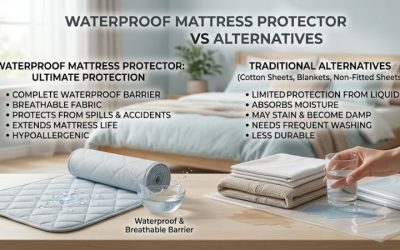
Cooling Mattress Pad vs Breathable Mattress Protector
These products can look similar, but their primary purposes are different.
Mattress Protection and Liquid Resistance
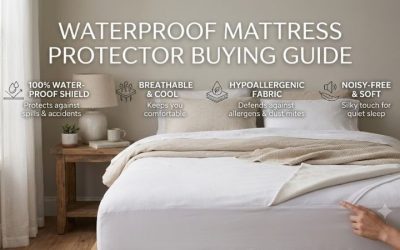
A mattress protector is designed primarily to shield the mattress from substances such as spills, perspiration, and household debris.
Waterproof designs commonly incorporate a barrier or membrane. That barrier can restrict the movement of liquid water while allowing varying amounts of water vapor to pass, depending on the material.
A conventional cooling mattress pad may have no liquid barrier at all.
Unless the manufacturer explicitly identifies the pad as waterproof or water-resistant, do not assume it provides spill protection.
For homes with children, pets, or frequent spills, protective performance may matter more than a cool-touch finish.
Layering a Pad Over a Protector
A cooling mattress pad can sometimes be used over a mattress protector, provided both fit correctly and the manufacturer allows the arrangement.
However, adding layers can affect the overall thermal behavior.
A breathable pad placed over a relatively impermeable protector cannot eliminate the restrictions created by the underlying barrier.
Multiple thick or tightly fitted layers may also interfere with fit or create uncomfortable bunching.
If mattress protection is essential, consider a well-fitting protector first, then evaluate whether an additional pad provides enough benefit to justify the extra layer.
Which Option Is Easier to Maintain?
Both products may be machine washable, but laundering instructions vary by construction.
Pads containing thick fill or specialty treatments may require gentler wash settings or specific drying temperatures.
Waterproof protectors may have membrane-care restrictions, including limits on drying heat.
Check the care label rather than assuming that products with similar appearances can be cleaned identically.
For allergy-sensitive households, mattress encasements are another distinct category; a standard pad should not be treated as a substitute for a fully enclosing protective cover.
Cooling Mattress Pad vs Breathable Sheets
Sheets are the layer in closest contact with your skin, making them an important part of sleeping comfort.
Direct Contact and Surface Temperature
A cooling mattress pad sits beneath the fitted sheet, whereas the sheet directly touches your body.
This distinction matters because a sheet can influence the immediate sensation of warmth, friction, and moisture against your skin.
For example, a breathable mattress pad beneath a dense, insulating fitted sheet may provide less noticeable comfort improvement than expected.
If you mainly feel uncomfortable where your skin contacts the bedding, changing your sheets may be a simpler first step than purchasing another mattress layer.
Cotton, Linen, and Lyocell Sheets
Different textile constructions offer different comfort characteristics.
Cotton: Can provide good breathability and moisture absorption, but weave, yarn thickness, and fabric finish influence how warm it feels.
Linen: Often has an open texture that allows air movement. Its distinctive feel may be less appealing to people who prefer very smooth bedding.
Lyocell: Can provide a smooth surface and useful moisture management, depending on fabric construction and finishing.
A high thread count does not automatically indicate better cooling. Denser constructions can sometimes reduce airflow.
Material labels alone are insufficient to predict thermal performance because weave and fabric weight also matter.
Which Is Better for Nighttime Perspiration?
If your main concern is damp sheets or a sticky sensation, first evaluate the bedding touching your skin.
Moisture-managing sheets may improve how perspiration spreads and evaporates. A breathable pad underneath can complement them, but it cannot independently prevent sweating.
Persistent or unexplained night sweats should not be treated solely as a bedding problem.
Cooling Mattress Pad vs Active Cooling System
The most substantial functional difference appears when comparing passive pads with powered cooling systems.
Temperature Control and Cooling Capacity
Passive mattress pads can modify heat transfer at the sleep surface, but they do not maintain a selected temperature.
Powered systems may use circulating water or airflow to remove heat or influence the temperature around the sleeper.
Water-based systems can transfer heat between the bed and a powered control unit. Air-based systems may move conditioned or room air through or across the bedding.
Results depend on the device, surrounding conditions, and how the cooling mechanism is implemented.
A passive pad can be suitable for someone who wants a more comfortable surface. A powered system is more relevant when the ability to adjust cooling is the main purchasing objective.
Phase-Change Materials vs Powered Cooling
Some cooling mattress pads incorporate phase-change materials, often called PCMs.
These materials are engineered to absorb or release heat as they undergo a phase transition within a designed temperature range.
Unlike powered systems, however, their heat-storage capacity is finite.
Once the material has absorbed sufficient heat, its initial cooling contribution may diminish until conditions allow it to release that heat again.
A PCM label alone does not reveal cooling duration, thermal capacity, or the conditions necessary for the material to reset.
For sustained temperature adjustment, an active system offers a fundamentally different mechanism.
Noise, Electricity, and Maintenance
A passive cooling pad operates without a motor, power supply, water reservoir, or control unit.
That simplicity is useful in shared bedrooms, guest rooms, and spaces where additional equipment would be inconvenient.
Powered cooling devices introduce practical considerations:
-
Operating noise from fans, pumps, or control units.
-
Electricity use during operation.
-
Space for equipment and cables.
-
Cleaning procedures and replacement components.
-
Potential water leakage in liquid-based systems.
-
Compatibility with adjustable beds and surrounding furniture.
Actual noise levels, operating costs, and maintenance requirements are model-specific. They should be verified rather than assumed.
Which Is Better for Couples?
Couples with different temperature preferences may benefit from an active system offering independently adjustable zones.
A conventional passive pad generally cannot offer separate temperature settings, even if different bedding materials are used on each side.
However, dual-zone cooling requires a compatible system specifically designed for that function.
For couples with similar preferences and relatively minor warmth issues, passive bedding may be sufficient without the extra equipment.
Cooling Mattress Pad vs Replacing the Mattress
A new mattress is a substantially larger purchase, but there are circumstances where adding more bedding is unlikely to solve the underlying problem.
When the Mattress Construction Is the Problem
Mattress construction influences heat retention, airflow, and body contact.
A mattress with thick, highly conforming comfort layers can create a close-fitting sleep surface that limits air movement around the body.
Adding a thin cooling pad may change the immediate surface sensation, but it cannot fundamentally alter the mattress’s internal structure.
Hybrid mattresses with ventilated coil interiors may offer different airflow characteristics than some all-foam designs. However, overall cooling still depends on the comfort layers, covers, and sleeping environment.
Neither construction guarantees cool sleep.
When Replacement Makes More Sense
Consider mattress replacement if the current mattress has visible sagging, persistent discomfort, damaged components, or a construction that no longer meets your needs.
A cooling mattress pad is not designed to repair structural defects.
If the mattress remains supportive and the main complaint is mild warmth, replacing it may be unnecessary.
Try addressing room conditions and bedding layers before committing to a major purchase.
How to Choose the Best Cooling Solution for Your Bedroom
1. Identify Where the Heat Problem Starts
Different complaints suggest different starting points.
| Sleep complaint | First option to consider | Reason |
|---|---|---|
| Surface feels slightly warm | Breathable cooling mattress pad | Modest surface adjustment |
| Sheets feel damp or sticky | Moisture-managing sheets | Direct skin contact |
| Mattress feels too firm and warm | Suitable cooling topper | Changes cushioning and surface properties |
| Need liquid protection | Breathable waterproof protector | Prioritizes mattress protection |
| Want adjustable bed temperature | Active cooling system | Provides powered temperature control |
| Mattress is sagging or worn | Mattress assessment or replacement | Accessories cannot repair structural failure |
Avoid buying the thickest accessory simply because you sleep hot. Additional cushioning can also add insulation.
2. Check Mattress Dimensions and Pocket Depth
Common US mattress dimensions include:
| Mattress size | Standard nominal dimensions |
|---|---|
| Twin | 38 × 75 inches |
| Twin XL | 38 × 80 inches |
| Full | 54 × 75 inches |
| Queen | 60 × 80 inches |
| King | 76 × 80 inches |
| California King | 72 × 84 inches |
Actual mattress measurements can vary. Always verify the product’s stated dimensions and fit range.
When choosing a fitted cooling pad, measure the mattress thickness, including any topper that will remain underneath.
A pad with insufficient pocket depth can pull away from corners or place unwanted tension on the bedding.
For adjustable beds, confirm that the pad can accommodate movement without bunching or slipping.
3. Evaluate Fill Material and Thickness
A thinner cooling pad may better preserve the existing mattress feel.
Thicker quilted pads can create more cushioning, but fill density and construction influence how much insulation they add.
For shoppers primarily concerned with temperature, consider whether the extra loft provides a meaningful benefit.
A pad containing synthetic fill is not automatically unsuitable, and a natural-fiber pad is not automatically cooler. Fabric structure, moisture handling, and the complete bedding arrangement determine the practical outcome.
4. Understand Cooling Claims Before Paying More
Cooling-related terminology can describe several different features.
| Marketing term | What it may describe | What it does not establish |
|---|---|---|
| Cool touch | Initial heat transfer at contact | All-night cooling |
| Moisture wicking | Movement of liquid moisture | Lower body temperature |
| Breathable | Air or vapor permeability | Guaranteed temperature reduction |
| Gel infused | Gel incorporated into a material | Sustained heat removal |
| Phase-change material | Temperature-responsive heat storage | Unlimited cooling capacity |
| Temperature regulating | A claimed influence on thermal comfort | Precise thermostat-style control |
When available, look for transparent testing that specifies the measurement method, test conditions, comparison material, and duration.
A product description without supporting measurements should be treated as a manufacturer claim, not verified cooling performance.
5. Consider Your Bedroom Environment
Room temperature, humidity, airflow, sleepwear, and blankets all affect how warm the bed feels.
A thick comforter can contribute to overheating regardless of which mattress pad is underneath.
Likewise, a humid bedroom may reduce the effectiveness of evaporative moisture management.
Before purchasing more bedding, evaluate whether changes to ventilation, air conditioning, humidity management, or blanket weight could address the discomfort.
These adjustments may provide more value than adding another layer to the mattress.
6. Compare Total Ownership Cost
Cooling mattress pads and breathable sheets generally involve simpler ownership than powered cooling equipment.
Active systems can involve electricity costs, specialized cleaning supplies, replacement parts, and eventual equipment service.
Mattress toppers may require more storage space and can be difficult to machine wash, particularly when their cores contain foam or latex.
A higher initial price does not necessarily produce better value for someone who only needs a minor change in surface comfort.
Assess the complete ownership burden, not just the purchase price.
Advantages and Disadvantages of Each Cooling Approach
Cooling Mattress Pad
Advantages
-
Changes surface feel without major mattress modification.
-
Does not require electricity.
-
Many designs are removable for cleaning.
Disadvantages
-
Limited ability to address substantial heat buildup.
-
Cooling claims vary in meaning and supporting evidence.
-
Extra fill may increase insulation.
Choose it if: Your mattress is comfortable and you want a relatively simple surface adjustment.
Cooling Mattress Topper
Advantages
-
Can provide meaningful cushioning and pressure redistribution.
-
Offers more control over mattress feel.
-
Available in different materials and firmness options.
Disadvantages
-
May retain additional heat.
-
Requires attention to thickness and mattress compatibility.
-
Often harder to store or clean than a thin pad.
Choose it if: Comfort and pressure relief matter as much as temperature.
Breathable Mattress Protector
Advantages
-
Helps protect the mattress from daily exposure.
-
Often adds minimal cushioning.
-
Waterproof versions can protect against liquid spills.
Disadvantages
-
Breathability varies, particularly with barrier membranes.
-
Limited ability to alter mattress comfort.
-
Some designs may produce noise or texture changes.
Choose it if: Protecting the mattress is the main goal.
Breathable Sheets
Advantages
-
Directly influence skin-level comfort.
-
Can be changed without altering mattress support.
-
Available in different fabrics and constructions.
Disadvantages
-
Do not correct heat retention deep inside the mattress.
-
Performance varies by weave and fabric weight.
-
May require combining with other bedding adjustments.
Choose them if: Your primary complaint is warm, damp, or uncomfortable fabric against your skin.
Active Cooling System
Advantages
-
Offers powered temperature adjustment.
-
Some systems support separate sleeping zones.
-
Does not rely solely on passive fabric properties.
Disadvantages
-
Higher purchase and ownership complexity.
-
May produce noise and require regular maintenance.
-
Needs electricity and installation space.
Choose it if: Adjustable temperature control is essential and simpler interventions have not solved the problem.
Breathable Replacement Mattress
Advantages
-
Addresses mattress construction rather than just the top layer.
-
Can simultaneously improve support and comfort when correctly selected.
-
Provides an opportunity to reconsider the full sleeping setup.
Disadvantages
-
Substantial purchase commitment.
-
Cooling performance is not guaranteed by mattress type.
-
Requires careful consideration of support, firmness, and return terms.
Choose it if: Your current mattress has structural or comfort problems that accessories cannot resolve.
Common Buying Mistakes to Avoid
Assuming a Gel-Infused Product Stays Cool All Night
Gel-infused foam may behave differently from otherwise similar foam, but the presence of gel alone does not establish how much heat the product transfers or retains.
Avoid selecting a topper exclusively because its description includes cooling gel.
Consider the entire construction and available evidence.
Using Too Many Thick Bedding Layers
Stacking a waterproof protector, thick pad, foam topper, and tightly fitted sheets can produce an unnecessarily complicated sleeping surface.
Each layer contributes to the overall transfer of heat, moisture, and air.
Use only the layers needed for protection and comfort, and ensure the fitted components remain secure.
Ignoring Washing and Drying Instructions
Some cooling finishes and specialized materials require particular care.
Improper washing temperatures, harsh cleaners, or excessive drying heat can damage certain components.
Review care instructions before purchasing, especially when easy laundering is a priority.
Expecting a Pad to Fix Room Temperature
A cooling pad cannot replace adequate bedroom ventilation or room-temperature management.
If the room itself is excessively hot, passive bedding may offer limited relief.
The best approach may involve improving the room environment and selecting compatible bedding rather than relying on a single product.
Who Should Choose Each Cooling Solution?
For Hot Sleepers on a Limited Budget
Start with your existing bedroom conditions and the bedding in direct contact with your body.
If heavy sheets or blankets appear to contribute to discomfort, changing those may be more useful than immediately purchasing a specialized cooling pad.
A breathable mattress pad becomes a reasonable next option when you also want light cushioning.
For Side Sleepers Seeking Pressure Relief
Prioritize an appropriate topper if shoulder or hip pressure is the main issue.
The topper’s firmness, thickness, and interaction with the underlying mattress deserve more attention than cooling claims alone.
Choose a breathable construction when heat retention is also a concern.
For Apartment Dwellers and Small Bedrooms
A passive mattress pad avoids the floor space, controls, cables, and servicing needs of powered cooling equipment.
It is also generally easier to remove when changing apartments or beds.
For small bedrooms with limited storage, simple bedding solutions may offer better everyday practicality.
For Couples With Different Temperature Preferences
Consider a compatible dual-zone active cooling system if independent temperature adjustment is genuinely important.
Passive pads provide a less complicated solution when both sleepers are comfortable with similar bedding conditions.
For Families With Children or Pets
Prioritize appropriate mattress protection if spills are likely.
A breathable waterproof protector may be more important than extra cushioning, provided its fit and care requirements are appropriate.
For infant sleep, follow applicable safe-sleep guidance and use only a firm, flat, properly fitted sleep surface and approved bedding. Do not add aftermarket mattress pads or toppers to infant sleep spaces.
Frequently Asked Questions
Is a Cooling Mattress Pad Better Than a Cooling Topper?
A cooling mattress pad is generally better when you want minimal change to your mattress feel. A topper is more suitable when additional cushioning or pressure redistribution is necessary. Neither category is inherently cooler without considering its exact construction and supporting evidence.
Can a Cooling Mattress Pad Make a Memory Foam Mattress Cooler?
It may improve surface comfort or moisture handling, but it cannot eliminate heat retention caused by the underlying foam.
For a mattress that already feels very warm, the effect of a thin pad may be limited. Assess the bedding above the pad, room conditions, and mattress construction together.
Are Cooling Mattress Pads Worth Buying?
They can be worthwhile when you have a comfortable mattress and want a modest, relatively easy-to-maintain change to its surface.
They are less compelling when you expect precise temperature control, substantial pressure relief, or a solution to mattress sagging.
Value depends on whether the product addresses your specific problem.
Do Cooling Mattress Pads Work Without Air Conditioning?
Passive pads do not require air conditioning, but their effectiveness depends partly on the surrounding temperature and humidity.
In a very warm room, a pad may feel less effective because the environment limits opportunities for heat dissipation.
Room-temperature management may be more important than the mattress pad itself.
Can You Use a Cooling Mattress Pad With an Electric Blanket?
Compatibility depends on the specific products and manufacturers’ instructions.
Do not assume a cooling pad, foam topper, electric blanket, or powered bed-cooling system can safely be layered together.
Follow the instructions for each device, including restrictions relating to heat, electrical components, folding, and moisture.
How Long Does a Cooling Mattress Pad Last?
Lifespan varies with fabric construction, filling, washing frequency, sleep conditions, and manufacturing quality.
Quilted fill may compress, elastic can lose tension, and specialty finishes may change with use or laundering.
Replace the pad if it no longer fits securely, develops significant damage, or stops providing the comfort characteristics you purchased it for.
Conclusion
For most shoppers comparing a cooling mattress pad vs alternatives, the best starting point is the specific problem: choose a pad for light cushioning and surface comfort, breathable sheets for skin-level moisture management, a topper for pressure relief, or an active system for adjustable temperature control. If the mattress itself is damaged or uncomfortable, address that underlying issue rather than expecting another bedding layer to correct it.