Our Top Picks
 Zinus 14 Inch Cooling Comfort Support Hybrid MattressQueen80 x 60 x 14 inches82.16 poundsCheck on Amazon
In the memory foam vs hybrid mattress choice, pick memory foam if you want deep contouring, motion isolation and a lower cost, and pick a hybrid if you want a bouncier surface, stronger edges and better airflow. Both can be medium firm, and both come in a box, so the real decision is about how you sleep: your position, your body weight, how hot you run and whether you share the bed. This guide compares the two on the points that change how a mattress feels after the first month, with measurements and a decision table.
Key takeaways
- Memory foam hugs and slows down pressure; hybrids push back with coils and sit “on top” of the surface.
- Hybrids usually sleep cooler and have firmer edges, which helps with sitting on the side and getting in and out of bed.
- Memory foam is quieter and isolates motion best, which suits light sleepers and couples.
- Sleepers over about 230 pounds usually do better on a hybrid or a thicker, high-density foam than on a thin foam mattress.
- Thickness matters: under 10 inches for foam and 12 inches for a hybrid is a warning sign for durability.
Memory foam vs hybrid mattress: the short answer by sleep style
If you sleep on your side and want your shoulders and hips to sink in, memory foam usually suits you. If you sleep on your back or stomach and need to stay on top of the mattress, a hybrid is usually the better fit. Combination sleepers who change position often tend to like a hybrid because the coils respond quickly and make it easier to turn.

Zinus 12 Inch Full Foam and Spring Hybrid Mattress, Medium Feel | Fiberglass Free, Durable Support, Mattress in a Box, CertiPUR-US & OEKO-TEX Certified Safe Materials
Chosen because it specifies Medium Feel and Fiberglass Free.
View on AmazonZinus 14 Inch Cooling Comfort Support Hybrid Mattress [New Version], Queen, Fiberglass Free, Medium Plush, Cooling Motion Isolation, Certified Safe Foams & Fabric, Mattress in A Box
Chosen because it specifies Queen and Fiberglass Free.
View on Amazon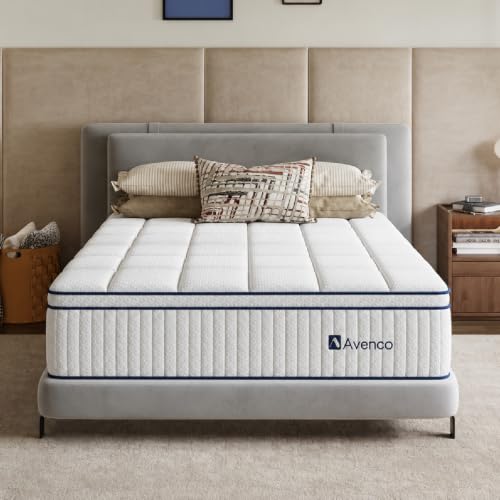
Avenco Queen Mattress 12 inch, Hybrid Mattress Queen in a Box, Medium Firm | Individual Pocket Coils & Cooling Gel Memory Foam, Motion Isolation, Pressure Relief, CertiPUR-US Certified
Chosen because it specifies Hybrid Mattress Queen in a Box and Medium Firm.
View on AmazonZinus 12 Inch Queen Foam and Spring Hybrid Mattress, Medium Feel | Fiberglass Free, Durable Support, Mattress in a Box, CertiPUR-US & OEKO-TEX Certified Safe Materials
Chosen because it specifies Medium Feel and Fiberglass Free.
View on AmazonMemory foam vs hybrid mattress: comparison table
| Factor | Memory foam | Hybrid |
|---|---|---|
| Typical thickness | 8 to 14 inches | 10 to 14 inches |
| Construction | Layers of foam over a high-density base | Pocketed coils under foam or latex comfort layers |
| Feel | Slow contouring, hugging | Responsive, more buoyant |
| Cooling | Can trap heat unless gel or open-cell foam is used | Coils let air move, usually cooler |
| Edge support | Softer, can compress at the edge | Firmer, especially with reinforced edges |
| Motion isolation | Excellent | Good, depends on coil type |
| Weight in a box (queen) | Roughly 50 to 80 pounds | Roughly 80 to 120 pounds |
| Cost tier | Budget to mid | Mid to premium |
| Typical lifespan | 6 to 8 years with good density | 7 to 10 years with good coils |
These ranges are general industry figures and individual models vary, so check the maker page for the exact specifications of any mattress you are considering.
How each type is built
An all-foam mattress usually has a firm base layer of polyurethane foam, a transition layer in the middle and a memory foam comfort layer on top. The base layer carries the weight, and the memory foam layer provides pressure relief. Many budget foam mattresses add green tea extract or gel beads, which are mainly marketing touches rather than measurable cooling.
A hybrid mattress replaces the base and transition layers with a layer of individually wrapped coils, usually 6 to 8 inches tall, topped by 2 to 4 inches of foam. The coils offer bounce and airflow. Better hybrids use zoned coils that are firmer under the hips and softer under the shoulders. Some also add a perimeter of heavier-gauge coils or a foam edge to hold the sides up.
Firmness and body weight
Firmness is the most common reason a mattress feels wrong. Medium firm, around 6 or 7 on a 10-point scale, suits most people, but your weight changes how the same mattress feels. A lighter person sinks less into the comfort layer and may find a firm mattress too hard. A heavier person sinks more and may bottom out on a thin mattress.
| Sleeper | Foam better when | Hybrid better when |
|---|---|---|
| Under 130 lbs, side sleeper | You want a soft, pressure-relieving feel | The hybrid has a plush top and thin coils |
| 130 to 230 lbs, any position | You like to feel hugged and want motion isolation | You prefer a lively, easy-to-move surface |
| Over 230 lbs | It is 12 inches or more with a dense base | It has high-gauge coils and 12 to 14 inches |
| Back or stomach sleeper | It is firm enough to keep hips level | It supports the hips without sinking |
| Combination sleeper | It has a responsive foam, not slow-recovery | You want to turn over without feeling stuck |
Cooling and night sweats
Memory foam traps heat because it conforms closely to the body and has less airflow. Modern foams with open-cell structure, gel infusions or perforations help, but they are still generally warmer than a hybrid. Hybrids move air through the coil layer, which keeps the core of the mattress cooler. If you overheat, a hybrid, a cooling cover or a breathable mattress protector helps more than any gel claim.
If you sleep hot and you like foam, look for a thinner comfort layer, a breathable cover and a mattress that lists open-cell or ventilated foam. If you sleep cold, memory foam is a plus because it keeps warmth near the body.
Edge support, bounce and everyday use
Edge support is the strength of the mattress at the perimeter. A weak edge compresses when you sit, which makes getting out of bed harder and reduces the usable sleep surface by a few inches. Hybrids with a reinforced perimeter hold up better. This matters for older adults, people with joint pain and couples who sleep near the edge. Foam mattresses with a dense base can also have decent edges, but the thinner budget models often do not.
Bounce matters if you share the bed or use it for activities other than sleep. Hybrids have more bounce, which makes turning over easier but transfers more motion. Memory foam absorbs motion, so a partner’s turning is less likely to wake you. If your partner is a restless sleeper, foam is the safer choice. If you are a combination sleeper, you may prefer the responsiveness of a hybrid.
Examples of each type
Real models help make the difference concrete. These are listed as examples of the type, not rankings, and you should check the maker page for the current specifications.
- Zinus 12 Inch Queen Green Tea Memory Foam Mattress: medium firm foam mattress, 12 inches thick, aimed at pressure relief and full-body support per listing.
- VISCOFLEX Memory Foam Mattress Queen, 14 Inch: a thick, firm foam mattress marketed for spinal support and pressure relief per listing.
- Novilla 14 Inch Queen Size Hybrid Mattress: hybrid with gel memory foam and pocketed coils and a cool-to-touch cover per listing.
- Ailis Queen Mattress, 12 Inch Hybrid: medium firm hybrid with upgraded pocket springs marketed for motion isolation per listing.
Durability and warranty realities
Foam mattresses lose firmness when the base foam breaks down, and the first sign is a body-shaped dip. Density is the clue: higher-density foam usually lasts longer. A hybrid wears at the comfort layer first, then the coils may feel less supportive in the middle. A warranty that excludes impressions under about 1 inch is typical, so check the exact depth and the care requirements.
Whatever type you buy, use a supportive base. A slatted frame should have slats no more than 3 inches apart for foam or hybrid mattresses. A sagging frame voids many warranties and shortens the life of the mattress.
Weight, delivery and moving
A queen hybrid weighs roughly 80 to 120 pounds, which is a lot for one person to move upstairs. A queen foam mattress is usually lighter. Boxed mattresses expand over 24 to 72 hours and may off-gas for a day or two, so unbox them in a ventilated room. If you live up several flights of stairs or in a tight apartment, the weight difference may matter as much as the feel.
A short checklist before you decide
- Write down your main sleep position. Side sleepers lean toward foam, back and stomach sleepers toward hybrids, and combination sleepers should favor responsive foams or hybrids.
- Note how you feel at 3 a.m. If you wake up hot, weigh cooling first. If you wake up with sore shoulders or hips, weigh pressure relief first.
- Check your partner’s habits. A light sleeper beside a restless one benefits most from motion isolation.
- Measure the route to the bedroom. A boxed queen hybrid is heavy and the box is about 16 to 20 inches in diameter when rolled. Doorways, stair turns and elevators matter.
- Look at the trial period and return terms. Most boxed mattresses need 30 days to feel normal. A trial of 100 nights or more gives you time to decide, but read how returns and fees work.
- Match the mattress to the base. Check the maker’s foundation rules before you buy, because a wrong base can void the warranty.
If you are still undecided after the checklist, consider a medium-firm hybrid with a modest foam comfort layer of 2 to 3 inches. It sits between the two types: it contours less than an all-foam bed but holds you up better and sleeps cooler. Sleepers who like a very deep sink should stay with foam, and those who dislike feeling stuck should stay with a hybrid.
Frequently asked questions
Is a hybrid or memory foam mattress better for back pain?
Neither is better for everyone. Back pain tends to improve when the mattress keeps your spine neutral, which usually means medium firm. Side sleepers often prefer foam, and back or stomach sleepers often prefer a hybrid. Talk to a doctor if the pain is persistent.
Which mattress sleeps cooler?
Hybrids usually sleep cooler because airflow moves through the coil layer. Cooling gels in memory foam help a little, but they are less effective than a mattress with a breathable core.
Which lasts longer?
Both can last 7 to 10 years if well made. High-density foam and good coils matter more than the type. Cheap versions of either wear faster.
Is memory foam good for couples?
Yes, because it isolates motion. If one of you needs firm edge support or a lively feel, a hybrid might suit both better.
Do I need a box spring?
Usually not. A platform bed or a slatted frame with slats no more than 3 inches apart is enough. Check the maker page for foundation requirements.
How firm should a mattress be?
Medium firm suits most people. Lighter sleepers often want softer, heavier sleepers firmer.
Pick memory foam if, pick a hybrid if
- Pick memory foam if you are a side sleeper who wants pressure relief and a hugging feel.
- Pick memory foam if your partner moves a lot and you wake easily.
- Pick memory foam if you are shopping on a tight budget.
- Pick a hybrid if you sleep hot or share a warm bedroom.
- Pick a hybrid if you sit on the edge of the bed or need easier exits.
- Pick a hybrid if you are a heavier sleeper, or if you change positions often.
Sources
- Manufacturer product pages and listing descriptions for the example models
- Sleep Foundation mattress type guidance
- Consumer Reports mattress buying guidance
More from Amazon
Programs that pair well with the guide above. Offers and eligibility are set by Amazon and may change.
Collect the home and kitchen items you want in one registry that guests can shop from.
Create a wedding registrySet up recurring deliveries of everyday items on eligible products. Terms and savings are set by Amazon.
Explore Subscribe & SaveFree shipping on eligible items, Prime Video and more. Eligible new members can start with a free trial.
Start a Prime free trialAudiobooks and podcasts to listen to on the go. Eligible new members can start with a free trial.
Try Audible freeAs an Amazon Associate we earn from qualifying purchases.