Key takeaways
- Under-bed drawers are a strong choice when stored items need to be accessed regularly. Their primary advantage is not simply their storage capacity, but the ability to retrieve belongings without dismantling a stack of boxes or opening several bags.
Compare under bed storage drawers with bins, vacuum bags, baskets, bed risers, and storage beds for capacity, accessibility, dust protection, and value.
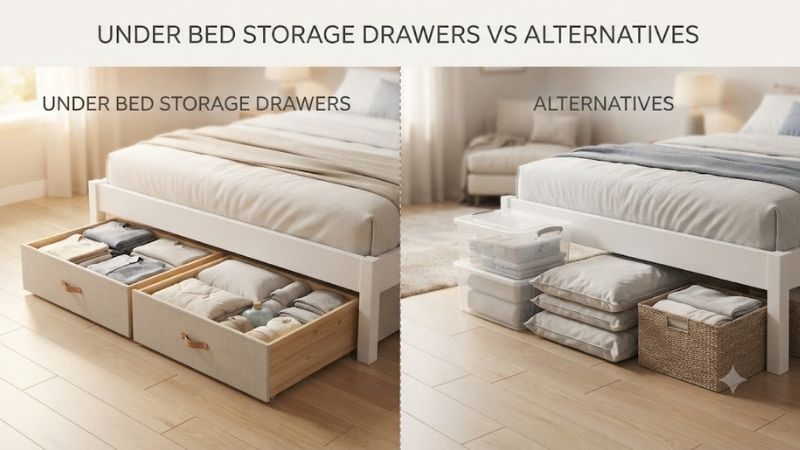
Under bed storage drawers vs alternatives is a practical comparison for anyone trying to organize clothing, shoes, linens, and seasonal items without buying more furniture. Rolling drawers provide convenient access, but plastic bins, fabric bags, vacuum storage, and built-in bed drawers have different advantages. This guide compares usable capacity, clearance, cleaning, and everyday convenience to help you choose wisely.
Quick Verdict: Are Under-Bed Storage Drawers Worth It?
Under-bed drawers are a strong choice when stored items need to be accessed regularly. Their primary advantage is not simply their storage capacity, but the ability to retrieve belongings without dismantling a stack of boxes or opening several bags.
However, they are not always the best solution.
Rigid plastic bins may provide more straightforward protection for occasional storage. Fabric bags can be convenient for lightweight belongings in very shallow spaces. Vacuum bags reduce the volume of suitable textiles but do not provide drawer-style organization. Built-in furniture drawers create a more integrated appearance, while bed risers may increase available clearance when the bed frame safely supports them.
| Storage option | Main advantage | Main limitation | Best use |
|---|---|---|---|
| Rolling under-bed drawer | Convenient repeated access | Needs pull-out clearance | Everyday clothing and shoes |
| Sliding drawer unit | Organized smaller compartments | Requires extension space | Accessories and small items |
| Plastic storage bin | Rigid enclosed storage | May require full removal | Seasonal clothing and linens |
| Fabric under-bed bag | Lightweight, often compressible | Limited structural protection | Spare bedding |
| Vacuum storage bag | Reduces volume of suitable textiles | Contents are inconvenient to access frequently | Seasonal textile storage |
| Furniture-style drawer | Coordinated bedroom appearance | Bed-frame compatibility | Permanent bedroom furniture |
| Storage bed | Integrated capacity | Higher upfront cost and fixed layout | Long-term bedroom organization |
| Bed risers with containers | Potential additional clearance | Strict bed stability requirements | Compatible elevated beds |
The best choice depends primarily on how often you access the items and the physical space available beneath and beside the bed.
Why Accessibility Matters More Than Advertised Capacity
Storage capacity is often advertised in liters or quarts, which makes comparison appear straightforward. Yet the container with the largest numerical volume is not necessarily the most useful.
Consider a household storing socks, workout clothes, extra sheets, and winter blankets.
Socks and workout clothes may be needed several times per week. Winter blankets may only be retrieved twice a year.
If everything is packed into one enormous container, finding everyday clothing can require removing several unrelated items. A smaller divided drawer may offer less total capacity but significantly better access.
The practical question is therefore not merely how much a container holds. It is how easily the owner can find, remove, and return belongings.
Daily Access Requires a Different Storage Mechanism
A rolling drawer is especially useful for items retrieved regularly.
On appropriate flooring, it can be pulled from beneath the bed and opened without moving other storage containers.
However, the design must allow comfortable movement. Weak casters, poor handles, or inadequate floor clearance can make repeated access frustrating.
For everyday use, a drawer with slightly less capacity but dependable wheels may be preferable to a larger box that scrapes the floor.
Seasonal Storage Prioritizes Protection and Capacity
Seasonal items do not need to be opened frequently.
A lidded plastic bin or fabric storage bag may provide adequate organization at a lower cost.
The key considerations become cleanliness, moisture conditions, protection from dust, and whether the container fits the available space.
A rolling mechanism may add cost without meaningful benefit when the contents are retrieved only occasionally.
Mixed Storage Needs Often Benefit From More Than One Format
It can be sensible to combine a shallow rolling drawer for everyday belongings with a separate covered container for seasonal items.
This uses the under-bed area according to retrieval frequency rather than forcing every object into one storage system.
However, the arrangement should remain easy to move and clean. Filling every inch beneath a bed can make dust removal and inspection unnecessarily difficult.
Under-Bed Drawers vs Plastic Storage Bins
Plastic bins are among the closest alternatives to rolling under-bed drawers.
Both can store clothing, shoes, accessories, and linens. The main differences involve access, movement, enclosure, and internal organization.
Convenience During Daily Use
A rolling drawer with a suitable handle can be moved toward the user repeatedly.
A nonrolling plastic bin may need to be dragged or lifted.
When the bin is heavy or located far beneath the bed, retrieving it can become inconvenient.
For someone who uses the storage area as an extension of their dresser, this difference is significant.
Dust and Spill Protection
A rigid plastic bin with a well-fitting lid may offer more complete physical enclosure than an open furniture-style drawer.
That can be useful for seasonal clothing or extra linens.
However, an ordinary lidded bin is not necessarily airtight or waterproof. The product’s construction and closure system determine its actual level of protection.
Store textiles clean and completely dry. Sealing moisture inside a plastic container can create odor and deterioration problems.
Structural Strength
Plastic bins vary widely in wall thickness and load capacity.
A rigid bin may be appropriate for certain heavier items, but a budget box with thin walls can deform under excessive weight.
Rolling drawers add additional potential failure points, such as wheel mounts and pull handles.
When storing heavy belongings, check the stated load capacity rather than assuming that rigid plastic is sufficient.
Which Is Better?
Choose rolling drawers for regular access and plastic bins for relatively infrequent storage where enclosure matters more than movement.
A lidded rolling plastic container can provide a useful compromise when both features are important.
Under-Bed Drawers vs Fabric Storage Bags
Fabric bags are appealing because they are lightweight and may fit in shallow spaces where a rigid drawer would be too tall.
Some use zippers and handles, while others include clear windows or internal dividers.
Their flexibility can be useful, but it also creates limitations.
Shallow Clearance
A soft-sided bag can sometimes accommodate minor changes in the shape of its contents.
However, it should not be overfilled or forced beneath structural components.
The packed height still matters.
For an extremely low bed, a slim fabric bag may fit where a wheeled drawer cannot, particularly when the drawer’s casters add significant height.
Protection From Dust and Moisture
A zippered fabric cover can reduce exposure to ordinary household dust.
However, fabric bags are not automatically waterproof, airtight, or resistant to persistent humidity.
They are most appropriate for clean, dry textiles stored in a reasonably dry bedroom.
Handling and Shape Retention
Fabric bags may sag when lifted, especially with heavy or unevenly distributed contents.
This can make them awkward to retrieve from deep beneath a bed.
A structured drawer provides a more predictable shape and may slide more reliably.
Which Is Better?
Choose fabric bags for lightweight, infrequently accessed bedding or clothing.
Choose drawers when belongings are accessed frequently and predictable movement matters.
Under-Bed Drawers vs Vacuum Storage Bags
Vacuum storage bags are designed to reduce the volume of compressible textiles by removing air from the package.
They can be helpful when the main challenge is bulky seasonal bedding rather than everyday organization.
However, reducing volume is different from improving access.
What Vacuum Compression Actually Does
A vacuum bag removes air from spaces within and around suitable textiles.
This can reduce the overall package thickness significantly, although the result depends on the material and how it compresses.
Bulky synthetic-filled bedding may compress differently from dense cotton sheets.
The reduced size is not a guaranteed permanent dimension. Air may gradually return through imperfect seals, and the contents can expand when opened.
Why Vacuum Bags Are Poor for Daily Use
A rolling drawer can be opened, one item removed, and closed again.
A vacuum bag must be unsealed, and its contents may expand immediately.
Recompressing the bag may require a vacuum cleaner or compatible pump.
That process is unnecessarily complicated for frequently used clothes.
Vacuum storage is generally better reserved for items that will remain packed for longer periods.
Fabric-Specific Storage Concerns
Not every textile benefits from prolonged tight compression.
Certain insulating fills, delicate materials, or structured items may lose preferred loft or shape when stored under substantial compression.
Follow the item manufacturer’s storage recommendations rather than assuming every blanket or duvet can be vacuum-packed safely.
Which Is Better?
Choose vacuum bags for appropriate seasonal textiles when reducing storage volume is the main priority.
Choose under-bed drawers for regular access, organization, and convenient retrieval.
Under-Bed Drawers vs Built-In Storage Beds
A storage bed incorporates drawers or compartments into the furniture itself.
This creates a more integrated appearance and can eliminate the need for separate storage containers.
However, choosing a storage bed is a substantially different purchase from adding inexpensive rolling drawers beneath an existing frame.
Appearance and Organization
Built-in drawers often use finished panels designed to match the bed.
This can create a cleaner bedroom appearance, particularly when the bed remains visible in a studio apartment.
However, some built-in drawers are open at the top and may offer limited protection from dust.
A separate covered organizer could provide better enclosure for certain belongings.
Dependence on the Bed Frame
Built-in storage is tied to the furniture’s dimensions and construction.
If the bed is replaced, the storage system may no longer be useful.
Independent rolling drawers are often easier to reuse with another frame, provided the new bed has sufficient clearance.
Moving and Assembly
Storage beds can be more complicated to move because of integrated compartments, panels, and hardware.
A renter who expects frequent moves may prefer separate containers that can be packed independently.
On the other hand, someone furnishing a permanent bedroom may value the coordinated appearance and dedicated compartments.
Which Is Better?
Choose a storage bed when purchasing new furniture and integrated organization is important.
Choose independent drawers when you already own a suitable frame or want greater flexibility when moving.
Under-Bed Drawers vs Bed Risers
Bed risers are sometimes used to increase the clearance beneath a bed frame.
That may create room for taller storage containers, but altering bed height has consequences beyond storage.
Additional Clearance
Raising a bed can increase the vertical space available for drawers and boxes.
However, the change must be supported by the bed frame and riser manufacturer’s specifications.
Not every bed can safely be placed on independent risers.
Stability and Loading
A bed supports both its own weight and the forces created during ordinary use.
Incompatible risers can create instability, particularly when used with unusual legs or frames.
Do not improvise using blocks, stacked objects, or other unsupported materials.
Bed Height and Everyday Comfort
A higher bed may make getting in and out more difficult for children, older adults, or people with mobility limitations.
It can also change the room’s appearance and relationship with nearby furniture.
Increasing storage space is not worth creating an unsafe or inconvenient bed height.
Which Is Better?
Use the existing clearance when possible.
Consider risers only if the exact frame and selected system permit the arrangement and the resulting bed height is appropriate.
How to Measure Before Choosing an Alternative
The purchasing process should begin with the actual bed, not the storage product’s advertised capacity.
Measure the minimum vertical clearance, available width between legs, usable depth, and open floor space needed to retrieve the container.
A container may fit beneath the frame but remain inaccessible because of a nearby dresser.
Example: A Bed With Seven Inches of Clearance
Imagine a hypothetical bed with 7 inches of usable vertical clearance.
A rolling drawer with an overall height of 7.2 inches cannot fit without modification.
A fabric bag packed to 6 inches may fit, while a rigid container measuring 6.5 inches high may also be practical.
However, consider where the opening is lowest. A center brace or uneven floor can reduce clearance along the sliding path.
Measure the entire path rather than relying on one convenient measurement near the mattress edge.
Example: A Narrow Pull-Out Area
Suppose there are only 18 inches between the side of the bed and a dresser.
A 30-inch-deep box may fit beneath the bed but cannot be fully removed sideways without moving furniture.
A shorter drawer or compartmentalized unit may be more useful.
This illustrates why accessible storage volume can matter more than maximum theoretical volume.
Choosing by What You Need to Store
| Contents | Strong starting choice | Reason |
|---|---|---|
| Everyday socks and accessories | Sliding divided drawers | Frequent access and organization |
| Shoes | Divided rolling organizer | Keep pairs visible |
| Seasonal sweaters | Covered bins or drawers | Organized longer-term storage |
| Spare cotton sheets | Lidded bin or rolling drawer | Clean, contained storage |
| Suitable bulky seasonal blankets | Fabric bag or vacuum system | Volume reduction may matter |
| Heavy books | Properly rated rigid storage | Load capacity is critical |
| Delicate structured garments | Appropriate noncompressed storage | Preserve garment shape |
Everyday Clothing
Daily clothes benefit from an arrangement where contents remain visible.
A shallow drawer with dividers can be more effective than a large bag containing many layers.
The owner should be able to retrieve one item without disturbing the entire container.
Shoes
Shoes vary in height and shape.
A divided organizer may suit flats or low-profile sneakers, while boots require greater clearance.
Footwear should be clean and dry before enclosed storage.
Avoid compressing shoes into spaces that deform their structure.
Bedding and Seasonal Textiles
Clean, dry bedding can be stored in covered containers.
For bulky items, first evaluate whether the material tolerates compression.
A large comforter may require a different arrangement from thin cotton sheets.
Durability: What Matters Beyond Material Labels?
A well-designed storage system needs to withstand its intended loading and retrieval pattern.
For rolling drawers, casters and handles are important because they experience repeated movement.
For plastic bins, wall thickness, lid fit, and corner construction matter.
For fabric bags, seams, zippers, and handles are common wear points.
A premium appearance does not guarantee better service life.
A practical comparison should identify the weakest component likely to be stressed by the intended contents.
Common Buying Mistakes
Maximizing Volume While Ignoring Access
A large storage bin may hold more items but become difficult to retrieve.
For everyday belongings, accessibility often matters more than capacity.
Treating Fabric Bags as Waterproof Containers
Ordinary zippered fabric organizers may reduce dust but are not necessarily resistant to standing water or high humidity.
Store dry belongings in appropriate room conditions.
Vacuum-Packing Every Textile
Some materials should not be stored under prolonged tight compression.
Follow the bedding or clothing manufacturer’s guidance.
Raising a Bed Without Checking Compatibility
Unapproved risers can create instability and alter bed-entry height.
Do not modify the frame merely to fit a preferred storage product.
Frequently Asked Questions
Are Under-Bed Drawers Better Than Storage Bins?
Drawers are generally more convenient for frequently accessed items, while covered bins can work well for seasonal storage. The better choice depends on the floor surface, clearance, contents, and how often the container must be opened.
Do Vacuum Bags Save More Space Than Drawers?
Vacuum bags may reduce the volume of suitable compressible textiles more effectively, but they are less convenient for regular access. They also are not appropriate for every material or long-term storage situation.
Are Fabric Storage Bags Good for Under a Bed?
They can be useful for lightweight clothing and bedding, particularly when clearance is limited. However, fabric bags provide less rigid protection and may not be waterproof or airtight. Keep contents dry and avoid overloading the handles.
Should I Buy a Storage Bed Instead of Drawers?
A storage bed may be worthwhile when replacing the furniture anyway and wanting an integrated appearance. Separate drawers offer more flexibility and can be reused with different compatible frames.
Can I Store Heavy Items in Rolling Drawers?
Only when the product’s stated load capacity and construction support them. Wheels, handles, and mounting points can fail when overloaded. For dense books or equipment, a properly rated rigid container or another storage location may be safer.
How Do I Choose Storage for a Very Low Bed?
Measure the minimum actual clearance beneath the frame. A shallow rigid box or suitable fabric bag may fit better than a wheeled drawer. If the space is too restricted, choose another storage location rather than forcing containers beneath structural parts.
Conclusion
Under-bed drawers are the better option for belongings you retrieve frequently, while plastic bins and fabric bags suit many seasonal storage needs. Vacuum bags can save volume for appropriate textiles, and storage beds offer a more integrated furniture solution. Compare real clearance, pull-out access, contents, load capacity, and maintenance before buying. The most useful system is the one you can access and maintain easily.