Key takeaways
-
Device dimensions and available placement space.
-
Lowest and highest volume settings.
-
Sound profiles you actually expect to use.
-
Whether audio is digitally generated or recorded.
-
Timer and continuous-playback availability.
-
Plug-in, rechargeable, or replaceable-battery operation.
-
Ease of adjusting volume in darkness.
-
Display brightness or lighting controls.
-
Power-cord length and safe routing.
-
Warranty and return terms.
-
Whether another person shares the room.
Choose a white noise machine for small spaces by comparing device size, sound quality, volume control, timers, portability, power, and bedroom placement.
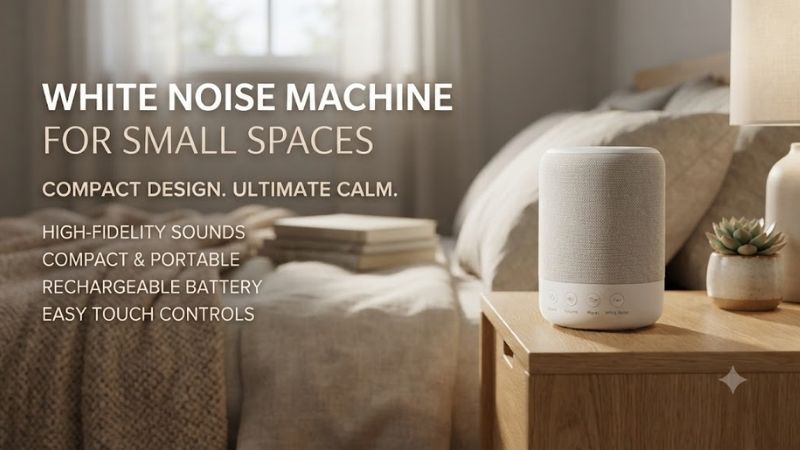
A white noise machine for small spaces should create comfortable background sound without overpowering a bedroom, occupying unnecessary nightstand space, or disturbing other people. In studio apartments, dorm rooms, compact bedrooms, and shared living spaces, the ideal machine often differs from one intended for a large room. Speaker placement, minimum volume, physical controls, and power requirements can matter more than having dozens of sound options.
This guide explains how to choose a compact white noise machine, understand its sound-masking limitations, compare mechanical and digital designs, and avoid unnecessary spending on features that do little to improve everyday use.
Why a Small Room Changes White Noise Machine Requirements
In a compact bedroom, the listening distance between a sound machine and the sleeper is often short. A device sitting on a narrow nightstand may be only a few feet from the head, while a machine in a larger bedroom may be positioned farther away.
This difference makes precise volume adjustment particularly important. A device with a very loud maximum output may be less useful than one that can produce a quiet, comfortable background sound.
Small rooms may also contain reflective surfaces, nearby walls, and several pieces of furniture. These factors can influence how sound is perceived, although room size alone does not determine noise-machine performance.
The best approach is to evaluate the actual listening environment rather than assuming that the most powerful speaker provides better masking.
Sound Masking Is Not Soundproofing
A white noise machine adds a consistent background sound to the room.
This can reduce the perceived contrast between ordinary silence and intermittent disturbances, such as quiet hallway movement or distant conversations.
However, it does not physically block sound entering through walls, doors, or windows.
For example, a machine may make faint hallway noises less noticeable, but it cannot reliably eliminate loud construction noise or a neighboring television playing at high volume.
In a small apartment, improving door seals or addressing other sources of noise transmission may be more useful than increasing the machine’s volume.
Why Maximum Volume Is a Poor Shopping Priority
Marketing descriptions often emphasize powerful speakers or high maximum decibel levels.
That does not mean the device provides a better sleeping experience.
A machine placed close to the bed should be comfortable at its normal operating level. The ability to make the sound quieter in small increments may be more valuable than the ability to make it extremely loud.
For shoppers using compact bedrooms, look for accessible volume controls and a sufficiently low minimum output.
Why the Device’s Physical Size Matters
A small nightstand may already hold a lamp, phone, charging cable, and other essential items.
A compact sound machine can reduce clutter, but it should not be chosen solely for its small dimensions.
The controls must still be usable, and the speaker should provide a sound character the user finds comfortable.
A slightly larger device with clearly labeled buttons may be more practical than a tiny model requiring several button combinations.
Mechanical Versus Digital Sound Machines
The most important technological distinction is how the machine produces its sound.
Mechanical models create noise through physical moving components, usually a fan-like mechanism. Digital models generate or reproduce sound electronically through a speaker.
These approaches can feel different to listeners even when both are marketed as white noise machines.
| Feature | Mechanical machine | Digital machine |
|---|---|---|
| Sound generation | Physical airflow or mechanical sound | Electronic audio generation or playback |
| Typical sound selection | Variations of fan-like sound | Fan sounds, noise colors, nature audio |
| Physical size | Depends on internal mechanism | Can be very compact |
| Moving components | Usually present | Typically absent from audio generator |
| Portability | Often plug-in | Plug-in or rechargeable |
| Controls | Often simple physical adjustments | Buttons, timers, apps, or schedules |
| Best starting buyer | Prefers natural fan-like sound | Wants multiple sound profiles |
Mechanical Fan Machines
A mechanical sound machine uses a moving mechanism to produce a consistent fan-like sound.
Some people find this more natural than digitally reproduced fan noise. Others dislike the mechanical character or the limited variety.
For a small bedroom, a mechanical design can be appealing when the user already knows they enjoy sleeping with a fan.
However, mechanical devices generally require enough space for the internal mechanism and may be less convenient for travel than small digital models.
Digital Sound Machines
Digital machines can provide several background sound profiles from one compact device.
Some electronically generate continuous noise, while others play recordings.
A user can switch between white noise, fan-like sound, pink noise, brown noise, rainfall, or other options depending on the product.
This variety may be useful in an apartment where different environmental disturbances occur at different times.
However, more sound choices do not guarantee better sound quality.
Why Digital Playback Quality Matters
Some inexpensive devices use short recordings that repeat.
If the repetition is noticeable, the sound can become distracting.
A continuous digitally generated sound avoids the same type of recorded loop, although the resulting sound character remains a matter of preference.
When comparing digital models, determine whether sounds are generated continuously or reproduced from recordings.
Choosing the Right Sound for a Small Bedroom
White noise is not the only form of steady background audio.
Different noise profiles emphasize different frequencies, which can change the way they sound and how comfortable they feel.
White Noise
White noise has equal power per unit of frequency.
Listeners often describe it as a steady hiss.
This sound can make some intermittent background noises less noticeable, but its high-frequency character may feel sharp to certain users.
In a compact bedroom, a bright hiss played too loudly can become more distracting than the disturbance it is intended to mask.
Pink Noise
Pink noise has less high-frequency energy relative to lower frequencies when compared across equal-width frequency bands.
It is often perceived as softer or more balanced than white noise.
Some sleepers prefer this type of sound for continuous background listening.
However, there is insufficient evidence to declare pink noise universally better for sleep.
Brown Noise
Brown noise places greater emphasis on low frequencies.
It may sound deeper, more like a low rumble.
A person who dislikes the sharpness of white noise may find brown noise more comfortable.
However, a small speaker may reproduce low-frequency sound differently from a larger speaker, so the final listening experience depends on the device.
Fan Sounds
Fan-like sound may appeal to people who already sleep comfortably with an ordinary room fan.
Digital machines can offer several fan variations without physically moving air.
This can be convenient when the user wants sound but does not want additional airflow.
Rain and Nature Sounds
Nature recordings can create a familiar or relaxing atmosphere.
However, some contain noticeable changes in loudness, such as raindrops, thunder, or bird calls.
A sleeper sensitive to sudden sounds may prefer a more uniform noise profile.
Where Should You Place a White Noise Machine?
Placement affects perceived volume, comfort, and safety.
In a small bedroom, the device may be close to the sleeping position simply because few other surfaces are available.
The goal should be to position the machine where its output is audible but not intrusive.
Nightstand Placement
A nightstand is convenient because the controls remain accessible.
However, a machine placed directly beside the head may sound louder than expected.
Begin at a low setting and avoid directing a powerful speaker straight toward the ears at close range.
If the minimum volume remains intrusive, consider another position or a device with finer adjustment.
Dresser Placement
A dresser farther from the bed can provide additional distance.
This may create a more diffuse listening experience, depending on the room.
However, a high dresser is not appropriate if the device or its power cable could fall or become a hazard.
Choose a stable surface and route the cable safely.
Near a Noisy Window
Some users place a sound machine near the window facing a street.
This arrangement may be comfortable, but the machine does not intercept or cancel incoming traffic sound in the way that acoustic window improvements can.
Placement should be based on how the user perceives the audio, not the assumption that the speaker blocks sound at its source.
Avoid Unstable or Unsafe Locations
Do not place sound machines on narrow ledges, unstable furniture, or surfaces where they may be knocked into bedding.
Keep power cords away from walking routes and children’s reach.
White Noise Machines for Dorm Rooms
Dorm rooms introduce special constraints because the sleeping and studying areas often share the same space.
There may also be a roommate with different preferences.
Roommate Considerations
A sound machine that helps one person sleep may disturb another.
Discuss acceptable volume and operating times before using the device overnight.
A machine with fine volume increments and a timer can be more practical than one with limited adjustment.
Study and Sleep Settings
Some students use steady background audio during studying as well as sleeping.
However, sound preferences differ by task.
A noise level comfortable during daytime work may be unnecessarily loud at night.
Use separate settings when possible rather than maintaining the same output for every activity.
Power Requirements
Dormitory electrical rules may restrict certain appliances or extension cords.
A compact USB-powered sound machine may be convenient, but its adapter and cable arrangement must still comply with residence requirements.
Travel During School Breaks
A portable rechargeable machine can be easy to pack.
However, battery capacity and charging requirements should be checked if the device will be used overnight without an outlet.
White Noise Machines for Studio Apartments
A studio apartment may contain one open area serving as a bedroom, office, dining room, and living space.
Background sound from the refrigerator, ventilation system, outside traffic, or neighboring units can become more noticeable when the room is quiet.
Choose a Machine That Can Be Repositioned
A compact machine can move between a nightstand and a desk.
However, portability is only useful if the power arrangement is convenient.
A plug-in device with a short power cable may be less flexible than expected.
Avoid Excessively Powerful Output
In one open space, audio can be heard throughout the living area.
An unnecessarily loud machine may disturb other people or make conversation difficult.
A gentle background level is generally more practical.
Consider Combined Devices Carefully
Some sound machines include an alarm clock, night light, or Bluetooth speaker.
Combining functions may reduce the number of devices on a small nightstand.
However, the extra features add value only when they replace equipment you would otherwise use.
Portable, Rechargeable, and Plug-In Models
Power configuration affects convenience and long-term ownership.
Plug-In Sound Machines
Plug-in models are practical for permanent bedside use.
They do not need regular battery charging.
However, they depend on a suitable outlet and cable arrangement.
Rechargeable Sound Machines
Rechargeable models provide portability and may operate during temporary power interruptions.
Their runtime depends on battery condition, sound level, and other features.
A machine advertised with long battery life may have been tested at a relatively low volume, so compare the actual operating conditions.
Replaceable-Battery Models
Some machines operate using disposable batteries.
This can provide flexible backup power, but repeated battery purchases create ongoing expense.
For daily use, rechargeable or adapter-powered alternatives may be more economical.
Bluetooth Models
Bluetooth can be useful when the device also functions as a portable speaker.
However, a Bluetooth connection is not necessary for a dedicated white noise machine with built-in sounds.
Do not pay extra for Bluetooth solely because it appears more advanced.
Timers and Continuous Playback
A timer allows the machine to stop after a selected duration.
This is convenient for people who only want background sound while falling asleep.
However, some disturbances continue throughout the night.
When a Timer Makes Sense
A short timer may work when the bedroom becomes quiet after bedtime.
For example, someone who wants a familiar wind-down sound but does not need overnight masking may appreciate a 30- or 60-minute setting.
When Continuous Playback May Be Better
If hallway noise or traffic continues throughout the night, turning the machine off may make later disturbances more noticeable.
A consistent low-volume background may be preferable for someone who finds continuous sound comfortable.
Does Continuous Operation Guarantee Better Sleep?
No.
Research on white noise and sleep has produced mixed findings.
Some people may find background sound useful, while others sleep better in a quieter environment.
Choose a playback duration based on actual comfort rather than assuming continuous sound is always beneficial.
Sound Level Safety in Small Rooms
A sound machine should not be operated at an unnecessarily high volume, especially when placed close to the listener.
For adults, the lowest comfortable level that achieves the intended masking effect is a sensible starting point.
For infants and young children, additional caution is required.
Infant Sound Machine Safety
The American Academy of Pediatrics has highlighted concerns about the potential output of infant sleep machines.
When such a device is used, the AAP advises placing it as far from the infant as practical, setting the volume as low as possible, and limiting duration.
Do not place a device or its cord inside a crib or other infant sleep space.
Why Maximum Speaker Output Is Not a Safe Operating Target
A manufacturer’s maximum volume describes capability, not a recommended sleeping level.
A machine that can become very loud may be useful in other situations, but that capacity should not determine the normal nighttime setting.
Measuring Actual Sound
Phone-based sound measurements may provide rough guidance, but their accuracy varies by device and app.
For precise assessment, a properly calibrated sound-level instrument is more appropriate.
Regardless of measurement, avoid listening levels that feel uncomfortable or interfere with ordinary communication.
How to Compare Value in Compact White Noise Machines
A budget machine with comfortable sound and dependable controls may be a better purchase than a premium smart device whose features are rarely used.
Essential Features
Prioritize adjustable volume, a suitable sound profile, dependable operation, and convenient power.
Useful Optional Features
Timers, rechargeable operation, a dimmable display, and physical controls can improve convenience.
Features That May Be Unnecessary
Subscription sound libraries, decorative lighting, voice assistants, and extensive Bluetooth functions are not essential for basic masking.
Long-Term Cost
Consider replacement batteries, charging accessories, subscription charges, and warranty support.
The cheapest purchase price is not necessarily the lowest ownership cost.
Small-Space Buying Checklist
Before ordering, confirm:
-
Device dimensions and available placement space.
-
Lowest and highest volume settings.
-
Sound profiles you actually expect to use.
-
Whether audio is digitally generated or recorded.
-
Timer and continuous-playback availability.
-
Plug-in, rechargeable, or replaceable-battery operation.
-
Ease of adjusting volume in darkness.
-
Display brightness or lighting controls.
-
Power-cord length and safe routing.
-
Warranty and return terms.
-
Whether another person shares the room.
Common Buying Mistakes
Choosing Based on the Number of Sounds
A machine with forty presets is not necessarily more useful than one with six.
Most users develop preferences for a small number of sounds. Comfortable playback, reliable controls, and appropriate volume are more important than quantity.
Buying a Machine That Cannot Play Quietly Enough
A compact bedroom places the listener relatively close to the speaker.
If the minimum output remains intrusive, the machine may be unsuitable even when its maximum volume is impressive.
Look for fine adjustment at the lower end of the range.
Assuming White Noise Cancels External Noise
Ordinary white noise machines do not actively cancel sound entering a room.
They provide masking, which changes how noticeable some disturbances feel.
For loud noise sources, physical improvements to doors, windows, or walls may be more appropriate.
Frequently Asked Questions
What Size White Noise Machine Is Best for a Small Bedroom?
The best physical size is one that fits a stable location and remains easy to operate. Compact digital machines are often practical, but sound quality and volume control matter more than minimizing dimensions. A small device that cannot play quietly may be less useful than a slightly larger one.
Where Should I Put a White Noise Machine in a Studio Apartment?
Place it on stable furniture where the sound is comfortable at a low level and the controls are accessible. Avoid positioning a loud speaker directly beside the head. Keep cables away from walking routes and do not place devices within an infant’s sleep area.
Is White Noise Better Than Brown Noise in Small Rooms?
Neither is universally better. White noise is often perceived as brighter, while brown noise emphasizes lower frequencies. Speaker quality and listener preference influence the result. Try different profiles at comfortable volumes rather than assuming one is scientifically superior for all sleepers.
Should I Choose a Rechargeable White Noise Machine?
Rechargeable models are useful for travel or rooms with inconvenient outlets. For a machine that remains beside the bed, plug-in power may be simpler. Consider actual battery runtime, charging frequency, and whether the device supports the intended overnight use.
Can a White Noise Machine Disturb a Roommate?
Yes. A sound that one person finds soothing may be irritating to another. Discuss acceptable volume, sounds, and timing, particularly in dorms or shared bedrooms. Fine volume control and timers can improve compatibility.
Does White Noise Make a Small Room Quieter?
It does not physically reduce most external sound transmission. Instead, it adds background audio that may make intermittent disturbances less noticeable. If the primary problem is loud traffic or poor wall insulation, a white noise machine is only a partial comfort measure.
Conclusion
The best white noise machine for small spaces provides comfortable sound at low volume, simple bedside controls, and a practical power arrangement without unnecessary bulk. Compact digital models suit buyers who want several noise profiles, while mechanical designs appeal to people who prefer authentic fan sound. Prioritize placement, reliable operation, and the lowest useful output rather than maximum loudness or sound-library size.