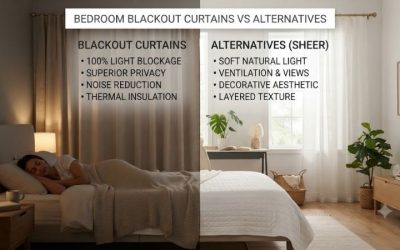
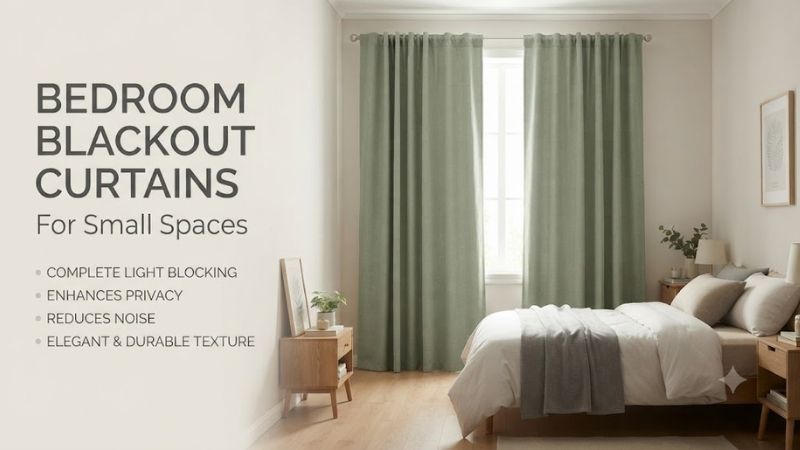
Choosing bedroom blackout curtains for small spaces requires more than finding dark fabric that fits a window. In compact apartments, studio bedrooms, dorm rooms, and narrow sleeping areas, curtains can affect how spacious a room feels, whether furniture remains accessible, and how effectively unwanted light is blocked. A curtain with excellent fabric opacity may still perform poorly if light enters around the edges, while oversized panels can make a small room feel unnecessarily crowded.
This guide explains how to measure windows, compare blackout materials, select space-efficient mounting hardware, and create a darker sleeping environment without overwhelming the bedroom. It also covers rental-friendly installation, thermal comfort, cleaning, and the practical trade-offs between curtains and alternative window treatments.
Start With the Window and Room Layout, Not the Curtain Fabric
The first step in choosing blackout curtains for a compact bedroom is understanding the space surrounding the window. A window positioned above a narrow desk requires a different treatment from one extending nearly to the floor. Similarly, a window close to a wall corner may limit how far the curtain rod can extend beyond the frame.
This matters because effective light control depends on coverage, not simply the curtain’s ability to block light through its material. A narrow curtain installed directly within the window opening may allow substantial daylight to enter around both sides.
Before shopping, measure the window, identify nearby furniture, and decide whether the panels need to open fully during the day. A blackout curtain that blocks the only practical place for a wardrobe door to open is not a good small-space solution, even if it creates a darker room.
Measure the Actual Window Opening
Measure the visible window width from one side of the frame to the other. Then measure the height from the top of the frame to the bottom.
These numbers describe the window itself, but they should not automatically become the curtain dimensions. Blackout curtains generally need additional coverage beyond the glass and frame to reduce light leakage.
For example, a window that is 36 inches wide may benefit from a curtain rod extending several inches beyond each side, provided there is adequate wall space. The exact extension depends on the room, mounting hardware, and desired light control.
Record the available wall width as well as the window width. This prevents buying panels that cannot be mounted properly.
Check the Space Above the Window
Mounting a curtain rod above the window can reduce the amount of light entering over the top of the fabric. It may also create the visual impression of a taller room.
However, a compact bedroom may have limited wall space between the window and ceiling. Crown molding, air-conditioning equipment, or an unusually low ceiling can restrict placement.
Measure the available height before deciding on the curtain length. The goal is to reduce top-edge gaps without placing hardware where it cannot be installed securely.
Identify Nearby Furniture and Obstacles
A desk, dresser, radiator, wall-mounted shelf, or air-conditioning unit may interfere with curtain movement.
If furniture sits immediately beneath the window, floor-length curtains may be inconvenient. A shorter panel can be more practical, provided it still covers the window sufficiently.
Also consider whether the window needs to open for ventilation. Thick curtains should not obstruct required access to window controls or create hazards near heating equipment.
How Much Curtain Width Do You Need?
Panel width is one of the most common sources of blackout performance problems. Shoppers often assume that a window measuring 48 inches wide requires exactly 48 inches of curtain fabric.
In practice, curtains need additional material to form folds, overlap at the center, and extend beyond the window frame. The appropriate fullness varies with fabric thickness, hanging style, and desired appearance.
A heavy lined curtain may require less decorative fullness than lightweight fabric, but it still needs adequate coverage to avoid gaps.
Understanding Curtain Fullness
Curtain fullness is the relationship between total flat fabric width and the width being covered.
For decorative curtains, shoppers commonly consider approximately 1.5–2 times the coverage width, although other ratios may be appropriate.
A 48-inch coverage width at 1.5 times fullness would require approximately 72 inches of total flat panel width. At twice fullness, it would require approximately 96 inches.
These are planning examples, not mandatory blackout specifications.
For a compact bedroom, the right amount of fullness should balance privacy, darkness, and the space occupied when the curtains are open.
Example: A 40-Inch Apartment Window
Consider a window that measures 40 inches across, with a rod extending 5 inches beyond each side.
The total rod span becomes approximately 50 inches.
| Desired fullness | Approximate total flat fabric width | Practical consideration |
|---|---|---|
| 1.0× | 50 inches | Minimal fullness; little margin for overlap |
| 1.5× | 75 inches | Moderate folds and coverage |
| 2.0× | 100 inches | Fuller appearance and more fabric |
| 2.5× | 125 inches | Substantial fullness that may be bulky |
Two panels measuring 50 inches each provide approximately 100 inches of total flat width.
That may be a practical starting point for this hypothetical window, depending on the heading style and the installed rod.
However, an extremely narrow room may not have enough wall space for the curtains to stack neatly when opened. Fullness should therefore be considered together with the available wall area.
Why Panel Packaging Matters
Some curtains are sold individually, while others are supplied as a pair.
A product description stating 52 inches wide might describe one panel rather than the combined package.
Before ordering, confirm the number of panels and whether the width refers to each panel or the complete set.
This is especially important when comparing prices. A lower advertised price may not be better value if two separate panels are required.
Understanding True Blackout Versus Room-Darkening Curtains
Not every curtain marketed using the word blackout provides the same level of light control.
Some fabrics use dense woven construction to reduce incoming light. Others incorporate a separate opaque lining or backing designed to block transmitted light more completely.
For someone sleeping during daylight hours, that distinction can be more important than fabric color or decorative texture.
Room-Darkening Curtains
Room-darkening curtains reduce incoming light but may allow some transmission through the fabric.
The exact result depends on yarn density, construction, thickness, and color.
A dark-colored room-darkening curtain may block more light than a pale version of the same material, although results differ between products.
These curtains can be appropriate when the bedroom already has blinds or receives relatively little direct sunlight.
They are less suitable when near-total darkness is essential.
Opaque-Lined Blackout Curtains
A dedicated opaque backing is intended to prevent light from passing through the curtain fabric.
This can be useful when the visible front fabric is white, beige, or another light color.
However, an opaque backing does not prevent light from entering around the installed curtain.
A high-performing blackout fabric hung several inches away from the wall may still leave the room noticeably bright.
Triple-Weave Curtains
Triple-weave construction uses multiple textile layers to affect opacity and fabric behavior.
Some triple-weave curtains provide substantial room darkening, but the construction name alone does not establish total blackout.
When strong light control is a priority, compare the exact product’s opacity claims and any meaningful testing information.
Do not assume every curtain within one brand’s collection performs identically.
Choosing the Right Curtain Construction for Small Rooms
| Curtain construction | Best practical use | Main benefit | Important limitation |
|---|---|---|---|
| Opaque-lined blackout | Daytime sleeping and bright exterior light | Strong fabric light blocking | Heavier panels and hardware |
| Triple-weave room-darkening | Moderate daylight control | Softer conventional drape | Light transmission varies |
| Textured blackout-backed | Decorative small bedrooms | Combines visual texture with opacity | Often more fabric bulk |
| Blackout shade with side coverage | Very narrow window areas | Compact window treatment | Installation precision matters |
| Blackout curtain over existing blinds | Bedrooms with persistent edge leaks | Layered light control | Additional hardware and cost |
The Best Curtain Length for a Small Bedroom
Curtain length affects both light leakage and how the room feels visually. A floor-length panel can create a continuous vertical line, while a shorter curtain may leave more wall and floor visible.
Neither is automatically better. The right length depends on the window position, furniture, heating equipment, and whether the curtains need to open daily.
Floor-Length Curtains
Floor-length curtains can make a room appear taller when mounted appropriately.
They also reduce the amount of light entering beneath the fabric compared with curtains that stop at the windowsill, assuming the rest of the installation is comparable.
However, excessively long curtains may collect dust, interfere with cleaning, or bunch on the floor.
For a compact bedroom where every inch of floor area is used, avoid unnecessary fabric pooling.
Windowsill-Length Curtains
Shorter curtains may work well when a desk or dresser sits beneath the window.
They usually require less fabric and may be easier to wash.
However, curtains ending at the sill can allow more light around the lower edge.
If the purpose is strong blackout performance, ensure that the fabric extends sufficiently beyond the window opening without interfering with furniture.
Ceiling-Height Mounting
Mounting near the ceiling can create a visually taller appearance.
It can also reduce top-edge light leakage when the design covers the window fully.
The trade-off is longer panels and potentially more complex installation.
Before purchasing, confirm that the walls or ceiling can support the rod and the curtain’s weight.
Space-Efficient Curtain Rods and Hanging Systems
A curtain’s mounting system affects darkness, appearance, and daily use.
In small bedrooms, the hardware should provide adequate coverage without unnecessarily projecting into the room.
Wraparound Curtain Rods
A wraparound rod curves toward the wall at its ends, allowing the curtain fabric to cover more of the side gaps.
This can be particularly useful for windows exposed to streetlights or early sunlight.
However, the rod must be mounted securely, and the curtain must have enough width to wrap toward the wall.
A wraparound rod cannot compensate for a panel that is too narrow.
Ceiling-Mounted Curtain Tracks
Ceiling tracks may create a cleaner visual appearance than conventional rods with prominent brackets.
They can also allow curtains to move across a wider wall area.
For some compact bedrooms, this creates a streamlined look.
However, installation may be more demanding, and not every ceiling is suitable for the hardware.
Tension Rods
Tension rods are sometimes attractive to renters because they avoid drilling.
However, load capacity and stability vary.
Heavy blackout curtains can exceed the capacity of some tension systems.
A falling rod can cause damage or injury. Use only hardware rated for the actual curtain weight and installation conditions.
Grommet Versus Rod-Pocket Curtains
Grommet curtains slide relatively easily along a rod and create regular folds. Their upper construction may leave more light gaps around the rod.
Rod-pocket designs can produce a more continuous fabric appearance, but they may be harder to open and close smoothly.
Neither heading style guarantees darkness. Evaluate the complete installed arrangement.
How to Reduce Light Leakage Around the Edges
Even the best blackout fabric cannot make a room dark when daylight enters around the window covering.
For small spaces, edge management often delivers greater improvement than buying increasingly expensive fabric.
Side Gaps
A curtain installed exactly at the edge of the window may allow bright vertical strips of light to enter.
Extend the curtain beyond the frame when wall space permits.
Wraparound rods or appropriately designed tracks can further reduce these gaps.
Top Gaps
Light can enter above the curtain rod, particularly when the rod sits well below the upper frame.
Mounting higher or using an appropriate valance or pelmet may improve coverage.
Any added component must be installed securely and must not create child-safety hazards.
Center Gaps
Two panels can separate where they meet.
Adequate fullness and center overlap can reduce this problem.
Some installations use compatible closures, but these should not damage the fabric or create accessible hazards.
Bottom Gaps
A curtain that stops above the window’s lower edge may permit visible light beneath it.
Choose an appropriate length while considering floor clearance and nearby furniture.
For extremely light-sensitive sleepers, a correctly fitted blackout shade beneath the curtains may be worth considering.
Choosing Curtains for Different Compact Bedroom Layouts
Studio Apartments
A studio bedroom may share visual space with a living room or home office.
In this situation, curtain color and texture contribute to the entire room’s appearance.
Neutral opaque-lined curtains can provide light control without requiring additional decorative layers.
Choose panels that can be opened fully to admit daylight when the sleeping area is used for daytime activities.
Dorm Rooms
Dorm residents may have installation restrictions and limited laundry facilities.
Confirm housing rules before purchasing hardware that requires drilling.
Choose manageable panel lengths and an appropriate hanging system rather than relying on a heavy curtain that cannot be installed securely.
Bedrooms With a Desk Under the Window
A desk may prevent floor-length curtains from hanging freely.
Consider shorter blackout panels that extend beyond the window’s lower edge or an appropriately sized cordless blackout shade.
Avoid letting fabric interfere with electrical equipment or heating devices.
Bedrooms Shared With Young Children
Window-covering cords create a serious strangulation hazard.
The US Consumer Product Safety Commission recommends cordless window coverings wherever young children are present.
Keep cribs, beds, and furniture away from window-covering cords. A blackout feature is never a reason to accept an accessible hazardous cord arrangement.
Blackout Curtains and Bedroom Temperature
Curtains can influence the transfer of heat around windows, but they do not replace insulation, well-sealed frames, or appropriately sized heating and cooling equipment.
A close-fitting curtain can help reduce certain forms of heat transfer by limiting air movement around the window.
The benefit depends on the window, installation, fabric, season, and indoor conditions.
Summer Comfort
An appropriately backed curtain can reduce incoming sunlight when closed.
This may make a sunny bedroom more comfortable during certain periods of the day.
However, results vary with window orientation and local climate.
A dark decorative curtain is not automatically more effective at limiting solar heat gain than a curtain with a suitable reflective or light-colored backing.
Winter Comfort
Lined curtains may help reduce heat loss through the window area, particularly when installed close to the wall and floor.
However, gaps around the curtain can allow room air to circulate behind it.
The installation quality often matters as much as the fabric’s apparent thickness.
Why Small Bedrooms Still Need Ventilation
A blackout curtain should not permanently prevent appropriate ventilation or access to necessary window controls.
Maintain suitable indoor air quality and follow building safety requirements.
Cleaning and Maintaining Blackout Curtains
Cleaning requirements should influence the purchasing decision, particularly when the bedroom has limited laundry capacity.
Polyester Curtains
Many polyester curtains can be washed under specific conditions, but not every backed or coated design tolerates the same cycle or temperature.
Follow the product label.
Coated Blackout Fabrics
Certain blackout backings may be sensitive to high heat, aggressive agitation, or inappropriate detergents.
Damaging the backing can reduce the fabric’s intended performance.
Drying and Wrinkles
Some curtains should be air-dried, while others permit tumble drying under specified conditions.
Do not assume ironing is safe on an opaque backing.
If ironing is permitted, follow the manufacturer’s temperature and surface-contact instructions.
Dust Management
Curtains accumulate household dust, particularly near the floor.
Regular appropriate cleaning can help maintain appearance without requiring frequent full washing.
Common Small-Space Blackout Curtain Buying Mistakes
Choosing Panels Exactly as Wide as the Window
This leaves little allowance for folds, overlap, or side coverage. The result may look acceptable when open but permit substantial light leakage when closed.
Measure the desired rod span and calculate sufficient fabric fullness instead of matching panel width directly to glass width.
Buying Heavy Curtains for Weak Hardware
Thick opaque-lined curtains can weigh substantially more than lightweight decorative panels.
A low-capacity tension rod or improperly mounted bracket may fail.
Confirm the total fabric weight and use suitable installation hardware.
Ignoring Where Curtains Stack When Open
A curtain may provide excellent darkness when closed yet block much of the window when opened.
In a small room, inadequate stacking space can reduce usable daylight and make the space feel darker throughout the day.
Consider narrower panel stacks, appropriate tracks, or an alternative shade when the wall area beside the window is restricted.
Frequently Asked Questions
What Type of Blackout Curtain Is Best for a Small Bedroom?
An opaque-lined curtain with adequate width and a close-fitting installation is a strong starting point when darkness is the priority. For very narrow windows or restricted wall space, a well-fitted blackout shade may be more practical. The best choice depends on window dimensions, mounting options, and surrounding furniture.
Are Floor-Length Curtains Better for Small Bedrooms?
Floor-length curtains can create a visually taller appearance and reduce some bottom-edge light leakage. However, they may interfere with desks, heating equipment, or limited floor space. Choose the length based on practical clearance and desired coverage rather than appearance alone.
How Wide Should Blackout Curtains Be?
Curtains generally need additional width beyond the window opening. Decorative fullness of roughly 1.5–2 times the coverage width is a common planning reference, but the appropriate amount depends on heading style, fabric thickness, and available wall space. Strong blackout performance also requires side and center overlap.
Can I Install Blackout Curtains Without Drilling?
Some renter-friendly mounting methods are available, but they must support the actual curtain weight and comply with housing rules. Heavy lined panels may exceed the capacity of basic tension rods. A securely installed cordless blackout shade may be another option when suitable.
Do Blackout Curtains Make Small Bedrooms Look Smaller?
Not necessarily. A suitable color, correct length, and simple installation can create a clean appearance. Excessively bulky folds or hardware may make a compact room feel crowded. Choose enough fabric for darkness without adding unnecessary decorative volume.
Can Blackout Curtains Replace Blinds?
They can provide effective light control and privacy, but the best solution depends on the window. For demanding daytime sleep conditions, combining a fitted blackout shade with curtains may reduce edge leakage more effectively than relying on either treatment alone.
Conclusion
The best bedroom blackout curtains for small spaces combine opaque fabric with correct measurements, practical mounting, and sufficient edge coverage. Choose lined panels when strong fabric light blocking matters, use space-efficient hardware where wall space is limited, and consider a fitted shade for narrow or awkward windows. Prioritize full-window coverage, secure installation, and manageable fabric volume over decorative thickness or unsupported blackout claims.