Key takeaways
-
Whether the material is genuinely opaque or primarily room-darkening.
-
Fabric and backing composition.
-
Number of panels included.
-
Width and length of each panel.
-
Desired rod or track span.
-
Required fullness and center overlap.
-
Heading style and hardware compatibility.
-
Available space for side coverage.
-
Total fabric weight and suitable mounting hardware.
-
Cleaning restrictions.
-
Whether the window-covering system is cordless or otherwise safe for the household.
-
Return and alteration conditions.
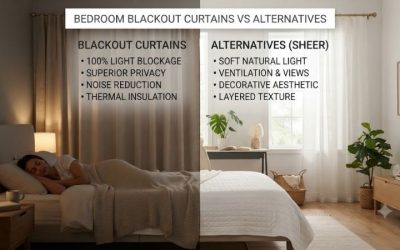
The best bedroom blackout curtains should reduce unwanted light, provide privacy, and suit the window without creating unnecessary maintenance or installation problems. Yet curtains described as blackout do not all perform equally. Some have opaque linings, others rely on tightly woven fabric, and even a completely light-blocking panel can allow daylight to enter around the edges. This bedroom blackout curtains buying guide focuses on the technical differences that influence purchasing decisions. You’ll learn how to distinguish blackout from room-darkening construction, evaluate fabric and backing materials, measure panel coverage, understand thermal claims, and decide which features justify spending more.
What Does Blackout Actually Mean for Bedroom Curtains?
Blackout describes the intended ability of a window treatment to block light transmission. However, consumers need to distinguish the opacity of the material itself from the amount of darkness achieved after installation.
A curtain fabric can be effectively opaque while the bedroom remains bright because light enters over the curtain rod, beside the panels, or through the center opening.
This distinction is fundamental when comparing products. A manufacturer may test or advertise the material’s opacity without demonstrating that the complete installed treatment creates a completely dark room.
Blackout Fabric Versus Room-Darkening Fabric
Room-darkening curtains reduce visible light passing through the material. Their performance depends on weave density, yarn composition, color, finishing, and backing.
A dark, tightly woven panel can provide substantial reduction while still allowing some sunlight to pass through. Under strong backlighting, this may be visible as a glow across the fabric.
A genuinely opaque blackout construction aims to block transmitted light through the panel itself. Opaque backing or lining often makes this possible without relying on a very dark front color.
For shift workers and other sleepers highly sensitive to daylight, verifying true fabric opacity is more valuable than selecting a curtain based on a generic room-darkening label.
Why a Blackout Percentage Is Not the Whole Story
Some product listings advertise 85%, 95%, 99%, or 100% light blocking.
Such numbers can be difficult to compare unless manufacturers disclose the testing method, wavelength range, color variation, and conditions.
Even a panel demonstrating complete opacity in a controlled test will not eliminate daylight entering around the installed window treatment.
When assessing a percentage claim, determine whether it describes transmitted light through the fabric or the overall room-darkening outcome.
Does Curtain Color Determine Blackout Quality?
Darker colors can improve light reduction in certain unlined woven materials.
However, a light-colored curtain with a genuine opaque backing may block transmitted light more effectively than a dark curtain without one.
This means shoppers do not have to choose black or navy fabric solely to obtain strong light blocking.
The backing construction often matters more than decorative color.
Comparing Blackout Curtain Fabric Constructions
Several textile designs appear in blackout curtain listings. Understanding their differences helps shoppers avoid comparing products that merely use similar marketing terms.
| Construction | How it reduces light | Main advantage | Main trade-off |
|---|---|---|---|
| Triple-weave polyester | Dense multilayer textile | Soft conventional drape | Opacity varies by model and color |
| Coated blackout fabric | Opaque coating applied to fabric | Strong potential fabric opacity | Coating can require careful cleaning |
| Separate blackout lining | Additional opaque textile layer | Allows more decorative front fabrics | Additional weight |
| Foam-backed curtain | Opaque backing layer | Strong potential light blocking | Texture and care requirements vary |
| Decorative textured blackout | Front textile plus opacity layer | Combines styling and darkness | Higher cost and fabric bulk |
Triple-Weave Polyester
Triple-weave curtains use a textile construction intended to reduce light transmission through the fabric itself.
These products often retain a flexible, conventional drape and may not have the stiff feel associated with some coated fabrics.
However, a triple-weave designation does not guarantee complete opacity.
Lighter colors may perform differently from dark colors, depending on the exact yarns and construction.
Choose this category when you want a balance of appearance, privacy, and room darkening, but verify the exact model if near-total fabric opacity is essential.
Coated Blackout Curtains
Coated curtains use an additional material applied to the back or within the textile structure to block light.
This can create strong opacity even when the decorative surface is light colored.
The main consideration is maintenance. Some coatings can deteriorate when exposed to unsuitable washing temperatures, aggressive agitation, or repeated folding.
Check the care label and assess whether the coating feels appropriate for the desired room appearance.
Separate Blackout Linings
A separately lined curtain uses one material for appearance and another for light blocking.
This construction can allow velvet, linen-look, textured polyester, or other decorative fabrics to be paired with an opaque layer.
The main advantage is greater flexibility in appearance.
The trade-off is additional fabric weight, which may require stronger rods, brackets, and anchors.
Foam-Backed Curtains
Foam-backed designs use an opaque backing material to reduce transmitted light.
They may be effective, but the backing’s texture and care limitations can differ from ordinary washable polyester.
Some shoppers dislike the appearance of a backing when curtains are viewed from outside the window.
Compare both the room-facing and window-facing surfaces before purchasing.
The Most Important Blackout Curtain Performance Criteria
Fabric opacity is only one of several specifications worth evaluating.
The completed curtain system should provide appropriate coverage, move conveniently, and remain durable under ordinary use.
Light Transmission
Light transmission describes how much light passes through a material under specified test conditions.
A lower transmission value generally indicates greater opacity.
However, comparisons are meaningful only when measurement methods are sufficiently consistent.
A dramatic product photograph of a dark room is not a substitute for documented performance.
Panel Dimensions
The curtain must cover the window adequately.
A narrow opaque panel can underperform a wider, moderately darkening curtain in the complete installation if substantial light enters around its edges.
Confirm both width and length.
Heading Construction
Grommets, rod pockets, back tabs, pinch pleats, and track-compatible headings create different fabric arrangements near the top.
These arrangements affect light leakage, how easily the curtain moves, and how much fabric is needed for a full appearance.
Side Coverage
Side gaps can be particularly noticeable in bedrooms facing bright streetlights or early sunlight.
A wraparound rod or suitable track can help bring the fabric closer to the wall.
However, the panel must still be wide enough to reach the intended position.
Measuring Curtains for Proper Coverage
Curtain sizing should start with the window and the proposed hardware rather than the mattress size or bedroom dimensions.
Determine the Coverage Width
Measure the window opening, then decide how far the curtain rod or track can extend beyond each side.
For example, a 60-inch-wide window with 6 inches of additional rod extension on each side has a total planned span of 72 inches.
That rod span is the starting point for calculating fabric fullness.
Calculate Panel Fullness
Using 1.5 times fullness for the hypothetical 72-inch span produces 108 inches of total flat curtain width.
Using twice fullness produces 144 inches.
These calculations help buyers compare panel packages consistently, though actual requirements depend on hanging style and the desired appearance.
| Rod span | 1.5× total flat fabric width | 2.0× total flat fabric width |
|---|---|---|
| 36 inches | 54 inches | 72 inches |
| 48 inches | 72 inches | 96 inches |
| 60 inches | 90 inches | 120 inches |
| 72 inches | 108 inches | 144 inches |
| 96 inches | 144 inches | 192 inches |
These are planning calculations, not requirements that guarantee complete blackout.
Choose the Correct Length
Measure from the installed rod or track to the intended lower edge.
For grommet curtains, account for the relationship between the top of the fabric and the position of the rod through the grommets.
For curtain tracks or hooks, the hanging hardware may change the effective drop.
Do not assume a panel advertised as 84 inches long will hang exactly 84 inches below every mounting system.
Consider Center Overlap
Two panels should meet without creating a visible opening.
If they barely touch when fully extended, small movements may allow light to enter.
Sufficient width and an appropriate closing arrangement can improve coverage.
How Curtain Hardware Influences Darkness
The hardware is often treated as an aesthetic accessory, but it materially affects performance.
Conventional Straight Rods
Straight rods are familiar and relatively easy to install.
However, the outer ends often leave a gap between the fabric and the wall.
This can permit light to enter from the sides.
For moderate light control, the simplicity may be acceptable.
For more demanding darkness, additional coverage may be needed.
Wraparound Rods
Wraparound rods curve toward the wall at their ends.
They can bring curtain fabric closer to the surrounding wall and help reduce side leakage.
This is especially useful when strong sunlight reaches the window at an angle.
However, they cannot correct inadequate fabric width or poorly mounted brackets.
Ceiling Tracks
Ceiling-mounted tracks can allow curtains to cover large window areas and may create a streamlined appearance.
They can also support panel arrangements that overlap or extend beyond the window frame.
Installation quality is important because a long track must safely support the total curtain weight.
Pelmets and Valances
A pelmet or correctly designed top covering can reduce light entering above the curtain.
This may also affect air movement around the window.
However, added components increase complexity and require suitable mounting.
Use them only when the improvement justifies the installation.
Blackout Curtains for Shift Workers
Daytime sleepers have different needs from people who simply want to reduce early morning brightness.
Daylight can enter through small gaps that are barely noticeable at night but highly visible during the day.
For a shift worker, fabric opacity and perimeter coverage deserve particular attention.
Prioritize Complete Window Coverage
A genuinely opaque panel is a strong starting point.
However, it should extend beyond the window frame and close securely at the center.
Side and top leakage may still make the room bright.
Consider Layered Window Treatments
A well-fitted blackout shade beneath curtains can provide an additional barrier.
This arrangement may reduce light entering through the gaps left by curtains alone.
However, it costs more and may require additional hardware.
Do Not Ignore Bedroom Temperature
Daytime sleeping often occurs when exterior temperatures are higher.
Blackout curtains can reduce sunlight entering the room, but the room’s overall temperature still depends on insulation, ventilation, air conditioning, and building orientation.
Balance Darkness With Safety
Curtains should not block necessary exits or create unsafe cord arrangements.
In homes with young children, cordless window coverings are the safest option for avoiding window-covering cord strangulation hazards.
Thermal Insulation: How Much Can Blackout Curtains Help?
Curtains can influence heat transfer around windows, but their performance depends heavily on installation.
A fabric’s thermal-related marketing should not be treated as a guarantee of a particular reduction in room temperature or energy bills.
Solar Heat Gain
Direct sunlight passing through windows can warm interior surfaces.
Closing an appropriate window covering can reduce some incoming solar energy.
The outcome depends on window orientation, glazing, backing material, and time of day.
A light-colored or reflective backing may behave differently from a dark exposed textile.
Winter Heat Loss
Close-fitting lined curtains may help reduce heat loss through window areas by limiting some air circulation and radiant exchange.
However, large gaps at the top, sides, or bottom can reduce the potential benefit.
For maximum practical effect, the complete installation matters.
Why Thermal Claims Are Difficult to Compare
Retail listings sometimes advertise percentages of energy savings or degrees of temperature reduction without describing the test environment.
A result measured for one window cannot automatically be applied to every bedroom.
Treat unsourced numerical claims cautiously.
Better Long-Term Improvements
If the room suffers from major drafts, leaking window seals, or inadequate insulation, addressing those problems may offer more meaningful benefits than replacing one curtain fabric with another.
Blackout curtains can complement building improvements but do not substitute for them.
Can Blackout Curtains Reduce Noise?
Some heavy textile curtains can influence sound absorption and room acoustics.
However, this is different from preventing external noise from entering through a window.
A standard blackout curtain is not a substitute for acoustic glazing, appropriate seals, or building soundproofing.
Sound Absorption Versus Sound Blocking
Absorption describes reducing certain sound reflections within a space.
Sound blocking concerns limiting transmission through an assembly.
A thick curtain may affect reverberation without substantially reducing loud traffic noise passing through an inadequately sealed window.
Avoid Unsupported Decibel Claims
A product advertised as reducing noise by a particular number of decibels should provide meaningful test context.
Test conditions, frequencies, and installation matter.
Without suitable evidence, do not assume the same result will occur in your bedroom.
Choosing Fabric Based on Bedroom Style
A curtain should meet light-control requirements, but appearance still matters because it covers a substantial wall area.
Smooth Polyester
Smooth polyester is often practical for everyday bedrooms.
It can provide a relatively understated appearance and may have manageable cleaning requirements.
Linen-Look Fabric
Linen-look curtains create a textured appearance without necessarily containing actual flax linen.
A genuine linen front layer may be paired with a blackout lining.
Check material composition carefully.
Velvet and Plush Fabrics
Velvet-like curtains create a heavier, more decorative appearance.
However, pile fabrics can attract dust and may require more careful cleaning.
Their thickness alone does not establish complete light blocking.
Neutral Colors
Light and neutral front colors can create a calmer visual appearance in bedrooms.
When paired with a suitable opaque backing, they need not sacrifice fabric opacity.
How to Compare Budget, Midrange, and Premium Curtains
A higher price can reflect decorative fabric, custom dimensions, additional lining, specialized hardware, or branding.
It does not guarantee better darkness.
Budget Blackout Curtains
Budget products may provide strong light blocking when they have genuine opaque construction and suitable dimensions.
The main limitations may be simpler finishes, limited sizes, or less sophisticated hanging arrangements.
Midrange Curtains
Midrange options may offer more texture choices, improved finishing, additional heading styles, or more size options.
These features are valuable when they improve installation or fit.
Premium and Custom Curtains
Custom curtains can be useful for unusual windows or installations requiring precise dimensions.
However, expensive fabric cannot compensate for poorly planned coverage.
Compare the total installed cost, including hardware, alterations, and professional installation where needed.
Maintenance and Durability
Blackout construction may require more careful handling than ordinary unlined fabric.
Washing Instructions
Check whether the panels can be machine-washed, hand-washed, or must be professionally cleaned.
Coatings and linings can have specific restrictions.
Drying
High dryer temperatures may damage some backings.
Follow the exact instructions rather than assuming all polyester curtains tolerate the same heat.
Wrinkle Removal
Some curtains permit low-temperature ironing or steaming under specified conditions.
Avoid applying high heat directly to an opaque coating unless expressly approved.
Signs of Wear
Look for damaged backing, separated lining, torn seams, weakened grommets, or panels that no longer close properly.
These problems can affect both appearance and light control.
A Practical Blackout Curtain Buying Checklist
Before purchasing, confirm:
-
Whether the material is genuinely opaque or primarily room-darkening.
-
Fabric and backing composition.
-
Number of panels included.
-
Width and length of each panel.
-
Desired rod or track span.
-
Required fullness and center overlap.
-
Heading style and hardware compatibility.
-
Available space for side coverage.
-
Total fabric weight and suitable mounting hardware.
-
Cleaning restrictions.
-
Whether the window-covering system is cordless or otherwise safe for the household.
-
Return and alteration conditions.
Common Blackout Curtain Buying Mistakes
Trusting the Word Blackout Without Checking Construction
Products sold under similar terms may vary significantly in opacity.
Compare the actual fabric and lining rather than relying entirely on the product title.
Buying Based on Fabric Color Alone
Dark fabrics are not automatically opaque, and light-colored curtains are not automatically ineffective.
Backing construction matters.
Ignoring Installation Gaps
A fully opaque curtain can still leave a bright room when light enters around its perimeter.
Plan the entire window treatment.
Comparing Prices Without Counting Panels
A single inexpensive panel may cost more overall than a complete pair from another brand.
Check package quantity and dimensions.
Expecting Soundproofing
Blackout and acoustic performance are different characteristics.
Do not assume ordinary curtains will eliminate outdoor noise.
Frequently Asked Questions
Are 100% Blackout Curtains Really Completely Blackout?
A material advertised as 100% blackout may block essentially all light passing through the fabric, but the installed curtain can still allow light around its edges. Verify what the claim measures and plan adequate side, top, and center coverage.
Is Triple-Weave Fabric Better Than Blackout Lining?
Neither is universally better for every household. Triple-weave fabric can provide a soft appearance and substantial darkening, while a dedicated opaque lining may offer more dependable fabric light blocking. Compare exact models rather than construction names alone.
Do Blackout Curtains Have to Be Dark Colored?
No. An opaque backing can allow strong light blocking behind white, beige, and other light-colored front fabrics. Unlined room-darkening products may be more sensitive to fabric color.
How Much Wider Should Curtains Be Than the Window?
The combined flat panel width generally needs to exceed the window or rod span to provide fullness and overlap. A planning range of 1.5–2 times the coverage width is common for many curtain styles, but exact requirements vary with installation.
Can Blackout Curtains Lower Bedroom Temperature?
They can reduce certain forms of solar heat gain and heat transfer, depending on window orientation, backing construction, and placement. However, they cannot guarantee a particular room-temperature reduction or replace insulation and air conditioning.
Are Expensive Blackout Curtains Worth It?
They may be worthwhile for custom sizes, better fitting, decorative fabric, or specific construction details. However, a correctly installed budget opaque-lined curtain may provide better light control than a premium panel with inadequate coverage.
Conclusion
The best bedroom blackout curtains combine verified fabric opacity with adequate panel width, effective edge coverage, and appropriate installation hardware. Choose opaque lining when strong light blocking matters, compare fabric and backing materials rather than color alone, and calculate the full installed cost before buying. For demanding daytime sleep conditions, a properly fitted layered window treatment may provide better results than relying on curtain fabric alone.