Key takeaways
-
Waterproof mattress protector: Best for everyday protection against spills, urine, and liquid reaching the mattress.
-
Water-resistant mattress protector: Best for limited exposure to light moisture when full waterproofing is unnecessary.
-
Mattress encasement: Best for six-sided coverage, particularly when allergen barriers or bed bug management are priorities.
-
Mattress pad: Best for light cushioning rather than guaranteed liquid protection.
-
Mattress topper: Best for changing comfort or pressure relief rather than protecting against liquids.
-
Cooling mattress protector: Best for shoppers who need waterproofing but also prioritize moisture management and surface comfort.
-
Absorbent bed pad: Best for localized protection and easier cleanup during recurring accidents.
Quick Verdict: Which Mattress Protection Option Is Best?
For most households concerned about accidental spills, a well-fitting waterproof mattress protector offers a practical balance of protection, convenience, and minimal changes to mattress feel. However, it is not the best solution for every sleeping environment.
-
Waterproof mattress protector: Best for everyday protection against spills, urine, and liquid reaching the mattress.
-
Water-resistant mattress protector: Best for limited exposure to light moisture when full waterproofing is unnecessary.
-
Mattress encasement: Best for six-sided coverage, particularly when allergen barriers or bed bug management are priorities.
-
Mattress pad: Best for light cushioning rather than guaranteed liquid protection.
-
Mattress topper: Best for changing comfort or pressure relief rather than protecting against liquids.
-
Cooling mattress protector: Best for shoppers who need waterproofing but also prioritize moisture management and surface comfort.
-
Absorbent bed pad: Best for localized protection and easier cleanup during recurring accidents.
Bottom line: If protecting the mattress against liquid damage is the main concern, choose a waterproof barrier. If you need additional cushioning, pest protection, or targeted absorption, another product may be more appropriate.
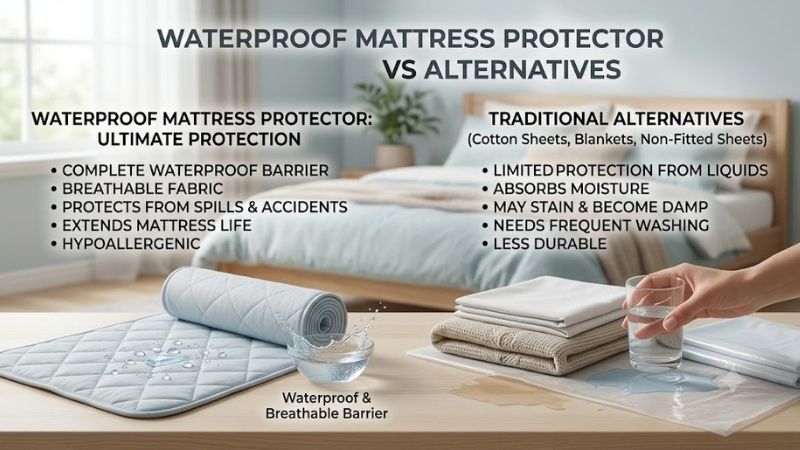
Waterproof Mattress Protector vs Alternatives: Quick Comparison Table
| Option | Liquid protection | Coverage | Effect on comfort | Primary limitation |
|---|---|---|---|---|
| Waterproof mattress protector | Blocks liquid through the protected areas when intact | Usually top and sometimes sides | Usually minimal | Breathability varies by membrane |
| Water-resistant protector | Resists limited moisture exposure | Usually top | Minimal | Not reliable against prolonged pooling |
| Zippered mattress encasement | Model-dependent; waterproof versions available | All six sides | Usually minimal | More difficult to remove |
| Standard mattress pad | Usually absorbs moisture without blocking it | Primarily top | Adds light cushioning | Not necessarily waterproof |
| Mattress topper | Usually little or no liquid protection | Primarily top | Can significantly change feel | Core may absorb spills |
| Cooling waterproof protector | Blocks liquid and may manage surface moisture | Usually top | Usually minimal | Cooling performance varies |
| Absorbent bed pad | Depends on backing and design | Localized section | May alter surface texture | Limited coverage |
The most important distinction is between absorbing liquid, resisting liquid, and preventing liquid penetration. These functions are not interchangeable.
How Waterproof Mattress Protectors Work
Waterproof Membranes and Barrier Construction
A waterproof mattress protector usually combines a textile sleeping surface with a liquid-blocking barrier underneath.
Common barrier materials include polyurethane films, thermoplastic polyurethane (TPU), and vinyl. Their performance depends on film thickness, composition, bonding method, seams, and overall construction.
The surface fabric may be cotton, polyester, lyocell, or a blend. It can influence texture, moisture absorption, and comfort, but the waterproof layer is generally responsible for preventing liquids from reaching the mattress.
A waterproof label should not be interpreted as a guarantee that every edge, seam, or side panel blocks liquid. Coverage must be confirmed for the specific product.
Breathability and Moisture Vapor Movement
A waterproof protector can prevent liquid water from penetrating while allowing some moisture vapor transfer, depending on its membrane construction.
This distinction explains why certain waterproof materials are marketed as breathable.
However, breathability is not identical to unrestricted airflow. A membrane may allow moisture vapor diffusion while substantially limiting the passage of air.
The finished protector, rather than the surface fabric alone, determines its overall behavior.
For sleepers concerned about overheating, membrane properties, fabric construction, and the surrounding bedding deserve consideration.
What Waterproof Protection Cannot Do
A waterproof protector does not prevent perspiration, regulate body temperature independently, or repair a damaged mattress.
It also cannot guarantee protection when the membrane is torn, improperly installed, or damaged by unsuitable laundering.
A fitted protector may leave the mattress sides or underside exposed. Liquid reaching those areas may still cause damage.
Proper sizing, correct installation, and regular inspection are therefore essential.
Waterproof Mattress Protector vs Water-Resistant Protector
These two products may appear similar, but their ability to handle liquid exposure differs.
Liquid Resistance and Spill Protection
A waterproof protector is designed to prevent liquid penetration through its barrier under intended conditions.
A water-resistant protector may repel or delay moisture penetration without offering a continuous waterproof barrier.
Water-resistant designs often depend on fiber treatments, dense fabric construction, or surface finishes.
When a spill remains on the surface for an extended period, liquid may eventually penetrate a water-resistant material.
For occasional small droplets, limited resistance may be adequate. For bed-wetting, pet accidents, or larger spills, a properly constructed waterproof protector is generally more suitable.
Breathability and Sleeping Comfort
Water-resistant fabric without a continuous membrane may allow more air movement than some waterproof constructions.
That advantage is not universal. Fabric density, coatings, and finishing processes can also influence airflow.
Likewise, waterproof protectors with moisture-vapor-permeable membranes may provide acceptable comfort for many sleepers.
Choose based on the required protection level rather than assuming that all water-resistant products are cooler.
Durability and Maintenance
The durability of water resistance depends on how it is achieved.
A surface-applied finish may lose effectiveness after repeated washing or abrasion. A waterproof laminated membrane may maintain its barrier longer when cared for correctly, but it can also deteriorate through heat damage, cracking, or delamination.
Neither category has a universal lifespan.
Best choice: Select waterproof protection when liquid penetration would create a meaningful problem. Choose water resistance only when occasional light moisture exposure is the main concern.
Waterproof Mattress Protector vs Zippered Mattress Encasement
A fitted protector and a zippered encasement offer different coverage.
Top-Surface Protection vs Six-Sided Coverage
A fitted mattress protector usually covers the sleeping surface and extends around the mattress edges.
A mattress encasement surrounds the entire mattress, including the underside, and closes with a zipper.
This additional coverage matters when the goal is to limit exposure to dust-mite allergens or help manage bed bugs.
However, not every encasement is waterproof. Some emphasize tightly woven allergen barriers instead of liquid protection.
For comprehensive moisture protection, check which surfaces have waterproof backing.
Protection From Bed Bugs and Allergens
A standard fitted waterproof protector is not equivalent to a bed-bug-proof encasement.
Bed bugs can access exposed mattress seams and sides even when the top surface is protected.
A properly designed encasement intended for bed bug control uses full coverage, durable material, and an appropriately secured zipper.
Encasements are one component of a broader pest-management approach, not a stand-alone solution for an infestation.
For dust-mite allergen management, a suitable allergen-barrier encasement may also provide more complete coverage than a fitted protector. Its effectiveness depends on fabric properties, fit, and correct use.
Installation and Cleaning
Fitted protectors are generally simpler to remove because they slip over the mattress like fitted sheets.
Encasements require lifting and maneuvering the mattress to fully enclose it.
That process can be inconvenient with large, heavy mattresses or beds with limited clearance.
For households frequently washing bedding after accidents, a removable fitted protector may be more practical.
Which Option Should You Choose?
Choose a fitted waterproof protector when spills, urine, and everyday mattress care are the main priorities.
Choose a full encasement when six-sided coverage is important, particularly for specified allergen-barrier or bed bug applications.
If both functions are needed, a compatible waterproof encasement or an encasement combined with a washable fitted protector may be useful.
Waterproof Mattress Protector vs Mattress Pad
Mattress pads primarily modify sleeping comfort, while waterproof protectors prioritize liquid protection.
Cushioning and Mattress Feel
A standard mattress pad may contain cotton, polyester fiberfill, wool, or other cushioning materials.
Its construction can soften the immediate sleep surface, although most pads do not substantially change underlying mattress support.
A conventional waterproof protector tends to be thinner and less focused on cushioning.
If your mattress already feels comfortable, a thin waterproof protector may preserve its original feel better than a heavily quilted pad.
If you want additional plushness, a mattress pad may be more suitable.
Absorption vs Waterproofing
Many quilted mattress pads can absorb some liquid because their fibers retain moisture.
Absorption does not mean the liquid is prevented from reaching the mattress.
Without a dedicated waterproof barrier, a spill may pass through the pad and reach the mattress underneath.
Some manufacturers offer waterproof mattress pads combining cushioning with a liquid-blocking membrane.
These hybrid products can serve both purposes, but their actual protection depends on construction.
Layering a Mattress Pad Over a Protector
Using a mattress pad above a waterproof protector can provide cushioning while maintaining a protective barrier below.
The arrangement generally places the protector directly over the mattress, followed by the pad and fitted sheet.
However, the product instructions should determine the final configuration.
Multiple layers can affect pocket depth, mattress feel, and moisture handling. Make sure the bedding remains secure and does not bunch.
Best choice: A waterproof protector is more appropriate for spill prevention, while a standard mattress pad is preferable when extra surface cushioning is the main objective.
Waterproof Mattress Protector vs Mattress Topper
A mattress topper serves a fundamentally different role.
Comfort and Pressure Redistribution
Mattress toppers are designed to change how the mattress feels.
Depending on material and thickness, a topper can provide additional cushioning, reduce pressure at certain contact points, or alter the degree of body contouring.
Common materials include memory foam, latex, wool, and fiberfill.
A waterproof protector does not generally produce the same level of comfort modification.
If your mattress feels too firm, adding a protector alone is unlikely to provide meaningful pressure relief.
Liquid Absorption and Topper Protection
Many topper materials can absorb or retain liquid.
Foam toppers may be especially inconvenient to clean because their cores are not typically intended for conventional machine washing.
A spill that penetrates a fitted sheet can damage both the topper and the mattress if neither is protected.
To protect the complete sleeping surface, choose a waterproof protector that fits over the topper and mattress together, provided the manufacturer permits that arrangement.
The combined thickness must remain within the protector’s specified pocket-depth range.
Breathability and Heat Retention
Thicker toppers can change the thermal behavior of the bed.
Highly conforming materials may reduce airflow around the body, while other constructions may provide more ventilation.
A waterproof protector above the topper can further influence vapor movement and surface feel.
If you sleep hot, consider how the layers work together instead of selecting materials based on cooling labels alone.
When a Topper Makes More Sense
A topper is appropriate when the mattress remains structurally sound but needs a different comfort feel.
It is not a replacement for waterproof protection, and it cannot reliably repair significant mattress sagging.
Best choice: Use a topper to adjust comfort and a waterproof protector to guard against spills. These products are often complementary rather than competing purchases.
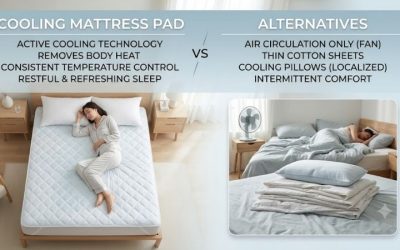
Waterproof Mattress Protector vs Cooling Mattress Protector
Not all waterproof mattress protectors are designed with the same thermal comfort priorities.
Waterproofing and Cooling Are Separate Features
Waterproofing describes liquid resistance through a barrier.
Cooling-related claims may involve a cool-touch textile, moisture-wicking fabric, phase-change material, or other surface construction.
A protector can include both types of features, but neither automatically establishes the performance of the other.
A cool-touch fabric may feel cooler briefly because of its heat-transfer properties. That does not guarantee continuous heat removal throughout the night.
Surface Materials and Moisture Management
Cotton can absorb moisture, while certain lyocell and engineered polyester fabrics are designed to move moisture across the surface.
The effectiveness of moisture management depends on textile construction and ambient humidity.
Even a fabric that handles perspiration well may feel uncomfortable if moisture accumulates above a relatively impermeable barrier.
Evaluate the entire protector rather than assuming that a particular fiber name guarantees superior cooling.
Is a Cooling Protector Worth the Additional Cost?
A specialized cooling protector may be worthwhile if you need liquid protection and dislike the surface feel of conventional waterproof bedding.
However, cooling claims should be supported by meaningful details or transparent measurements.
Do not assume that higher prices or proprietary fabric names indicate better thermal performance.
For hot sleepers, breathable sheets, lighter blankets, and bedroom temperature management may be equally important.
Waterproof Mattress Protector vs Absorbent Bed Pad
Absorbent bed pads, sometimes called underpads, are another option for managing localized liquid exposure.
Localized Absorption vs Mattress-Wide Protection
An absorbent bed pad is designed to retain liquid in a specific area.
Products may be disposable or reusable, and some include waterproof backing to prevent moisture from passing through.
Unlike a fitted mattress protector, an underpad generally does not cover the entire mattress.
This localized design may be useful for recurring nighttime accidents or situations where rapid cleanup is important.
However, liquid can still reach unprotected parts of the mattress.
Washing and Replacement
Reusable absorbent pads can reduce reliance on disposable products, but they require laundering.
Disposable versions simplify certain cleanup tasks but create recurring replacement costs and additional waste.
Actual absorbency varies by construction. Without published capacity measurements, shoppers should not assume that all products manage the same volume of liquid.
Combining an Underpad With a Waterproof Protector
A waterproof mattress protector beneath an absorbent underpad can provide an additional layer of protection.
The underpad manages liquid near the source, while the mattress protector provides wider coverage if moisture escapes the localized pad.
Ensure both layers remain secure and appropriate for the sleeper.
Best choice: Use an absorbent bed pad for targeted liquid management and a waterproof protector for broader mattress protection.
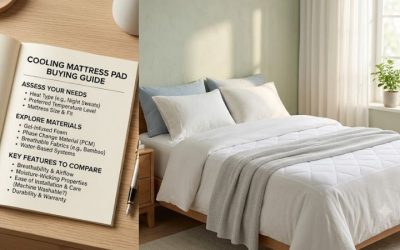
Key Buying Factors: Which Alternative Offers the Best Value?
1. Match Protection to Household Risks
Start with the reason you need mattress protection.
| Household situation | Recommended approach | Main reason |
|---|---|---|
| Occasional drinks in bed | Waterproof fitted protector | Broad spill protection |
| Young child experiencing nighttime accidents | Waterproof protector, optionally with an absorbent underpad | Easier cleanup and liquid protection |
| Pets sleeping on the bed | Waterproof protector | Helps manage accidental moisture and spills |
| Concern about bed bugs | Purpose-designed zippered encasement | Full mattress coverage |
| Dust-mite allergen management | Suitable allergen-barrier encasement | Enclosed barrier construction |
| Mattress feels too firm | Topper plus appropriate protection | Separates comfort from waterproofing |
| Mild surface discomfort | Mattress pad | Adds light cushioning |
| Minimal liquid exposure | Water-resistant cover may suffice | Lower protection requirement |
The appropriate product depends on the intended purpose, not simply how many features appear in its marketing description.
2. Confirm Dimensions and Pocket Depth
Most fitted protectors use standard US mattress sizes, but the fit also depends on mattress thickness.
| US mattress size | Nominal dimensions |
|---|---|
| Twin | 38 × 75 inches |
| Twin XL | 38 × 80 inches |
| Full | 54 × 75 inches |
| Queen | 60 × 80 inches |
| King | 76 × 80 inches |
| California King | 72 × 84 inches |
Actual dimensions can differ slightly from these nominal sizes.
Measure the mattress, including any topper that will remain underneath the protector.
For fitted designs, verify pocket depth and skirt elasticity. For encasements, confirm the permitted mattress height range.
A poorly fitting protector may slip, bunch, or expose areas to liquid.
3. Examine Barrier Materials
Common waterproof materials offer different practical characteristics.
| Barrier material | General characteristics | Main consideration |
|---|---|---|
| Polyurethane membrane | Flexible liquid barrier with formulation-dependent vapor permeability | Care and membrane durability |
| TPU film | Thermoplastic polyurethane barrier used in laminated fabrics | Construction-specific flexibility and breathability |
| Vinyl/PVC | Liquid-impermeable sheet material | Can feel less breathable or produce noise |
| Coated textile | Fabric treated with a moisture-resistant or waterproof coating | Performance depends on coating and construction |
TPU is a type of polyurethane, not an entirely separate material family.
Material identity alone cannot establish a product’s durability, safety, or sleeping comfort.
For meaningful comparisons, examine the finished protector’s specifications and available test information.
4. Evaluate Noise and Fabric Feel
Some protectors produce rustling sounds when sleepers change position.
Noise depends on material flexibility, fabric lamination, fit, and bedding layers.
A stiff barrier may be more noticeable than a flexible laminated design, although this cannot be generalized to every product.
If noise sensitivity is important, prioritize products with clearly described construction and credible user feedback rather than relying solely on phrases such as silent or noiseless.
5. Review Cleaning Instructions
Different protectors have different washing and drying limitations.
Many fitted protectors are machine washable, but allowable temperatures and detergent requirements vary.
High heat can damage some laminated waterproof membranes. Harsh chemicals or unsuitable washing methods may also affect durability.
Follow the manufacturer’s cleaning instructions and avoid assuming that every protector tolerates hot-water washing or high-heat tumble drying.
For repeated nighttime accidents, ease of cleaning can be as important as the barrier itself.
6. Consider Long-Term Cost
The least expensive protector is not automatically the best value.
A product that fits poorly or loses its barrier integrity after relatively little use may require early replacement.
Likewise, purchasing a full encasement may be unnecessary when a simple fitted protector adequately addresses the household’s needs.
Compare verified construction, care requirements, replacement conditions, and warranty terms where available.
Do not assume that buying a mattress protector automatically preserves mattress warranty coverage. Review the specific mattress manufacturer’s warranty conditions.
Advantages and Disadvantages of Each Option
Waterproof Mattress Protector
Advantages
-
Designed to prevent liquid from reaching protected mattress surfaces.
-
Usually straightforward to remove and launder.
-
Often preserves the original mattress feel.
Disadvantages
-
Breathability varies with membrane construction.
-
Fitted designs do not necessarily protect the underside.
-
Barrier damage can compromise waterproofing.
Choose it if: Everyday liquid protection is your priority.
Water-Resistant Protector
Advantages
-
Can provide limited moisture protection without a fully waterproof construction.
-
Some designs offer good air movement.
-
Usually adds little cushioning.
Disadvantages
-
May allow liquid penetration during extended exposure.
-
Performance can change with wear or laundering.
Choose it if: Spills are rare and complete liquid protection is unnecessary.
Zippered Mattress Encasement
Advantages
-
Encloses the mattress on all six sides.
-
Appropriate designs can help with allergen or bed bug management.
-
Can provide broader protection than a fitted cover.
Disadvantages
-
More difficult to install and remove.
-
Not every encasement is waterproof.
-
Correct fit and zipper integrity are critical.
Choose it if: Full mattress coverage is essential.
Mattress Pad
Advantages
-
Adds light cushioning.
-
Available in several filling and fabric constructions.
-
Often removable for laundering.
Disadvantages
-
May not include a waterproof barrier.
-
Extra fill can change heat retention.
Choose it if: Comfort is more important than liquid protection.
Mattress Topper
Advantages
-
Can significantly modify surface comfort.
-
Offers multiple materials and thickness options.
-
May improve pressure distribution on a suitable mattress.
Disadvantages
-
Usually does not provide waterproof protection.
-
Some materials are difficult to clean.
-
May increase heat retention.
Choose it if: Your mattress needs a comfort adjustment rather than only a protective layer.
Absorbent Bed Pad
Advantages
-
Provides targeted liquid absorption.
-
Available in reusable and disposable formats.
-
Can make cleanup more convenient.
Disadvantages
-
Does not cover the entire mattress.
-
Absorbent capacity varies.
-
Some designs can shift during sleep.
Choose it if: You need extra protection in a particular area.
Common Mistakes When Comparing Mattress Protection
Confusing Waterproof With Water-Resistant
A material that sheds droplets does not necessarily prevent a larger spill from penetrating.
Read the product’s actual protection description before relying on it for recurring accidents.
Assuming Every Mattress Pad Is Waterproof
Many quilted pads contain absorbent filling without any liquid barrier.
A pad that becomes wet may allow moisture to reach the mattress beneath it.
Verify the presence and coverage of a waterproof backing.
Buying an Encasement for Cooling Alone
Encasements are primarily designed for full coverage rather than temperature control.
A breathable encasement may provide adequate comfort, but six-sided construction does not inherently make it cooler.
Ignoring Mattress Thickness
A fitted protector that stretches excessively may slip or pull at the corners.
An encasement that is too small may be difficult to close securely.
Check both horizontal dimensions and mattress height.
Using Improper Washing Temperatures
A waterproof membrane can deteriorate if exposed to washing or drying conditions outside the manufacturer’s instructions.
Proper care is necessary for maintaining barrier performance.
Forgetting the Mattress Topper
If a topper sits above the protector, the topper may remain vulnerable to spills.
When compatible, a protector covering both the topper and mattress can provide more comprehensive surface protection.
Frequently Asked Questions
Is a Waterproof Mattress Protector Better Than a Mattress Pad?
A waterproof mattress protector is better for preventing liquids from reaching the mattress. A standard mattress pad is better when light cushioning is the main concern. Some hybrid products combine both functions, but their waterproof construction must be verified.
Can a Waterproof Mattress Protector Make You Sleep Hot?
It can affect sleeping comfort, but the result depends on the membrane, surface fabric, and surrounding bedding.
Some waterproof barriers restrict airflow or moisture transfer more than others. A waterproof label alone does not establish how warm the protector will feel.
Do Waterproof Mattress Protectors Stop Bed Bugs?
A standard fitted protector does not enclose the entire mattress and should not be relied upon for bed bug control.
A purpose-designed, fully zippered encasement can be a useful component of bed bug management, provided it fits and remains intact.
Should a Waterproof Protector Go Above or Below a Mattress Topper?
If the goal is to protect both the topper and mattress, a compatible fitted protector generally goes over both.
However, the protector must accommodate their combined thickness, and both manufacturers’ instructions should permit the arrangement.
Are Waterproof Mattress Protectors Completely Breathable?
Not necessarily. Waterproof barriers differ in moisture-vapor permeability and airflow resistance.
A soft or breathable top fabric does not guarantee unrestricted breathability through the complete product.
Look for meaningful material details and testing rather than broad marketing claims.
How Often Should You Replace a Waterproof Mattress Protector?
There is no universal replacement interval.
Inspect for tears, peeling or delaminating membranes, damaged elastic, persistent fit problems, and signs of liquid penetration.
Replace the protector when it can no longer provide its intended coverage or barrier performance. Follow the manufacturer’s care and warranty guidance.
Conclusion
When comparing a waterproof mattress protector vs alternatives, choose according to the specific problem you need to solve. A fitted waterproof protector is generally the most practical option for everyday spills and moisture protection. A zippered encasement offers more complete coverage, while mattress pads and toppers focus on comfort rather than guaranteed waterproofing. Water-resistant covers and absorbent underpads can serve narrower needs, but neither automatically replaces a properly constructed waterproof barrier. For the best long-term result, prioritize the correct protection level, secure fit, suitable membrane construction, and manageable cleaning requirements.