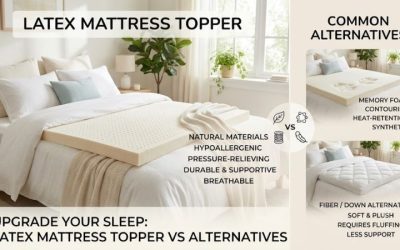
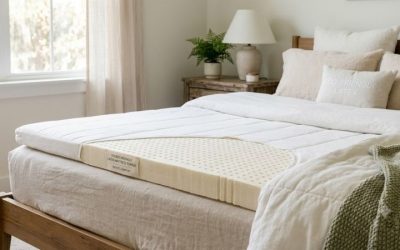
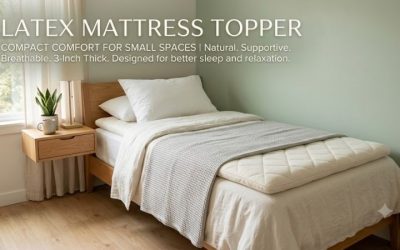
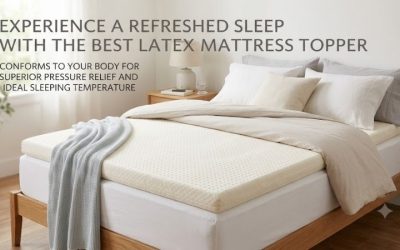
Choosing the wrong mattress topper can leave your bed too soft, too firm, or uncomfortable despite the extra cushioning. This latex mattress topper buying guide explains how to compare thickness, firmness, materials, and sleeping positions so you can find a topper that works with your existing mattress and sleep preferences.
Quick Answer: How to Choose a Latex Mattress Topper
A latex mattress topper is a removable comfort layer placed over an existing mattress to adjust its surface feel. Latex provides responsive cushioning, allowing the body to compress the material while experiencing more spring-back than the slow, body-hugging sensation associated with traditional memory foam.
For most shoppers, a 2-inch latex topper is a practical starting point for moderate comfort adjustments, while a 3-inch model is worth considering when substantially more cushioning is needed. Firmness matters just as much as thickness, and neither can compensate for a mattress that has lost its underlying structural support.
Your best choice depends on three questions:
-
Is your current mattress too firm, too soft, or simply uncomfortable around pressure points?
-
Do you primarily sleep on your side, back, stomach, or a combination of positions?
-
Do you prefer a buoyant, responsive surface or deeper, slower-contouring cushioning?
A soft latex topper may help relieve pressure from an overly firm mattress. A medium or firmer topper may provide a more resilient surface feel, but it cannot reliably correct a sagging mattress underneath.
Quick Latex Mattress Topper Selection Table
| Your Situation | Starting Point | Main Consideration |
|---|---|---|
| Firm mattress with shoulder pressure | Soft, 2–3 inches | Enough cushioning for side sleeping |
| Firm mattress with mild discomfort | Medium, 2 inches | Moderate comfort adjustment |
| Back sleeper wanting balanced cushioning | Medium, 2 inches | Maintain comfortable spinal alignment |
| Stomach sleeper wanting slight cushioning | Medium-firm or firm, 1–2 inches | Avoid excessive pelvic sinking |
| Combination sleeper | Medium, 2 inches | Responsive movement and balanced feel |
| Hot sleeper | Ventilated latex with breathable cover | Whole-bed airflow and bedding materials |
| Guest bedroom | Medium, 2 inches | Versatility across different sleepers |
| Severely sagging mattress | Mattress replacement | Restore underlying support |
These are starting points rather than guaranteed matches. The existing mattress, sleeper’s body weight, and individual preferences can change the outcome significantly.
Understanding Latex Mattress Toppers Before You Buy
Latex mattress toppers differ in their manufacturing process, material composition, thickness, and construction. Understanding these differences helps buyers avoid paying extra for features that may not improve their particular sleep setup.
What Is a Latex Mattress Topper?
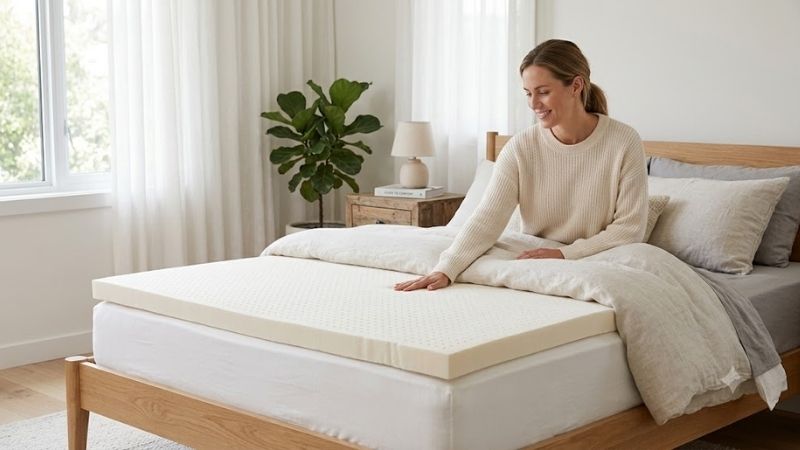
A latex mattress topper is a separate cushioning layer, commonly around 1 to 3 inches thick, positioned directly over the mattress beneath the fitted sheet.
Unlike a thin mattress protector, which primarily guards against spills, dirt, and moisture, a topper is designed to change the feel of the sleeping surface.
Latex foam compresses under body weight and rebounds when pressure is removed. This responsiveness can make changing positions easier for people who dislike feeling enveloped by memory foam.
The existing mattress still provides much of the bed’s overall support. A topper works in combination with that mattress rather than replacing its support system.
Natural Latex vs. Synthetic Latex vs. Blended Latex
Latex foam can be manufactured from natural rubber latex, synthetic rubber, or a combination of both.
Natural latex uses rubber-tree latex as its principal rubber ingredient. It is often preferred by shoppers seeking plant-derived materials and is commonly associated with resilient, durable bedding.
Synthetic latex is made using manufactured rubber polymers. Depending on the formulation, it may offer a lower purchase price, although its performance and longevity depend on the actual construction.
Blended latex combines natural and synthetic rubber components. The proportions vary, so a product described simply as latex should not automatically be assumed to contain 100% natural rubber latex.
The term natural also does not mean a finished product contains no processing agents or additives.
When evaluating material claims, look for a clear explanation of the latex composition rather than relying on a general description such as premium, green, or eco-friendly.
Dunlop Latex vs. Talalay Latex
Dunlop and Talalay refer to different latex foam manufacturing processes, not necessarily different sources of rubber.
Dunlop latex is produced through a comparatively straightforward molding and vulcanization process. It is often associated with a substantial, supportive feel.
Talalay production introduces additional steps, including vacuum expansion and freezing, to help create a more consistent cellular structure. Talalay latex is often associated with an airy, buoyant feel.
| Feature | Dunlop Latex | Talalay Latex |
|---|---|---|
| Manufacturing | Molded and vulcanized foam | Additional vacuum and freezing stages |
| Typical feel | Substantial, resilient | Buoyant, responsive |
| Firmness options | Soft through firm | Soft through firm |
| Pressure relief | Depends on firmness and thickness | Depends on firmness and thickness |
| Breathability | Influenced by foam structure and ventilation | Influenced by foam structure and ventilation |
| Typical cost | Often less expensive | Often more expensive |
| Best suited to | Buyers seeking resilient support and value | Buyers preferring a buoyant comfort feel |
Neither manufacturing process automatically guarantees better cooling, pressure relief, or durability.
A soft Dunlop topper may feel more cushioning than a firm Talalay topper. Firmness, thickness, and the specific formulation often matter more than the manufacturing label alone.
How Latex Feels Compared With Memory Foam
The most noticeable difference between latex and traditional memory foam is responsiveness.
Memory foam typically conforms more slowly, creating the sensation of settling into the surface. Latex responds and recovers more quickly, producing a springier feel.
Latex may be attractive to sleepers who change positions frequently or dislike the sensation of being surrounded by foam.
Memory foam may appeal to sleepers who prioritize deep, localized contouring and motion absorption.
Neither material is universally better for pressure relief. The appropriate choice depends on the complete mattress setup, including the firmness of the material underneath.
Latex Mattress Topper vs. Mattress Pad vs. Mattress Protector
These products perform different functions.
| Product | Main Function | Comfort Impact |
|---|---|---|
| Latex mattress topper | Changes mattress cushioning and feel | Moderate to substantial |
| Mattress pad | Adds a relatively thin layer of padding | Usually modest |
| Mattress protector | Protects against spills, stains, or allergens, depending on design | Usually minimal |
If the bed is uncomfortable because its surface is too firm, a topper is generally the more relevant solution.
If the existing comfort level is acceptable and the goal is protecting the mattress, a protector is the better category to consider.
Choosing the Right Latex Mattress Topper Thickness
Thickness is one of the most important purchasing decisions because it determines how much the topper can change the interaction between your body and the mattress underneath.
A thicker topper generally allows more compression before your body reaches the original mattress surface.
However, adding thickness also changes bed height, sheet fit, and sometimes ease of getting into or out of bed.
Is a 1-Inch Latex Mattress Topper Enough?
A 1-inch latex topper is suitable when only a subtle surface adjustment is needed.
It may add a small amount of cushioning without significantly changing the established support characteristics of the mattress.
Best for: Sleepers who already like their mattress but want a minor change in surface feel.
Main limitation: One inch may not provide sufficient cushioning for prominent pressure points, particularly when placed over a very firm mattress.
A thin topper also follows the contours of the mattress underneath, making it unsuitable for correcting significant sagging.
When Should You Buy a 2-Inch Latex Topper?
A 2-inch latex topper is a versatile starting point for shoppers who want a meaningful comfort adjustment without adding excessive height.
Depending on firmness, it can soften the feel of a hard mattress, create a more responsive surface, or moderately change the amount of contouring.
Best for: Back sleepers, combination sleepers, guest bedrooms, and side sleepers who need moderate cushioning.
Main limitation: A 2-inch topper may not provide enough pressure relief for someone whose shoulders or hips require substantial additional compression room.
Buyers should evaluate the existing mattress before assuming that two inches will provide the same experience across different beds.
When Is a 3-Inch Latex Topper Better?
A 3-inch topper can create a more noticeable change in the sleeping surface.
This depth allows additional compression, making it useful when a very firm mattress needs substantially more cushioning.
Soft and medium versions may appeal to side sleepers who experience pressure around the shoulders or hips.
Best for: Sleepers seeking a significant comfort change, particularly on an otherwise supportive but overly firm mattress.
Main limitation: A thick, soft topper can allow excessive sinking for some sleepers. It may also increase total bed height and make fitted-sheet compatibility more difficult.
Do You Need a 4-Inch Latex Mattress Topper?
A 4-inch topper is a specialized choice rather than a default upgrade.
It may be suitable when the buyer deliberately wants a substantial new comfort layer over a structurally sound mattress.
However, a topper this thick begins to function more like a separate mattress comfort system.
Its benefits depend heavily on whether the material firmness complements the original mattress.
For a mattress that already feels too soft, adding four inches of soft latex could make the problem worse.
Thickness Comparison
| Thickness | Degree of Feel Change | Typical Use | Main Trade-Off |
|---|---|---|---|
| 1 inch | Subtle | Minor surface adjustment | Limited cushioning |
| 2 inches | Moderate | General comfort improvement | May not resolve strong pressure points |
| 3 inches | Significant | Additional cushioning | Greater sinking potential |
| 4 inches | Substantial | Major comfort-layer modification | Added height, weight, and cost |
Buying recommendation: Choose the least thickness that reasonably addresses your comfort problem. Extra thickness is not automatically better.
How to Choose the Right Latex Topper Firmness
Firmness describes how resistant a sleeping surface feels under pressure.
Latex toppers are commonly marketed as soft, medium, medium-firm, or firm. These labels are helpful for comparing options within a manufacturer’s range, but they are not standardized across brands.
A medium topper from one manufacturer may feel noticeably different from another company’s medium product.
Soft Latex Toppers for Pressure Relief
Soft latex allows relatively deep surface compression.
It is often a useful option for someone whose current mattress causes discomfort around pressure-sensitive areas.
Side sleepers may particularly benefit because their shoulders and hips need room to settle into the sleeping surface.
The trade-off is reduced resistance to sinking. If the mattress below is already soft, a soft topper can make alignment less comfortable.
Medium Latex Toppers for Balanced Comfort
Medium latex offers a compromise between cushioning and resistance.
For shoppers who cannot decide between plush and firm, medium is a reasonable starting point when the existing mattress is supportive.
It may suit combination sleepers who alternate between side and back sleeping.
However, medium should not be treated as universally ideal. Body weight and the mattress underneath remain important.
Firm Latex Toppers for a More Resilient Surface
Firm latex resists compression more strongly than softer formulations.
It may appeal to sleepers who prefer less sinkage, especially when positioned over a mattress that already offers adequate underlying support.
A firm topper can change the sensation at the surface, but it cannot reliably restore worn-out internal foam or broken support components.
Someone whose mattress has developed deep impressions should consider replacing the mattress rather than trying to reinforce it with a firm topper.
Understanding ILD and Firmness Ratings
Indentation Load Deflection, commonly abbreviated ILD, is one way manufacturers describe foam firmness.
An ILD measurement indicates the force required to compress a foam sample by a specified amount under standardized conditions.
A higher ILD generally indicates greater resistance to compression when comparing measurements obtained through the same method.
However, ILD values are not always directly comparable because testing conditions and reported metrics may differ.
Important distinctions include:
-
ILD: Describes measured resistance to indentation under specified conditions.
-
Density: Describes material mass per unit volume.
-
Thickness: Describes the physical depth of the topper.
-
Perceived firmness: Describes how the combined sleeping surface feels to an individual.
A denser topper is not necessarily firmer, and a higher ILD does not automatically mean better spinal support.
If comparing firmness numbers, confirm that the manufacturers report them using comparable test methods.
Best Latex Mattress Topper Firmness by Sleeping Position
Sleeping position influences which parts of the body press most strongly into the mattress.
The appropriate topper should allow enough cushioning for comfort without creating excessive sinking through the torso or pelvis.
Side Sleepers: Prioritize Shoulder and Hip Cushioning
Side sleepers concentrate more pressure around the shoulders and hips.
A topper that is too firm can prevent those areas from settling sufficiently, potentially creating pressure discomfort.
A soft or medium latex topper, often around 2 to 3 inches thick, is a practical starting point when the existing mattress feels too hard.
Lighter side sleepers may prefer softer options because they apply less force to the surface.
Heavier side sleepers may require greater compression resistance to avoid sinking too deeply.
Back Sleepers: Balance Contouring and Support
Back sleepers generally benefit from a surface that accommodates the body’s natural contours without allowing excessive pelvic sinking.
A medium 2-inch latex topper is a useful initial option when the underlying mattress is supportive but uncomfortable.
A softer version may be suitable when the mattress is particularly firm. A firmer version may feel better to sleepers who prefer minimal sinkage.
Evaluate the entire surface rather than judging firmness from the topper alone.
Stomach Sleepers: Avoid Excessive Hip Sinkage
Stomach sleeping can become uncomfortable when the pelvis sinks substantially lower than the upper body.
For this reason, stomach sleepers commonly prefer thinner, firmer comfort layers.
A 1- to 2-inch medium-firm or firm latex topper may be more appropriate than a thick plush model.
Nevertheless, a firmer topper cannot correct major sinking caused by a deteriorated mattress.
Combination Sleepers: Look for Responsive Comfort
Combination sleepers change positions during the night and may benefit from latex’s springy recovery.
A medium, 2-inch topper is a useful starting point for someone alternating between back and side sleeping.
People who regularly switch between stomach and side sleeping may need to prioritize the position in which they experience the most discomfort.
How Body Weight Changes Your Choice
Body weight changes how deeply a person compresses a given latex topper.
| Sleeper Weight | General Starting Consideration |
|---|---|
| Under 130 pounds | Softer latex may allow sufficient contouring |
| 130–230 pounds | Medium options often provide a useful starting point |
| Over 230 pounds | Medium-firm or firm latex may offer better resistance to sinking |
These weight ranges are broad shopping references, not medical or ergonomic rules.
Body shape, individual sensitivity, sleep position, and existing mattress construction can all change the preferred firmness.
A heavier side sleeper, for example, may still prefer a softer surface if the original mattress is especially firm and supportive.
Latex Mattress Topper Materials, Construction, and Certifications
Not all latex toppers contain the same materials or offer the same construction features.
The latex core, outer cover, ventilation design, and independently verified material claims can affect practical usability.
Natural and Organic Latex Certifications
Certification labels should be evaluated according to what they actually cover.
Global Organic Latex Standard (GOLS) addresses organic latex materials and related production requirements. Certification claims should be checked against the exact product and certificate scope.
Global Organic Textile Standard (GOTS) applies to organic textile products and their processing. A GOTS-certified cotton cover does not automatically establish that the latex core is certified organic.
OEKO-TEX STANDARD 100 concerns testing textiles and applicable components for specified harmful substances. It is not, by itself, proof that a topper is organically produced.
A certified component also does not necessarily mean that every component of the finished product carries the same certification.
Buyers who prioritize organic materials should verify the latex core, cover, and finished-product claims separately.
Should You Buy a Topper With a Cotton Cover?
A cotton cover creates a fabric barrier around the foam and can make everyday handling more convenient.
A removable, washable cover may be beneficial for keeping the sleeping surface clean.
However, washing instructions differ between products. Some covers may require specific temperature settings or drying methods.
A cotton cover can also affect price, and not every latex topper includes one.
Before purchasing, determine whether the advertised price includes the cover or only the foam core.
Is a Wool-Covered Latex Topper Worth Considering?
Some latex toppers incorporate wool batting or wool-filled quilting above the latex.
Wool can influence surface cushioning, moisture handling, and temperature regulation.
These designs may appeal to buyers who prefer a softer quilted surface over the latex core.
However, wool-containing toppers may require more restrictive cleaning methods, and their feel differs from an exposed latex slab.
Wool is not a suitable material choice for every household or preference.
Does Perforated Latex Improve Breathability?
Many latex toppers feature small holes extending through the foam.
These perforations can provide potential pathways for airflow, but their actual effect depends on hole geometry, foam construction, surrounding fabrics, and the mattress underneath.
Perforation alone does not establish that one product sleeps cooler than another.
A highly breathable topper covered by an impermeable protector may still create an uncomfortable sleeping environment for some people.
Consider the complete bedding system rather than focusing on a single ventilation feature.
Latex Allergy and Material Sensitivity
Natural rubber latex contains substances that can trigger allergic reactions in susceptible individuals.
Although processed latex foam differs from raw latex products, buyers with known latex allergies should not assume that a latex mattress topper is safe simply because it is covered by fabric.
Anyone with a known or suspected natural rubber latex allergy should seek guidance from a qualified healthcare professional and consider a nonlatex alternative.
An organic designation or third-party material certification should not be interpreted as an allergy-safety guarantee.
Latex vs. Memory Foam vs. Polyfoam Mattress Toppers
The best topper material depends on the type of discomfort you want to address and how you prefer the bed to respond.
Latex has a distinctive combination of contouring and spring-back, but memory foam and conventional polyurethane foam can also be appropriate.
| Buying Factor | Latex | Memory Foam | Conventional Polyfoam |
|---|---|---|---|
| General response | Springy and quick to recover | Often slower to recover | Varies by formulation |
| Contouring sensation | Buoyant cushioning | Often deeper body-hugging | Ranges from light to substantial |
| Motion absorption | Can transfer more movement | Often absorbs movement well | Varies |
| Heat management | Often relatively breathable | Depends heavily on formulation | Depends on construction |
| Durability | Quality latex can be long-lasting | Varies with density and quality | Varies widely with quality |
| Purchase cost | Often higher | Wide price range | Often more affordable |
| Ease of changing positions | Usually good | Can require more effort in slower foams | Depends on responsiveness |
When Latex Is the Better Choice
Latex is particularly worth considering when the buyer wants responsive cushioning and does not enjoy a deeply enveloping foam sensation.
Its resilient feel can suit combination sleepers and people who want noticeable cushioning without excessive slow-moving contouring.
Latex is also appealing when shoppers prioritize natural rubber materials, provided the particular product’s composition is verified.
When Memory Foam Makes More Sense
Memory foam may be preferable when close body contouring or movement absorption is the main priority.
Couples who are easily disturbed by movement may appreciate the motion-dampening characteristics of a suitable memory foam topper.
However, thickness and firmness still matter, and not every memory foam topper provides better pressure relief than latex.
When a Budget Polyfoam Topper Is Enough
A conventional polyfoam topper may be sufficient for someone seeking a modest comfort adjustment at a lower initial cost.
It can make sense for a guest bed or temporary setup where long-term material resilience is a lower priority.
The trade-off is that inexpensive low-density foams may compress or develop impressions sooner than higher-quality alternatives.
Without comparable material specifications and durability evidence, buyers should avoid assuming all polyfoam products perform alike.
Mattress Size, Fit, and Bed Compatibility
Even a well-chosen latex topper can be inconvenient if it does not fit the mattress or surrounding bedding.
Before purchasing, measure the existing mattress rather than relying only on the bed-frame description.
Standard US Mattress Topper Dimensions
Common US mattress dimensions provide a useful starting point.
| Mattress Size | Nominal Width | Nominal Length |
|---|---|---|
| Twin | 38 inches | 75 inches |
| Twin XL | 38 inches | 80 inches |
| Full | 54 inches | 75 inches |
| Queen | 60 inches | 80 inches |
| King | 76 inches | 80 inches |
| California King | 72 inches | 84 inches |
These dimensions are nominal references. Actual finished measurements and allowable tolerances can vary by manufacturer.
Latex is also elastic, so small dimensional differences may occur during production or handling.
Measure Mattress Height Before Buying
Topper thickness adds to the height of the mattress assembly.
For example, placing a 3-inch topper over a 12-inch mattress produces approximately 15 inches of combined height before accounting for any additional bedding layers.
This can affect fitted-sheet compatibility.
Measure the mattress depth and review the fitted sheet’s stated pocket-depth range.
Do not assume that a sheet advertised as deep-pocket will necessarily fit every mattress-and-topper combination.
Will a Latex Topper Work on an Adjustable Bed?
Latex is flexible, making many latex toppers potentially suitable for adjustable bed bases.
However, compatibility depends on the topper’s thickness, construction, cover, and the mattress beneath it.
A thicker or more structured topper may shift or fold differently as the base changes position.
Check the manufacturer’s compatibility guidance and consider how easily the topper follows the mattress when the head or foot section is raised.
Can You Use Latex on a Memory Foam Mattress?
A latex topper can be placed over a memory foam mattress when the original mattress remains structurally sound.
The combined bed will retain the support characteristics of the underlying memory foam while adding latex’s responsive surface feel.
A soft underlying mattress may still allow excessive sinking even when covered by firmer latex.
The topper should therefore be selected according to the complete mattress setup, not simply the material underneath.
Does a Latex Topper Need Corner Straps?
Corner straps can help secure a topper, especially if the sleeping surface tends to shift.
However, some latex toppers rely on their weight, surface friction, a fitted sheet, or a separate cover rather than integrated straps.
Movement depends on the topper’s construction and the fabrics in contact with it.
If slipping is a concern, look for an attachment method that is compatible with the mattress and does not damage the topper.
How to Decide Whether a Latex Mattress Topper Is Worth the Cost
Latex toppers can cost substantially more than basic polyester-filled pads or inexpensive polyfoam toppers.
The buying decision should focus on how well the added expense addresses the actual comfort problem.
Consider Material Quality Before Comparing Prices
A lower-priced latex topper is not automatically a better value.
Check whether the product uses natural, blended, or synthetic latex, and whether the advertised thickness and firmness match your needs.
A particularly inexpensive listing that provides little material information may be difficult to evaluate.
Likewise, a more expensive organic product is not automatically more comfortable.
The appropriate value comparison considers relevant specifications, construction transparency, expected usability, and purchase terms.
Evaluate the Cost of the Cover
Some manufacturers sell latex cores separately from their covers.
An optional cover can increase the total purchase price, but may provide useful protection and easier maintenance.
Compare the complete cost of the configuration you intend to use.
Avoid comparing an uncovered foam slab directly against a fully encased topper without recognizing the construction difference.
Check Return Policies and Sleep Trials
Comfort is subjective, making return terms especially important.
Look for clear answers to these questions before ordering:
-
Can the topper be returned after it has been opened?
-
Is there a minimum period before a return is accepted?
-
Are return shipping or handling charges involved?
-
Must the product retain its original packaging?
-
Are firmness exchanges available?
-
Does the return policy differ for discounted or custom-sized products?
Do not assume mattress trial policies automatically apply to toppers sold by the same company.
Understand Warranty Coverage
Warranty length alone does not establish durability.
Read the terms to understand which manufacturing defects are covered, whether permanent impressions must meet a specified threshold, and whether damage from improper care is excluded.
Normal softening and changes in personal comfort preferences may not qualify as defects.
Keep the purchase documentation and follow the stated care instructions.
Consider Longevity Without Assuming a Fixed Lifespan
Quality latex can offer good resistance to permanent compression, but longevity varies with manufacturing quality, firmness, usage conditions, and maintenance.
There is no universal lifespan that applies to every latex topper.
A durable topper may offer better long-term value than a lower-cost option requiring earlier replacement, but this comparison should be based on actual product quality and not an unsupported number of years.
Practical Buying Scenarios: Which Latex Topper Should You Choose?
Different sleeping problems call for different solutions.
These examples demonstrate how thickness, firmness, and material preferences can guide the purchase.
Scenario 1: Your Mattress Is Too Firm for Side Sleeping
Suppose your mattress feels structurally supportive but creates uncomfortable pressure around the shoulders.
A soft 2- or 3-inch latex topper is a sensible option to consider.
The additional comfort layer can allow greater shoulder compression while preserving much of the mattress’s underlying support.
Start with 2 inches if the discomfort is mild. Consider 3 inches if additional cushioning seems necessary and the mattress beneath remains firm.
Scenario 2: Your Mattress Feels Good but Needs Slightly More Cushioning
If the bed is mostly comfortable, an overly thick topper can introduce a new problem.
A 1- or 2-inch latex topper may provide the small adjustment required.
A medium firmness is a reasonable starting point when you want to preserve the existing balance rather than produce a dramatically softer surface.
Scenario 3: You Sleep on Your Stomach and Dislike Sinking
A firm or medium-firm topper with a relatively thin profile may suit your preference.
Avoid assuming extra softness will improve comfort.
When the hips already sink too far into the mattress, a topper may not address the real issue.
Determine whether the underlying mattress needs replacement before purchasing.
Scenario 4: You Share a Bed With Someone Who Moves Frequently
Latex can make repositioning easier because of its responsive character.
However, that responsiveness may also transmit some movement through the sleeping surface.
If minimizing partner disturbance is your highest priority, compare latex against slower-response memory foam.
For partners with significantly different comfort preferences, separate toppers on compatible split sleeping surfaces may be worth considering.
Scenario 5: You Want a Cooler-Feeling Bed
Look for breathable cover materials and a topper construction that allows airflow.
Latex may be preferable to some traditional memory foam designs, but it does not actively cool the sleeper.
The mattress underneath, room temperature, humidity, protector, sheets, and comforter all influence thermal comfort.
Avoid products that claim superior cooling without meaningful supporting evidence.
Scenario 6: Your Existing Mattress Has Deep Sagging
A mattress with pronounced impressions or failed internal support is a poor candidate for a comfort topper.
Latex follows the surface beneath it and cannot rebuild damaged mattress components.
A thick topper might temporarily change the sensation, but it will not reliably correct the structural issue.
Replacing the mattress is generally the more appropriate long-term decision.
How to Care for a Latex Mattress Topper
Proper care helps preserve material condition and reduces unnecessary damage.
Always prioritize the instructions provided for the specific product, because cleaning and handling requirements can differ.
How to Clean the Latex Foam
Bare latex foam generally should not be placed in a washing machine or dryer.
For minor surface contamination, follow the manufacturer’s spot-cleaning instructions, typically using a lightly dampened cloth and any approved mild cleaning solution.
Avoid saturating the foam.
Allow it to dry completely under the conditions recommended by the manufacturer before replacing bedding.
Do not apply bleach, harsh solvents, or strong chemical cleaning agents unless explicitly approved.
How to Wash a Removable Topper Cover
A removable cover may simplify upkeep, but machine washability must be confirmed for the exact model.
Follow the care label regarding water temperature, detergent, drying, and shrinkage precautions.
Do not assume wool-containing or specialty quilted covers can be cleaned in the same way as an ordinary cotton cover.
Should You Rotate Your Latex Mattress Topper?
Rotation may help distribute repeated loading across the surface when permitted by the manufacturer.
However, some toppers are constructed with different layers or surfaces and may not be intended for flipping.
A zoned topper may also have a particular orientation.
Check the product instructions before rotating or flipping it.
How to Store a Latex Topper
Latex foam can be heavy and flexible, especially in larger sizes.
If the topper needs to be moved or stored, avoid pulling aggressively on one edge, which may cause tearing.
Follow manufacturer instructions for rolling, folding, or storing the foam.
Keep it protected from excess moisture, heat, and direct sunlight where the manufacturer’s guidance requires this.
Do not assume a topper can remain tightly compressed for extended periods without consequences.
Common Latex Mattress Topper Buying Mistakes
A few purchasing errors can undermine an otherwise reasonable choice.
Buying the Thickest Topper Available
Thickness changes comfort, but more material does not guarantee better sleep.
An unnecessarily thick topper can create excessive sinkage, increase bed height, and complicate fitted-sheet compatibility.
Choose thickness according to the amount of comfort adjustment required.
Assuming Firm Latex Will Repair a Soft Mattress
A firm topper can feel more resistant at the surface.
It cannot reliably compensate for damaged springs, degraded support foam, or deep mattress impressions.
When the underlying support system has failed, replacement is a more appropriate solution.
Choosing Solely by Dunlop or Talalay Labels
Manufacturing methods influence material characteristics, but neither label tells the entire story.
A topper’s actual firmness, thickness, composition, and cover can be more relevant to comfort.
Compare the complete construction rather than selecting a product only because it uses one latex process.
Confusing Density With Firmness
Foam density and firmness are distinct properties.
A dense material is not automatically the firmest option, and density alone does not establish durability.
Use manufacturer-provided firmness guidance and comparable testing information where available.
Ignoring the Existing Mattress
A topper should complement the mattress underneath.
A soft topper over a very soft mattress can amplify sinking, while a firm topper over an already hard mattress may fail to address pressure discomfort.
Identify the source of discomfort before ordering.
Overlooking Return Restrictions
Because comfort cannot be judged fully from specifications, restrictive return policies create additional purchasing risk.
A slightly more expensive topper with clearly documented trial terms may be a more practical purchase than one that cannot be returned after opening.
Latex Mattress Topper Buying Checklist
Before selecting a final product, compare the features that have the greatest effect on everyday comfort and usability.
| Buying Factor | What to Verify | Why It Matters |
|---|---|---|
| Mattress condition | No major sagging or structural failure | Topper depends on underlying support |
| Sleeping position | Side, back, stomach, or combination | Influences cushioning needs |
| Firmness | Soft, medium, or firm with clear manufacturer guidance | Controls surface resistance |
| Thickness | Usually 1–3 inches, depending on needs | Determines degree of comfort change |
| Latex composition | Natural, synthetic, or blended | Affects material preferences and cost |
| Manufacturing process | Dunlop or Talalay | Influences construction and feel |
| Dimensions | Exact width, length, and tolerance | Prevents poor fit |
| Cover | Included, optional, removable, or washable | Affects care and total price |
| Certifications | Exact standard and certified components | Helps verify material claims |
| Allergy considerations | Natural rubber latex content | Important for sensitive individuals |
| Return terms | Trial eligibility, fees, and exchanges | Reduces comfort-selection risk |
| Warranty | Covered defects and exclusions | Clarifies long-term protection |
The most important rule is to match the topper to the mattress you already own, rather than selecting one based on popularity or thickness alone.
Frequently Asked Questions
Is a 2-Inch or 3-Inch Latex Mattress Topper Better?
A 2-inch latex topper is generally a better starting point when the mattress needs a moderate comfort adjustment. A 3-inch version may be more suitable when the existing mattress is quite firm and additional cushioning is required. The correct choice depends on topper firmness, body weight, sleeping position, and the mattress underneath.
Can a Latex Mattress Topper Help With Back Pain?
A suitable topper may improve comfort when an overly firm sleeping surface contributes to pressure or discomfort. However, a latex topper is not a proven treatment for back pain, and the correct firmness varies between individuals. A deteriorated mattress may require replacement. Persistent, severe, or worsening back pain should be assessed by a healthcare professional.
Are Latex Mattress Toppers Good for Hot Sleepers?
Latex toppers can be a reasonable option for hot sleepers because many designs offer responsive foam with ventilation features. Nevertheless, actual sleeping temperature depends on the complete bedding system, including the mattress, cover, sheets, and room conditions. No passive latex topper can guarantee cool sleeping conditions.
Do Latex Mattress Toppers Need a Mattress Protector?
A compatible mattress protector can help limit exposure to spills, moisture, and everyday contamination. It is especially useful when the latex core cannot be machine washed. Choose a protector that fits the combined mattress height and consider how its materials may affect breathability and surface feel.
Can You Put a Latex Mattress Topper Directly Under a Fitted Sheet?
Many latex toppers can be used directly beneath a fitted sheet, provided that arrangement is consistent with the manufacturer’s instructions. An optional fabric cover may simplify handling and cleaning. Ensure the sheet fits securely without distorting the topper or creating excess loose fabric.
How Long Does a Latex Mattress Topper Last?
The usable lifespan depends on latex quality, foam construction, thickness, firmness, body weight, cleaning practices, and environmental conditions. Quality latex can be relatively durable, but no single lifespan applies to all products. Noticeable permanent impressions, tearing, or persistent loss of comfort may indicate that replacement is needed.
Conclusion
The best choice from this latex mattress topper buying guide is a topper that corrects a specific comfort problem without compromising the support of your existing mattress. For a moderate adjustment, start by considering a 2-inch medium latex topper; choose softer or thicker latex when additional pressure cushioning is needed, or a thinner, firmer option when minimizing sinkage matters most. Compare verified materials, exact dimensions, cover construction, and return terms before purchasing, and replace a structurally worn mattress rather than expecting a topper to repair it.