Key takeaways
-
Best Overall: Sleep On Latex Pure Green Natural Latex Mattress Topper — versatile thickness and firmness configurations with detailed published specifications.
-
Best for Firmness Customization: PlushBeds Organic Latex Mattress Topper — particularly useful for shoppers who want more firmness choices, including extra-firm options.
-
Best for Zoned Comfort: Turmerry Organic Latex Mattress Topper — features a seven-zone Dunlop latex design and multiple thickness configurations.
-
Best for a Plush Surface: Birch Plush Organic Mattress Topper — a convenient two-inch comfort upgrade with organic latex and cotton.
-
Best for a Certified Organic Construction: Naturepedic Adagio Organic Latex Mattress Topper — a complete two-inch topper featuring an organic cotton encasement and multiple material certifications.
-
Best Flexible Alternative: Latex For Less Natural Latex Mattress Topper — offers two thicknesses, three firmness choices, and an optional cotton cover.
Find the best latex mattress topper for your sleep style. Compare six natural and organic latex options by firmness, thickness, comfort, materials, and value.
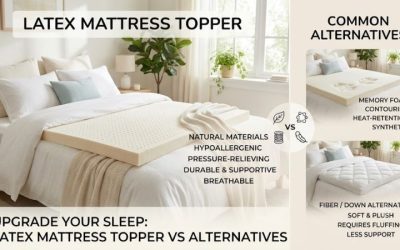
Finding the best latex mattress topper can help make an uncomfortable bed feel more inviting without replacing the entire mattress. Whether you need softer cushioning, responsive support, or a more breathable sleep surface, these six latex toppers offer different combinations of firmness, thickness, materials, and practical features.
Quick Verdict: Which Latex Mattress Topper Should You Buy?
The Sleep On Latex Pure Green Natural Latex Mattress Topper is our best overall recommendation because its three thickness choices, three firmness options, and optional covers give shoppers considerable flexibility. Its published foam firmness measurements also help buyers compare configurations more meaningfully.
For other needs, several alternatives stand out:
-
Best Overall: Sleep On Latex Pure Green Natural Latex Mattress Topper — versatile thickness and firmness configurations with detailed published specifications.
-
Best for Firmness Customization: PlushBeds Organic Latex Mattress Topper — particularly useful for shoppers who want more firmness choices, including extra-firm options.
-
Best for Zoned Comfort: Turmerry Organic Latex Mattress Topper — features a seven-zone Dunlop latex design and multiple thickness configurations.
-
Best for a Plush Surface: Birch Plush Organic Mattress Topper — a convenient two-inch comfort upgrade with organic latex and cotton.
-
Best for a Certified Organic Construction: Naturepedic Adagio Organic Latex Mattress Topper — a complete two-inch topper featuring an organic cotton encasement and multiple material certifications.
-
Best Flexible Alternative: Latex For Less Natural Latex Mattress Topper — offers two thicknesses, three firmness choices, and an optional cotton cover.
These selections reflect construction, available configurations, and practical suitability rather than independently measured comfort rankings. The right choice still depends on the condition of your existing mattress, your sleep position, and how much you want its feel to change.
Quick Comparison Table: 6 Best Latex Mattress Toppers
| Product | Best For | Key Specifications | Main Advantage | Trade-Off |
|---|---|---|---|---|
| Sleep On Latex Pure Green | Overall versatility | 1″, 2″, 3″; soft, medium, firm; organic latex | Broad thickness range and published firmness data | Cover costs extra |
| PlushBeds Organic Latex | Firmness customization | 2″, 3″; organic Dunlop latex; multiple firmness options | Includes very firm configurations | Exact firmness selection requires care |
| Turmerry Organic Latex | Zoned cushioning | 2″, 3″, 4″ configurations; seven-zone Dunlop latex | Zoned design and thicker options | Zones may not align equally with every body |
| Birch Plush Organic | Plush comfort | 2″ organic latex comfort layer; organic cotton | Simple cushioned design | Limited firmness customization |
| Naturepedic Adagio Organic | Complete organic construction | 2″ GOLS organic latex; GOTS organic cotton | Included encasement and extensive certifications | One thickness configuration |
| Latex For Less Natural Latex | Adjustable comfort | 2″, 3″; soft, medium, medium-firm | Straightforward firmness and thickness selection | No 1″ option |
Specifications represent manufacturer-published product configurations, not independent performance measurements. Cover options, return policies, and other purchase terms should be checked for the exact configuration.
How We Selected the Best Latex Mattress Toppers
Our selections prioritize identifiable latex topper products with published information about their construction, available configurations, and suitability for different sleeping preferences.
We focused on six evaluation factors.
Latex construction: Natural and certified organic latex products received consideration because material composition is a central purchasing factor. We distinguished latex foam from accompanying cotton covers and other components.
Firmness selection: We considered whether shoppers can choose between soft, medium, firm, or additional comfort levels. A topper with more choices can be easier to match to an existing mattress, although firmness labels are not standardized between brands.
Thickness options: Products offering different thicknesses can accommodate both minor comfort adjustments and more substantial changes to surface cushioning.
Practical comfort: We evaluated how published construction features may influence responsiveness, body contouring, mobility, and the sensation of sleeping on top of the mattress rather than deeply within it.
Material documentation: We considered relevant manufacturer-reported certifications, including GOLS, GOTS, GREENGUARD Gold, and OEKO-TEX STANDARD 100, while recognizing that these standards verify different characteristics.
Everyday usability: We examined cover availability, cleaning requirements, mattress compatibility, and the limitations of using a topper over an existing bed.
The recommendations are research-based editorial assessments. They do not represent personal ownership, laboratory testing, measured cooling results, or verified long-term durability comparisons.
Detailed Reviews: The 6 Best Latex Mattress Toppers
1. Sleep On Latex Pure Green Natural Latex Mattress Topper — Best Overall
Best For: Side, back, and combination sleepers seeking a customizable latex topper without committing to one predetermined firmness or thickness.
Why We Picked It
The Sleep On Latex Pure Green stands out for its straightforward configuration system. Buyers can choose among one-, two-, and three-inch thicknesses, along with soft, medium, and firm latex.
Unlike products that rely exclusively on subjective firmness descriptions, Sleep On Latex publishes indentation force deflection measurements for its foam. These measurements provide more specific information about resistance to compression, although they cannot predict an individual’s sleeping comfort.
Key Specifications
| Feature | Details |
|---|---|
| Material | GOLS-certified organic natural latex |
| Thickness | 1, 2, or 3 inches |
| Firmness | Soft, medium, firm |
| Construction | Solid latex foam |
| Cover | Optional organic cotton cover |
| Sizes | Twin, Twin XL, Full, Queen, King, California King |
| Reported certifications | GOLS, GOTS for applicable covered configurations, OEKO-TEX STANDARD 100 |
Features & Benefits
The one-inch version is useful when a mattress needs only a subtle surface adjustment. A two-inch version provides more noticeable cushioning while preserving much of the underlying mattress’s character.
The three-inch configuration produces a larger comfort change. It can be particularly relevant when a firm mattress leaves a side sleeper feeling excessive pressure around the shoulders or hips.
The optional cover provides a separate protective layer. Buyers can select a covered configuration or use the latex beneath appropriate bedding.
Performance & Practical Use
Natural latex compresses under body weight and rebounds relatively quickly. This responsiveness can make repositioning easier than on some slow-response memory foams.
The soft option provides greater surface cushioning, while medium and firm configurations resist compression more strongly.
However, a firm topper cannot reliably repair a sagging mattress. The support and shape of the underlying mattress remain important.
What Makes It Different
Its combination of three thicknesses, three firmness levels, optional covers, and manufacturer-published foam firmness measurements makes this one of the most configurable products in the roundup.
Pros
-
Three thicknesses accommodate different levels of adjustment.
-
Published compression-resistance measurements add useful specification detail.
-
Organic latex with optional organic cotton covers.
Cons
-
A cover requires an additional purchase.
-
An uncovered latex slab needs careful handling and protection.
Buy If: You want to fine-tune an otherwise supportive mattress and prefer meaningful choices in thickness and firmness.
Skip If: You want an integrated, quilted pillow-top feel or expect a topper to correct major mattress sagging.
2. PlushBeds Organic Latex Mattress Topper — Best for Firmness Customization
Best For: Shoppers who want particularly detailed control over firmness, including those who prefer a noticeably firmer sleeping surface.
Why We Picked It
PlushBeds offers an organic Dunlop latex topper with two thickness options and a wide firmness selection.
The manufacturer lists soft, medium-soft, medium, firm, and extra-firm choices in its product configuration. This range makes it useful for buyers whose preferences fall outside a typical soft-medium-firm lineup.
Key Specifications
| Feature | Details |
|---|---|
| Material | GOLS-certified organic Dunlop latex |
| Thickness | 2 or 3 inches |
| Firmness | Soft, medium-soft, medium, firm, extra-firm options |
| Cover | Optional organic cotton |
| Sizes | Twin, Twin XL, Full, Queen, King, California King |
| Reported certifications | GOLS, OEKO-TEX STANDARD 100, GREENGUARD Gold |
Features & Benefits
The range of firmness options is the central advantage.
A soft configuration may help someone whose existing mattress feels excessively rigid. Medium and firmer configurations can suit people looking for responsive cushioning without creating a deeply plush surface.
The two-inch configuration provides a moderate adjustment, while the three-inch option allows more of the latex layer to influence how the bed feels.
An optional organic cotton cover adds protection without requiring a completely different topper model.
Performance & Practical Use
Dunlop latex is resilient and responds quickly when compressed. This makes it a reasonable material for people who dislike the delayed recovery associated with certain memory foam products.
Still, the firmness of the latex does not independently determine overall spinal support. A firm topper placed over a significantly sagging mattress will follow some of the shape beneath it.
The extra-firm configuration may be useful for sleepers who specifically prefer a resistant surface, but it could create uncomfortable pressure for someone needing greater cushioning.
What Makes It Different
PlushBeds offers more finely divided firmness choices than several alternatives in this roundup.
Pros
-
Broad selection of firmness configurations.
-
Choice of two- or three-inch thickness.
-
Multiple documented material certifications.
Cons
-
Numerous firmness choices may complicate selection.
-
Optional covers increase the total purchase cost.
Buy If: You already have a clear preference for latex firmness and want options beyond basic soft, medium, and firm.
Skip If: You prefer a simpler purchasing process or want a topper with a permanently integrated quilted comfort layer.
3. Turmerry Organic Latex Mattress Topper — Best for Zoned Comfort
Best For: Sleepers interested in a zoned latex surface and shoppers seeking configurations thicker than the usual two or three inches.
Why We Picked It
Turmerry distinguishes its organic latex topper through a seven-zone design.
The manufacturer describes different regions of the topper intended to provide varied cushioning across the body. Its range also includes a four-inch, dual-layer configuration that can be flipped to change the surface feel.
Key Specifications
| Feature | Details |
|---|---|
| Material | Organic Dunlop latex |
| Design | Seven-zone, perforated construction |
| Thickness | 2, 3, or 4 inches |
| Firmness | Multiple choices, including soft, medium, firm, and extra-firm on applicable configurations |
| Four-inch version | Dual-layer, flippable soft/medium arrangement |
| Cover | Optional for certain configurations; included with the four-inch version |
| Reported material standards | GOLS and other manufacturer-listed testing and sourcing standards |
Features & Benefits
The zoning system is intended to vary how different parts of the topper compress.
This may appeal to someone who wants a more structured latex comfort layer rather than a uniformly configured slab.
The four-inch option is particularly distinctive. It combines two separate two-inch latex layers within one cover, giving buyers two surface-feel arrangements.
Perforations in the foam provide pathways through the material for ventilation. Actual sleeping temperature will also depend on sheets, mattress construction, bedding, and room conditions.
Performance & Practical Use
Zoned construction is not automatically better for every sleeper.
People with different heights, body proportions, or sleeping positions may contact the zones differently. A body area intended to receive additional cushioning might not line up perfectly for everyone.
The four-inch configuration also raises the total bed height more substantially than thinner options. This can create issues with fitted-sheet depth, mattress protectors, or an already tall bed.
Its flippable arrangement adds useful flexibility, but it does not replace the underlying mattress’s structural support.
What Makes It Different
Turmerry combines zoned latex construction with relatively thick configurations, including a dual-layer option.
Pros
-
Seven-zone latex design.
-
Two-, three-, and four-inch options.
-
Flippable comfort arrangement on the four-inch model.
Cons
-
Zoned areas may not align equally well with every sleeper.
-
Thicker configurations require deeper bedding and add more bed height.
Buy If: You are specifically interested in zoned cushioning or want a thicker latex configuration with adjustable surface feel.
Skip If: You prefer uniform foam firmness across the entire mattress or want only a minimal height increase.
4. Birch Plush Organic Mattress Topper — Best for Plush Comfort
Best For: Sleepers who want to add a softer-feeling organic latex comfort layer without comparing numerous firmness configurations.
Why We Picked It
The Birch Plush Organic Mattress Topper provides a two-inch organic latex comfort layer with organic cotton.
Its purpose is straightforward: add surface cushioning to an existing mattress while retaining the responsive characteristics of latex.
Key Specifications
| Feature | Details |
|---|---|
| Primary material | GOLS-certified organic latex |
| Additional material | Organic cotton |
| Comfort layer | Approximately 2 inches |
| Feel | Plush-oriented design |
| Construction | Organic latex with cotton covering |
| Reported certifications | GOLS, GREENGUARD Gold |
Features & Benefits
The Birch topper emphasizes plush comfort instead of a wide selection of foam firmness levels.
Its latex layer offers compression and rebound, while the cotton contributes to the surface construction.
For shoppers who find their mattress supportive but uncomfortably firm at the top, this design may provide the additional cushioning they are seeking.
The two-inch profile is also easier to accommodate than a particularly thick four-inch topper, although sheet depth still needs to be checked.
Performance & Practical Use
The Birch is best understood as a surface-comfort adjustment.
It may make a firm mattress more comfortable for someone who experiences pressure at prominent body areas. However, its two-inch comfort layer cannot substantially change the support characteristics of a mattress with damaged or collapsed internal components.
The absence of a broad firmness selection is a practical limitation. Someone who wants a firmer latex topper may be better served by Sleep On Latex or PlushBeds.
What Makes It Different
Rather than offering several versions of an exposed latex slab, Birch focuses on a complete topper design intended for plush cushioning.
Pros
-
Two-inch organic latex comfort layer.
-
Organic cotton construction.
-
Straightforward configuration for softening a firm mattress.
Cons
-
Limited firmness personalization.
-
Not ideal for buyers looking to create a distinctly firm surface.
Buy If: Your mattress remains supportive but you want a more cushioned sleeping surface.
Skip If: You need firm or extra-firm latex, substantial thickness customization, or a solution for a visibly sagging mattress.
5. Naturepedic Adagio Organic Latex Mattress Topper — Best Complete Organic Construction
Best For: Buyers who prioritize documented organic materials, an included fabric encasement, and a relatively modest two-inch comfort adjustment.
Why We Picked It
The Naturepedic Adagio combines a solid layer of GOLS-certified organic latex with a GOTS-certified organic cotton encasement.
It also carries additional manufacturer-listed certifications, including MADE SAFE and GREENGUARD Gold.
This makes it especially relevant to buyers interested in documented material standards rather than selecting individual foam and cover components.
Key Specifications
| Feature | Details |
|---|---|
| Latex | GOLS-certified organic latex |
| Thickness | 2 inches |
| Cover | GOTS-certified organic cotton encasement |
| Construction | Solid perforated latex |
| Sizes | Twin, Twin XL, Full, Queen, King, California King |
| Reported certifications | GOLS, GOTS, MADE SAFE, GREENGUARD Gold |
| Care | Spot clean only |
Features & Benefits
The organic cotton encasement is included as part of the topper rather than offered as a separate upgrade.
The latex features perforations that provide pathways for air movement within the foam. These support the breathable construction concept, although they do not establish a particular temperature reduction.
Its solid latex layer provides a consistent surface without the loose filling associated with some fiber-filled mattress toppers.
The two-inch design can produce a noticeable comfort adjustment without dramatically increasing bed height.
Performance & Practical Use
The Adagio is appropriate for someone who wants more cushioning while preserving the fundamental support of an existing mattress.
Its responsive construction can provide a different movement experience from slow-response memory foam.
One important limitation is maintenance: Naturepedic specifies spot cleaning rather than machine washing. Buyers should use appropriate bedding protection and follow the manufacturer’s care instructions.
What Makes It Different
The combination of included organic cotton encasement, certified latex, and extensive material documentation distinguishes the Adagio from simpler uncovered latex toppers.
Pros
-
Organic latex and organic cotton encasement.
-
Several named certification programs.
-
Complete two-inch topper design without requiring a separate cover purchase.
Cons
-
Limited thickness and firmness selection.
-
Spot-clean-only care requires attention to spills.
Buy If: Certified materials and a complete covered construction matter more to you than extensive customization.
Skip If: You need a three-inch topper, prefer a firmer selectable latex configuration, or want machine-washable entire-topper care.
6. Latex For Less Natural Latex Mattress Topper — Best Flexible Alternative
Best For: Buyers who want a traditional latex topper with multiple comfort configurations and an optional organic cotton cover.
Why We Picked It
Latex For Less provides a straightforward alternative to more complicated product ranges.
Its Natural Latex Mattress Topper uses GOLS-certified organic latex and is offered in two thicknesses and three firmness options.
The available soft, medium, and medium-firm configurations make it relevant to shoppers seeking additional cushioning or a more balanced surface feel.
Key Specifications
| Feature | Details |
|---|---|
| Material | GOLS-certified organic latex |
| Thickness | 2 or 3 inches |
| Firmness | Soft, medium, medium-firm |
| Cover | Optional GOTS-certified organic cotton |
| Sizes | Twin, Twin XL, Full, Queen, King, California King |
| Construction | Natural latex foam |
Features & Benefits
The two-inch version suits shoppers looking for a moderate adjustment to an otherwise functional mattress.
The three-inch option provides more latex between the sleeper and the mattress, allowing the topper to exert a greater influence on surface comfort.
Firmness selection offers further flexibility.
The soft configuration is worth considering when pressure cushioning is the main goal. Medium and medium-firm options may be more appropriate for shoppers who want a less plush, more resistant surface.
Performance & Practical Use
Natural latex responds quickly to movement and offers a buoyant feel that differs from slow-recovery memory foam.
The outcome depends on the selected firmness and the mattress underneath.
Someone who already has a very soft mattress should not assume the medium-firm version will restore the support of a new mattress. Likewise, a thick, soft topper can allow more compression than a stomach sleeper finds comfortable.
Buyers should distinguish between the foam’s firmness and the support supplied by the complete bed.
What Makes It Different
Latex For Less provides a conventional, configurable organic latex topper without adding features such as zoning or dual-layer construction.
Pros
-
Two thicknesses and three firmness choices.
-
GOLS-certified organic latex.
-
Optional organic cotton cover.
Cons
-
No one-inch configuration for very minor comfort adjustments.
-
No extra-firm option in the listed range.
Buy If: You want a simple latex topper with enough configuration options to accommodate different preferences.
Skip If: You need extra-firm latex, an integrated pillow-top design, or a one-inch comfort layer.
Buying Guide: How to Choose the Best Latex Mattress Topper
Selecting a latex topper is less about identifying one universally superior brand and more about matching the topper to the mattress you already own.
Choose the Right Thickness: 1, 2, 3, or 4 Inches
Thickness determines how much additional material separates you from the existing mattress.
| Thickness | Typical Use | Main Trade-Off |
|---|---|---|
| 1 inch | Minor surface adjustment | Limited ability to change comfort |
| 2 inches | Moderate cushioning or firmness adjustment | Existing mattress remains influential |
| 3 inches | More substantial change to surface feel | Greater height and risk of excessive softness |
| 4 inches | Major comfort-layer adjustment | More bulk, weight, and bedding compatibility concerns |
A one-inch topper is often best for someone who generally likes the mattress but wants a subtle adjustment.
Two inches can be a useful starting point for sleepers who need additional comfort without substantially changing bed height.
Three inches may suit sleepers who need more cushioning, particularly when a firm mattress creates uncomfortable contact pressure.
Four inches changes the sleeping surface more substantially. That does not automatically make it more supportive or comfortable.
For most buyers with a structurally sound mattress, a two- or three-inch topper is a sensible range to investigate first.
Match Firmness to Your Sleeping Position
Sleep position influences which body regions apply pressure to the mattress and how deeply different areas compress.
| Sleeping Position | Starting Firmness to Consider | Main Consideration |
|---|---|---|
| Side sleeper | Soft to medium | Shoulder and hip cushioning |
| Back sleeper | Medium to medium-firm | Balanced contouring and support |
| Stomach sleeper | Medium-firm to firm | Avoiding excessive pelvic sink |
| Combination sleeper | Medium | Movement and position flexibility |
These are starting points, not universal rules.
A lightweight side sleeper may need a softer latex layer because their body compresses the material less deeply. Someone with greater body weight may prefer a configuration with more resistance or additional thickness.
The firmness of the existing mattress also matters. A soft topper over a very firm mattress may feel different from the same topper placed on a medium mattress.
Important: Firmness labels are brand-specific. A “medium” topper from one manufacturer is not necessarily equivalent to another manufacturer’s medium configuration.
Understand Dunlop vs. Talalay Latex
Dunlop and Talalay refer to different latex foam manufacturing processes.
Dunlop latex is formed through a process that includes foaming latex, pouring it into a mold, and vulcanizing it. It is commonly used in mattress comfort and support layers.
Talalay latex involves additional processing, including vacuum expansion and freezing before vulcanization. It can be manufactured in a range of firmness levels.
Both methods can produce soft or firm latex, and neither process alone determines the final sleeping experience.
A soft Dunlop topper may feel more comfortable to a particular sleeper than a firmer Talalay product, or vice versa.
The most useful comparisons involve the actual product’s firmness, thickness, composition, and construction rather than assuming one processing method is universally better.
All six products in this roundup are latex-based, with the reviewed options emphasizing natural or organic latex construction.
Natural Latex vs. Organic Latex: What Is the Difference?
Natural latex is derived from rubber tree sap.
However, the word “natural” on a product page does not, by itself, establish the exact percentage of natural rubber or confirm that every component is organic.
Organic latex certification adds requirements related to sourcing, processing, and manufacturing.
Buyers should distinguish among several commonly referenced standards:
| Certification | What It Addresses |
|---|---|
| GOLS | Organic latex content, processing, and related production requirements |
| GOTS | Organic textile materials and textile processing standards |
| GREENGUARD Gold | Chemical emissions evaluated against specified limits |
| OEKO-TEX STANDARD 100 | Testing of textile-related materials for specified harmful substances |
A certified latex core does not automatically mean every fabric or accessory in the finished product carries the same certification.
Certification also does not establish that a mattress topper will be comfortable for everyone, medically beneficial, or incapable of causing an allergic reaction.
For buyers who value documented sourcing and material testing, check the specific certified product or component rather than relying solely on broad advertising descriptions.
Consider Pressure Relief Without Sacrificing Alignment
Pressure relief and spinal support are related but different aspects of mattress comfort.
Pressure relief refers to how contact forces are distributed where the body touches the sleeping surface.
A softer latex layer can allow the shoulders and hips to sink farther into the bed. This can make a firm mattress feel less harsh to a side sleeper.
However, too much compression may allow the pelvis or torso to sink excessively, depending on sleeping position and the mattress underneath.
For back sleepers, a moderately responsive topper may provide a useful compromise between cushioning and resistance.
Stomach sleepers should be more cautious about adding thick, soft layers that may increase midsection sink.
A topper cannot guarantee spinal alignment, eliminate pain, or treat a medical condition. Persistent pain warrants appropriate clinical evaluation rather than relying on bedding changes alone.
Is a Latex Mattress Topper Good for Hot Sleepers?
Latex is a reasonable material to consider if you dislike the close-conforming sensation of some memory foam products.
Its responsive structure and the ventilation perforations found in certain models can support airflow within the comfort layer.
However, the material alone does not determine sleeping temperature.
Important factors include:
-
The topper’s construction and cover.
-
Mattress protector and sheet materials.
-
Room temperature and humidity.
-
Blanket and comforter insulation.
-
The ventilation characteristics of the mattress beneath it.
A perforated latex topper may be more breathable than a particular dense foam alternative, but this does not prove that it will sleep cooler in every household.
If overheating is a major concern, evaluate the entire bedding system rather than depending on a topper’s cooling claims.
Evaluate Motion Transfer and Ease of Movement
Latex generally returns to its original shape quickly after pressure is removed.
This responsiveness can make turning over and changing positions easier for sleepers who feel restricted by slow-response memory foam.
The trade-off is that latex’s springy character may transmit some movement across the sleeping surface.
Motion transfer also depends on the underlying mattress, bed frame, topper thickness, and whether movement reaches the other sleeper.
A responsive latex topper should not be assumed to outperform a memory foam topper in motion isolation without comparable measurements.
Couples who prioritize effortless repositioning may appreciate latex, while particularly motion-sensitive sleepers should consider how the whole mattress behaves.
Check Mattress Size and Bedding Compatibility
A topper should match the intended mattress dimensions rather than relying only on the size label.
Common US mattress dimensions are:
| Mattress Size | Nominal Dimensions |
|---|---|
| Twin | 38″ × 75″ |
| Twin XL | 38″ × 80″ |
| Full | 54″ × 75″ |
| Queen | 60″ × 80″ |
| King | 76″ × 80″ |
| California King | 72″ × 84″ |
Actual topper dimensions can vary slightly between manufacturers.
Measure the mattress before ordering, especially if it has unusual dimensions, rounded corners, or a nonstandard construction.
You should also check your fitted sheets.
For example, adding a three-inch topper to a 12-inch mattress creates a combined nominal height of approximately 15 inches before allowing for any protector or additional padding.
A fitted sheet that previously worked may no longer stay in place.
The mattress foundation must also remain appropriate for the existing mattress, and a topper should not be used to compensate for an unsuitable bed base.
For bunk beds and elevated beds, additional topper height can reduce the effective safety height of guardrails. Follow the bed manufacturer’s mattress-height restrictions rather than assuming a topper will fit safely.
Understand Latex Topper Weight and Handling
Latex foam can be relatively heavy and flexible compared with thin fiber-filled mattress pads.
Thicker and larger toppers may require two people to position neatly, especially when moving them onto a king-size bed.
Because latex is flexible, dragging or pulling forcefully on a small section can stretch or damage the foam.
Support a broad area of the topper when moving it and follow the manufacturer’s unpacking and handling instructions.
Latex toppers also need appropriate protection from moisture, spills, and prolonged exposure to damaging environmental conditions.
Should You Choose a Topper With a Cover?
A cover can help protect latex from direct contact with body oils, dirt, and routine bedding wear.
It may also make handling the topper easier.
However, not all covers are machine washable, and removing or reinstalling a tight-fitting cover can be difficult.
Check whether the selected model includes:
-
A removable cover.
-
A machine-washable component.
-
An organic cotton fabric.
-
A zipper or other access method.
-
Specific washing or spot-cleaning instructions.
Do not put an entire latex foam slab in a washing machine unless its manufacturer explicitly authorizes that procedure.
For uncovered latex, a compatible mattress protector may be a practical addition. A highly impermeable protector, however, may change the surface feel and ventilation characteristics.
When Should You Replace the Mattress Instead?
A latex topper is most useful when the mattress remains structurally sound but has an uncomfortable surface feel.
It is less likely to solve problems caused by:
-
Deep sagging or permanent body impressions.
-
Broken or collapsed internal support components.
-
Significant edge collapse.
-
Persistent moisture damage.
-
An unsuitable or damaged foundation.
If the mattress has developed a pronounced dip, the topper will tend to conform partly to that depression.
A thicker or firmer topper may temporarily change the sensation, but it cannot restore the original support structure.
When the underlying support system is failing, mattress replacement is generally the more appropriate long-term solution.
Frequently Asked Questions
1. What Is the Best Latex Mattress Topper for Side Sleepers?
A soft, two- or three-inch latex topper is a reasonable starting point for side sleepers who find their mattress too firm.
The Sleep On Latex Pure Green offers both soft and multiple thickness options, making it especially adaptable.
PlushBeds and Latex For Less also offer soft latex configurations.
The ideal thickness depends on body weight, shoulder and hip pressure, and how firm the mattress already feels.
2. Is a 2-Inch or 3-Inch Latex Mattress Topper Better?
A two-inch topper is usually more appropriate when you want a moderate comfort adjustment while retaining much of the underlying mattress’s feel.
A three-inch topper creates a larger comfort-layer change and may suit sleepers who need more cushioning.
Neither thickness is universally better. A soft three-inch topper can be too plush for some sleepers, while a firmer two-inch topper may provide a more comfortable balance.
3. Can a Latex Mattress Topper Make a Soft Mattress Firmer?
A firm latex topper can change the immediate surface feel of a mattress, but it cannot reliably correct a weakened or sagging support system.
If the mattress is structurally sound but its comfort layer feels slightly too soft, a firmer topper may be worth considering.
If the mattress has developed deep body impressions or substantial internal deterioration, replacing it is usually more effective.
4. How Long Does a Latex Mattress Topper Last?
The usable life of a latex topper depends on its foam formulation, construction, thickness, usage, environment, and care.
Natural latex is known for its resilience, but that does not establish a guaranteed lifespan for a specific topper.
Avoid assuming every latex topper will last a certain number of years. Monitor for permanent indentations, cracking, substantial softening, or changes that reduce sleeping comfort.
Manufacturer warranty terms should not be treated as a direct prediction of usable life.
5. Are Latex Mattress Toppers Safe for People With Latex Allergies?
People with known or suspected latex allergies should not assume natural latex bedding is safe simply because the latex is covered or certified organic.
Exposure risks vary with the individual’s sensitivity and the product’s construction.
Someone with a diagnosed latex allergy should seek guidance from an appropriate healthcare professional before using a latex topper. A non-latex material may be the more appropriate choice.
6. How Do You Clean a Latex Mattress Topper?
Cleaning requirements differ by product.
Generally, latex foam should be protected from unnecessary saturation, harsh cleaning chemicals, and excessive heat.
For a small spill, follow the manufacturer’s instructions for localized cleaning and allow the affected area to dry completely before replacing bedding.
Removable covers should be washed only according to their care labels.
For example, Naturepedic specifies spot cleaning for the Adagio, while Sleep On Latex provides different care guidance depending on the selected cover.
A compatible mattress protector can help reduce how often the foam itself requires cleaning.
Conclusion
The Sleep On Latex Pure Green Natural Latex Mattress Topper is the best overall choice for shoppers seeking versatile thickness and firmness options, while PlushBeds is particularly appealing for firmness customization and Turmerry for zoned construction. Birch and Naturepedic offer more complete organic comfort designs, and Latex For Less provides another flexible alternative. Choose according to your sleep position, existing mattress firmness, desired cushioning, and bedding compatibility. A well-matched latex topper can improve surface comfort, but it should complement a supportive mattress rather than substitute for one that needs replacing.