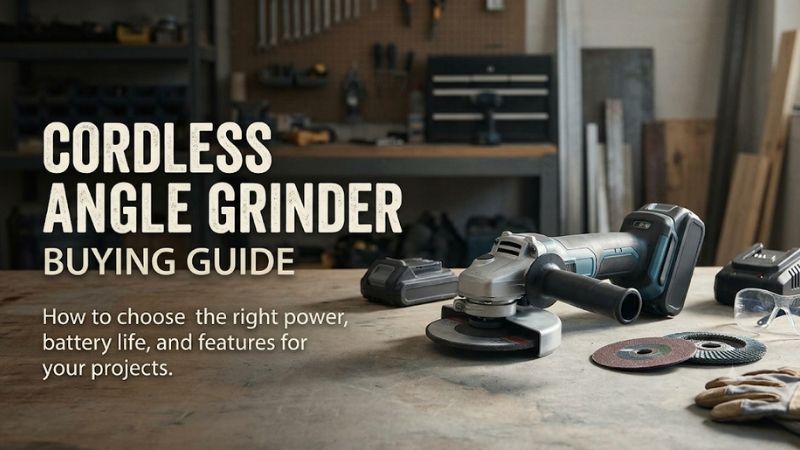
This cordless angle grinder buying guide explains how to choose the right grinder for cutting metal, removing rust, preparing welds, and completing garage repairs. Wheel diameter, motor performance, battery capacity, guard configuration, switch design, and electronic protection all influence usability. Understanding these features helps buyers select an appropriate tool without sacrificing safety.
What Should You Look for in a Cordless Angle Grinder?
The most important consideration is the work you intend to perform.
A homeowner removing surface rust occasionally may need a basic 4-1/2-inch grinder.
A frequent metalworker may benefit from a brushless model with electronic braking, kickback-related protection, and a suitable high-output battery.
A user working in restricted locations may prefer a specialized 4-inch or flathead grinder.
The correct tool must also support the intended accessories.
A grinder suitable for surface grinding may require a different guard configuration before it can perform cutting operations.
The major selection factors are wheel diameter, spindle compatibility, no-load RPM, power system, switch behavior, guard requirements, and total operating weight.
Safety-related features should receive substantial attention because wheel breakage and kickback can cause severe injuries.
Understand How Cordless Angle Grinders Work
Rotational Grinding Action
An angle grinder uses a motor and gearbox to rotate an abrasive wheel or other compatible accessory at high speed.
The rotating accessory removes or cuts material through abrasion or another approved cutting action.
This makes angle grinders useful for metal preparation, weld cleanup, rust removal, and certain cutting applications.
However, different operations require different accessories.
A wheel intended for grinding should not automatically be used for cutting.
How the Gearbox Affects Performance
The motor drives a gear assembly that changes the direction of rotation and transfers power to the spindle.
Gear design influences torque delivery, efficiency, and durability.
However, a particular gearbox material or configuration does not guarantee superior performance.
Actual capability depends on the complete tool design.
Why Cordless Power Is Useful
Cordless grinders eliminate the need for an electrical cable.
This is useful for mobile repairs, outdoor work, and locations without convenient outlets.
However, battery capacity limits operating time.
Demanding grinding operations can consume energy rapidly.
Limitations of Cordless Grinders
Cordless grinders require compatible batteries and chargers.
Battery size affects operating weight.
Some models may reduce output when battery charge becomes low or operating temperature increases.
For prolonged continuous grinding, a corded tool may be more practical.
Choose the Correct Wheel Diameter
4-Inch Grinders
A 4-inch grinder is useful for certain restricted-space applications.
Its smaller wheel can help with access.
However, cutting depth and accessory availability may be limited.
Check the exact tool’s mounting interface and required speed ratings.
4-1/2-Inch Grinders
The 4-1/2-inch format is common for home garage applications.
It supports a wide range of appropriate grinding and cutting accessories.
This makes it a practical starting size for many buyers.
However, wheel size alone does not establish output.
5-Inch Grinders
Some cordless models support 5-inch wheels.
This can provide greater flexibility for certain tasks.
However, larger wheel diameter may increase tool bulk and affect access.
The correct guard must be used.
6-Inch Grinders
Larger cordless models may support 6-inch accessories.
These can be useful for demanding cutting and grinding applications.
However, they generally require more operating space and may be heavier.
7-Inch and Larger Grinders
Large grinders are specialized tools for demanding applications.
They require substantial control and appropriate safety equipment.
Most homeowners do not need such large wheels for routine garage maintenance.
Understand RPM Ratings
What RPM Means
RPM refers to revolutions per minute.
A grinder rated at 9,000 RPM can rotate its spindle up to that specified speed under no-load conditions.
However, this does not directly measure cutting capability.
Why Higher RPM Is Not Always Better
Cutting and grinding performance depends on wheel design, motor output, material resistance, and feed pressure.
A lower-speed grinder may perform well with suitable gearing and sufficient power.
Higher RPM also increases the importance of accessory speed compatibility.
Wheel Speed Ratings
Every wheel has an approved maximum operating speed.
The wheel’s rating must be compatible with the grinder.
Never install an accessory rated below the required operating speed.
Variable-Speed Grinders
Variable speed can be useful for specialized surface-preparation accessories.
However, reducing speed does not automatically make every accessory suitable.
Follow the wheel and grinder manufacturers’ instructions.
Compare Brushed and Brushless Motors
Brushed Motor Design
Brushed motors use carbon brushes to transfer electrical current during operation.
They can provide useful capability at relatively accessible prices.
However, brushes wear.
Brushless Motor Design
Brushless motors use electronic commutation.
They eliminate conventional brush wear and can improve efficiency.
Many higher-end cordless grinders use brushless technology.
Does Brushless Mean More Power?
Not necessarily.
Actual performance depends on motor design, battery delivery, electronics, and gearing.
A brushless label does not establish cutting speed.
Which Should You Buy?
For occasional light work, a brushed grinder may be adequate.
For frequent demanding applications, a brushless model may justify additional investment.
Evaluate Battery Voltage and Capacity
18V and 20V MAX Systems
Some systems use nominal 18V ratings, while others advertise 20V MAX.
These labels do not necessarily indicate fundamentally different battery voltage classes.
For example, 20V MAX systems may use nominal 18V battery packs.
However, platform compatibility remains manufacturer-specific.
Higher-Voltage Systems
Certain cordless grinders use higher-voltage platforms intended for demanding applications.
These can support substantial output.
However, they may require larger or more expensive batteries.
Choose according to workload.
Battery Capacity
Battery capacity is commonly expressed in amp-hours.
Higher capacity generally provides more stored charge within the same voltage class.
However, power delivery also depends on cell design and electronics.
Battery Power Delivery
Some grinders achieve their highest advertised performance only with specified high-output packs.
A smaller compatible battery may not reproduce the same results.
Check the manufacturer’s recommended battery configurations.
Battery Runtime
Runtime varies with grinding pressure, wheel type, material, temperature, and battery capacity.
A single advertised number of cuts per charge does not apply to every application.
Battery Weight
Large packs can increase operating weight and affect balance.
This matters during overhead or prolonged work.
Choose a suitable battery configuration that allows secure control.
Understand Switch Types
Paddle Switches
Paddle switches require deliberate activation.
Certain designs stop the motor when the operator releases pressure.
This can be useful for users who prefer no-lock operation.
Slide Switches
Slide switches may support lock-on operation.
This can reduce continuous finger pressure during certain tasks.
However, the operator must remain able to shut the tool down immediately.
Trigger-Grip Switches
Some grinders use trigger-style controls integrated into a rear handle.
These can provide different ergonomic characteristics.
Choose according to the approved operating grip and intended work.
Switch Lock-Off Features
Lock-off mechanisms are designed to reduce accidental activation.
Understand their operation before using the tool.
They do not replace disconnecting the battery during maintenance.
Understand Electronic Braking
How an Electronic Brake Works
An electronic brake uses motor-control circuitry to reduce wheel rotation after the switch is released.
This can reduce stopping time.
However, actual stopping behavior depends on the tool and accessory.
Why Braking Matters
A grinder wheel can continue rotating after power is removed.
During this period, accidental contact remains possible.
Rapid braking can reduce the waiting interval.
However, the wheel must stop completely before the tool is set down.
Braking Is Not Kickback Prevention
An electronic brake and kickback-detection system are different features.
A brake primarily addresses wheel stopping.
Kickback-related electronics may respond to certain bind-up conditions.
Some grinders combine both.
Understand Kickback and Bind-Up Protection
What Causes Kickback?
Kickback can occur when a rotating wheel becomes pinched, jammed, or suddenly stalled.
The resulting reaction can move the grinder unexpectedly.
Electronic Clutches
Some grinders incorporate electronic systems that detect rapid changes associated with certain stalls.
They may shut down the motor.
However, no system can prevent every kickback event.
Anti-Rotation Systems
Certain compact grinders use electronic anti-rotation features intended to respond to bind-up.
These can provide additional control.
However, safe cutting technique remains essential.
Correct Cutting Technique
Maintain wheel alignment.
Support the workpiece so the kerf remains open.
Avoid twisting a cut-off wheel.
Never force the tool through material.
Choose the Correct Guard
Grinding Guards
Grinding guards are designed for approved grinding accessories.
They help protect the operator from certain fragments and accidental contact.
The correct configuration depends on the tool and wheel.
Cutting Guards
Cut-off operations may require a different or additional guard.
Follow the grinder manufacturer’s instructions.
Do not assume the supplied grinding guard is sufficient.
Guard Adjustment
Some models allow tool-free adjustment.
This can improve convenience.
However, the guard must lock securely in the correct position.
Never Remove the Guard
Removing the guard exposes the operator to severe hazards.
If a guarded grinder cannot reach the workpiece, choose another tool or change the work setup.
Understand Spindle and Accessory Compatibility
Threaded Spindles
Many US-market small angle grinders use a 5/8-inch-11 spindle.
However, mounting requirements vary.
Check the exact model.
Flanges and Locknuts
Conventional grinding accessories may use mounting flanges and locknuts.
These components must be installed according to the manufacturer’s instructions.
Do not improvise with unsuitable hardware.
X-LOCK Systems
Bosch X-LOCK grinders use a dedicated accessory interface.
This can simplify wheel changes.
However, conventional threaded accessories may not be compatible.
Wheel Diameter and Arbor
A wheel with the correct outside diameter may still have an incompatible arbor.
Confirm both dimensions.
Accessory Speed Rating
Every wheel must be rated for the grinder’s speed.
This is a critical safety requirement.
Choose the Right Grinding Accessories
Depressed-Center Grinding Wheels
These are used for specified surface-grinding applications.
They must be operated at appropriate contact angles.
Cut-Off Wheels
Cut-off wheels are designed for cutting rather than side grinding.
Thin wheels should never be subjected to prohibited lateral loads.
Flap Discs
Flap discs are useful for certain weld blending and surface-finishing operations.
Select appropriate abrasive grit and disc construction.
Wire Wheels
Wire accessories are useful for rust and coating removal.
They can release wires and particles.
Use appropriate protection and compatible guards.
Diamond Accessories
Certain diamond wheels are designed for approved masonry applications.
However, not every angle grinder supports every masonry cutting operation.
Dust control and guard requirements are especially important.
How to Match a Grinder to Common Projects
Rust Removal
Choose an approved wire or abrasive accessory.
Avoid unnecessarily aggressive material removal.
Protect surrounding surfaces.
Weld Preparation
Use appropriate grinding accessories and follow fabrication requirements.
Avoid removing excessive base material.
Metal Cutting
Use an approved cut-off wheel with the correct guard.
Secure the workpiece and maintain wheel alignment.
Concrete Cutting
Verify that the tool supports the intended material and accessory.
Use appropriate dust extraction and respiratory protection.
Garage Equipment Repairs
Consider whether the component can be removed for safer work.
Protect nearby sensitive parts.
Automotive Repairs
Do not grind near fuel systems or other sensitive components without appropriate controls.
Follow vehicle service procedures.
Ergonomics and Handling
Tool Weight
Compare complete operating weight, including battery and wheel.
Heavy tools can increase fatigue.
Side Handles
Use the manufacturer-recommended auxiliary handle.
It helps control reaction forces.
Grip Diameter
A slim grip may improve comfort for some users.
However, grip preferences vary.
Tool Balance
Battery placement affects balance.
Evaluate the complete configuration.
Vibration
Grinding produces vibration that can affect comfort and exposure.
Choose appropriate tools and limit unnecessary prolonged use.
Common Buying Mistakes
Choosing Maximum RPM Alone
RPM does not establish cutting performance.
Evaluate the complete tool.
Ignoring Wheel Ratings
An incompatible wheel can fail catastrophically.
Check all relevant specifications.
Buying a Bare Tool Without Batteries
Calculate the complete system cost.
Choosing the Wrong Guard
Use the required guard for cutting or grinding.
Overlooking Switch Preferences
Choose a control system that supports secure operation.
Ignoring Dust and Sparks
Grinding creates fire and exposure hazards.
Plan the workspace accordingly.
Frequently Asked Questions
What size cordless angle grinder is best for home use?
A suitable 4-1/2-inch grinder is a practical starting point for many home garage applications.
Is brushless worth the extra cost?
It can be for frequent work because of efficiency and maintenance advantages. However, a suitable brushed model may be adequate for occasional use.
Is a paddle switch safer than a slide switch?
Switches have different operational characteristics. Neither eliminates grinding hazards. A no-lock paddle can be useful for certain users, but correct grip and technique remain essential.
Can a cordless grinder cut stainless steel?
Some grinders can cut suitable stainless steel using accessories specifically approved for that material and the tool.
Do all cordless grinders have electronic brakes?
No. Braking and electronic protection features vary by model.
Can I use a larger wheel for deeper cuts?
Only when the grinder manufacturer approves that wheel size and the required guard configuration. Never exceed the rated wheel capacity.
Conclusion
This cordless angle grinder buying guide recommends selecting a grinder according to wheel compatibility, intended material, battery system, and safety features. A 4-1/2-inch brushless grinder is versatile for many garage applications, while specialized 4-inch and larger models address different needs. Prioritize correct guards, appropriate accessory speed ratings, effective control, and realistic operating requirements over maximum advertised RPM.
More from Amazon
Programs that pair well with the guide above. Offers and eligibility are set by Amazon and may change.
Collect the home and kitchen items you want in one registry that guests can shop from.
Create a wedding registrySet up recurring deliveries of everyday items on eligible products. Terms and savings are set by Amazon.
Explore Subscribe & SaveFree shipping on eligible items, Prime Video and more. Eligible new members can start with a free trial.
Start a Prime free trialAudiobooks and podcasts to listen to on the go. Eligible new members can start with a free trial.
Try Audible freeAs an Amazon Associate we earn from qualifying purchases.