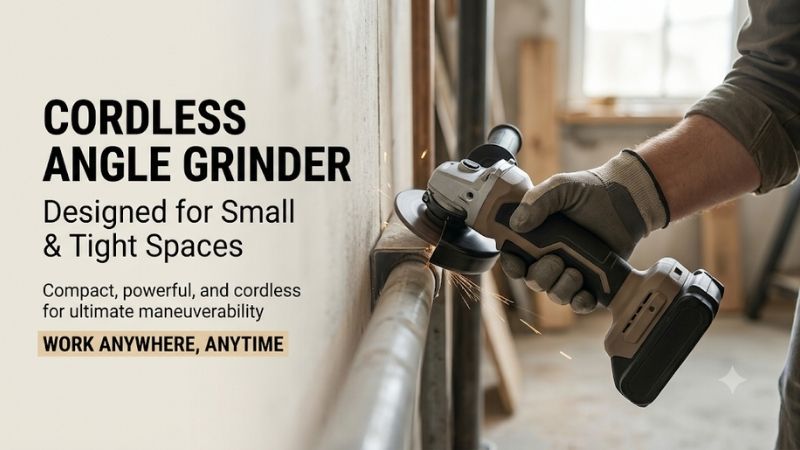
A cordless angle grinder for small spaces should provide enough cutting or grinding capability while allowing safe access to crowded mechanical assemblies. Compact head dimensions, wheel diameter, battery placement, switch location, and guard configuration all affect usability. This guide explains how to choose a grinder for restricted metalworking without compromising control or safety.
Quick Answer: What Makes an Angle Grinder Suitable for Tight Spaces?
The most suitable cordless angle grinder for restricted work combines a slim gear head, manageable battery configuration, appropriate wheel size, and controls that can be operated without changing to an unsafe grip.
A smaller wheel can improve access, but it also limits cutting depth and may require less common accessories.
For example, the DEWALT ATOMIC DCG400B uses a 4-inch wheel and a slim design intended for confined metalworking.
The Bosch GWX18V-8-2N is another relevant option because its compact housing and X-LOCK system can simplify accessory changes, although it uses a larger 4-1/2-inch wheel.
The Metabo HPT G18DSL2Q4 offers a relatively light conventional grinder layout with a 4-1/2-inch wheel.
However, tool dimensions alone do not establish suitability.
A grinder must have enough clearance for its guard, auxiliary handle, rotating wheel, operator’s hands, and the complete cutting path.
Never remove a guard, use an oversized wheel, or substitute an incompatible accessory simply to reach a fastener or metal component.
Understand the Different Types of Restricted Workspaces
Crowded Automotive Components
Vehicle repairs often involve metal brackets, exhaust components, suspension parts, and closely spaced mechanical assemblies.
An angle grinder may be useful for cutting a suitable metal component or removing corrosion when the operation is permitted by the repair procedure.
However, nearby wiring, fuel lines, rubber components, and brake hoses can make grinding hazardous.
The tool’s small size does not eliminate the risk of sparks, heat, or accidental contact.
Before using a grinder, determine whether the component can be removed and worked on away from the vehicle.
This is often safer than grinding directly inside a crowded mechanical assembly.
Narrow Fabrication Corners
Metal fabrication frequently requires access to inside corners, welded joints, and closely spaced structural members.
A slim-head grinder can improve reach in certain positions.
However, the wheel must contact the workpiece at an appropriate angle, and the operator must maintain the correct grip.
A conventional grinder may be suitable for open surfaces but difficult to control in a narrow recess.
In some situations, a die grinder or another specialized tool may be more appropriate.
The correct choice depends on the material, required finish, and available access.
Small Home Garages
A small garage may have limited floor space, narrow workbenches, and crowded storage.
Cordless grinders eliminate the need to route a power cable around equipment.
However, they still require adequate room for operator movement and workpiece support.
Grinding can generate sparks and hot particles that travel beyond the immediate cutting location.
Remove combustible materials and follow appropriate fire-prevention procedures.
Do not perform spark-producing work in an enclosed area containing flammable vapors.
Installed Metalwork
Installed railings, brackets, and other metal assemblies may create difficult cutting positions.
A compact grinder can sometimes provide access, but the workpiece must be secured.
Cutting may release stored mechanical loads or cause a section to move unexpectedly.
Before cutting, determine how the material is supported and what will happen when separation occurs.
For structural or safety-critical assemblies, follow an appropriate repair or fabrication plan.
Choose the Right Grinder Configuration
Compact 4-Inch Cordless Grinders
A 4-inch grinder can provide better access than a larger model when the gear head, guard, and housing are also designed for compact operation.
The DEWALT DCG400B illustrates this category.
Its slim design, 12,500 RPM no-load speed, and electronic brake are intended for controlled work in restricted locations.
However, a smaller wheel has less cutting reach.
The 4-inch format also requires accessories specifically compatible with the grinder’s mounting system and speed.
A 4-1/2-inch wheel must never be installed merely because the operator wants greater cutting depth.
4-1/2-Inch Cordless Grinders
A 4-1/2-inch grinder offers a useful combination of accessory availability and manageable dimensions.
This size is common for general metal grinding, surface preparation, and cutting suitable stock.
Models such as the DEWALT DCG413B and Metabo HPT G18DSL2Q4 are relevant.
However, the gear head and guard may prevent access to narrow recesses.
A 4-1/2-inch grinder is not automatically suitable for a confined space simply because it is categorized as a small angle grinder.
5-Inch-Capable Grinders
Certain cordless grinders support both 4-1/2-inch and 5-inch accessories.
The Milwaukee M18 FUEL 2880-20 and Makita XAG11Z are examples.
The larger capacity can be useful for varied open-access applications.
However, a larger wheel may require a different guard or reduce clearance around the workpiece.
When access is the priority, confirm whether the tool can use a smaller approved accessory and corresponding guard arrangement.
Flathead Angle Grinders
A flathead grinder uses a specially shaped gear housing intended to improve access to certain narrow angles.
The DEWALT DCG413FB is an example of a cordless flathead configuration.
Such tools can be useful for grinding in areas where a conventional gear head interferes with the workpiece.
However, a flathead design does not guarantee safe access to every inside corner.
The correct accessory and guard remain necessary.
Measure the Complete Working Clearance
Gear-Head Dimensions
The gear head is often the first component to interfere with a restricted work area.
Its thickness, shape, and position relative to the wheel determine how closely the tool can approach surrounding material.
Two grinders with the same wheel diameter may have substantially different head dimensions.
Check actual product drawings or physical dimensions when available.
The measurement should include the guard and installed accessory, not just the exposed housing.
Battery Clearance
The battery is usually mounted at the rear of a cordless grinder.
Large packs may interfere with walls, pipes, machinery, or nearby metal assemblies.
A smaller compatible battery may improve maneuverability.
However, reduced battery capacity can also affect runtime and sustained performance.
Use a battery approved for the grinder and suitable for the intended workload.
Do not use unauthorized adapters merely to change battery orientation.
Auxiliary Handle Position
Many angle grinders allow the side handle to be installed on either side of the housing.
The handle improves control and helps resist reaction forces.
However, it can also affect access.
Choose the approved handle position that provides the best control for the application.
Do not remove a required auxiliary handle merely to fit the grinder into a narrow opening.
Wheel Guard Clearance
The guard occupies space around part of the wheel.
It protects the operator from certain fragments and accidental contact.
The guard must be positioned according to the manufacturer’s instructions.
A restricted workspace that cannot accommodate the required guard is not suitable for that grinding configuration.
Consider another tool or disassembling the component for safer access.
Cutting Path
A grinder must be able to travel through the intended cut without the wheel becoming pinched.
The starting position alone is not enough.
Plan the entire wheel path and the movement of the separated material.
Avoid cutting arrangements where the kerf may close around the wheel.
Understand Wheel Size and Cutting Depth
Why a Smaller Wheel Helps Access
A smaller wheel can reduce the diameter of the cutting assembly.
This may allow the grinder to reach tighter locations.
However, actual access depends on the gear head, guard, and body.
A compact 4-inch grinder may fit better than a bulky 4-1/2-inch model.
But it may have less useful cutting depth.
Choose the smallest approved wheel configuration that satisfies the actual cutting requirement.
Cutting Depth Is Not Half the Wheel Diameter
A common purchasing mistake is assuming that a 4-inch grinder can cut two inches deep.
The spindle, flange, gear housing, and guard reduce usable reach.
Wheel wear also changes the available cutting diameter.
Maximum practical cutting depth must be evaluated for the exact tool and accessory.
Do not estimate cutting capacity solely from wheel radius.
Grinding Versus Cutting Wheels
Grinding wheels and cutting wheels are designed for different loads.
Depressed-center grinding wheels may be used at specified contact angles.
Thin cut-off wheels are designed for appropriate cutting applications.
Using a cut-off wheel for side grinding can cause failure.
Always select the correct wheel and guard combination.
Accessory Thickness
Thin cutting discs can create narrow kerfs, but their design may make them sensitive to side loading.
Thicker grinding wheels are intended for different contact conditions.
Never force a thin wheel sideways to widen a cut.
Choose the accessory according to the material and operation.
Why Switch Design Matters in Confined Work
Paddle Switches
A paddle switch generally requires deliberate operator activation.
Certain models use a no-lock design that stops the motor when pressure is released.
This can be useful in restricted areas where rapid shutdown may be desirable.
However, the paddle must remain accessible throughout the operation.
Do not hold the grinder in an awkward position that prevents immediate release.
Slide Switches
Slide switches may allow continuous operation.
This can reduce sustained trigger pressure during extended tasks.
However, lock-on operation requires careful control.
The tool must not be placed down while running.
For restricted positions, evaluate whether the switch can be operated without changing grip.
Anti-Restart Protection
Anti-restart systems are intended to prevent unintended startup following certain interruptions.
They can be valuable when a battery is inserted or power is restored.
However, they do not substitute for removing the battery before changing accessories.
Electronic Brakes
Electronic brakes help reduce wheel stopping time after shutdown.
This can be useful when frequently repositioning the tool.
However, the wheel remains hazardous until completely stopped.
Never use the brake as a justification for touching the accessory immediately after releasing the switch.
Battery Selection for Tight-Space Grinding
Compact Battery Packs
Smaller packs may reduce weight and rear-end bulk.
This can improve maneuverability around closely spaced components.
However, demanding grinding operations can require substantial current.
A battery with insufficient power delivery may reduce performance or trigger protective shutdowns.
Check the manufacturer’s recommendations.
High-Capacity Batteries
Larger batteries can provide greater stored energy and, depending on the design, higher sustained output.
They may be useful for repeated cutting or heavy surface preparation.
However, their size can interfere with restricted work.
The extra weight may also increase fatigue.
Battery Balance
The position of the battery changes the grinder’s center of mass.
A heavy rear battery may affect handling during horizontal or overhead work.
Evaluate the complete operating configuration.
Existing Battery Ecosystems
Battery ownership can substantially reduce purchase cost.
However, a familiar battery platform should not override critical safety or access requirements.
Choose the tool that can perform the work correctly.
Choosing Accessories for Confined Metalworking
Thin Cut-Off Wheels
Thin cut-off wheels are commonly used for appropriate metal cutting.
They can produce narrow cuts, but must remain aligned with the cutting path.
Side loading can cause wheel breakage.
Use the required cutting guard.
Grinding Wheels
Grinding wheels are used for material removal and surface preparation.
The correct wheel depends on the metal and intended contact geometry.
Avoid removing excessive material from structural or safety-critical components.
Flap Discs
Flap discs can be useful for blending welds and refining metal surfaces.
They combine abrasive flaps around a backing structure.
However, they must be approved for the grinder’s speed and operating arrangement.
Wire Accessories
Wire wheels and brushes can remove suitable rust and coatings.
They may throw wires or debris during operation.
Use appropriate guarding, eye and face protection, and other required PPE.
Do not exceed the accessory’s speed rating.
Specialized Grinding Accessories
Some tasks require a die grinder, straight grinder, or other tool instead of a conventional angle grinder.
For tight internal features, a compact rotary accessory may provide better reach.
Do not improvise incompatible mounting arrangements.
Practical Tight-Space Applications
Cleaning Rust Around Brackets
A grinder may remove corrosion from suitable metal brackets.
However, nearby seals, hoses, and coatings can be damaged by sparks or abrasive contact.
When practical, remove the bracket before working on it.
Choose an accessory that removes the required material without unnecessary damage.
Preparing Small Welded Joints
A compact grinder can help prepare certain welded surfaces.
However, excessive grinding can reduce the strength of a joint.
Follow the relevant fabrication requirements.
Cutting Accessible Metal Fasteners
Some metal fasteners may need to be cut during repairs.
A grinder can be appropriate when the fastener is accessible and surrounding components are protected.
However, cutting near fuel lines, wiring, or other sensitive components may be unsafe.
Consider alternative removal methods.
Working on Installed Railings
Grinding installed railings requires careful consideration of sparks, material support, and nearby surfaces.
Protect combustible materials.
Do not cut structural members without an appropriate plan.
Small Fabrication Workbenches
A compact cordless grinder can be convenient for cleaning and trimming metal parts.
However, the workpiece must be clamped securely.
Keep the cutting area free of unnecessary objects.
Safety Considerations for Confined Grinding
Maintain the Correct Guard
The guard is essential.
Never remove it to gain clearance.
Use the guard required for the exact wheel and operation.
Use the Side Handle
Maintain the manufacturer-recommended grip arrangement.
The side handle helps control reaction forces.
Do not compromise grip for access.
Protect Against Sparks
Grinding sparks can ignite flammable materials.
Remove combustible items from the work area and follow appropriate fire-prevention procedures.
Do not grind near flammable vapors.
Control Wheel Binding
Avoid forcing the wheel or twisting it inside a cut.
Support the workpiece so the kerf remains open.
Stop if the wheel begins to bind.
Use Appropriate PPE
Grinding can require eye and face protection, hearing protection, gloves appropriate to the task, and respiratory protection.
PPE selection depends on the operation and material.
Inspect the Workpiece
Check for hidden services, unexpected loads, or unstable components.
Do not cut blindly.
Frequently Asked Questions
Is a 4-inch angle grinder better for tight spaces?
It can be, particularly when the gear head and guard are designed for compact access. However, a smaller wheel has reduced cutting reach and requires compatible accessories.
Can a cordless grinder be used one-handed?
Follow the manufacturer’s instructions. Many angle-grinding operations require two-handed control with the auxiliary handle. Do not assume compact size makes one-handed operation appropriate.
Is a flathead grinder worth buying?
A flathead grinder can be useful for certain restricted grinding angles. Its value depends on whether conventional gear-head geometry prevents access.
Does a smaller battery make grinding safer?
A smaller battery may improve handling, but it does not eliminate grinding hazards. Battery performance must remain suitable for the tool.
Can I remove the guard to reach a narrow gap?
No. If the required guard cannot fit, choose another tool or change the work setup.
What tool is better than an angle grinder for tiny internal spaces?
A die grinder or another specialized tool may provide better access, depending on the material and task. Use only approved accessories and operating methods.
Conclusion
A cordless angle grinder for small spaces should be chosen according to gear-head dimensions, wheel capacity, battery clearance, and safe operating positions. The DEWALT ATOMIC DCG400B is especially relevant to confined metalworking, while compact 4-1/2-inch models offer broader accessory availability. A flathead grinder may provide additional access in certain situations. Never sacrifice guarding, grip stability, or wheel compatibility to make a tool fit.
More from Amazon
Programs that pair well with the guide above. Offers and eligibility are set by Amazon and may change.
Collect the home and kitchen items you want in one registry that guests can shop from.
Create a wedding registrySet up recurring deliveries of everyday items on eligible products. Terms and savings are set by Amazon.
Explore Subscribe & SaveFree shipping on eligible items, Prime Video and more. Eligible new members can start with a free trial.
Start a Prime free trialAudiobooks and podcasts to listen to on the go. Eligible new members can start with a free trial.
Try Audible freeAs an Amazon Associate we earn from qualifying purchases.