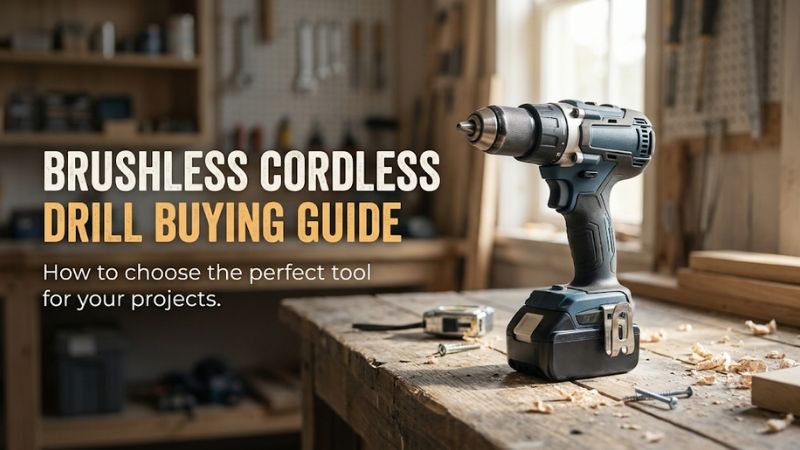
This brushless cordless drill buying guide explains how to choose a drill for woodworking, furniture assembly, home repairs, garage projects, and demanding renovations. Motor efficiency matters, but battery compatibility, adjustable torque, chuck construction, drilling speed, physical size, and safe handling are equally important. Understanding these features will help you select a drill that matches your actual workload.
What Should You Look for in a Brushless Cordless Drill?
The best starting point is identifying the materials you work with and the operations you perform most frequently.
A homeowner who primarily assembles furniture and installs shelves may need a compact drill with smooth trigger control and an adjustable clutch.
A frequent DIY user drilling larger holes in lumber may benefit from a higher-output 18V-class drill with a sturdy chuck and auxiliary handle.
A contractor who regularly drills masonry should evaluate whether a hammer drill or rotary hammer is more appropriate.
The essential buying factors are drilling capability, motor and transmission design, battery system, chuck size, adjustable clutch, operating dimensions, weight, and manufacturer-supported applications.
Maximum advertised torque should not be your only selection criterion.
How Brushless Cordless Drills Work
Understanding Brushless Motor Technology
A brushless motor uses electronic commutation to control the magnetic fields that rotate its internal components.
Traditional brushed motors rely on carbon brushes and a mechanical commutator to transfer electrical current during rotation.
Eliminating brushes removes one source of mechanical wear and can improve efficiency.
Electronic control also allows the tool manufacturer to optimize motor behavior under different loads.
However, brushless motors still contain bearings, windings, electronics, and other components subject to heat and wear.
The design is not maintenance-free, and actual performance depends on the complete drill.
Why Brushless Efficiency Matters
Efficiency influences how effectively electrical energy is converted into useful mechanical work.
Improved efficiency can reduce wasted energy and support useful runtime within a given battery configuration.
However, comparing drills requires more than identifying motor technology.
Battery capacity, electronics, gearbox losses, material resistance, and the selected bit all affect energy consumption.
A brushless drill does not automatically outperform every brushed model in every application.
Are Brushless Drills More Durable?
Brushless motors eliminate brush replacement as a routine motor-maintenance requirement.
This can be beneficial for users who operate their drills frequently.
Nevertheless, durability also depends on gears, bearings, chuck construction, housing strength, thermal management, and environmental exposure.
A tool used beyond its rated capacity can fail regardless of whether it has a brushless motor.
Choose a drill with documented capabilities appropriate to your workload.
Choose the Correct Battery Voltage
Compact 12V Drills
Modern 12V-class cordless drills can provide useful capability for household and installation work.
Their smaller batteries and compact housings often make them comfortable for furniture assembly, cabinet installation, and repetitive overhead fastening.
They are especially attractive when working in confined spaces.
However, some demanding applications involving large bits or dense materials may exceed the capacity of a compact drill.
Evaluate specific model specifications rather than assuming every 12V drill performs identically.
18V-Class Drills
18V-class cordless systems provide access to a broad range of drill designs, from compact household models to high-output professional equipment.
They can be suitable for general woodworking, metal drilling, demanding home renovation, and other applications requiring greater capability.
However, an 18V label alone does not establish performance.
Motor design, electronics, gearbox ratios, and battery current-delivery capability also matter.
Compare actual product features and intended applications.
Understanding 20V MAX Marketing
Some battery systems marketed as 20V MAX use a nominal operating voltage of 18V.
The maximum voltage figure refers to a different measurement condition than nominal voltage.
Therefore, a 20V MAX label does not automatically mean that the tool is more powerful than an 18V alternative.
Battery platforms are also manufacturer-specific.
Never assume that batteries are interchangeable because voltage labels appear similar.
When Higher Voltage Is Worth Considering
For ordinary household projects, a capable 12V or 18V-class drill is often sufficient.
Higher-voltage systems may be relevant to specialized tools requiring different power characteristics, but they are not automatically preferable for general drilling.
More voltage can introduce additional weight or equipment cost depending on the system.
Buy according to supported tool capability, not voltage alone.
Understand Drill Torque Ratings
What Torque Means
Torque describes rotational force and is commonly expressed in inch-pounds or newton-meters.
A higher advertised maximum torque may indicate greater potential for demanding operations.
However, it does not establish actual drilling speed, sustained power, or suitability for every accessory.
A drill with high peak torque can still struggle if the selected bit is inappropriate or the battery cannot support the required load.
Peak Torque Versus Usable Performance
Manufacturer torque claims may be determined under specific operating conditions.
Actual results depend on speed selection, battery condition, material resistance, and tool design.
A drill that produces high peak torque at low speed may not necessarily remove material faster than a lower-rated tool with better sustained speed under load.
For demanding applications, look for credible independent comparisons performed under similar conditions.
Unit Watts Out
Some manufacturers publish Unit Watts Out rather than directly comparable peak torque ratings.
This is a different performance measure.
Do not convert a UWO figure into an inch-pound torque value without knowing the relevant operating speed and measurement conditions.
Comparing unrelated manufacturer specifications as though they represent the same quantity can lead to misleading conclusions.
How Much Torque Does a Homeowner Need?
There is no universal requirement.
Small pilot holes and ordinary screw-driving generally demand less capability than large holes in dense lumber.
A compact drill may be sufficient for most occasional household tasks.
For larger bits and demanding repetitive drilling, choose a model with suitable documented capacities.
Do not purchase the highest torque rating simply because it appears more impressive.
Understand Drill Speed Settings
Low-Speed Gear
The lower mechanical speed range is typically used for applications that require greater rotational force.
This can include larger drilling accessories and certain demanding screw-driving operations.
However, low gear does not eliminate the need for appropriate technique.
Large bits can still bind, especially when they encounter knots, embedded hardware, or unsupported material.
High-Speed Gear
Higher rotational speed is useful for drilling operations where smaller bits and the workpiece material permit faster cutting.
The correct speed depends on bit diameter, cutting material, and lubrication requirements.
For example, metal drilling often benefits from careful speed selection and suitable cutting fluid.
Operating too quickly can overheat the bit or damage its cutting edge.
Variable-Speed Trigger
A variable-speed trigger allows gradual adjustment of rotational speed.
This is useful when starting pilot holes and engaging screws without losing alignment.
However, trigger control is not equivalent to a calibrated speed regulator under all load conditions.
Choose the mechanical speed range first, then use the trigger to manage the operation.
Why More Speed Is Not Always Better
Higher no-load RPM does not automatically mean faster or better drilling.
A drill may lose rotational speed as resistance increases.
Bit geometry and material properties also influence cutting efficiency.
Correct drilling technique often matters more than maximizing the trigger position.
Select the Right Chuck Size
3/8-Inch Chucks
A 3/8-inch chuck is common on lighter drill/drivers and supports compatible accessories within its rated shank capacity.
It may be suitable for many household and furniture-assembly tasks.
However, chuck size alone does not determine torque or the maximum hole diameter.
Check the manufacturer’s drilling recommendations.
1/2-Inch Chucks
A 1/2-inch chuck accommodates larger shanks and is commonly found on midrange and professional cordless drills.
It offers flexibility for many wood and metal drilling accessories.
However, the larger chuck may add front-end size and weight.
For users working primarily in restricted spaces, overall tool dimensions can be more important than maximum chuck capacity.
Keyless Chuck Design
Most modern cordless drill/drivers use keyless chucks that allow bit installation without a separate chuck key.
This is convenient for users who frequently alternate between drill bits and driver accessories.
However, proper tightening remains essential.
Follow the tool manufacturer’s instructions, particularly when using large bits or accessories subject to high loads.
Metal Versus Composite Chucks
Metal chucks can offer durability advantages, but the quality of the complete mechanism matters more than the material label.
Composite components may reduce weight in certain designs.
Neither construction should be judged without considering retention, wear, and intended application.
Choose a suitable product rather than assuming a metal chuck guarantees superior performance.
Understand Clutch Settings
What the Clutch Does
An adjustable clutch helps limit torque transmission during screw-driving operations.
It can reduce the likelihood of overdriving screws into certain materials.
However, clutch settings are not standardized torque measurements and may behave differently depending on the drill and operating conditions.
The correct setting should be established through careful use on the intended fastener and workpiece.
Using the Clutch for Furniture Assembly
Furniture materials can be damaged by excessive fastening force.
Start with a lower clutch setting and increase it only when necessary.
Use the proper driver bit and ensure the fastener is aligned.
For sensitive joints or fittings, final hand tightening may be preferable.
Using the Clutch for Cabinet Installation
Cabinet installations often involve screws driven into wood or engineered panels.
An adjustable clutch can help control screw depth and reduce the likelihood of damage.
However, appropriate pilot holes, fastener selection, and installation procedures remain essential.
Clutch adjustment cannot compensate for an incorrectly sized or unsuitable screw.
When to Use Drilling Mode
Drilling mode generally bypasses the adjustable torque-limiting clutch so the drill can deliver greater available rotational force.
This setting is suitable for appropriate drilling operations.
However, it can increase the risk of sudden reaction if a bit binds.
Use a firm grip and auxiliary handle where the manufacturer requires one.
Compare Conventional Drills and Hammer Drills
Conventional Drill/Drivers
A conventional drill/driver provides rotary motion for drilling and fastening.
It is suitable for many wood, metal, plastic, and other appropriate materials when used with suitable bits.
For homeowners who rarely work with masonry, this configuration may provide sufficient versatility without additional mechanisms.
Hammer Drill/Drivers
A hammer drill/driver adds a percussion function intended for appropriate masonry work.
This can be useful for drilling certain brick, block, and concrete materials within the tool’s published limits.
Hammer mode should not be used indiscriminately.
Select the correct mode and bit for the material.
Rotary Hammers
A rotary hammer uses a more specialized percussion mechanism for demanding masonry drilling.
It is generally better suited than an ordinary hammer drill for many substantial concrete applications.
However, rotary hammers may be unnecessarily expensive and bulky for ordinary household drilling.
Choose the correct tool according to the material and hole requirements.
Should You Pay Extra for Hammer Mode?
Hammer mode is worthwhile when you expect to drill suitable masonry regularly.
If most projects involve wood, metal, cabinetry, and household hardware, a conventional drill/driver may be sufficient.
Avoid paying for features you do not need unless the overall package remains competitively priced.
Compare Battery Capacity and Runtime
Understanding Amp-Hours
Battery capacity is commonly measured in amp-hours.
A higher-capacity pack generally stores more charge than a lower-capacity pack of the same nominal voltage, assuming comparable specifications.
However, runtime still depends on the energy demanded by the drill.
A demanding drilling operation can consume battery energy much faster than light screw-driving.
Compact Batteries
Compact batteries are useful when weight and clearance matter.
They can make a drill easier to handle overhead or inside cabinets.
However, they may provide less runtime and, in some systems, less maximum power delivery.
Choose a battery approved for the intended application.
High-Capacity Batteries
Larger batteries may improve runtime and support sustained demanding work.
Their disadvantages include additional weight, increased size, and potentially greater initial cost.
For many homeowners, a smaller battery and a second charged pack may be more convenient than one oversized battery.
Battery Temperature
Battery temperature can influence tool performance and charging behavior.
Lithium-ion batteries have manufacturer-specified operating and charging temperature ranges.
Avoid charging or using packs outside those limits.
If a battery becomes excessively hot or shows damage, stop using it and follow the manufacturer’s instructions.
Battery Compatibility
Different battery platforms are not interchangeable simply because they share similar voltage labels.
Using unauthorized adapters or mismatched chargers can create safety and reliability risks.
Verify the exact battery model and manufacturer-approved compatibility.
Evaluate Drill Weight and Ergonomics
Bare-Tool Weight Versus Operating Weight
Manufacturers may publish tool weights without batteries.
Others specify weight using a particular pack.
These figures should not be compared as though they represent identical configurations.
The operating weight includes the drill, battery, bit, and any installed accessory.
Overhead Work
Drilling overhead can increase fatigue, particularly with heavier tools.
A compact drill may offer better comfort during repeated fastening operations.
However, the tool must still provide enough capability for the job.
Use an appropriate working platform and maintain stable footing.
Grip Shape
Grip diameter, texture, and trigger placement influence handling comfort.
A tool that feels comfortable to one user may not suit another.
Consider hand size, glove use, and typical working positions.
Balance
Balance is determined by weight distribution throughout the tool and battery assembly.
A larger battery can shift the center of mass.
Evaluate the drill with the intended pack installed where possible.
Understand Essential Safety Features
Electronic Kickback Protection
Some premium drills include electronic systems that respond to sudden rotation or binding events.
These features can reduce certain hazards associated with high-torque drilling.
However, they cannot prevent every injury.
Use the recommended auxiliary handle and maintain control of the tool.
Overload Protection
Electronic overload protection can interrupt operation under specified excessive-load conditions.
This may help protect the motor and battery.
However, the presence of protection electronics does not justify using oversized bits or ignoring operating limits.
Work Lights
Integrated LEDs help illuminate the drilling area.
They are useful inside cabinets, garages, and poorly lit locations.
However, additional lighting may be needed for accurate alignment and inspection.
Forward and Reverse Controls
A forward/reverse switch allows rotation in either direction.
Confirm the selected direction before operating the drill.
Accidentally reversing a fastener or cutting accessory can damage the workpiece or create unexpected movement.
How to Match a Drill to Common Projects
Furniture Assembly
A compact drill with a controllable trigger and adjustable clutch is often ideal.
Choose suitable driver bits and use low torque settings.
Do not use maximum power merely to complete the job faster.
Woodworking
Woodworking requirements vary from small pilot holes to large holes requiring substantial torque.
Consider bit diameter, wood density, and available working clearance.
For demanding repetitive drilling, a capable 18V-class tool may be more appropriate.
Metal Drilling
Choose suitable drill bits and operate at speeds appropriate for the bit and material.
Secure the workpiece.
Use appropriate cutting lubrication when recommended.
Do not force the tool when the bit is dull or cutting poorly.
Masonry Work
Verify whether hammer-drilling capability is required.
Use masonry-rated bits and follow manufacturer recommendations.
For substantial concrete drilling, a rotary hammer may be preferable.
Garage Maintenance
A conventional drill is useful for many installation and repair tasks.
However, an impact wrench may be better for removing resistant nuts, while a torque wrench is needed for precise final tightening.
Do not treat a drill/driver as a universal replacement for every mechanical fastening tool.
Common Buying Mistakes
Selecting Only by Torque
Torque is important but does not fully describe drilling performance.
Evaluate speed ranges, bit compatibility, battery output, housing dimensions, and control features.
Ignoring Total Cost
Compare the drill, batteries, charger, bits, and accessories.
A bare tool may be economical for existing battery owners but expensive for first-time buyers.
Buying an Oversized Drill
High-output models can be heavier and less convenient for small household tasks.
Choose sufficient capability without unnecessary bulk.
Underestimating Drilling Requirements
A compact light-duty drill may struggle with demanding applications.
Select according to actual bit sizes, materials, and frequency of use.
Using the Wrong Accessories
Incorrect bits and unsuitable attachments can cause damage or poor results.
Follow accessory specifications and the drill manufacturer’s operating instructions.
Frequently Asked Questions
Are brushless drills better for DIY users?
Brushless drills can offer efficiency and maintenance advantages. Whether they justify additional cost depends on the specific tool, project frequency, and complete purchase price.
Is 12V enough for home repairs?
A capable 12V drill can handle many ordinary home maintenance tasks. Larger drilling jobs may require a more powerful model.
Should I buy a hammer drill or regular drill?
Choose a hammer drill when suitable masonry drilling is a regular requirement. A conventional drill/driver may be sufficient for most wood, metal, and general household applications.
Do higher amp-hour batteries make a drill stronger?
Not necessarily. Higher capacity generally increases stored energy, but power delivery also depends on battery design and tool compatibility.
How often should a drill be maintained?
Follow the manufacturer’s maintenance schedule. Inspect the chuck, housing, vents, battery connections, and accessories regularly, particularly after demanding work.
Can a cordless drill replace a drill press?
A handheld drill can perform many drilling tasks, but a drill press provides advantages in alignment, repeatability, and workpiece control for suitable workshop applications.
Conclusion
This brushless cordless drill buying guide recommends choosing a drill according to your actual materials, bit sizes, working conditions, and battery requirements. A compact 12V model is practical for lighter installation work, while a capable 18V-class drill offers versatility for demanding home and garage projects. Prioritize adjustable control, correct accessories, comfortable handling, and manufacturer-supported operating limits rather than the highest advertised torque alone.
More from Amazon
Programs that pair well with the guide above. Offers and eligibility are set by Amazon and may change.
Collect the home and kitchen items you want in one registry that guests can shop from.
Create a wedding registrySet up recurring deliveries of everyday items on eligible products. Terms and savings are set by Amazon.
Explore Subscribe & SaveFree shipping on eligible items, Prime Video and more. Eligible new members can start with a free trial.
Start a Prime free trialAudiobooks and podcasts to listen to on the go. Eligible new members can start with a free trial.
Try Audible freeAs an Amazon Associate we earn from qualifying purchases.