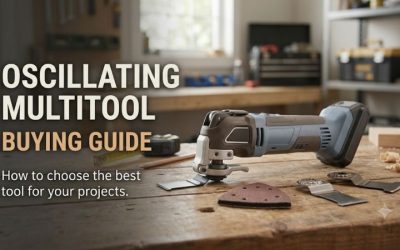
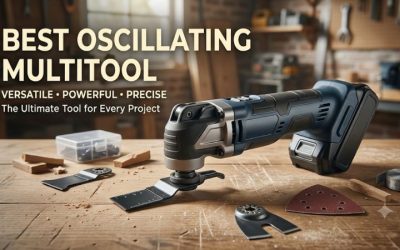
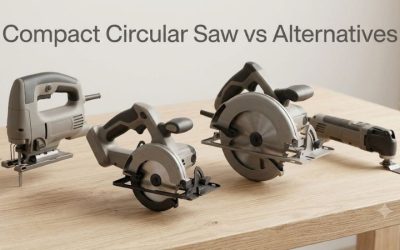
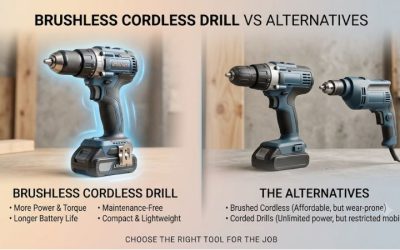
Comparing an oscillating multitool vs alternatives helps homeowners choose the right equipment for cutting, sanding, scraping, and renovation work. Jigsaws, reciprocating saws, rotary tools, detail sanders, and angle grinders perform different operations. Understanding their cutting mechanisms, accuracy, power, and limitations helps buyers avoid using the wrong tool for a project.
Quick Verdict: Which Tool Should You Choose?
An oscillating multitool is particularly useful for localized cuts, flush trimming, scraping, and detail sanding in restricted areas.
Its small side-to-side movement allows accessories to work close to installed surfaces where larger cutting tools may be difficult to position.
However, an oscillating multitool is not necessarily the fastest or most effective option for every job.
A jigsaw is better for many curved cuts. A reciprocating saw is more appropriate for demanding demolition. A rotary tool can be useful for intricate work on small components, while a dedicated detail sander is often more efficient for repeated sanding.
An angle grinder is designed for different cutting and grinding applications, particularly when using accessories approved for suitable metal or masonry work.
The correct choice depends on the material, cutting geometry, required finish, working clearance, and safety requirements.
Quick Comparison Table
| Tool | Primary strength | Main limitation | Best application |
|---|---|---|---|
| Oscillating multitool | Localized cutting and scraping | Slow for long cuts | Flush trimming and repairs |
| Jigsaw | Curved and irregular cuts | Blade deflection possible | Shaped woodworking |
| Reciprocating saw | Aggressive demolition | Less precise | Removing framing and pipes |
| Rotary tool | Detailed high-speed work | Limited material-removal capacity | Small components and engraving |
| Detail sander | Surface finishing | Cannot perform general cutting | Corners and furniture |
| Angle grinder | Grinding and compatible material cutting | Different hazards and less suited to delicate trim | Metalworking and masonry |
Oscillating Multitool vs Jigsaw
Cutting Mechanism
An oscillating multitool moves its accessory through a small angular arc.
A jigsaw uses a reciprocating blade that moves primarily up and down.
These mechanisms create different cutting behaviors.
Oscillating tools are useful for localized cuts and operations close to surrounding surfaces.
Jigsaws are designed to follow straight or curved cutting paths through suitable materials.
Straight Cutting
An oscillating tool can produce short straight cuts, especially when used with a suitable blade and guide.
However, it is generally inefficient for long cuts through boards or sheet materials.
A jigsaw can make longer straight cuts, although blade deflection may affect squareness under certain conditions.
For long straight cutting, a circular saw may be preferable to either tool.
Curved Cutting
A jigsaw is usually the more appropriate choice for curves and shaped openings.
Its narrow blade can follow a changing cutting path.
An oscillating blade is not designed to move continuously through long curved cuts.
Attempting to twist it through the material can cause binding or poor results.
Internal Cutouts
An oscillating tool can make certain localized plunge cuts.
This is useful for small openings in appropriate materials.
A jigsaw can also create internal cutouts, often after a suitable starter hole has been made.
For larger shaped openings, the jigsaw may be more efficient.
Flush Cutting
Oscillating tools offer advantages for certain flush-cutting operations.
Their accessory geometry allows cuts close to installed surfaces.
A conventional jigsaw usually requires additional space for its shoe and blade movement.
Choose the oscillating tool when the task requires appropriate close-surface trimming.
Which Is Better for Homeowners?
Choose a jigsaw when shaped cuts and curves dominate.
Choose an oscillating multitool when repairs involve localized trimming, scraping, or cutting near obstructions.
The tools complement one another.
Oscillating Multitool vs Reciprocating Saw
Cutting Action
A reciprocating saw moves its blade back and forth along a linear path.
This makes it useful for aggressive cutting and demolition.
An oscillating multitool uses a small angular movement better suited to localized operations.
The difference affects cutting speed, control, and access.
Demolition Performance
Reciprocating saws are commonly used for removing framing members, cutting suitable pipes, and dismantling materials.
Their longer blades can reach into some structures and cut through substantial material.
An oscillating multitool is less efficient for broad demolition.
It is better suited to controlled removal of smaller sections.
Precision
An oscillating multitool can provide more localized control around finished surfaces.
A reciprocating saw’s larger blade movement may be unsuitable for delicate trim.
However, the actual accuracy of either tool depends on technique and the cutting setup.
Working Near Finished Surfaces
Oscillating tools can be useful when removing a small section of installed wood without damaging nearby trim.
A reciprocating saw may create greater risk of unintended contact because of blade length and movement.
However, neither tool should be used blindly around hidden wiring or plumbing.
Cutting Metal
Both tools can cut certain metals with appropriate accessories.
A reciprocating saw may be better for larger accessible sections.
An oscillating tool can be more suitable for localized work.
Blade compatibility and material thickness remain critical.
Which Is Better for Remodeling?
For demolition, a reciprocating saw is often the more effective choice.
For detail repairs and controlled trimming, an oscillating multitool is more appropriate.
Many renovation projects benefit from both.
Oscillating Multitool vs Rotary Tool
Motion and Operating Speed
A rotary tool spins its accessory continuously at high speed.
An oscillating multitool moves its accessory through a small arc.
These different mechanisms suit different tasks.
Rotary tools are commonly used for small-scale grinding, polishing, engraving, and compatible cutting.
Oscillating tools are better suited to localized cutting, scraping, and sanding larger flat contact areas.
Detail Work
A rotary tool can be valuable for intricate work on small components.
Its various attachments support shaping and finishing operations.
However, a high-speed rotating accessory can be difficult to control near delicate surfaces.
The accessory must be appropriate for the material.
Woodworking
Oscillating tools can trim door jambs and make small plunge cuts.
Rotary tools can perform certain shaping, engraving, and detail operations.
Neither is a complete replacement for a conventional saw when cutting substantial lumber.
Metalworking
Rotary tools can use approved abrasive and cutting accessories for certain metal applications.
Oscillating tools can also cut compatible metal using appropriate blades.
The better choice depends on the material, thickness, and working geometry.
Safety Differences
Rotary tools operate at high rotational speeds.
Accessories must be rated for the tool’s RPM.
Oscillating tools have different movement and mounting requirements.
Both can produce flying debris and hazardous dust.
Use the correct protective equipment.
Which Is Better for Small Repairs?
A rotary tool is useful for intricate shaping and small-component work.
An oscillating multitool is more versatile for many household trim, scraping, and localized cutting tasks.
Oscillating Multitool vs Detail Sander
Sanding Mechanism
An oscillating multitool can use a triangular sanding pad.
This makes it useful for corners and narrow edges.
A dedicated detail sander is designed primarily for sanding and may offer better ergonomics for repeated surface finishing.
Small-Area Sanding
Both tools can sand corners and other restricted areas.
An oscillating multitool is convenient when sanding is only one part of a mixed repair.
A detail sander becomes attractive when sanding is the primary operation.
Large-Surface Sanding
Neither a small triangular multitool pad nor a compact detail sander is usually the most efficient choice for large flat surfaces.
A random-orbit sander or other appropriate sanding machine may provide greater productivity.
Choose according to surface area and finish requirements.
Dust Collection
Some dedicated sanders include dust-collection features designed around continuous sanding.
Oscillating multitools may also support dust-extraction accessories.
Actual collection performance varies.
Use appropriate respiratory protection and source control.
Abrasive Availability
Multitool sanding pads and dedicated detail sanders may use different abrasive shapes and attachment systems.
Check replacement sheet availability.
A tool requiring uncommon abrasives may increase long-term costs.
Which Is Better for Furniture Refinishing?
A dedicated sander is generally preferable for extensive refinishing.
An oscillating multitool can supplement it by reaching corners and small details.
For occasional touch-ups, the multitool may be sufficient.
Oscillating Multitool vs Angle Grinder
Different Cutting Mechanisms
An angle grinder uses a rapidly rotating disc or wheel.
It is designed for compatible grinding, cutting, and surface preparation tasks.
An oscillating multitool uses a small side-to-side arc.
It is generally better suited to localized repair operations.
Metal Cutting
Angle grinders can be effective for suitable metal cutting with approved wheels.
They are not necessarily appropriate for delicate work near finished surfaces.
Oscillating multitools can cut certain metals with compatible blades.
However, they are usually less efficient for substantial metal removal.
Grinding and Surface Preparation
Angle grinders can remove material aggressively using appropriate grinding accessories.
Oscillating tools are not designed to replace them for heavy grinding.
For localized adhesive removal or scraping, an oscillating tool may provide better control.
Working in Confined Spaces
An oscillating multitool can access some locations where a grinder’s wheel and guard cannot fit.
However, compactness does not remove the need for safe clearance.
Never remove a grinder guard or use an incompatible wheel to reach a restricted area.
Safety Risks
Angle grinders can produce high-speed debris, sparks, and severe injuries if wheels fail or bind.
Oscillating tools introduce different cutting and vibration hazards.
Use manufacturer-approved accessories and appropriate protective equipment.
Which Is Better for Garage Repairs?
For compatible metal grinding and substantial material removal, an angle grinder may be more appropriate.
For localized trimming, scraping, and detail cutting, an oscillating multitool is often more useful.
Oscillating Multitool vs Hand Tools
Manual Scrapers
Manual scrapers can remove certain adhesives and deposits without electrical power.
They may provide better tactile control on delicate surfaces.
However, they can require more physical effort.
An oscillating scraper may speed up suitable removal tasks.
Hand Saws
Hand saws are useful for many controlled wood cuts.
They produce less powered-tool noise and require no batteries.
However, they may be less convenient for certain flush cuts.
An oscillating tool can provide powered localized cutting where a hand saw is difficult to position.
Chisels
Wood chisels can perform accurate trimming and shaping when used correctly.
They can be preferable for certain joinery operations.
Oscillating tools are useful for rapid material removal but may not achieve the same level of precision in every task.
Sanding Blocks
Manual sanding blocks provide direct control.
They are useful for small surfaces and final finishing.
An oscillating sanding pad can reduce manual effort but may remove material too aggressively if mishandled.
Which Is Better for Occasional Repairs?
Manual tools are often economical and suitable for occasional tasks.
An oscillating multitool becomes more attractive when repetitive or awkward operations justify powered assistance.
Compare Tools by Common Home Projects
Undercutting Door Jambs
An oscillating multitool is particularly useful for undercutting door jambs during flooring installation.
Its blade can make a controlled horizontal cut near the floor.
A jigsaw or reciprocating saw is generally less convenient for this specific operation.
Removing Old Caulk
An oscillating scraper may help remove certain sealants.
However, delicate surfaces may be better handled with manual tools.
The correct approach depends on the sealant and substrate.
Cutting Drywall Openings
An oscillating tool can create localized openings.
A drywall saw or other approved cutting tool may also be appropriate.
Before cutting, inspect for hidden electrical wiring and plumbing.
Trimming Wood With Nails
A multitool fitted with an appropriate bi-metal blade can cut certain nail-embedded wood.
A reciprocating saw may be more efficient for larger demolition cuts.
Choose based on access and cutting volume.
Removing Tile Grout
An oscillating multitool with a suitable grout-removal attachment can work in tile joints.
An angle grinder may be too aggressive for certain narrow joints.
However, improper oscillating-tool use can still damage tile or waterproofing.
Sanding Cabinet Corners
A triangular sanding attachment can reach narrow corners.
A dedicated detail sander may provide greater efficiency for longer sanding sessions.
Cutting Metal Pipes
A reciprocating saw may be appropriate for certain accessible pipes.
An oscillating tool can help with localized cuts in restricted positions.
However, pipe material, contents, and surrounding services must be identified before cutting.
Removing Flooring Adhesive
An oscillating scraper may assist with localized adhesive removal.
For large areas, specialized floor-preparation equipment may be more appropriate.
Unknown old adhesives may contain hazardous substances and should not be disturbed without appropriate assessment.
How to Choose the Right Tool
Identify the Main Task
Start by determining whether your work involves cutting, sanding, scraping, grinding, or demolition.
An oscillating tool is particularly useful when several localized repair tasks must be completed with one device.
A specialized tool may be more efficient when one operation dominates.
Consider Material Thickness
Oscillating tools are not generally intended for long cuts through thick structural materials.
For substantial lumber, a circular or reciprocating saw may be preferable.
For small localized openings, an oscillating tool may provide better access.
Consider Cutting Geometry
Curved cuts favor a jigsaw.
Long straight cuts favor a circular saw.
Localized plunge and flush cuts often favor an oscillating tool.
Repeated precise crosscuts may require another specialized saw.
Evaluate Working Clearance
A tool must fit the workspace while allowing safe control.
Oscillating tools can operate in some confined locations, but accessory and housing dimensions still matter.
Do not force any tool into a position that prevents safe handling.
Compare Purchase Costs
A multitool may replace several manual tools for occasional tasks, but accessories can become expensive.
A specialized tool may be more economical when used frequently for one operation.
Compare complete ownership costs.
Consider Accessory Availability
Oscillating blades are consumables.
Replacement availability matters.
Check the mounting system and supported materials before buying.
Evaluate Safety
All cutting and grinding tools introduce hazards.
Choose equipment that permits correct guarding, workpiece support, and operator positioning.
The smallest tool is not automatically the safest.
Common Mistakes When Comparing Tools
Expecting One Tool to Do Everything
An oscillating multitool is versatile but not the best tool for every application.
Use specialized equipment when necessary.
Choosing Based on Advertised Power Alone
Motor ratings and speed figures do not fully describe cutting performance.
Consider the actual task and accessory.
Ignoring Accessory Compatibility
Blades and attachments may require specific interfaces.
Verify exact fit.
Using a Tool Beyond Its Intended Application
Improvised accessories and inappropriate cutting techniques can cause injury or equipment damage.
Follow the manufacturer’s instructions.
Overlooking Dust and Hidden Materials
Renovation work can disturb hazardous dust or concealed services.
Inspect the work area and use appropriate controls.
Frequently Asked Questions
Is an oscillating multitool better than a jigsaw?
An oscillating multitool is better for certain localized plunge and flush cuts. A jigsaw is generally more suitable for curved and irregular cuts through compatible materials.
Can an oscillating multitool replace a reciprocating saw?
Not for most demanding demolition. A reciprocating saw is usually more efficient for extensive cutting and material removal.
Is an oscillating tool better than a rotary tool?
It depends on the task. Oscillating tools are useful for localized cutting and scraping, while rotary tools are better suited to many intricate shaping and grinding applications.
Can an oscillating multitool replace a sander?
It can handle detail sanding, particularly in corners. Dedicated sanders are generally more efficient for larger surfaces.
Is an oscillating multitool useful for metal?
Yes, with appropriate accessories and within the blade manufacturer’s material limits. It is not a universal replacement for metal-cutting saws or grinders.
Is an oscillating multitool worth buying for occasional DIY?
It can be particularly valuable when projects involve trim, grout, scraping, and tight-space repairs. For simple tasks performed infrequently, manual tools may be sufficient.
Conclusion
When comparing an oscillating multitool vs alternatives, choose the multitool for localized cutting, flush trimming, scraping, and detail sanding. A jigsaw is more effective for many curves, a reciprocating saw suits demolition, a rotary tool handles intricate work, a dedicated sander improves large-area finishing, and an angle grinder is appropriate for specified grinding and cutting tasks. The best workshop combines tools according to their strengths rather than expecting one device to replace every alternative.
More from Amazon
Programs that pair well with the guide above. Offers and eligibility are set by Amazon and may change.
Collect the home and kitchen items you want in one registry that guests can shop from.
Create a wedding registrySet up recurring deliveries of everyday items on eligible products. Terms and savings are set by Amazon.
Explore Subscribe & SaveFree shipping on eligible items, Prime Video and more. Eligible new members can start with a free trial.
Start a Prime free trialAudiobooks and podcasts to listen to on the go. Eligible new members can start with a free trial.
Try Audible freeAs an Amazon Associate we earn from qualifying purchases.