Comparing a rolling tool chest vs alternatives helps homeowners choose the right storage for hand tools, power tools, and workshop equipment. Wall cabinets, portable toolboxes, utility carts, modular systems, and stationary workbenches each provide different benefits. This guide explains their storage capacity, mobility, accessibility, cost, and space requirements so you can build a more efficient garage.
Quick Verdict: Which Tool Storage System Should You Choose?
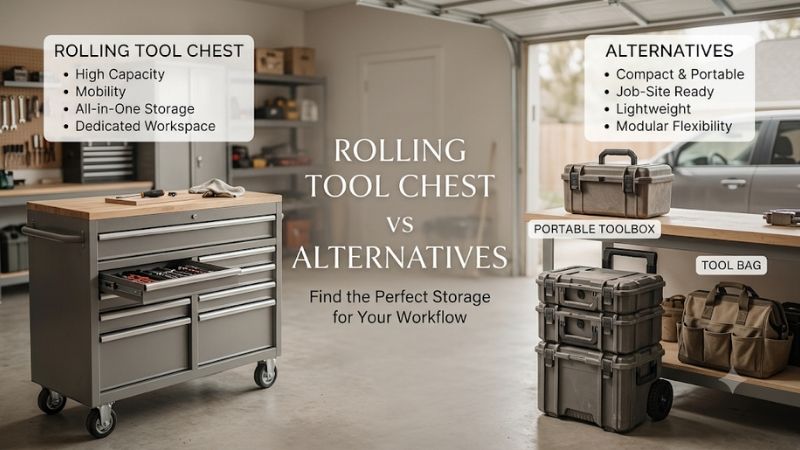
A rolling tool chest is usually a strong choice when you want organized drawers for many hand tools and enough mobility to reposition the cabinet around a garage.
Its main advantages are drawer separation, enclosed storage, locking capability, and a stable surface when the casters are secured.
However, it is not always the best storage method.
Wall-mounted cabinets can preserve valuable floor space.
Portable toolboxes are better for carrying selected tools between locations.
Rolling utility carts provide immediate access to equipment during active projects.
Modular toolboxes offer flexible transport and reconfiguration.
Pegboards and slatwall systems keep frequently used tools visible.
Stationary workbenches provide a dedicated surface for demanding assembly tasks.
The most practical solution often combines two or more methods.
For example, a homeowner might use a rolling cabinet for sockets and wrenches, wall storage for larger power tools, and a portable box for household repairs away from the garage.
Quick Comparison Table
| Storage system | Main advantage | Main limitation | Best for |
|---|---|---|---|
| Rolling tool chest | Organized drawers and mobility | Uses floor space | Mechanics and general garage storage |
| Wall-mounted cabinets | Preserves floor space | Requires secure installation | Small garages |
| Portable toolbox | Easy to carry | Limited storage volume | Mobile repairs |
| Rolling utility cart | Quick tool access | Less enclosed security | Active projects |
| Modular toolbox | Flexible transport | Less drawer organization | Contractors and mobile DIY |
| Pegboard or slatwall | Visible tool access | Exposure to dust and moisture | Frequently used tools |
| Stationary workbench | Stable working surface | Limited mobility | Assembly and fabrication |
Rolling Tool Chest vs Wall-Mounted Cabinets
Floor Space
A rolling cabinet occupies floor space.
This can be inconvenient in a narrow garage.
Wall-mounted cabinets use vertical space and may preserve room for vehicles and equipment.
However, wall cabinets require appropriate structural support.
Installation
Rolling cabinets generally need minimal assembly.
Wall-mounted units require secure attachment to suitable framing or another approved structure.
Improper installation can result in cabinet failure.
Follow the manufacturer’s loading and mounting instructions.
Tool Accessibility
Rolling drawers provide convenient access to organized hand tools.
Wall cabinets are useful for larger equipment and supplies.
However, high shelves can make heavy tools difficult to retrieve.
Weight Capacity
A rolling cabinet transfers its load through the frame and casters to the floor.
A wall cabinet transfers its load through mounting hardware and building structure.
The latter requires careful attention to installation.
Mobility
A rolling cabinet can be moved.
A wall cabinet is normally fixed in place.
This distinction matters when reorganizing a workshop.
Security
Both may offer locking doors or drawers.
However, lock strength varies.
Neither should be assumed to provide high-security protection.
Which Is Better for Small Garages?
Wall cabinets are useful for preserving floor area.
Rolling cabinets are better when tools need to be moved and accessed in organized drawers.
A combination may offer the greatest flexibility.
Rolling Tool Chest vs Portable Toolbox
Storage Volume
A rolling cabinet provides substantially more storage than an ordinary handheld toolbox.
It can organize extensive socket sets and numerous hand tools.
A portable toolbox is designed for selected equipment.
Transport
Portable toolboxes are convenient for carrying tools between rooms or job locations.
Rolling cabinets are heavy and generally intended to remain within a workshop.
Organization
A rolling cabinet offers multiple drawers.
Portable boxes may use trays and compartments.
However, smaller boxes can become cluttered.
Durability
Both formats vary in construction quality.
Steel rolling cabinets and high-quality portable boxes can provide long service life when used correctly.
Security
Some portable boxes include locking features.
However, they can often be removed entirely.
A heavy rolling cabinet may be less convenient to move but is not theft-proof.
Which Is Better for Home Maintenance?
A portable toolbox is useful for household repairs away from the garage.
A rolling chest is preferable for maintaining a larger centralized tool collection.
Rolling Tool Chest vs Rolling Utility Cart
Different Purposes
A rolling cabinet provides enclosed storage.
A utility cart usually provides accessible shelves and possibly a small number of drawers.
The cabinet emphasizes organization and longer-term storage.
The cart emphasizes convenience during active work.
Tool Access
A cart can keep frequently used tools within reach.
However, open shelves may expose tools to dust, debris, and accidental movement.
A cabinet protects tools inside drawers.
Mobility
Both systems use casters.
However, carts may be lighter and easier to move.
Loaded cabinets can weigh several hundred pounds.
Capacity
A rolling cabinet typically offers more enclosed storage.
A cart may hold large items on open shelves.
However, the cart’s total rated load must be respected.
Workspace Flexibility
A cart can accompany the operator between workstations.
A large rolling cabinet is more likely to remain parked.
Which Is Better for Automotive Repairs?
A rolling chest is useful for permanent tool organization.
A utility cart is useful for bringing selected tools to a vehicle.
Many mechanics benefit from both.
Rolling Tool Chest vs Modular Tool Storage
What Modular Storage Means
Modular storage systems use stackable boxes, drawers, organizers, and rolling bases.
Components can be assembled into different configurations.
This makes them particularly relevant to mobile users.
Portability
A modular system can be separated into smaller units.
A rolling cabinet generally remains one heavy structure.
For users who transport tools regularly, modular storage may be more convenient.
Drawer Organization
Some modular systems include drawers.
However, full-size rolling cabinets often provide greater continuous drawer width.
This can be useful for long socket rails and wrench sets.
Weather Resistance
Certain modular boxes are designed to resist water or jobsite contamination.
Conventional rolling steel cabinets are generally intended for sheltered workshop use.
However, weather-resistance ratings vary.
Weight Capacity
Modular systems have individual module and stack-loading limits.
A large rolling cabinet has its own total and drawer ratings.
Compare the actual intended loads.
Cost
Building a modular system from multiple components can become expensive.
However, it allows gradual expansion.
A rolling cabinet requires a larger initial purchase but may provide substantial storage immediately.
Which Is Better for Contractors?
Modular tool storage is attractive for moving equipment between locations.
A rolling cabinet is more practical for fixed workshop organization.
Rolling Tool Chest vs Pegboard
Visibility
Pegboard keeps tools visible and accessible.
This can reduce searching for commonly used hand tools.
Rolling drawers keep tools enclosed and organized by category.
Floor Space
Pegboard uses wall space.
A rolling cabinet occupies floor area.
Dust Protection
Tools stored openly can accumulate dust and moisture.
Drawers provide greater protection.
However, cabinets are not necessarily sealed against humidity.
Load Capacity
Pegboard capacity depends on material, mounting, and hook design.
Heavy equipment may require dedicated supports.
Rolling cabinets can store substantial loads when rated appropriately.
Reconfiguration
Pegboard hooks can be moved relatively easily.
Drawer layouts can also be changed using organizers, although cabinet geometry remains fixed.
Which Is Better for Frequently Used Tools?
Pegboard is convenient for tools used repeatedly during active projects.
A rolling cabinet is useful for protecting and organizing larger collections.
Rolling Tool Chest vs Slatwall Storage
System Design
Slatwall uses horizontal channels that accept compatible hooks, baskets, and shelves.
It is designed for flexible vertical organization.
Floor-Space Efficiency
Like pegboard, slatwall preserves floor space.
However, mounting requirements must be followed.
Tool Visibility
Frequently used tools can remain visible.
This can improve workflow.
Protection
Open storage exposes equipment to dust and workshop conditions.
Rolling drawers provide more enclosed protection.
Capacity
Slatwall systems have specific load limitations.
Do not assume that large hooks can support heavy power tools without suitable mounting.
Which Is Better?
Slatwall is useful for vertical storage and quick access.
Rolling cabinets are better for dense enclosed organization of many hand tools.
Rolling Tool Chest vs Stationary Workbench
Primary Function
A stationary workbench is designed around providing a work surface.
A rolling tool chest emphasizes storage.
Some mobile workbenches combine both functions.
Stability
A properly installed stationary bench can be suitable for demanding operations.
A rolling cabinet must remain within its worktop and load ratings.
Caster brakes do not turn every mobile cabinet into a heavy fabrication bench.
Tool Storage
Some workbenches include cabinets or drawers.
However, the configuration may not provide the same level of organization as a dedicated rolling tool chest.
Mobility
Stationary benches are generally fixed.
Rolling cabinets can be repositioned.
Space Efficiency
A mobile workbench can combine storage and assembly surfaces in one footprint.
However, it may be less stable than a purpose-built fixed bench for demanding operations.
Which Is Better for Woodworking?
A dedicated workbench is valuable for clamping, assembly, and controlled woodworking.
A rolling tool chest is useful for organizing the associated hand and power tools.
A mobile workbench may provide a practical compromise.
Rolling Tool Chest vs Garage Shelving
Storage Accessibility
Open shelving is useful for large boxes, cases, and supplies.
Drawer cabinets are better for small tools.
Floor Space
Shelving systems occupy floor or wall space depending on their design.
Rolling cabinets occupy a defined floor footprint.
Organization
Shelves can become cluttered if small tools are stored loosely.
Use labeled containers and bins.
Heavy Equipment
Shelves may be suitable for heavy equipment when rated correctly.
However, load distribution and installation matter.
Dust and Moisture
Open shelves expose equipment to workshop conditions.
Drawer cabinets provide more protection.
Which Is Better for Bulky Tools?
Shelving is useful for large tool cases and supplies.
A rolling cabinet is preferable for hand-tool organization.
Compare Storage Systems by Common Garage Tasks
Automotive Maintenance
A rolling cabinet is particularly effective for organizing sockets, ratchets, wrenches, pliers, and specialty tools.
A utility cart can carry selected equipment beside the vehicle.
Woodworking
A rolling cabinet can store measuring tools, drill bits, hand planes, and accessories.
Wall cabinets and shelving may be better for large power tools and cases.
A dedicated workbench remains important for assembly.
Household Repairs
A portable toolbox is convenient when moving between rooms.
A rolling cabinet can serve as the central storage location.
Electrical Work
Small parts organizers and modular boxes are useful for connectors, terminals, and accessories.
A rolling cabinet can hold larger hand tools and test equipment.
Plumbing Repairs
Portable boxes are useful when working away from the garage.
Shelving may accommodate bulky fittings and equipment.
Bicycle Maintenance
A compact rolling chest can store wrenches and bike-specific tools.
Pegboard can keep frequently used equipment visible.
Power-Tool Storage
Deep drawers, shelves, and modular cases can all work.
Choose according to tool size and battery-storage requirements.
Mobile Jobsite Work
Modular rolling toolboxes are generally more practical than moving a full steel cabinet.
Permanent Garage Workshop
A rolling chest combined with wall storage offers organized drawers and efficient use of vertical space.
How to Choose the Best Storage Method
Inventory Your Tools
Begin by listing what you own.
Group items by size, weight, and frequency of use.
Measure the Largest Equipment
Check the dimensions of long wrenches, power tools, and cases.
Use these measurements to evaluate drawer fit.
Consider Mobility
Determine whether tools remain in one workshop or travel frequently.
Choose accordingly.
Evaluate Floor Space
Measure the available garage area.
Include vehicle clearance and walking paths.
Plan Vertical Storage
Wall cabinets and shelving can reduce floor clutter.
However, heavy tools should remain at safe retrieval heights.
Check Weight Ratings
Every storage system has limits.
Follow cabinet, shelf, and mounting specifications.
Consider Security
Enclosed lockable storage may provide better casual access control than open shelves.
However, additional workshop security may still be necessary.
Compare Purchase Costs
Include accessories, installation, delivery, and organizers.
Think About Future Expansion
A growing tool collection may justify expandable cabinets or modular systems.
Prioritize Daily Convenience
The most efficient arrangement keeps frequently used tools accessible without creating clutter.
Common Storage Comparison Mistakes
Choosing a Rolling Chest for Frequent Transportation
Large steel cabinets are not intended to be moved between jobsites like portable modular boxes.
Using Wall Storage Without Proper Anchoring
Incorrect mounting can cause failure.
Overloading Utility Carts
Open carts also have weight limits.
Leaving Heavy Tools on High Shelves
This creates handling and falling-object hazards.
Buying Too Many Small Organizers
Excessive compartmentalization can make tools difficult to locate.
Ignoring Drawer Clearance
A cabinet may fit but still be impossible to use comfortably.
Assuming a Mobile Workbench Replaces Every Stationary Bench
Demanding tasks may require a dedicated stable surface.
Failing to Plan for Future Tools
Storage needs often grow over time.
Frequently Asked Questions
Is a rolling tool chest better than a wall cabinet?
A rolling chest provides organized drawer storage and mobility. Wall cabinets preserve floor space. The better choice depends on tool type and garage layout.
Should I buy a rolling tool chest or modular toolboxes?
Choose a rolling chest for fixed workshop organization and modular boxes for frequent transportation.
Is a utility cart enough for a home mechanic?
A utility cart is useful for active projects, but a larger collection usually benefits from additional enclosed storage.
Are pegboards better than drawers?
Pegboards provide visibility and quick access. Drawers offer enclosed organization and protect tools from dust.
Can a rolling chest replace a workbench?
A mobile workbench model may handle light assembly tasks, but demanding clamping and impact operations may require a dedicated bench.
What is the most space-efficient garage storage setup?
A compact rolling cabinet combined with properly mounted wall storage often provides a useful balance between floor space, tool protection, and accessibility.
Conclusion
When comparing a rolling tool chest vs alternatives, choose a rolling cabinet for organized, enclosed, and movable hand-tool storage. Wall cabinets and slatwall systems conserve floor space, portable and modular toolboxes support mobile work, and utility carts keep selected tools close during repairs. For most home garages, combining a properly sized rolling chest with vertical storage and a suitable workbench provides greater flexibility than relying on a single storage method.
More from Amazon
Programs that pair well with the guide above. Offers and eligibility are set by Amazon and may change.
Collect the home and kitchen items you want in one registry that guests can shop from.
Create a wedding registrySet up recurring deliveries of everyday items on eligible products. Terms and savings are set by Amazon.
Explore Subscribe & SaveFree shipping on eligible items, Prime Video and more. Eligible new members can start with a free trial.
Start a Prime free trialAudiobooks and podcasts to listen to on the go. Eligible new members can start with a free trial.
Try Audible freeAs an Amazon Associate we earn from qualifying purchases.