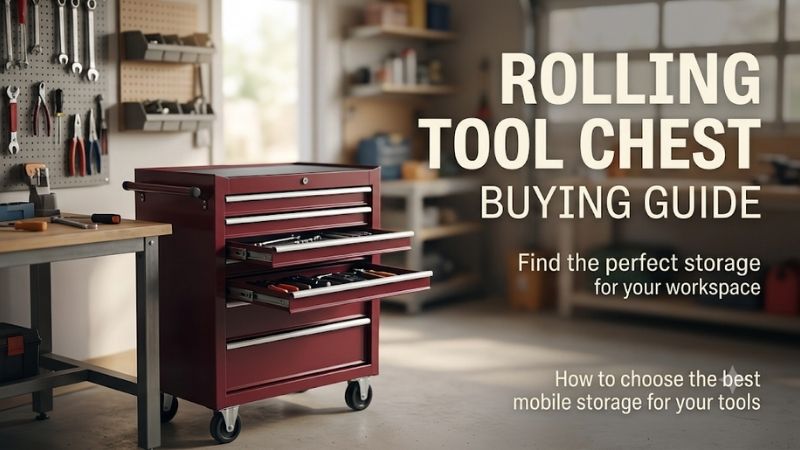
This rolling tool chest buying guide explains how to choose a cabinet that keeps hand tools, power tools, and workshop accessories organized. Width, depth, drawer configuration, steel construction, load capacity, casters, and locking systems all affect everyday usability. Understanding these factors helps homeowners avoid buying a cabinet that is too small, too difficult to move, or poorly suited to their tools.
What Should You Look for in a Rolling Tool Chest?
The most important feature is usable storage space that matches the types of tools you own.
A mechanic with several socket sets needs a different drawer arrangement from a woodworker storing cordless drills, sanding equipment, and measuring tools.
Cabinet width and depth determine how much garage space the unit occupies.
Drawer dimensions influence which tools can be stored.
Load ratings indicate the manufacturer’s intended capacity.
Casters and handles affect mobility.
Locks and drawer latches help secure the cabinet when it is stationary or being moved.
However, none of these features should be evaluated in isolation.
A large cabinet with poorly organized drawers can be less convenient than a smaller model with an appropriate layout.
Similarly, a cabinet rated for substantial loads may be difficult to move safely once filled.
Choose according to actual tool dimensions, storage habits, and workshop conditions.
Understand Rolling Tool Chest Types
Rolling Tool Cabinets
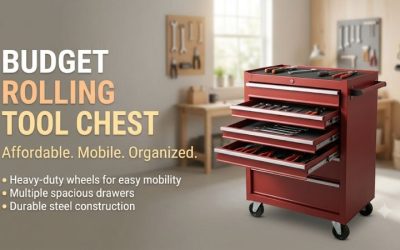
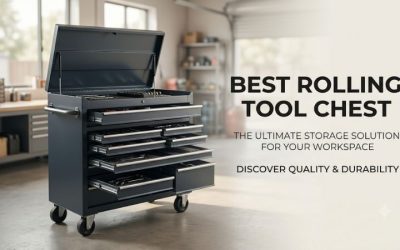
A rolling tool cabinet is a wheeled storage unit with drawers.
It usually provides a flat upper surface that may support an additional tool chest or appropriate worktop accessories.
Rolling cabinets are useful for organizing mechanic’s tools and general workshop equipment.
Their main advantage is accessible drawer storage.
However, large cabinets are heavy and require sufficient floor space.
Mobile Workbenches
Mobile workbenches combine tool storage with a dedicated working surface.
Some use solid wood tops.
Others use metal or composite surfaces.
This design is especially useful for homeowners without a separate workbench.
However, a worktop does not automatically permit heavy impact, welding, or other demanding operations.
Check its intended use.
Rolling Tool Chest Combos
A chest combo typically consists of a lower rolling cabinet and an upper chest.
This arrangement provides substantial vertical storage.
However, it raises the center of gravity.
The combined units must be approved for stacking and correctly secured.
Rolling Tool Carts
Tool carts are generally smaller and more open than full rolling cabinets.
Some have drawers plus open shelves.
They are convenient for moving a selected group of tools close to a work area.
However, they may provide less secure enclosed storage.
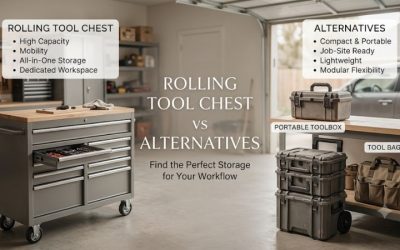
Portable Rolling Toolboxes
Some plastic or modular toolboxes use wheels and telescoping handles.
They are designed for transporting tools rather than serving as permanent mechanic’s cabinets.
They can be useful for mobile users.
However, their organizational features differ from steel drawer cabinets.
Choose the Correct Cabinet Width
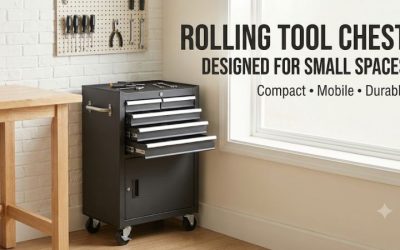
26- to 30-Inch Cabinets
This size is practical for smaller garages and modest tool collections.
A five- or seven-drawer model can accommodate hand tools without requiring a large wall section.
However, drawers may be too narrow for certain long tools.
40- to 46-Inch Cabinets
This range offers substantially greater storage flexibility.
Models such as the CRAFTSMAN S2000 41-Inch cabinet and Husky 46-Inch Mobile Workbench illustrate different approaches.
A wider cabinet can accommodate long socket rails and large organizers.
However, it requires more floor space.
52- to 56-Inch Cabinets
Larger cabinets are suitable for substantial collections.
They may include multiple banks of drawers.
However, they are heavy and may be difficult to install in a small garage.
72-Inch and Larger Cabinets
Very large rolling cabinets are intended for extensive storage.
They can be appropriate in professional workshops.
However, many homeowners would not benefit from their cost and space requirements.
Understand Cabinet Depth
Shallow Cabinets
An 18-inch-deep cabinet helps preserve floor clearance.
It can be useful in garages with parked vehicles.
However, some large tools and cases may not fit.
Standard Deep Cabinets
A 22-inch depth provides additional front-to-back storage.
This can accommodate larger socket organizers and equipment.
However, it may obstruct narrow walkways.
Extra-Deep Cabinets
Some workbenches and cabinets exceed 24 inches in depth.
They can provide substantial volume and a larger worktop.
However, their footprint must be justified by available space and tool requirements.
Measure Interior Dimensions
Exterior dimensions do not equal usable drawer space.
The cabinet frame and slide mechanisms consume room.
Always verify internal dimensions for large tools.
Choose the Right Drawer Count
Four-Drawer Cabinets
Four drawers can be sufficient for basic homeowner tools.
However, organization flexibility is limited.
Five-Drawer Cabinets
Five drawers provide additional separation for hand tools and compact power tools.
This is a useful category for small garages.
Seven-Drawer Cabinets
Seven drawers offer more organization within a relatively narrow width.
They are attractive for automotive hobbyists.
Nine- and Ten-Drawer Cabinets
These configurations are practical for larger tool collections.
They support category-based organization.
However, drawer dimensions still matter.
More Than Ten Drawers
Additional drawers can improve organization for very large collections.
However, they may also increase complexity and cost.
Understand Drawer Slide Types
Friction Slides
Basic drawers may use simple sliding mechanisms.
These can be adequate for lightweight storage.
However, they may become difficult to operate with heavier loads.
Ball-Bearing Slides
Ball-bearing slides are common in modern rolling cabinets.
They generally provide smoother movement under appropriate loads.
However, quality varies.
Full-Extension Slides
Full-extension slides allow access to more of the drawer’s depth.
This is useful for locating tools stored toward the back.
Soft-Close Slides
Soft-close mechanisms help reduce drawer slamming.
They can improve everyday convenience.
However, they do not eliminate the need for drawer latches or locking systems.
Drawer-Slide Ratings
Some slides are rated for 100 pounds or more.
However, the entire drawer and cabinet must still be loaded within manufacturer limits.
Do not overload one drawer based solely on the slide rating.
Evaluate Total Storage Volume
Cubic-Inch Capacity
Some manufacturers list storage volume in cubic inches.
This provides a useful comparison of internal capacity.
For example, the Husky 46-Inch Mobile Workbench provides approximately 14,000 cubic inches.
The U.S. GENERAL Series 3 42-Inch Roll Cabinet provides approximately 16,700 cubic inches.
However, volume alone does not determine usable organization.
Drawer Geometry
A long shallow drawer is useful for socket sets.
A deep narrow drawer may suit power tools.
The same total volume can produce different practical results.
Avoid Wasted Space
Oversized drawers can become cluttered if small items are stored loosely.
Use dividers and organizers.
Plan for Growth
Allow space for future tools.
Avoid filling every drawer immediately.
Understand Steel Construction
Steel Gauge
Steel gauge indicates sheet-metal thickness.
Lower gauge numbers generally mean thicker material.
However, different components may use different thicknesses.
Frame Reinforcement
A reinforced frame can support loaded drawers and resist distortion.
Look for stable construction and properly aligned components.
Weld Quality
Welded seams contribute to structural integrity.
However, visible welding alone does not establish quality.
Powder-Coated Finishes
Powder coatings can help protect against corrosion and wear.
However, chips and scratches may expose the underlying metal.
Cabinet Weight
A heavier cabinet may contain more material, but weight alone does not prove greater quality.
Evaluate design and ratings.
Understand Overall Load Capacity
Cabinet Capacity
The total load rating applies to the complete unit under specified conditions.
Do not exceed it.
Drawer Capacity
Individual drawers may have separate load limits.
Follow those restrictions.
Caster Capacity
Casters support the loaded cabinet.
However, caster rating should not be treated as permission to exceed the cabinet’s total rating.
Worktop Capacity
Some cabinets have separate worktop load limits.
Do not assume they match the overall cabinet rating.
Weight Distribution
Store heavier items lower.
Distribute weight across the cabinet.
Avoid concentrating heavy equipment at the front of open drawers.
Evaluate Casters
Caster Diameter
Larger casters may roll more easily over minor floor irregularities.
However, movement remains difficult when cabinets are heavily loaded.
Caster Width
Wider wheels can distribute loads differently.
However, material and construction also matter.
Fixed Casters
Fixed casters provide directional stability.
Swivel Casters
Swivel casters improve steering.
Locking Casters
Locking wheels help keep the cabinet stationary.
Engage brakes during normal use.
Caster Installation
Follow assembly instructions.
Loose caster hardware can cause instability.
Moving Heavy Cabinets
Use the supplied handle.
Avoid moving across slopes, stairs, or obstacles without appropriate assistance.
Evaluate Locking Systems
Central Drawer Locks
A central lock can secure multiple drawers with one key.
This improves convenience.
Individual Drawer Latches
Latches help keep drawers closed during movement.
Keyed Locks
Keyed locks provide basic access control.
However, they are not equivalent to high-security safes.
Electronic Locks
Some specialized cabinets provide electronic access.
However, they may add cost and maintenance requirements.
Locking Before Movement
Close and secure drawers before moving the unit.
Never transport a cabinet with multiple drawers open.
Choose the Right Worktop
Solid Wood Tops
Wood tops provide a useful assembly surface.
They can be comfortable for light mechanical and woodworking tasks.
However, they require protection from heat, solvents, and sharp objects.
Metal Tops
Metal tops may tolerate certain types of workshop wear.
However, they can scratch and transmit impact noise.
Rubber Mats
Rubber mats protect painted surfaces and reduce slipping.
However, they may be affected by certain chemicals.
Stainless-Steel Tops
Some models use stainless surfaces.
These can be useful for certain cleaning requirements.
However, they may still scratch or dent.
Match the Worktop to Your Projects
Choose according to intended operations.
Do not use a rolling tool cabinet as an anvil or welding bench unless specifically designed for that purpose.
Plan Tool Organization
Sockets
Organize by drive size and measurement system.
Use rails or trays.
Wrenches
Separate combination, adjustable, and specialty wrenches.
Pliers
Use dedicated racks or dividers.
Screwdrivers
Group by tip type and size.
Power Tools
Store in appropriately deep drawers.
Keep batteries according to manufacturer recommendations.
Measuring Tools
Protect calipers, gauges, and other precision equipment.
Consumables
Keep small fasteners and accessories in labeled compartments.
Chemical Products
Avoid storing incompatible chemicals with tools or batteries.
Follow product storage requirements.
Consider Power Strips and Charging
Integrated Outlets
A built-in power strip can simplify workshop charging.
However, its electrical rating must be respected.
USB Ports
USB ports may support suitable low-voltage devices.
Check output specifications.
Battery Charging
Follow charger ventilation and temperature requirements.
Cable Management
Keep power cables away from moving drawers and casters.
Electrical Safety
Inspect the integrated strip and cords.
Avoid overloading the circuit.
Delivery and Assembly Considerations
Shipping Weight
Large cabinets can be extremely heavy.
Check package weight.
Delivery Access
Measure doors, gates, and hallways.
Unloading
Use appropriate equipment and assistance.
Caster Assembly
Install casters according to the manufacturer’s instructions.
Initial Inspection
Check for shipping damage.
Inspect drawer alignment and locking mechanisms.
Level Installation
Position the cabinet on a stable, level surface.
Common Buying Mistakes
Buying Based Only on Drawer Count
Tool dimensions determine practical fit.
Ignoring Interior Drawer Measurements
Exterior dimensions can be misleading.
Choosing an Undersized Cabinet
Future expansion may require replacement.
Choosing an Oversized Cabinet
A large cabinet can block working space.
Overlooking Weight Capacity
Heavy mechanic’s tools require suitable storage.
Ignoring Casters
Poor mobility can make a cabinet frustrating to use.
Buying Without Checking Delivery Access
Large cabinets can be difficult to install.
Assuming All Top Chests Are Compatible
Use only approved combinations.
Frequently Asked Questions
What is the best rolling tool chest size?
It depends on tool collection and garage space. Small 27-inch cabinets suit modest collections, while 41- to 46-inch models provide more flexibility.
Is thicker steel always better?
Not necessarily. Overall construction quality, reinforcement, slides, and caster mounting also matter.
How many drawers do I need?
Choose according to the number and dimensions of tool categories, rather than drawer count alone.
Are soft-close drawers worth paying for?
They can improve convenience, but durability and load capacity should remain priorities.
Should I choose a mobile workbench?
A mobile workbench is useful when you need both storage and a light-duty work surface.
How do I maintain a rolling tool chest?
Keep drawers clean, inspect slides and casters, avoid overloading, and address scratches or corrosion according to the manufacturer’s instructions.
Conclusion
This rolling tool chest buying guide recommends starting with garage dimensions and actual tool sizes, then comparing drawer layouts, loading limits, steel construction, casters, and locking systems. A compact cabinet may be sufficient for basic home maintenance, while a deeper ten-drawer unit is more suitable for extensive mechanic’s collections. Choose a design that supports safe loading, convenient access, and realistic future expansion.
More from Amazon
Programs that pair well with the guide above. Offers and eligibility are set by Amazon and may change.
Collect the home and kitchen items you want in one registry that guests can shop from.
Create a wedding registrySet up recurring deliveries of everyday items on eligible products. Terms and savings are set by Amazon.
Explore Subscribe & SaveFree shipping on eligible items, Prime Video and more. Eligible new members can start with a free trial.
Start a Prime free trialAudiobooks and podcasts to listen to on the go. Eligible new members can start with a free trial.
Try Audible freeAs an Amazon Associate we earn from qualifying purchases.