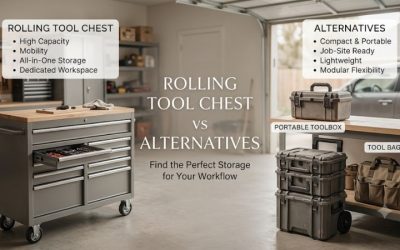
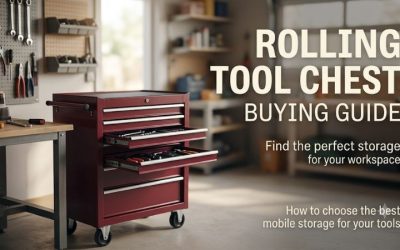
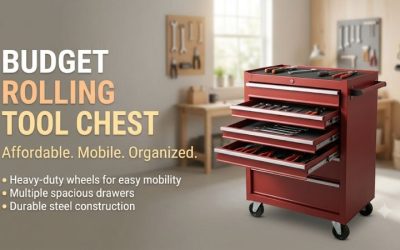
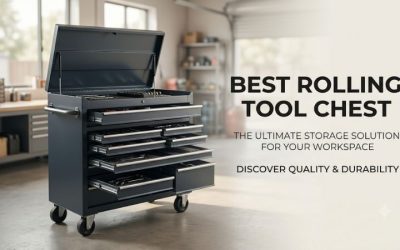
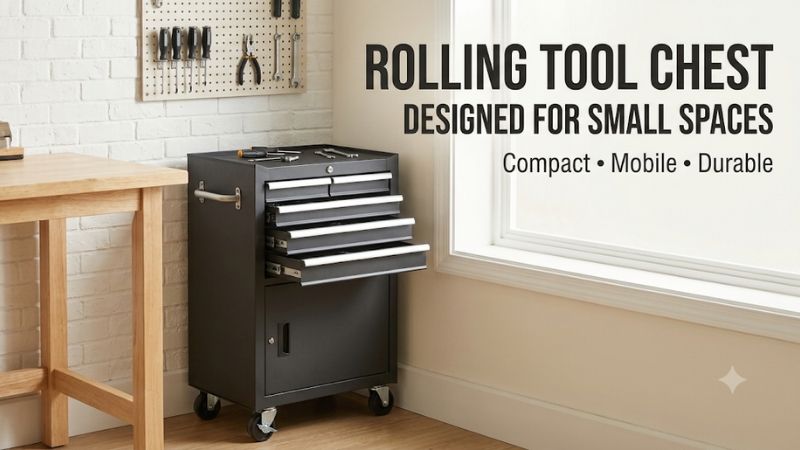
A rolling tool chest for small spaces can organize hand tools, power tools, and garage accessories without requiring an oversized workshop. However, compact storage involves more than choosing the narrowest cabinet. Drawer clearance, cabinet depth, weight distribution, caster design, and access to nearby work areas all influence whether a tool chest will fit your garage effectively.
Quick Answer: What Size Rolling Tool Chest Works in a Small Garage?
For many small home garages, a rolling tool cabinet approximately 26–30 inches wide is a practical starting point.
That size can provide several drawers for ordinary hand tools while occupying less wall space than conventional 41-, 46-, or 56-inch cabinets.
The Husky 27-Inch 5-Drawer Rolling Cabinet is one example of this category. Its relatively shallow 18-inch depth makes it relevant to garages where parked vehicles limit available walking space.
The U.S. GENERAL Series 3 27-Inch Roll Cabinet provides a different compromise. Its 22-inch depth occupies more floor space but offers seven drawers and a substantial 10,900 cubic inches of stated internal storage.
For buyers with a very modest collection, the Husky 26.5-Inch 4-Drawer Rolling Cabinet may be sufficient.
However, cabinet width does not determine whether a unit is truly space-efficient.
A narrow cabinet with deep drawers may be more useful than a wider unit with shallow compartments, depending on the tools you own.
The ideal choice fits your available space while providing enough usable storage to avoid buying another cabinet immediately.
Understand the Real Space Requirements
Measure the Floor Footprint
Before purchasing, measure the exact location where the cabinet will stand.
Record the maximum available width, depth, and height.
Include baseboards, wall outlets, plumbing, and other obstructions that could interfere with positioning.
A cabinet advertised as 27 inches wide may extend farther when its side handle is installed.
Similarly, the caster layout may affect how closely it can sit against a wall.
Check the full assembled dimensions rather than the nominal cabinet width alone.
Allow Full Drawer Extension
A rolling cabinet needs open space in front of its drawers.
If a parked car, motorcycle, or workbench blocks that area, the cabinet may be difficult to use even when its body fits.
Measure the longest drawer extension.
Then ensure there is enough additional clearance for you to stand comfortably and retrieve tools.
A useful storage cabinet should allow safe access without requiring awkward reaching or leaning.
Account for Vehicle Doors
Small garages often serve both parking and workshop functions.
A cabinet positioned beside a vehicle may interfere with the door swing.
Measure the available space with the vehicle parked in its normal position.
If necessary, open the vehicle doors to determine whether the cabinet obstructs access.
Do not rely only on the empty garage dimensions.
Consider Ceiling and Shelf Clearance
A compact rolling cabinet may fit below wall-mounted shelving.
However, it may become inconvenient if a shelf blocks the worktop.
If you plan to add a matching top chest, measure the complete stacked height.
Ensure there is enough clearance for lids and any upward-opening compartments.
Choose Between Shallow and Deep Cabinets
Why an 18-Inch Depth Is Useful
A cabinet around 18 inches deep can preserve more walking clearance than a 22- or 24-inch model.
This difference may be significant in a garage with limited aisle width.
For example, the Husky H27TR5BLK uses a 27-inch-wide, 18-inch-deep format.
That makes it suitable for placement beside workbenches or near garage walls.
However, shallow drawers may not fit large tool cases or some power tools.
Measure your equipment carefully.
When a 22-Inch Cabinet Makes Sense
A 22-inch-deep cabinet provides more front-to-back storage.
The U.S. GENERAL Series 3 27-Inch Roll Cabinet illustrates this configuration.
Its stated storage volume is 10,900 cubic inches.
The deeper drawers can accommodate a broader range of tools than some shallow homeowner cabinets.
However, the extra depth requires more floor clearance.
Do Not Confuse Exterior and Interior Dimensions
The cabinet’s exterior dimensions include its frame and structural components.
Usable drawer space is smaller.
A 27-inch-wide cabinet will not have drawers with a full 27 inches of internal storage width.
Check internal drawer dimensions when organizing long tools or socket rails.
Match Drawer Layout to Your Tools
Shallow Drawers for Hand Tools
Shallow drawers are useful for socket sets, screwdrivers, pliers, and small measuring tools.
They allow tools to remain visible and accessible.
However, very shallow drawers may not accommodate tall socket organizers or bulky handles.
Consider the actual height of your organizers.
Medium Drawers for Common Equipment
Medium-height drawers can store ratchets, combination wrenches, drill bits, and compact cordless tools.
They are versatile for mixed household collections.
However, excessive stacking can make tools difficult to find.
Use dividers or trays to improve organization.
Deep Drawers for Power Tools
Cordless drills, impact wrenches, reciprocating saws, and larger accessories may require deep drawers.
A cabinet with several shallow drawers but no deep compartments may be frustrating for these items.
Before purchasing, measure your largest tool with its battery attached.
Decide whether you want to store batteries separately.
Wide Drawers for Socket Sets
Wide drawers can accommodate long socket rails and organized wrench sets.
They may also hold specialty automotive tools.
However, long drawers become heavy when fully loaded.
Check the drawer-slide rating.
Drawer Count Versus Usable Capacity
More drawers can improve organization.
However, drawer count alone does not determine storage volume.
A five-drawer cabinet with deep compartments may store more bulky tools than a seven-drawer cabinet dominated by shallow trays.
Choose based on how your tools are distributed.
Recommended Cabinet Configurations for Small Spaces
Husky 26.5-Inch 4-Drawer Cabinet for Beginners
The Husky HKST98066BK is a compact standard-duty rolling cabinet.
It provides a straightforward four-drawer arrangement.
This can be sufficient for a modest collection of household tools.
Its limited drawer count means organization is especially important.
Choose suitable dividers and avoid storing tools in large unorganized piles.
The model is appropriate when low cost and minimum footprint matter more than future expansion.
Husky 27-Inch 5-Drawer Cabinet for General DIY
The Husky H27TR5BLK offers one additional drawer and a relatively shallow 18-inch cabinet depth.
This makes it useful for small garages.
Its layout can accommodate hand tools and selected compact power tools.
However, a five-drawer cabinet may become crowded if you regularly purchase more equipment.
U.S. GENERAL Series 3 27-Inch Cabinet for Serious Storage
The U.S. GENERAL provides seven drawers within a 27-inch width.
Its 22-inch depth and stated 1,200-pound load rating make it substantially more storage-focused than a basic homeowner cabinet.
This is attractive for automotive hobbyists with many sockets, ratchets, and specialty tools.
However, it is heavier and deeper.
Compact Rolling Workbench for Mixed Tasks
A rolling workbench may be a better choice when storage and work surface are equally important.
However, most workbench-style models are wider than 27 inches.
If your garage cannot accommodate that width, a narrow cabinet beside a separate folding bench may be more practical.
Evaluate Caster Design
Why Caster Diameter Matters
Casters support the cabinet and allow movement.
Larger wheels can improve rolling performance on suitable garage floors.
However, they do not make heavy cabinets safe to push over steep thresholds or uneven ground.
Fixed and Swivel Casters
Many rolling cabinets use a combination of fixed and swivel casters.
Fixed wheels help maintain directional stability.
Swivel wheels allow steering.
This combination can work well in a narrow garage.
Locking Casters
Locking casters help prevent movement while you open drawers or work near the cabinet.
Engage the brakes when the chest is stationary.
However, brakes are not a substitute for a level installation surface.
Caster Height
Casters contribute to the assembled cabinet height.
This matters when storing the cabinet under a workbench.
Check the assembled height, not the cabinet body alone.
Understand Weight Capacity and Stability
Overall Cabinet Rating
The total capacity describes a manufacturer’s specified load limit.
It does not mean the cabinet can safely carry that weight in every operating condition.
A loaded cabinet can become unstable when several heavy drawers are opened.
Individual Drawer Ratings
Drawer-slide capacity is different from total cabinet capacity.
A 100-pound-rated slide does not mean every drawer should automatically be loaded with 100 pounds.
Check both drawer and cabinet limits.
Store Heavy Tools Low
Place heavy impact wrenches, large sockets, and other dense equipment in lower drawers.
This helps keep the center of gravity lower.
Store lighter items in upper drawers.
Open One Heavy Drawer at a Time
Opening multiple loaded drawers shifts weight forward.
This can increase tipping risk.
Keep unnecessary drawers closed.
Follow the manufacturer’s instructions.
Moving a Loaded Cabinet
Close and lock the drawers before moving the cabinet.
Use the provided handle.
Avoid pulling on drawer handles to move the unit.
Do not move heavy cabinets over stairs or major thresholds without appropriate equipment and assistance.
Consider the Worktop
Metal Cabinet Tops
Many rolling cabinets use a painted metal upper surface.
A mat can help protect the finish.
However, the top may not be designed for heavy hammering or welding.
Wooden Worktops
Wooden tops can be useful for light assembly and inspection work.
However, they require protection from oils, solvents, heat, and sharp objects.
Rubber Mats
Rubber mats can reduce tool movement and surface scratching.
Choose materials compatible with the tools and chemicals used.
Do You Need a Built-In Workbench?
If a small garage already has a sturdy workbench, additional worktop space may be unnecessary.
Prioritize drawer capacity instead.
If you lack a bench, a wider mobile workbench may justify its footprint.
Organize Small Drawers Efficiently
Use Socket Rails
Socket rails keep sockets grouped by size and drive type.
They prevent small pieces from rolling around.
Group Wrenches by Type
Separate combination wrenches, adjustable wrenches, and specialty tools.
This reduces searching.
Use Drawer Dividers
Dividers can separate small accessories.
They are particularly useful in wide drawers.
Label Drawers
Labels make frequently used tools easier to find.
Choose a consistent system.
Leave Expansion Space
Avoid filling every drawer immediately.
A modest amount of unused space allows your collection to grow.
Common Small-Garage Buying Mistakes
Measuring Width but Ignoring Depth
A cabinet can fit along the wall but block the walking aisle.
Measure both dimensions.
Ignoring Drawer Clearance
Full-extension drawers require additional space.
Buying Too Small for Future Tools
A four-drawer cabinet may be inexpensive initially but require replacement later.
Choosing Too Many Narrow Drawers
Bulky power tools may not fit.
Overloading Upper Drawers
This increases instability.
Using a Rolling Cabinet as a Step Stool
Tool cabinets are not ladders.
Do not stand on drawers or worktops.
Frequently Asked Questions
What width rolling tool chest is best for a small garage?
A 26- to 30-inch cabinet is a practical starting point for many small garages, provided its depth and drawer clearance also fit.
Is a 27-inch cabinet enough for a home mechanic?
It can be for a moderate tool collection. A serious automotive collection may benefit from a deeper seven-drawer design.
Can a rolling tool chest fit under a workbench?
Some can, but measure assembled height, including casters, and ensure adequate ventilation and access.
Are deep drawers better for small spaces?
They can improve storage density for bulky tools, but shallow drawers are often better for organizing small hand tools.
Should I buy a top chest immediately?
Not necessarily. Start with the lower cabinet and assess storage needs before adding height and weight.
How do I prevent a rolling cabinet from tipping?
Use it on a level surface, engage caster brakes, keep heavy tools low, and avoid opening multiple loaded drawers.
Conclusion
A rolling tool chest for small spaces should be selected according to complete assembled dimensions, usable drawer clearance, and the tools you intend to store. A shallow Husky 27-Inch cabinet is practical for general DIY, while the deeper U.S. GENERAL Series 3 27-Inch model provides greater capacity for mechanics. Measure the garage with vehicles and workbenches in place, and prioritize safe weight distribution over maximum drawer count.
More from Amazon
Programs that pair well with the guide above. Offers and eligibility are set by Amazon and may change.
Collect the home and kitchen items you want in one registry that guests can shop from.
Create a wedding registrySet up recurring deliveries of everyday items on eligible products. Terms and savings are set by Amazon.
Explore Subscribe & SaveFree shipping on eligible items, Prime Video and more. Eligible new members can start with a free trial.
Start a Prime free trialAudiobooks and podcasts to listen to on the go. Eligible new members can start with a free trial.
Try Audible freeAs an Amazon Associate we earn from qualifying purchases.