Key takeaways
-
Surface fabric and weave
-
Fiber filling and quilting density
-
Backing material
-
Waterproof barriers, if present
-
Total thickness and loft
A cooling mattress pad for small spaces can help make a warm bed more comfortable without requiring a new mattress or major bedroom changes. The right choice depends on mattress size, cooling technology, available floor space, and maintenance needs. This guide explains how to select a practical solution for apartments, dorm rooms, studios, and compact bedrooms.
Quick Answer: What Cooling Mattress Pad Works Best in Small Spaces?
For most small bedrooms, a thin, breathable cooling mattress pad is the most practical starting point. It sits directly on the mattress, requires no additional floor space, and generally needs less maintenance than a powered cooling system.
A fitted cotton or lyocell pad is worth considering if your main problem is heat and humidity trapped in your bedding. A phase-change material (PCM) pad may be useful if you prefer a cool-to-the-touch sensation, although the effect depends on the product’s construction and the surrounding temperature.
If you experience persistent overheating despite breathable bedding and a comfortable room temperature, an active water-based or air-based cooling system may provide greater temperature control. However, these systems require equipment space, electrical access, and more maintenance.
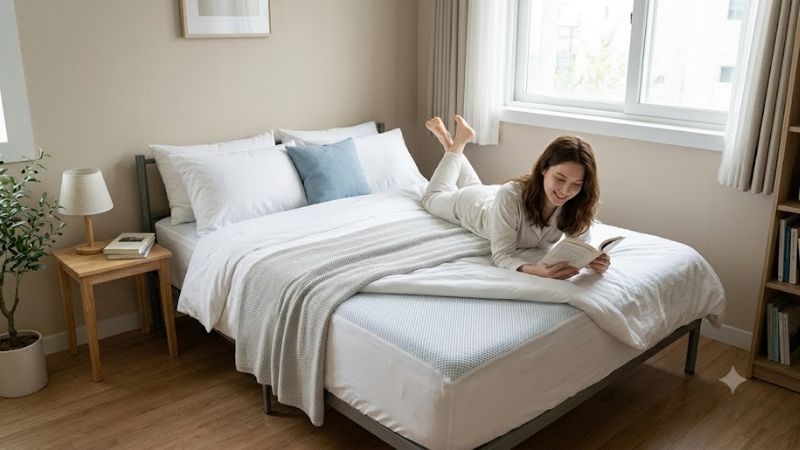
Best Cooling Approach by Living Situation
| Living Situation | Suitable Cooling Solution | Main Advantage | Important Limitation |
|---|---|---|---|
| Small apartment bedroom | Thin cotton or lyocell pad | Minimal space requirements | No powered temperature adjustment |
| College dorm room | Lightweight, washable cooling pad | Easy removal and cleaning | Dorm appliance rules may restrict powered systems |
| Studio apartment | Breathable pad with secure fitted skirt | No separate equipment footprint | Cooling depends on room conditions |
| Small room with persistent overheating | Compact active cooling system | Adjustable cooling on supported models | Needs space, power, and ventilation |
| Murphy bed or folding bed | Thin, flexible mattress pad | Less bulk during storage | Must be approved for the bed’s folding mechanism |
| Twin XL bed | Exact-size fitted cooling pad | Better fit without bunching | Limited size selection on some models |
| Adjustable bed | Flexible pad approved for articulation | Can accommodate mattress movement | Some pads and tubing systems restrict movement |
| Shared bed with different temperature preferences | Dual-zone cooling system | Individual temperature settings | Higher cost and equipment requirements |
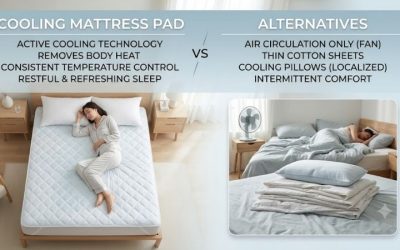
The biggest decision is whether you need better breathability or active temperature control. These are different functions, and understanding the distinction helps prevent unnecessary spending.
Understanding Cooling Mattress Pad Technology
Cooling mattress pads use several approaches to manage heat and moisture. Their effectiveness depends on fabric construction, mattress material, bedroom climate, and the bedding placed above them.
1. Breathable Cotton Mattress Pads
Cotton is a practical option for shoppers who want simple bedding without additional equipment.
Its comfort advantages come primarily from its ability to absorb moisture and allow air movement, depending on how tightly the fabric is woven and how the pad is constructed.
A thin cotton pad can work well on a firm mattress that already provides adequate support. It adds a modest comfort layer without substantially changing the mattress profile.
Best for: Small bedrooms, renters, and people who prioritize simple washing and minimal bulk.
Main trade-off: Cotton does not actively lower the mattress temperature. Thick quilting or dense synthetic filling can also reduce the breathability of an otherwise cotton-covered pad.
2. Lyocell and Bamboo-Derived Viscose Pads
Lyocell and bamboo-derived viscose are popular in temperature-regulating bedding because certain fabric constructions offer good moisture management and a smooth feel.
However, these are not identical materials or manufacturing processes.
Lyocell describes a regenerated cellulose fiber manufactured using a particular solvent-spinning process. Viscose derived from bamboo is also a regenerated cellulose fiber, but the original bamboo source alone does not establish superior cooling performance.
For compact bedrooms, the main benefit is that lightweight versions can provide a smooth sleeping surface without bulky padding.
Best for: Sleepers who dislike a heavy quilted feel and want a thin, comfortable surface.
Main trade-off: Cooling performance varies by fabric weight, weave, filling, and finishes. Labels such as “bamboo cooling” do not prove that a product will sleep cooler than cotton.
3. Phase-Change Material Cooling Pads
Phase-change materials absorb thermal energy during a change of physical state and can release that energy as conditions change.
In bedding, PCM treatments or components are intended to buffer temperature fluctuations near the sleeping surface.
This technology may be useful when you initially feel too warm after getting into bed.
However, PCM does not continuously remove unlimited amounts of heat. Once its heat-storage capacity is used, its cooling contribution changes until surrounding conditions allow it to release stored energy.
Best for: Sleepers who want passive temperature regulation without a separate control unit.
Main trade-off: Cooling sensations and duration depend on material quantity, placement, temperature conditions, and bedding layers. Product claims require supporting evidence.
4. Gel-Infused Cooling Pads
Some mattress pads and thin toppers incorporate gel-infused foam or gel-treated materials.
Gel can alter how heat moves through the sleeping surface, potentially creating a cooler initial sensation.
However, the effect is not equivalent to refrigeration, and a dense foam layer may reduce airflow around the body.
Gel marketing is particularly important to examine when shopping for a small bedroom because limited ventilation and a warm mattress can affect perceived comfort.
Best for: Buyers who also want a modest change in cushioning and prefer the feel of foam.
Main trade-off: Gel infusion alone does not establish sustained overnight cooling. Thicker foam products may also be mattress toppers rather than conventional thin mattress pads.
5. Water-Circulating Cooling Mattress Pads
Water-based systems circulate temperature-controlled water through internal channels or tubes in a mattress pad.
A connected control unit manages the water temperature. Depending on the model, the system may provide adjustable heating, cooling, or both.
These systems offer a different level of control from passive materials because they can actively transfer heat away from the sleeping surface.
For a compact bedroom, the control unit’s size and placement become important purchasing criteria.
Best for: Hot sleepers who need more temperature control than passive bedding can provide.
Main trade-off: Water-based systems can require reservoir care, tubing connections, electricity, and space for airflow around the unit. They also introduce potential leak and condensation considerations.
6. Air-Based Bed Cooling Systems
Air-based systems circulate air through bedding, under the covers, or through a compatible mattress surface, depending on their design.
Some systems actively condition the air, while others primarily move ambient room air.
That distinction matters: moving warm room air is not the same as supplying refrigerated air.
These systems may be useful if you dislike sleeping on a water-channel pad or want a cooling arrangement with fewer liquid-handling requirements.
Best for: Sleepers who prefer an airflow-based approach and have a suitable location for the equipment.
Main trade-off: Fan noise, airflow sensation, bed-frame clearance, outlet location, and the space occupied by the unit must be considered.
How to Choose the Correct Mattress Pad Size
Matching the pad to the mattress matters more in a small bedroom because loose edges, slipping fabric, and excessive bulk can make a compact sleeping area less comfortable.
Standard US Mattress Dimensions
| Mattress size | Typical dimensions |
| Twin | 38 × 75 inches |
| Twin XL | 38 × 80 inches |
| Full | 54 × 75 inches |
| Queen | 60 × 80 inches |
| King | 76 × 80 inches |
| California King | 72 × 84 inches |
Common nominal US mattress dimensions. Actual dimensions and manufacturing tolerances can vary.
A cooling pad should match the mattress’s actual width and length. A pad designed for a queen bed should not be treated as an interchangeable substitute for a full-size mattress, even if the skirt stretches.
Measure Mattress Depth Before Buying
Mattress depth is the distance from the top sleeping surface to the bottom of the mattress.
Measure it with any permanently installed topper included in the total height. Do not include removable sheets or blankets.
For fitted cooling pads, check the manufacturer’s published pocket-depth range rather than assuming a label such as “deep pocket” will accommodate every thick mattress.
A skirt that is too shallow may repeatedly pull free. An excessively loose skirt can create wrinkles or bunching.
Consider Split and Adjustable Mattresses
Owners of adjustable beds should confirm that their cooling pads tolerate repeated flexing.
A flexible fabric pad may be compatible with many adjustable setups, but that does not make every quilted or powered pad suitable.
Water-channel systems are especially important to evaluate because folding, pinching, or stretching tubing can affect their operation.
For split configurations, verify the exact mattress arrangement. Two Twin XL pads may be appropriate for certain split-king setups, while split-top mattresses require different compatibility considerations.
Small Bedroom Fit: How Much Space Does a Cooling System Need?
A conventional cooling mattress pad requires essentially no additional floor space beyond the bed.
Powered systems are different because the control hardware must fit somewhere outside or alongside the mattress.
Illustrative compact-bedroom layout
A passive pad stays on the mattress. An active system needs a separate, accessible location for its control unit, with manufacturer-specified ventilation clearance.
Check the Space Beside and Under the Bed
Before buying an active system, measure the intended equipment location.
Check the full height, width, and depth of the control unit, along with the room needed for connections and maintenance.
Under-bed installation should only be considered when the manufacturer explicitly permits it and required ventilation clearances are available.
A bed with drawers or enclosed storage may leave no suitable installation area underneath.
Plan for Electrical Access
Powered cooling systems require a suitable outlet and must be used according to their electrical instructions.
Check the product’s US electrical rating and whether it is designed for standard household power.
Avoid placing cords where they can be pinched by adjustable frames, trapped beneath furniture, or exposed to moisture.
Do not assume extension cords, power strips, or smart plugs are approved for a particular cooling device.
Consider Fan Noise in a Small Room
Noise can become more noticeable when a cooling unit sits close to the sleeper.
Look for credible published noise measurements, including the operating mode and measurement distance when available.
A quiet setting may move less air or provide less cooling than a high-performance setting, depending on the product.
If the manufacturer provides only subjective descriptions such as “whisper quiet,” treat these as marketing language rather than verified acoustic measurements.
Cooling Mattress Pad vs. Topper vs. Protector
These bedding categories overlap in advertising, but they serve different purposes.
| Feature | Cooling Mattress Pad | Cooling Mattress Topper | Cooling Mattress Protector |
|---|---|---|---|
| Main purpose | Temperature comfort and light cushioning | Changes mattress feel or adds substantial cushioning | Protects the mattress surface |
| Typical construction | Thin fabric or lightly filled layer | Thicker foam, latex, fiber, or other comfort material | Thin protective fabric, sometimes with a barrier |
| Effect on firmness | Usually modest | Can be significant | Usually minimal |
| Space requirements | Minimal | Adds mattress height | Minimal |
| Cooling capability | Passive or active, depending on design | Depends on construction and technology | Mainly breathability, unless specifically engineered otherwise |
| Washing | Often machine washable | Varies; some foam cannot be machine washed | Often washable, depending on materials |
When a Mattress Pad Is Enough
Choose a pad when your existing mattress is comfortable and you mainly want to manage heat or moisture.
A thin pad preserves more of the original mattress feel, making it practical for renters or people who already like their mattress’s support.
When a Topper Is More Appropriate
A topper is more suitable when temperature is only part of the problem and you also need a meaningful comfort adjustment.
However, adding a thick memory foam topper can increase the amount of material surrounding the body and may retain more heat than a thinner, breathable layer.
A topper also raises the mattress profile, which can affect fitted-sheet compatibility and the usable height of a bunk or loft bed.
When a Protector Should Take Priority
If spills, moisture, or mattress cleanliness are your main concerns, a protector may be more important.
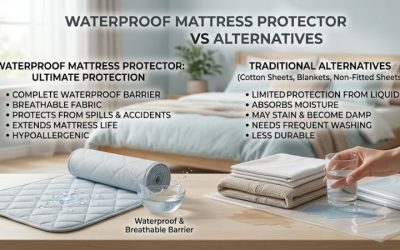
Not every cooling pad is waterproof. Likewise, waterproof protectors vary in breathability and may change the feel or sound of the sleeping surface.
Check whether the product provides a verified waterproof barrier rather than assuming moisture-wicking fabric prevents liquid penetration.
Key Features to Evaluate Before Buying
1. Breathability and Moisture Management
A breathable pad helps moisture vapor and warm air move through the bedding system.
This is especially relevant in humid apartments or rooms with limited air circulation.
Evaluate the entire pad construction, including:
-
Surface fabric and weave
-
Fiber filling and quilting density
-
Backing material
-
Waterproof barriers, if present
-
Total thickness and loft
A breathable fabric label does not guarantee that every layer underneath it offers similar airflow.
2. Thickness and Cushioning
Thin pads are generally easier to store, wash, and use with existing fitted sheets.
Thicker quilted pads can add softness, but they may change how deeply your body sinks into the sleeping surface.
If your mattress already feels too warm because you sink deeply into foam, adding a thick cushioned layer may not solve the underlying issue.
Prioritize temperature management over padding thickness when cooling is the primary objective.
3. Attachment and Stability
A cooling pad that repeatedly shifts can create wrinkles, interrupt sleep, and require frequent readjustment.
Fitted skirts, elastic corner straps, and other attachment designs have different compatibility requirements.
For smaller mattresses, precise fit is generally preferable to relying on excessive elastic stretch.
If you use an adjustable bed, verify that the attachment mechanism accommodates movement without putting tension on the pad.
4. Maintenance and Washing
Cleaning requirements affect convenience in apartments where access to laundry equipment may be limited.
For passive pads, check whether the entire product is machine washable and whether the care instructions permit tumble drying.
For active pads, confirm whether the mattress component can be separated from the control unit and safely washed.
A cooling pad that requires professional cleaning or complicated disassembly may be less practical for frequent use.
5. Material Sensitivity and Skin Comfort
Surface texture can matter as much as advertised cooling technology.
A smooth lyocell or cotton cover may feel more comfortable against bedding than a stiff, heavily treated synthetic surface, depending on the construction.
Buyers with known material sensitivities should review the full fiber composition, coatings, and care requirements.
Terms such as “hypoallergenic” or “non-toxic” should not replace meaningful material disclosures or product-specific evidence.
6. Long-Term Ownership Costs
A passive pad generally has fewer operating requirements than an active cooling system.
Powered systems may involve electricity, cleaning supplies, replacement components, subscriptions, or proprietary accessories.
Before purchasing, examine which features work without a subscription and whether replacement parts can be obtained.
A lower purchase price does not necessarily mean lower long-term ownership cost.
Choosing a Cooling Pad for Different Small-Space Bedrooms
Studio Apartments
In a studio apartment, the bed often shares space with living, cooking, and working areas.
A breathable, machine-washable cooling pad is usually the simplest option because it adds no equipment to an already crowded room.
Consider a thin cotton or lyocell design with a secure fitted skirt.
If persistent heat is the main concern, review the room’s ventilation and cooling conditions before investing in specialized bedding.
College Dorm Rooms
Dorm beds frequently use Twin XL mattresses, but exact dimensions and heights should still be verified.
A lightweight cooling pad makes seasonal storage and laundry easier.
Choose a product that can be removed without tools and cleaned using the available laundry facilities.
Powered cooling units may be restricted by residence rules, so check the housing policy before purchasing one.
Small Shared Bedrooms
Couples who share a compact bedroom may have different temperature preferences.
A conventional cooling pad affects the general bedding environment without providing independent temperature settings.
Dual-zone active systems may address that problem, but they usually introduce additional equipment and maintenance requirements.
A practical alternative is to experiment with individual blankets and appropriate breathable bedding before paying for a complex system.
Murphy Beds and Folding Beds
Folding systems place special demands on bedding thickness and flexibility.
A thin, flexible pad may be easier to accommodate than a thick topper or a pad with internal rigid components.
However, never assume an accessory is compatible merely because it is thin.
Check the Murphy bed manufacturer’s bedding-retention requirements and allowed mattress thickness. Remove incompatible powered cooling equipment before operating the folding mechanism.
Bunk Beds and Loft Beds
Mattress height is particularly important for elevated beds.
Adding a thick pad or topper can reduce the effective height of the guardrails relative to the sleeping surface.
Use only bedding configurations that comply with the bed manufacturer’s mattress-thickness limits and safety instructions.
A thin cooling mattress pad is generally the more practical category to consider, but compatibility must still be checked.
How Much Should You Spend on a Cooling Mattress Pad?
Rather than relying on a fixed price threshold, organize your budget around the function you actually need.
| Buying Tier | What to Prioritize | When It Makes Sense |
|---|---|---|
| Basic passive pad | Breathable fabric, correct fit, washable construction | You want a small, low-maintenance bedding upgrade |
| Enhanced passive pad | Documented fabric construction, PCM technology, durable attachment | You want temperature-buffering features without equipment |
| Premium passive pad | Better construction details, suitable materials, favorable care terms | You value material quality and long-term usability |
| Active cooling system | Adjustable cooling, compatible pad, serviceable control unit | Passive bedding is insufficient for your temperature preferences |
| Dual-zone system | Independent temperature settings and practical equipment placement | Two sleepers need different bed temperatures |
Avoid Paying for Marketing Claims Alone
A premium price does not establish that a pad will remain cooler throughout the night.
Be cautious with phrases such as “instant ice cooling,” “permanent cooling,” or “advanced thermal technology” when the product does not explain its construction or provide credible performance evidence.
A well-made breathable pad may be a better purchase than an expensive product with unsubstantiated cooling claims.
Compare the Complete Purchase
When comparing active systems, account for the entire package.
Confirm whether the listed configuration includes the mattress pad, control unit, connecting components, and accessories necessary for operation.
Also review the return policy, cleaning requirements, replacement-part availability, and warranty exclusions.
Do not assume all models within a brand have the same included components or service terms.
Common Mistakes When Buying Cooling Mattress Pads
Mistake 1: Assuming Every Cooling Pad Lowers Temperature
Many passive products are designed to improve heat or moisture management rather than actively refrigerate the bed.
If you expect the surface to maintain a selectable temperature all night, look for a system that explicitly provides active temperature control.
Mistake 2: Buying the Wrong Mattress Size
An oversized pad can bunch, while an undersized fitted pad can pull off the corners.
Measure the mattress before ordering, especially if you have a Twin XL, unusual mattress depth, or adjustable configuration.
Mistake 3: Ignoring the Existing Mattress
A thin cooling pad cannot fully overcome every thermal characteristic of the mattress beneath it.
Dense foam, deep body contouring, mattress protectors, heavy blankets, and poorly ventilated bedding can all affect heat retention.
Assess the full sleep setup instead of treating the pad as an isolated solution.
Mistake 4: Choosing Thick Foam for Cooling Alone
Extra cushioning is not always beneficial for temperature comfort.
A thick foam pad can change body contact and restrict airflow, even when it includes gel or cooling additives.
Choose additional thickness only when you also need the comfort adjustment.
Mistake 5: Overlooking Powered-System Placement
A control unit that fits physically under a bed may still lack adequate ventilation.
Never cover ventilation openings or place a powered system in an enclosed compartment unless its manufacturer specifically allows that installation.
Mistake 6: Forgetting the Bedding Above the Pad
A cooling mattress pad works as part of a layered sleeping environment.
Dense bedding placed above the pad can reduce the benefit of a breathable construction.
Evaluate the fitted sheet, blanket weight, and room conditions alongside the pad itself.
How to Set Up a Cooling Mattress Pad in a Small Bedroom
Step 1: Inspect and Measure Your Mattress
Confirm the mattress width, length, and depth.
Check for unusual corners, split sections, and adjustable mechanisms that could affect fit.
Step 2: Prepare a Clean, Dry Surface
Remove existing bedding and inspect the mattress for moisture, damage, or odors.
Allow any recently cleaned mattress surface to dry fully according to the mattress manufacturer’s instructions.
Do not install a new pad over a damp mattress.
Step 3: Position the Pad Correctly
Place the cooling pad over the mattress with its designated sleeping surface facing upward.
Secure fitted corners or straps according to the product instructions.
Smooth wrinkles and confirm that the pad does not pull excessively at the edges.
Step 4: Install Powered Components if Applicable
Follow the cooling system’s specific installation instructions.
Position its control unit on an approved, stable surface with adequate ventilation.
Route tubing and power cords away from pinch points, moving bed components, walking paths, and liquid hazards.
For water-based systems, use only the manufacturer-specified water type and maintenance products.
Step 5: Add Compatible Bedding
Use appropriately sized fitted sheets over the pad if the product requires them.
Avoid excessively tight sheets that distort the pad or place tension on cooling channels.
Step 6: Check the Setup Before Sleeping
For passive pads, confirm that the pad stays flat and that the sheets fit securely.
For powered systems, verify proper connections, normal operation, and the absence of leaks or abnormal sounds according to the manufacturer’s instructions.
Check again after the first few nights, particularly if the bed is adjustable.
Maintenance Tips for Better Long-Term Performance
Keep the Pad Clean and Dry
Wash passive cooling pads according to their care labels.
Different fabrics and fillings may require different water temperatures, spin cycles, and drying methods.
Do not assume that high heat is appropriate for products containing specialty coatings, elastic components, or PCM materials.
Prevent Moisture Buildup
Humidity can make a compact bedroom feel uncomfortable even when the bedding is relatively breathable.
Maintain reasonable ventilation and address persistent moisture sources.
If condensation or visible dampness appears around a powered cooling system, stop using it and follow the manufacturer’s troubleshooting and safety guidance.
Maintain Active Cooling Systems Properly
Water-based systems may require reservoir maintenance, cleaning cycles, and inspection of connections.
Air-based systems may require intake cleaning or filter maintenance, depending on the model.
Follow the specified service intervals rather than introducing household cleaning chemicals or improvised treatments.
Store Seasonal Bedding Correctly
Clean and fully dry a removable mattress pad before storage.
Use a dry, suitable storage location and avoid long-term compression when the manufacturer advises against it.
For active equipment, follow the manufacturer’s shutdown, draining, and storage procedure.
When a Cooling Mattress Pad May Not Solve the Problem
A cooling mattress pad can improve the immediate sleeping environment, but it has limits.
If the bedroom remains extremely warm, passive bedding cannot reliably maintain a lower temperature than the environment around it.
If the mattress provides inadequate support, a thin cooling pad will not correct a sagging foundation or worn-out support system.
Frequent or severe night sweats can also have causes unrelated to bedding. If sweating is new, persistent, unexplained, or accompanied by symptoms such as fever or unexplained weight loss, seek medical advice rather than relying only on cooling accessories.
For many small bedrooms, better room temperature management, lighter bedding, and adequate ventilation should be considered alongside a mattress pad.
Frequently Asked Questions
Can a cooling mattress pad make a small bedroom less hot?
A cooling mattress pad primarily affects the sleeping surface, not the overall room temperature. Passive materials can improve moisture and heat management near the body, while active systems may remove heat from the bed. Powered systems also release heat during operation, so they should not be treated as substitutes for room cooling.
Is a cooling mattress pad better than a cooling topper for a small bed?
A pad is usually the more practical choice when you want temperature comfort without significant changes to mattress firmness or height. A topper is preferable when you also need substantial cushioning or a different mattress feel. Product construction matters more than the label alone.
Do cooling mattress pads work without electricity?
Yes. Cotton, lyocell, certain breathable constructions, and PCM-based pads can offer passive temperature-management benefits without electricity. They do not provide the same adjustable cooling capability as powered water- or air-based systems.
Can I use a cooling mattress pad on a memory foam mattress?
Generally, yes, provided the pad fits and does not conflict with the mattress manufacturer’s requirements. A breathable pad may improve the surface feel, but it cannot eliminate all heat retention associated with the underlying foam. Avoid assuming that adding a thick gel-foam layer will necessarily improve cooling.
Can I wash a cooling mattress pad in a regular washing machine?
Many passive pads are machine washable, but the appropriate settings depend on fabric composition and construction. Some active cooling pads have removable washable components, while others require specialized cleaning. Always follow the exact product’s care instructions.
Is a cooling mattress pad worth buying for a dorm room or studio apartment?
It can be worthwhile if the existing mattress is comfortable but the bedding feels warm or clammy. Start with an accurately sized, breathable, washable pad that requires no separate equipment. Consider powered systems only when the cooling benefits justify their cost, noise, maintenance, placement needs, and any building restrictions.
Conclusion
The best cooling mattress pad for small spaces is one that matches your mattress dimensions, sleeping temperature needs, and available room space. For most apartments, dorms, and compact bedrooms, a thin cotton or lyocell pad offers a practical combination of breathability, easy maintenance, and minimal bulk. Choose PCM-based bedding for additional passive temperature regulation, or consider an active cooling system when you need adjustable cooling and have adequate space for its equipment. Prioritize verified construction details, secure fit, realistic cooling expectations, and straightforward maintenance over marketing claims.