Choose a bed rail for adults for small spaces by comparing compact handles, mattress compatibility, bedroom clearance, installation, and entrapment safety.
Choosing a bed rail for adults for small spaces requires more careful planning than simply finding a narrow product that fits beside the mattress. A portable bed rail may provide a handhold for getting out of bed, support repositioning, or help reduce certain falls, but it can also create serious entrapment hazards when used with an incompatible mattress or bed frame. In a compact bedroom, restricted walking space and nearby furniture add further considerations.
This guide explains how to select an appropriate rail or transfer handle, measure a small bedroom, check bed compatibility, and recognize situations where an alternative support arrangement may be safer.
Define the Purpose Before Choosing a Compact Bed Rail
Adult bed rails serve different functions, and those functions should not be confused. Some devices are primarily designed as transfer handles, while others provide more extensive coverage along the mattress edge.
A compact handle may be suitable for a person who remains mobile but appreciates a stable point of contact when moving from lying to sitting or standing. A longer rail may serve a different purpose, but it also introduces additional considerations involving mattress gaps, access, and the possibility of climbing over the barrier.
For small bedrooms, the correct product is usually the least obstructive design that safely meets the individual’s assessed needs.
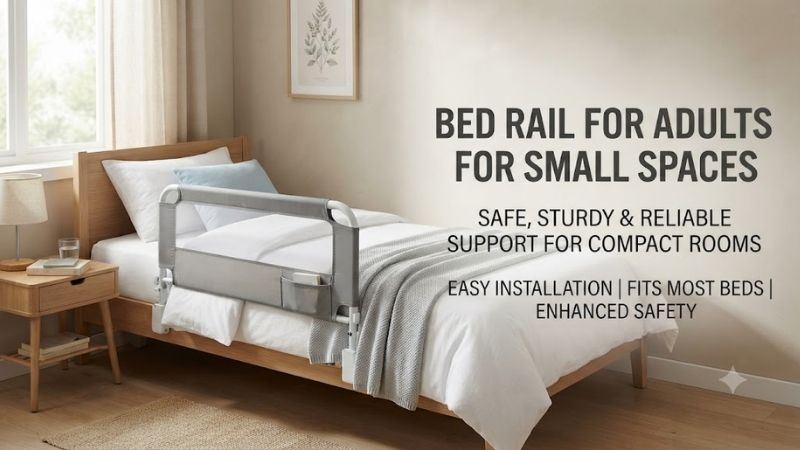
Transfer Handles for Getting Out of Bed
A transfer handle provides a grasping point near the mattress edge. Its primary function is to assist a person during an ordinary movement, such as moving from lying to sitting or preparing to stand.
This type of device may be attractive in a small bedroom because it typically occupies less length along the side of the mattress than an extended barrier.
However, a compact handle must still be securely installed. Its small size does not remove entrapment risks or guarantee compatibility with a particular bed.
The user must also have sufficient strength, balance, and understanding to use it appropriately.
Bed Rails Intended to Reduce Rolling From Bed
Some longer rails are intended to reduce certain risks associated with rolling toward the mattress edge.
These products cover more of the side of the bed and may restrict available entry and exit points.
A long rail should not be selected automatically for someone who has previously fallen. The cause of the fall and the person’s ability to move safely need to be assessed.
A barrier can create additional hazards if a person attempts to climb over it or becomes trapped between the rail and mattress.
Repositioning and Mobility Assistance
Other products provide multiple grasping points to assist with movement on the mattress.
They may be useful when a person can reposition independently but benefits from additional leverage.
However, no bed rail should be used to force a person into one position or prevent voluntary movement.
For users with significant mobility limitations, a qualified healthcare professional may recommend a different transfer aid or sleeping arrangement.
Which Bed Rail Type Fits a Small Bedroom?
| Device type | Main purpose | Small-space advantage | Important limitation |
|---|---|---|---|
| Compact bed cane | Transfer handhold | Less mattress-edge obstruction | Not a full protective barrier |
| Mobility-oriented handle | Transfers and repositioning | Targeted support | Requires appropriate user ability |
| Short portable rail | Limited side coverage | Smaller than extended rails | Must still meet safety requirements |
| Extendable bed rail | Adjustable edge coverage | Can adapt to specified arrangements | May obstruct exit routes |
| Pivoting rail | Movable bedside barrier | Can create access when appropriately operated | Requires movement clearance |
| Adjustable-bed-compatible rail | Support on specified adjustable platforms | Avoids incompatible general-purpose mounting | Bed-frame restrictions |
The appropriate product cannot be determined by width alone. Installation safety, intended function, and user suitability are more important.
How to Measure a Small Bedroom for an Adult Bed Rail
Many shoppers measure only the distance between the mattress and a nearby wall. That is not enough to establish whether a bed rail can be installed or used safely.
A product may extend outward during transfers, require access beneath the mattress, or need clearance from surrounding furniture.
The person also needs room to stand, use a walker if required, and move away from the bed without encountering obstacles.
Measure the Mattress and Bed Frame
Record the mattress width, length, and thickness.
Then examine the bed frame and identify the support structure beneath the mattress.
Some portable rails use a horizontal support section beneath the mattress with a retention strap or other approved securing system.
The presence of bed slats, solid platforms, drawers, or unusual frame geometry may influence compatibility.
Never assume that sliding a rail beneath the mattress is sufficient installation.
Measure Walking Clearance
A narrow bedroom may have only one practical route beside the bed.
If a rail extends into that route, it may create a tripping hazard or interfere with mobility equipment.
Measure the usable walking space with the product in its normal position and, if applicable, its folded or pivoted position.
There is no universal minimum clearance that makes every installation safe. The appropriate arrangement depends on the occupant’s mobility and the room.
Check Nearby Furniture
Nightstands, dressers, wardrobes, and headboards can create hazards when positioned too close to a portable rail.
CPSC consumer guidance recommends keeping at least 12.5 inches between the bed rail and the headboard or footboard and keeping nearby furniture away from the rail.
This recommendation addresses potential hazardous gaps, not merely convenience.
Do not assume a compact bedroom justifies reducing the required clearance.
An Example: A Bed Beside a Wall
Consider an adult sleeping on a full mattress with one side close to the wall.
A compact transfer handle may appear ideal because it occupies little space.
However, installation must still allow the required mattress fit and proper retention system. The nearby wall must not create an unsafe gap or obstruct movement.
If there is insufficient room for a safe installation and transfer route, the correct solution is not to squeeze the rail into place.
Rearranging furniture, changing bed position, or considering a different professionally assessed support option may be necessary.
Bed Rail Dimensions That Matter Most
A compact rail’s advertised width does not establish the complete space needed.
Manufacturers may specify rail length, height above the mattress, under-mattress support depth, and frame extension.
All of these can affect the installation.
Rail Length
A short rail may leave more of the mattress edge accessible.
This can be desirable for a person who needs a transfer handle.
A longer rail may provide additional edge coverage but also interfere with normal entry and exit.
Length should be selected according to the intended function, not simply maximum coverage.
Rail Height
The rail must provide the intended support relative to the mattress surface.
A rail that extends only slightly above a thick mattress may not function as expected.
For consumer adult portable bed rails, the applicable federal requirements include minimum structural dimensions under defined testing conditions.
Do not judge a product’s effective height using photographs alone.
Under-Mattress Depth
Some devices include a support section that extends beneath the mattress.
The dimensions of this section may affect compatibility with slatted or platform foundations.
Check the approved frame types and retention arrangement.
Clearance During Folding or Pivoting
A pivoting rail may appear compact when upright but require additional space to move out of the way.
Measure the full operating path.
If furniture blocks the mechanism, the product may not be suitable for that bedroom.
Mattress Compatibility Is More Important Than Compactness
One of the most serious hazards associated with adult portable bed rails is entrapment between the rail and mattress.
A mattress can compress under body weight, and that movement may create or enlarge gaps.
The problem is not limited to whether the rail appears securely positioned when the bed is unoccupied.
Mattress Thickness
Portable bed rails often specify a range of compatible mattress thicknesses.
A mattress outside that range may prevent the rail from reaching the intended height or remaining correctly positioned.
Do not assume that additional straps or cushions can compensate for an unsupported thickness.
Mattress Firmness
A thick but relatively firm mattress may behave differently from a soft mattress of the same height.
Soft edges can compress substantially, creating gaps that are not visible when the mattress is unloaded.
Check any manufacturer restrictions concerning extra-soft mattresses.
Mattress Toppers
Adding a topper changes total mattress height and may affect edge compression.
A bed rail that was originally compatible with the mattress may no longer satisfy its installation requirements.
Reassess compatibility whenever the mattress arrangement changes.
Memory Foam Mattresses
Some memory foam mattresses have softer edges or different compression characteristics from traditional innerspring constructions.
However, material alone does not determine compatibility.
The manufacturer’s stated requirements and the actual assembled bed system matter.
Understanding Entrapment Hazards
Entrapment occurs when a person’s body becomes trapped in an opening or space from which they cannot escape safely.
With adult portable bed rails, hazards can occur within the rail, between rail components, or between the rail and mattress.
The potential consequences include serious injury and asphyxiation.
This is why a bed rail should not be treated as an ordinary bedroom accessory.
Gaps Between the Rail and Mattress
A gap can develop when the rail is insufficiently secured or the mattress compresses.
A person may slide partly into the space and become unable to move.
The risk is particularly serious for someone with reduced strength or an impaired ability to reposition independently.
Openings Within the Rail
The rail’s own structure may contain openings.
Applicable safety standards address entrapment hazards within and around these structures.
Do not assume a visually simple design is safe without appropriate testing and documentation.
Gaps Near the Headboard or Footboard
A rail positioned too close to a headboard or footboard may create another trapping area.
This is especially relevant in small bedrooms where the rail is placed wherever there appears to be enough room.
Follow manufacturer placement requirements and applicable consumer safety guidance rather than improvising.
Why Extra Padding Is Not a Safe Fix
Do not stuff ordinary pillows, towels, blankets, or foam pieces into rail gaps to compensate for improper installation.
Such additions can move, compress, or create new hazards.
An incompatible rail should not be used until a suitable solution has been identified.
Who Should Use an Adult Bed Rail?
A portable rail may be appropriate for some adults who need limited assistance with movement or bed transfers.
However, the decision should consider the person’s physical and cognitive abilities.
Adults With Mild Transfer Difficulties
Someone who can understand instructions, move independently, and use a handhold appropriately may benefit from a suitable transfer device.
The rail must still be installed correctly and have an appropriate intended load rating.
Adults With Significant Weakness
A person who cannot reliably move or remove themselves from hazardous positions may face increased risk.
A portable rail is not a substitute for caregiver assistance or a professionally selected transfer system.
People With Dementia or Cognitive Impairment
Confusion, restlessness, and difficulty understanding a barrier can increase entrapment and fall hazards.
Some people may attempt to climb over a rail, creating a greater fall distance.
An individualized clinical assessment is particularly important in these situations.
People With Frequent Falls
A history of falling should prompt investigation of contributing factors.
These may include medication effects, dizziness, weakness, environmental obstacles, or difficulty transferring.
Installing a longer rail is not necessarily the best response and can introduce additional hazards.
Installation Requirements in a Small Bedroom
A portable rail must remain securely attached in the way intended by its manufacturer.
The under-mattress section alone may not provide sufficient retention.
Retention Straps
Some rails use a strap system that secures the product to the bed frame.
The strap must be installed and adjusted exactly as directed.
Do not omit it because the mattress seems heavy enough to hold the rail.
Approved Hardware
Some products designed for particular adjustable bed frames use specific mounting hardware.
Never substitute household screws or drill into an unsupported frame.
Post-Installation Checks
After installation, inspect the rail’s position relative to the mattress and verify that all required components are correctly secured.
The relevant safety tests are more sophisticated than simply shaking the handle by hand.
A product that feels stable in a casual test may still be incompatible.
Changes to the Bed
Moving the frame, replacing the mattress, adding a topper, or changing an adjustable-base configuration can alter the installation.
Reassess compatibility rather than assuming the original setup remains safe indefinitely.
Alternatives When a Bed Rail Will Not Fit Safely
A small bedroom may not have enough room for an appropriate portable rail and safe transfer route.
In that situation, another support strategy may be preferable.
Lowering the Bed
A lower sleeping surface may reduce the severity of certain falls.
However, a low bed can make standing more difficult for some adults.
The appropriate height depends on individual mobility.
Transfer Assistance Equipment
Some people benefit from a different professionally selected transfer aid.
This may include equipment intended to assist standing or repositioning without creating a rail along the mattress edge.
Environmental Changes
Improving lighting, removing obstacles, relocating furniture, and creating clear walking paths can address some fall risks.
These measures may be particularly valuable in a compact room.
Professional Home Assessment
An occupational therapist or another qualified professional can evaluate the bedroom, bed height, transfer method, and the person’s abilities.
This can prevent purchasing a device that fits physically but is inappropriate for the user.
What to Check Before Buying
| Buying question | Why it matters | Action |
|---|---|---|
| What assistance is actually needed? | Determines appropriate device type | Identify transfers, repositioning, or fall-risk concerns |
| Does the manufacturer document compliance? | Addresses mandatory safety requirements | Confirm exact model and applicable standard |
| Is the mattress compatible? | Helps prevent hazardous gaps | Check thickness and firmness restrictions |
| Is the bed frame supported? | Determines secure installation | Review frame and attachment instructions |
| Is there enough walking space? | Prevents obstruction and transfer hazards | Measure normal and operating positions |
| Are required straps included? | Essential to retention | Reject incomplete hardware |
| Is the person able to use the rail safely? | Prevents misuse and entrapment | Seek assessment when appropriate |
| Has the model been recalled? | Identifies known safety concerns | Check the exact product identity |
Common Small-Bedroom Bed Rail Buying Mistakes
Choosing the Shortest Product Without Checking Its Purpose
A compact handle may be attractive because it occupies little mattress space. However, it may not provide the intended assistance if the person’s needs involve a different type of support.
Start with a clear assessment of the task. A transfer handle and an extended barrier are not interchangeable simply because both are marketed as bed rails.
Installing a Rail Close to Furniture
A narrow room can encourage placing a bed rail immediately beside a nightstand, headboard, or other object.
This can create trapping hazards or interfere with movement. Follow the required placement clearances, including the applicable guidance concerning separation from headboards and footboards.
Believing a Tight Fit Means a Safe Fit
Pushing a rail firmly against the mattress is not sufficient if the product requires a retention strap or other approved attachment.
The mattress can compress and move during sleep.
Use every required component and follow the product-specific compatibility rules.
Frequently Asked Questions
What Is the Best Bed Rail for Adults in a Small Bedroom?
The best option is the least obstructive compliant device that safely meets the person’s actual needs. A compact transfer handle may be suitable when the main task is getting out of bed, while a longer rail serves a different function and may introduce additional hazards. Mattress compatibility and user suitability come before physical size.
Can I Use a Portable Bed Rail on a Platform Bed?
Only when the exact rail manufacturer supports that type of platform bed and provides appropriate installation instructions. Solid bases, unusual frames, and restricted attachment points can prevent secure mounting. Do not improvise straps or hardware.
Are Compact Bed Rails Safer Than Long Rails?
Not inherently. Both short and long portable rails can create entrapment hazards. Short handles may leave more of the mattress edge unobstructed, but safety depends on compliance, installation, mattress fit, and the person’s ability to use the device appropriately.
Can a Bed Rail Prevent an Older Adult From Falling?
A rail may reduce certain risks for appropriately selected users, but it does not prevent every fall. Some people may climb over rails or become trapped. A history of falls warrants individualized assessment rather than automatic installation of a longer barrier.
How Much Space Should I Leave Between a Bed Rail and Headboard?
CPSC consumer guidance recommends at least 12.5 inches between a portable adult bed rail and the headboard or footboard, along with keeping surrounding furniture away from the rail. Follow the manufacturer’s requirements and do not use a configuration that creates hazardous gaps.
Should Someone With Dementia Use a Bed Rail?
Portable bed rails can be particularly hazardous for people with confusion, restlessness, or impaired mobility. They should not be used as restraints. A qualified professional should assess whether a rail or a different arrangement is appropriate.
Conclusion
The best bed rail for adults for small spaces is a properly documented, compatible device that supports the user’s actual mobility needs without obstructing movement or creating dangerous gaps. A compact transfer handle may be more practical than an extended barrier when standing assistance is the main goal, but neither design is automatically safe. Check mattress and frame compatibility, required retention hardware, room clearance, and individual entrapment risk before purchasing.