Choosing a bedside sleeper bassinet is not simply a matter of finding a comfortable-looking place for your newborn. The product must provide a separate, firm, flat sleep surface, fit your adult bed correctly, and meet applicable infant sleep safety requirements. Features such as adjustable height, lowering side panels, wheels, and storage can make nighttime caregiving more convenient, but they must never compromise the baby’s sleeping environment.
Start by Identifying the Correct Type of Infant Sleep Product
One of the most important purchasing decisions comes before comparing brands or prices: determining whether you need a true attached bedside sleeper or a conventional bassinet placed near the adult bed.
These products can look similar in photographs, and retailers sometimes describe both as bedside bassinets. However, they do not necessarily use the same attachment systems or permit the same sleeping configurations.
A parent who wants a bassinet beside the bed may not need an attached sleeper at all. Conversely, someone specifically looking for approved bedside access must choose a product designed for that function, not modify a conventional bassinet.
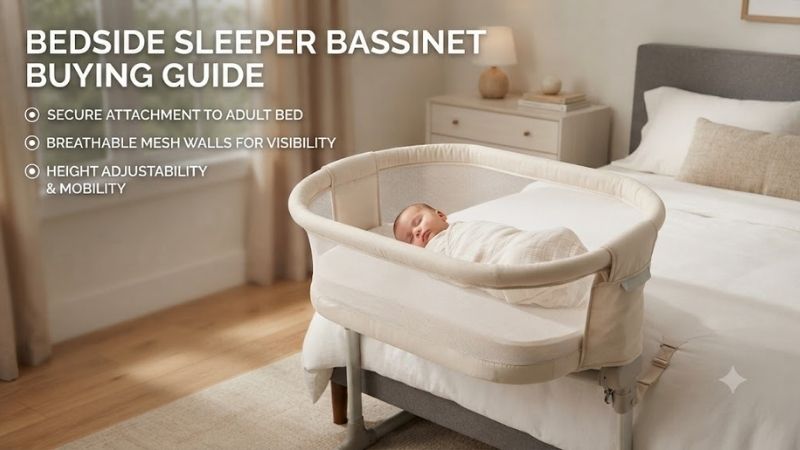
Attached Bedside Sleepers
A true bedside sleeper is designed to be secured to a compatible adult bed. Its attachment components are essential to the product’s intended configuration.
In the United States, bedside sleepers are subject to requirements under 16 CFR Part 1222, which incorporates the applicable ASTM bedside sleeper standard. These requirements address hazards such as separation from the adult bed, unintended disengagement, barriers, and entrapment.
The product must also meet applicable bassinet and cradle requirements.
For buyers, this means the attachment system, mattress-height alignment, and operating instructions are central safety considerations rather than optional features.
Choose an attached bedside sleeper when: You specifically want the approved attached configuration and can confirm that your adult bed supports the required installation.
Avoid this configuration when: The bed frame, mattress height, or attachment points do not meet the manufacturer’s requirements.
Freestanding Bedside Bassinets
A freestanding bassinet is a separate infant sleep product that can be positioned near the adult bed without being attached to it.
Some freestanding designs offer adjustable height, mesh sides, wheels, or a swivel mechanism to improve caregiver access. These features may be sufficient for parents who simply want the baby nearby.
The key restriction is that a conventional freestanding bassinet cannot be converted into an open-sided attached sleeper unless the exact product is expressly designed and approved for that configuration.
A zipper, hinge, or lowering panel does not independently establish that open-sided sleep is permitted.
Bassinets Versus Mini Cribs
A mini crib may be another suitable choice when the family wants a relatively compact sleeping space that can remain useful beyond the earliest infancy stage.
However, mini cribs and bedside sleepers serve different purposes.
A mini crib generally does not provide the same attached access arrangement. It may also occupy more floor space and have different assembly and mattress requirements.
The better choice depends on intended use, available bedroom space, and how long the family expects to use the product.
Bedside Sleeper Bassinet Comparison: Which Design Fits Your Needs?
| Product type | Primary advantage | Important limitation | Best starting situation |
|---|---|---|---|
| Attached bedside sleeper | Approved attachment to compatible adult bed | Requires secure connection and correct alignment | Parents seeking attached bedside access |
| Freestanding bassinet | Separate enclosed infant sleep area | Requires sufficient floor space | Parents wanting simple room sharing |
| Height-adjustable bassinet | Easier positioning near different bed heights | Adjustment does not guarantee attachment compatibility | Households with higher or lower beds |
| Swivel bassinet | Convenient movement of the sleeping compartment | Supporting base may be large | Bedrooms with appropriate floor clearance |
| Portable bassinet | Easier moving or storage when approved | Assembly and locking mechanisms must be checked | Families needing portability |
| Mini crib | Potentially longer useful sleep stage | Usually lacks bedside-sleeper attachment | Families prioritizing longer-term use |
This comparison describes product categories, not an endorsement of every model sold under those names. The exact product’s compliance, instructions, and compatibility remain decisive.
The Non-Negotiable Requirements for Safe Infant Sleep
No amount of premium fabric, electronic rocking, or storage convenience can compensate for an unsuitable infant sleep surface.
The American Academy of Pediatrics recommends that babies sleep on their backs, on a firm, flat, non-inclined surface, in their own appropriate sleep space. The area should contain the approved mattress and properly fitted sheet, without loose blankets, pillows, toys, or other soft objects.
A parent choosing a bedside sleeper should begin with these fundamentals before considering convenience features.
Firm and Flat Mattress Construction
Infant mattresses are intentionally firm. An adult may regard the surface as uncomfortable, but adult bedding preferences are not a reliable guide to infant sleep safety.
A compliant bassinet should use the mattress supplied or expressly approved by the manufacturer. Its size and firmness are part of the intended sleep system.
Adding a foam topper, folded towel, additional mattress, or ordinary pillow can create softness and gaps that the product was not designed to accommodate.
If a bassinet mattress seems unusually thin, do not replace it with a thicker aftermarket product without explicit manufacturer approval.
A Level, Non-Inclined Sleeping Surface
A bassinet should not be deliberately tilted to help with ordinary infant reflux, congestion, or fussiness.
An inclined surface can allow an infant’s position to change in ways that affect breathing. The AAP advises against infant sleep surfaces inclined more than 10 degrees and recommends a firm, flat, level surface.
This is especially important when comparing products advertised with adjustable positioning. A height adjustment designed to align a sleeper with an adult bed should not be confused with permission to incline the infant mattress.
Parents concerned about reflux should seek pediatric guidance rather than using wedges or improvised mattress elevation.
Back Sleeping for Every Sleep
Infants should be placed on their backs for nighttime sleep and naps.
Marketing terms such as breathable mattress or airflow mesh do not change that recommendation.
Mesh sides may offer visibility and ventilation, but they do not make stomach sleeping safe for a newborn or justify adding sleep positioners.
Room Sharing Without Bed Sharing
Keeping the infant’s separate sleep space in the parents’ room can make nighttime care more convenient. The AAP recommends room sharing without bed sharing, ideally for at least the first six months.
This does not mean placing the newborn on the adult mattress.
Even with an attached bedside sleeper, the infant remains on a separate approved sleeping surface, and the entire product must be operated according to its instructions.
Understanding US Bassinet and Bedside Sleeper Safety Standards
A product being available online does not, by itself, establish that it meets applicable safety requirements.
For US shoppers, the relevant product classification determines which standards apply.
Bassinets and Cradles: 16 CFR Part 1218
Bassinets and cradles are covered by the federal bassinet safety rule. The applicable standard and edition depend on the product’s manufacturing or import date and the regulations in effect.
These requirements address issues such as structural integrity, stability, sleeping surfaces, and other hazards associated with infant sleep products.
When purchasing a new product, verify the exact model and its documentation rather than relying on an unsupported statement that it is simply certified safe.
Bedside Sleepers: 16 CFR Part 1222
A true bedside sleeper must address additional risks that arise from being secured to an adult bed.
These include the possibility of a dangerous gap between the adult mattress and sleeper, separation of attachment components, and problems with a lowering side or barrier.
A model designed for attached operation should have clear instructions explaining which adult beds are compatible and how every required attachment component is installed.
What to Look for in Product Documentation
A legitimate product should have identifiable manufacturer information, a model designation, appropriate labels, and accessible instructions.
When information is missing or ambiguous, request clarification before purchase.
Avoid products whose safety claims consist only of vague phrases such as medical-grade, hospital quality, or universal protection.
Adult Bed Compatibility: The Most Important Attached-Sleeper Check
Many buying guides focus on how many height adjustments a bedside sleeper offers. That is useful information, but it does not establish whether the product can be installed safely.
An attached sleeper must work with the actual adult bed, including mattress height, frame construction, and the attachment system.
Measuring Mattress Height
Measure from the floor to the top of the adult mattress in its ordinary sleeping configuration.
Do not measure only the bed frame or mattress thickness.
A thick mattress placed on a low platform can have a different overall height from a thinner mattress on a tall foundation.
Compare the measurement with the manufacturer’s supported range.
Platform Beds
Platform beds may have a solid base, recessed mattress support, or structural panels that interfere with attachment straps.
Some sleepers require a particular route for securing components.
Do not assume that a product is compatible simply because its legs fit beneath the bed.
Storage Beds
Storage beds often contain drawers or enclosed lower frames.
These features can block attachment paths or prevent the sleeper from being secured as designed.
If installation requires modifying the frame or using improvised hardware, the product is not an appropriate choice for that configuration.
Adjustable Beds
Adjustable beds change shape as the head and foot sections move. This can alter the relationship between the adult mattress and an attached sleeper.
Use an attached sleeper only when the manufacturer expressly supports the specific adjustable-bed arrangement.
The apparent fit while the bed is flat does not establish safety through every adjustment position.
Why Attachment Straps Cannot Be Optional
The attachment system is designed to keep the sleeper in its intended position relative to the adult bed.
If the sleeper moves away, a dangerous gap can develop.
Do not rely on pushing the bassinet tightly against the mattress or placing heavy furniture nearby as substitutes for the required retention system.
How to Measure Your Bedroom for a Bassinet
The size printed on a product listing often describes the sleeping compartment, but the frame may be much larger.
A bassinet with a compact interior can have legs or a supporting base that extend into the walkway.
Measure the complete external footprint, including any components that project beyond the sleeping area.
Width and Depth
The product needs enough floor space to stand securely without obstructing doors, drawers, or essential walking routes.
Consider the bassinet’s position during nighttime care, not just where it looks best when the room is empty.
Bedside Clearance
The caregiver should be able to access the baby and get out of bed without climbing over obstacles.
A large swivel base or outward-extending legs may interfere with the available route.
A smaller freestanding product may be more suitable when floor clearance is tight.
Nearby Furniture
Nightstands, dresser drawers, and closet doors can conflict with a bassinet’s footprint.
Do not place furniture so close that it prevents the product from being assembled or operated as intended.
Also keep curtains, window-covering cords, charging cables, and similar hazards outside the infant’s reach.
An Example of a Bedroom Fit Decision
Consider a hypothetical bedroom with a queen-size bed, a nightstand, and a dresser.
A parent identifies 28 inches of visible space beside the bed and assumes any bassinet narrower than 28 inches will fit.
However, the bassinet’s legs may extend beyond the sleeping compartment, and the dresser drawer may require additional clearance.
The correct approach is to measure the full base and the room’s usable movement paths. If the attached model cannot be installed correctly or obstructs essential access, a different compliant freestanding bassinet may be preferable.
Height Adjustments, Swivels, and Lowering Sides
Convenience features can be valuable during repeated nighttime caregiving, but every adjustment introduces additional operating requirements.
Height Adjustment
Height adjustment may allow the bassinet to sit at a more convenient position relative to the adult mattress.
For a true attached sleeper, the selected position must satisfy the manufacturer’s specific alignment requirements.
A product offering six height settings is not necessarily more compatible than one offering four.
Actual supported measurements are more important than the number of positions.
Swivel Mechanisms
A swivel mechanism can help move the sleeping compartment toward or away from the caregiver.
This may improve accessibility in a suitable bedroom layout.
However, the supporting base still requires adequate floor space, and the product must remain stable in its intended operating positions.
Lowering or Zip-Down Side Panels
Some bedside sleepers have an access wall that can be lowered.
Whether that panel may remain lowered during sleep depends on the exact approved configuration.
Never assume that a visible zipper or lowering wall authorizes an open-side arrangement.
Follow the product’s instructions for securing the wall and attachment components.
Wheels and Mobility
Wheels can make some freestanding bassinets easier to reposition.
However, they do not automatically make the product appropriate for transporting an infant while occupied.
Check the instructions and locking requirements. A wheeled bassinet must remain stable during sleep.
Mesh Sides, Visibility, and Airflow Claims
Mesh is a common feature of contemporary bassinets. It can make the infant more visible and may allow airflow through the side panels.
However, it should not be treated as the single feature that determines whether the product is safe.
A bassinet with mesh sides still requires a suitable mattress, stable frame, appropriate dimensions, and correct assembly.
Visibility During Nighttime Care
Mesh panels can allow caregivers to see the infant without leaning over the sleeping compartment.
This may be useful in a bedroom where the bassinet is positioned immediately beside the adult bed.
However, visibility does not remove the need for safe sleep practices or appropriate supervision.
Breathable Mattress Marketing
Some manufacturers emphasize specialized mattress designs intended to permit airflow.
These claims should not be interpreted as permission for prone sleeping, loose bedding, or soft surfaces.
The baby should still be placed on the back on the approved firm, flat mattress.
Privacy and Environmental Conditions
A bassinet’s mesh construction does not guarantee a particular sleeping temperature.
Room conditions, clothing, and appropriate infant sleepwear remain important.
Avoid adding padded liners or blankets to modify the side panels.
Cleaning and Maintenance: Features That Matter Every Day
Newborn sleep products frequently require cleaning because of spit-up, leaks, and everyday use.
A practical bassinet should allow caregivers to maintain the approved sleeping surface without replacing components with unsuitable alternatives.
Removable Fabric Components
Some bassinets have removable fabric panels, while others require more limited cleaning.
Before purchase, check whether the fabric can be washed and how it must be reinstalled.
Improper reassembly can affect the stability or function of the product.
Mattress and Sheet Care
Use the manufacturer’s approved mattress and compatible fitted sheet.
A replacement sheet that appears close in size may still fit loosely or bunch around the mattress.
The exact dimensions and compatibility matter.
Drying Requirements
All washable components should be thoroughly dry before reassembly.
Do not use the bassinet with damp fabric or incorrectly installed components.
Replacement Parts
Check whether the manufacturer offers approved replacement sheets, mattress components, and hardware.
Do not use substitute attachment straps or improvise missing locks.
A product with inexpensive initial pricing may be poor value if essential replacements cannot be obtained.
Storage Features and Bedroom Organization
Integrated storage can be convenient, especially when diapers and routine supplies need to be close to the bed.
However, storage should remain completely separate from the infant sleeping area.
Under-Bassinet Baskets
A lower basket may provide space for diapers, wipes, and spare clothing.
This can reduce the need for an additional bedside storage cart.
However, follow the basket’s load limits and do not use it for heavy objects the frame was not designed to support.
Side Pockets
Small pockets may hold lightweight caregiver items.
Keep contents from falling into the infant’s sleep space, and ensure nothing creates a reachable cord or entanglement hazard.
Why More Storage Is Not Always Better
Large baskets and shelves can increase the product’s footprint.
If bedroom space is severely restricted, a simpler bassinet and an existing safe storage location may be a better arrangement.
Product Lifespan: When Does a Baby Outgrow a Bassinet?
Bassinets are intended for early infancy. Their safe-use limits depend on the exact model and the child’s development.
Weight limits are important, but they are not the only restriction.
Manufacturer Weight Limits
The product may specify a maximum weight.
Never exceed it.
However, a baby may need to transition to another sleep space before reaching that limit.
Developmental Milestones
Some bassinets require discontinuation when the infant begins pushing up, rolling in specified ways, or otherwise reaches a stated developmental stage.
Read the exact instructions rather than relying on a general age estimate.
Why This Affects Buying Value
A premium bassinet may provide helpful conveniences but still be used for a limited period.
Before purchasing, consider the cost of the next crib or other approved sleep product.
Spending more on an electronic feature may offer limited value if it is rarely used during the product’s relatively short lifespan.
New Versus Secondhand Bassinets
A used bassinet can appear economical, but its safety depends on verifiable identity, history, condition, and complete components.
Model Identification
Look for the model number and manufacturer information.
If the product cannot be identified, checking current safety requirements or recall status becomes difficult.
Attachment Hardware
For attached sleepers, every required strap, lock, and attachment component must be present.
Do not replace missing components with improvised alternatives.
Mattress Condition
The original or expressly approved mattress must be available and fit correctly.
An aftermarket mattress selected only because it looks similar is not sufficient.
Recall Status
Check the exact model for recalls and safety warnings.
A brand’s general reputation does not establish the status of a specific product.
When to Avoid a Used Product
Do not purchase a bassinet with missing hardware, unknown modifications, damaged structural components, substituted mattresses, or unavailable instructions.
A discount cannot compensate for those uncertainties.
A Practical Bedside Sleeper Buying Checklist
| Check | Why it matters | Acceptable purchasing evidence |
|---|---|---|
| Exact model identity | Allows verification of requirements and recalls | Manufacturer model number |
| Intended configuration | Distinguishes attached from freestanding use | Official product instructions |
| Infant sleep compliance | Addresses mandatory safety requirements | Applicable product documentation |
| Adult-bed compatibility | Essential for attached sleepers | Supported frame and mattress specifications |
| Attachment components | Prevents dangerous separation | Complete approved hardware |
| Mattress and fitted sheet | Maintains intended sleep surface | Manufacturer-approved components |
| Full exterior footprint | Determines room fit | Width, depth, base dimensions |
| Maximum-use limits | Guides safe transition | Weight and developmental restrictions |
| Cleaning procedure | Supports safe reassembly | Complete care instructions |
| Replacement availability | Affects long-term maintenance | Approved replacement parts |
Common Buying Mistakes
Buying Based on Appearance Rather Than Configuration
Two bassinets may look nearly identical while supporting different operating modes. One may be a true attached sleeper, while the other is intended only for freestanding use.
Read the exact instructions and product classification before purchase. Do not assume that a drop-down wall or bedside marketing label establishes approved attachment.
Choosing a Product That Almost Fits the Adult Bed
A mattress-height difference, incompatible frame, or inaccessible attachment point can prevent correct installation.
Never compensate by propping up the sleeper, altering the adult bed, or using additional furniture to hold the product in position. Choose a compatible product instead.
Adding Extra Padding
Parents sometimes assume a thin bassinet mattress needs additional cushioning. For infants, that assumption is unsafe.
Use only the approved firm, flat mattress and fitted sheet. Do not add a topper, folded blanket, wedge, or pillow.
Overpaying for Features With Limited Use
Automatic movement, music, lighting, and extensive accessories may increase price without improving the basic sleeping function.
Prioritize compliance, bed fit, cleaning, and easy operation. Consider premium features only when they meet a specific household need.
Frequently Asked Questions
What Is the Difference Between a Bedside Sleeper and a Bassinet?
A true bedside sleeper is designed to be secured to a compatible adult bed, while a conventional bassinet may be positioned nearby without attachment. The distinction affects installation, permitted side-panel configurations, and applicable safety requirements. Always follow the exact manufacturer’s instructions rather than using the terms interchangeably.
Are Bedside Sleeper Bassinets Safe for Newborns?
A compliant product intended for infant sleep can provide an appropriate sleeping space when used correctly. The baby should sleep on the back on a firm, flat, non-inclined mattress with only the approved fitted sheet. Safety also depends on correct assembly, attachment where required, and respecting developmental limits.
Can I Leave the Bassinet Side Lowered Overnight?
Only when the exact attached bedside sleeper is designed and approved for that configuration, installed correctly, and operated in accordance with all instructions. A lowering access panel on a freestanding bassinet does not automatically permit open-sided sleep. Never leave an unapproved opening beside an adult mattress.
Do I Need a Bassinet With Adjustable Height?
Height adjustment can be useful, but it is not mandatory for every freestanding bassinet. For an attached sleeper, the product must match the adult bed within its specified installation range. The number of height settings matters less than actual compatibility and the ability to secure the product correctly.
Should I Buy a Bassinet or a Mini Crib?
A bassinet may offer convenient early-infant bedside access, while a mini crib can be worth considering for longer-term use and compact floor-space planning. The right choice depends on room dimensions, caregiving preferences, product limits, and available budget. Both require appropriate compliance and correct sleep surfaces.
Can I Buy a Bedside Sleeper Secondhand?
Only when its identity, recall status, complete original or approved hardware, mattress, condition, and instructions can be verified. An attached sleeper with missing securing components should not be used. Avoid purchasing products with unknown modifications or an unidentifiable model, even when they appear inexpensive.
Conclusion
The best bedside sleeper bassinet provides a compliant, separate infant sleep surface while matching the family’s actual caregiving needs and bedroom arrangement. Choose an attached sleeper only when the adult bed supports its approved attachment system; otherwise, a suitable freestanding bassinet may be more practical. Prioritize correct mattress construction, secure installation, full exterior dimensions, cleaning convenience, and developmental limits over premium electronics or decorative features.