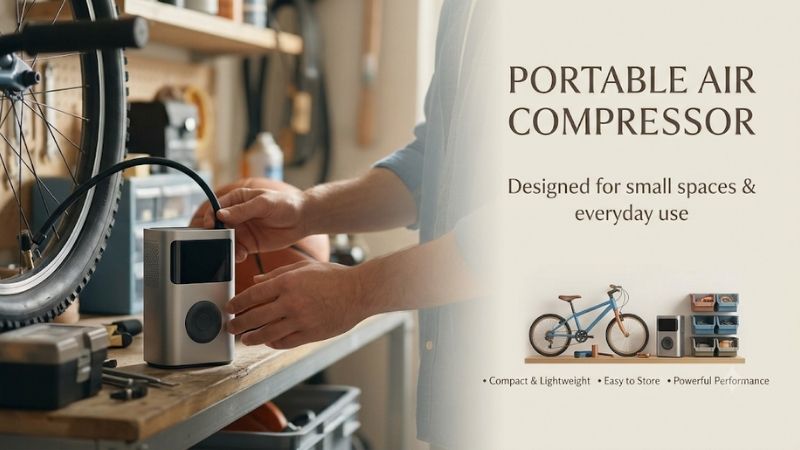
A portable air compressor for small spaces should fit comfortably in a crowded garage, storage closet, or compact workshop without sacrificing the airflow needed for your tools. Tank shape, overall dimensions, noise, ventilation, and carrying weight matter as much as advertised pressure. This guide explains how to choose a space-efficient compressor for realistic household applications.
Quick Answer: Which Air Compressor Works Best in a Small Space?
The best compressor for a small area depends on whether your main objective is minimum footprint, low noise, or sufficient airflow for a particular pneumatic tool.
For light trim work in a compact garage, the Makita MAC100Q deserves consideration. Its one-gallon tank, published 58 dB sound rating, and compact roll-cage configuration make it suitable for many intermittent low-demand applications.
However, it delivers only 0.7 CFM at 90 PSI, so it is not a good match for continuous air tools requiring substantially more airflow.
The California Air Tools 1P1060S is another small, low-noise option with a one-gallon tank. It is especially relevant for hobby users who need modest airflow and compact storage.
For buyers needing more capability, the Makita MAC210Q provides 2.0 CFM at 90 PSI and a two-gallon tank. Its main compromise is weight, at approximately 45.2 pounds despite its relatively compact shape.
A conventional six-gallon pancake compressor can also work in a small garage. Models such as the PORTER-CABLE C2002 have relatively low, broad tanks and convenient carrying handles.
However, the pancake shape may occupy more floor space than expected.
For purely automotive tire inflation, a dedicated tankless inflator can be more space-efficient than any compressor with an air reservoir.
Understand What Small-Space Portability Actually Means
Footprint Versus Total Size
A compressor’s footprint describes the floor area it occupies.
This is different from total volume.
A tall, narrow compressor may occupy little floor space but interfere with shelves or workbench storage.
A wide pancake compressor may fit beneath a workbench but require more horizontal clearance.
Before purchasing, measure the storage area and compare it with the manufacturer’s stated length, width, and height.
Allow additional room for handles, hose connections, pressure gauges, and ventilation.
A compressor that barely fits into a tight compartment may be inconvenient or unsafe to operate there.
Operating Clearance
Air compressors need sufficient airflow around their motors and pumps to prevent overheating.
A storage cabinet that can hold a compressor may not be a suitable location for operating it.
Follow the manufacturer’s specified clearance requirements.
Do not block cooling vents or place the compressor against combustible materials.
For a compact workshop, it may be safer to store the compressor beneath a bench and move it into an open position before use.
Noise Reflection
Small enclosed spaces can make compressor noise feel more intense.
Hard walls and ceilings reflect sound, and a compressor running in a narrow garage may sound louder than the same machine operating in an open environment.
A low-noise compressor can improve comfort, but published ratings may not represent the acoustic conditions in your room.
Check the manufacturer’s measurement method where available.
Wear hearing protection when exposure conditions warrant it.
Carrying Versus Rolling
A compressor may be physically small but heavy.
The Makita MAC210Q illustrates this distinction: it uses a two-gallon tank but weighs approximately 45.2 pounds.
By comparison, some six-gallon pancake compressors weigh around 30 pounds.
Wheels can improve movement across smooth floors, but they may be less useful on stairs.
Consider the route between storage and the work area.
Choose the Right Compressor Type
One-Gallon Compressors
One-gallon compressors are suitable for buyers who prioritize compact storage and relatively light intermittent air demand.
They can be useful for certain brad nailers, airbrushes, and inflation tasks, depending on their output.
However, small tanks store limited compressed air.
The compressor may restart frequently during repeated tool use.
Always compare CFM at the required working pressure.
A one-gallon compressor with insufficient airflow will not become suitable for a demanding tool simply because it can reach a high maximum pressure.
Two-Gallon Compressors
Two-gallon compressors offer a compromise between compactness and stored air.
Models such as the Makita MAC210Q provide a useful amount of airflow for certain pneumatic fastening applications.
However, tank capacity alone does not establish performance.
A well-designed two-gallon model may deliver more airflow than a larger, less capable compressor.
Check both CFM and maximum pressure.
Pancake Compressors
Pancake compressors use a low, broad tank shape.
They are popular for garage work because they combine relatively stable placement with useful compressed-air storage.
Six-gallon models are especially common.
However, their width can be inconvenient in narrow closets or between shelving units.
Measure the actual footprint before choosing.
Twin-Stack Compressors
Twin-stack compressors use two tanks arranged to provide combined storage.
This can create a relatively compact shape for the available tank capacity.
Some models prioritize higher airflow and rugged construction.
However, they may be heavy.
The Makita MAC2400, for example, offers 4.2 CFM at 90 PSI but weighs approximately 77 pounds.
It is portable in the sense that it can be moved, not in the sense that it is effortless to carry.
Wheeled Compressors
Wheeled models are convenient for garages where the compressor moves across a smooth floor.
A wheeled eight-gallon unit may be easier to reposition than a smaller compressor that must be lifted.
However, wheels and handles increase the overall dimensions.
They may also complicate storage in a narrow closet.
Tankless Tire Inflators
Tankless inflators are often the most compact solution for checking and inflating vehicle tires.
They can be powered by a vehicle connection, rechargeable battery, or household outlet, depending on the model.
However, they are not generally intended to supply pneumatic nailers, sanders, or other conventional compressed-air tools.
Choose a tankless inflator when tire inflation is the primary task.
Compact Compressor Models Worth Considering
Makita MAC100Q for Minimal Storage
The Makita MAC100Q uses a one-gallon tank and is part of Makita’s Quiet Series.
Its published 58 dB sound rating is attractive for indoor workshops.
The compressor delivers 0.7 CFM at 90 PSI and has a maximum tank pressure of 135 PSI.
This makes it a practical candidate for light intermittent work.
However, it is not suited to continuous tools requiring high airflow.
Its roll-cage design protects major components but contributes to the overall physical dimensions.
California Air Tools 1P1060S for Low-Noise Hobby Work
The California Air Tools 1P1060S is another one-gallon quiet compressor.
Its relatively small format is relevant to compact workshops and hobby applications.
However, buyers should confirm the exact current configuration, outlet pressure, air-delivery rating, and dimensions.
Do not assume that all one-gallon models provide identical performance.
A small tank is useful for storage but cannot compensate for insufficient pump airflow.
Makita MAC210Q for Trim Installation
The MAC210Q provides a two-gallon tank and 2.0 CFM at 90 PSI.
It also has a published sound level of 60 dB.
These characteristics make it appealing for finish carpentry and cabinet installation.
However, its weight is an important trade-off.
Buyers should prioritize it when quiet operation and usable fastening airflow matter more than minimum carrying weight.
PORTER-CABLE C2002 for General Garage Work
The C2002 provides a six-gallon tank, 150 PSI maximum pressure, and 2.6 SCFM at 90 PSI.
It weighs approximately 30 pounds.
Its pancake form can fit conveniently beneath some workbenches, although the tank is relatively wide.
It is better suited to general household pneumatic work than very small one-gallon compressors.
California Air Tools 8010 for Quiet Garage Storage
The 8010 uses an eight-gallon steel tank and offers a manufacturer-rated 60 dB sound level.
It is larger than a compact one- or two-gallon compressor.
However, the wheeled design may make it practical for a garage where it can remain on the floor.
Its 2.2 CFM at 90 PSI supports many intermittent uses.
It should not be selected for continuous high-airflow applications solely because the tank is larger.
How Much Airflow Do You Need?
Understanding CFM at 90 PSI
CFM describes air volume delivered over time.
The 90 PSI rating is useful because many manufacturers publish compressor delivery at that pressure.
A model delivering 2.0 CFM at 90 PSI can replenish air faster than a 0.7 CFM model under comparable measurement conditions.
However, actual performance also depends on hose restrictions and the connected tool.
Do not confuse maximum tank pressure with delivered airflow.
Low-Demand Intermittent Tools
Certain brad nailers and pin nailers consume brief bursts of air.
Small compressors may operate them effectively when firing frequency is moderate.
However, the exact tool requirements vary.
Check the nailer’s published air consumption and operating pressure.
Moderate-Demand Tools
Finish nailers and some intermittent air tools may benefit from greater airflow or stored air.
A two-gallon or six-gallon compressor can be appropriate depending on the model.
The frequency of operation matters.
A tool fired occasionally may function adequately with a smaller compressor, while rapid continuous use can exceed its recovery capability.
High-Demand Continuous Tools
Air sanders, grinders, and some spray equipment require sustained airflow.
A small compressor may reach the correct pressure but fail to maintain it during operation.
This can cause reduced tool performance and frequent compressor cycling.
Choose equipment with sufficient continuous air delivery.
Two Tools at Once
Two couplers do not mean the compressor can deliver twice its published airflow.
Connected tools share the same air supply.
If both operate simultaneously, their combined requirements must be considered.
A compact compressor may support two nailers used intermittently but not two continuous high-consumption tools.
Noise Considerations for Small Workshops
Understanding Decibel Ratings
A compressor’s published dB rating provides a general indication of operating sound.
However, measurement distance, test environment, and methodology affect the number.
A quieter advertised model is often more comfortable in a residential setting.
Nevertheless, exact comparisons should account for test conditions.
Quiet-Series Compressors
Makita Quiet Series models emphasize lower operating speeds and reduced sound levels.
The MAC100Q is specified at 58 dB, while the MAC210Q is rated at 60 dB.
These figures make them relevant to indoor installation work.
However, lower noise does not guarantee adequate airflow for every application.
Placement and Vibration
Compressor vibration can transmit into floors, shelves, and workbenches.
A unit placed on a resonant wooden surface may produce additional noise.
Use a stable surface and follow the manufacturer’s placement instructions.
Do not place the compressor on improvised padding that blocks ventilation or reduces stability.
Neighbors and Shared Living Areas
In an apartment or attached garage, operating hours and building rules may matter.
Even a quieter compressor can be disruptive during early morning or late-night use.
For inflation-only tasks, a smaller dedicated inflator may be more practical.
Storage Planning
Under-Workbench Storage
Many compact compressors can be stored beneath workbenches.
However, the space must allow access to handles, gauges, and drains.
Do not operate the compressor in a compartment that restricts cooling air.
Move it to a suitable position before use when necessary.
Shelving Storage
A one-gallon compressor may fit on a sturdy shelf.
However, shelf load capacity and the compressor’s weight must be considered.
Do not place heavy compressors on unstable shelving.
Secure the unit against falling.
Closet Storage
A dry utility closet can be suitable for storing certain compressors after use.
However, the tank should be drained and the unit prepared according to the manufacturer’s instructions.
Do not store a hot compressor against combustible materials.
Wall Storage
Most tank compressors are not designed to hang from ordinary hooks.
Only use wall-mounting systems specifically approved for the product.
Do not improvise mounting methods for pressurized tanks.
Hose Storage
Hoses can occupy more space than expected.
A compact reel or organized hook arrangement can help prevent kinks and tangles.
Store hoses without sharp bends and inspect them regularly.
Tank Capacity and Recovery in Small Spaces
Why a Larger Tank Is Not Always Better
A larger tank increases stored air but also adds size and weight.
For occasional brad nailing, a large reservoir may be unnecessary.
For repeated pneumatic use, greater storage can reduce the frequency of motor starts.
However, the pump’s airflow still determines long-term recovery.
Understanding Pressure Switches
Most tank compressors automatically start and stop according to pressure-switch settings.
The motor starts when tank pressure falls to the cut-in level.
It stops when pressure reaches the cut-out level.
These values differ among models.
Do not alter factory pressure-switch settings unless the manufacturer specifically authorizes the procedure.
Avoiding Excessive Cycling
Frequent cycling may indicate that the connected tool consumes air faster than the tank can support comfortably.
It can also occur when the tank is very small.
Check airflow requirements and operating conditions.
Do not bypass thermal protection or pressure controls.
Electrical and Ventilation Requirements
Household Electrical Supply
Many portable compressors operate on 120V electricity.
However, startup current requirements vary.
Use an appropriate outlet and branch circuit.
Extension Cords
Improper extension cords can cause voltage drop and motor-starting problems.
Follow the manufacturer’s recommendations.
An air hose extension may sometimes be preferable to a long electrical extension cord, but hose sizing and pressure loss must also be considered.
Cooling Clearance
Compressors generate heat.
Air must circulate around the motor and pump.
Do not operate a compressor inside a closed cabinet or cramped enclosure unless the manufacturer specifically approves that arrangement.
Indoor Air Quality
Compressors draw air from their surroundings.
Avoid operation where the intake may collect harmful fumes or combustible vapors.
Compressed air from ordinary workshop compressors is not suitable for breathing.
Practical Applications
Inflating Vehicle Tires
A compact compressor can inflate vehicle tires when equipped with a suitable hose and tire chuck.
Use the vehicle’s specified cold inflation pressure.
A tire-only inflator may be more space-efficient.
Cabinet Installation
Small quiet compressors can be useful with compatible brad or finish nailers.
Check the nailer’s air requirements.
Use an appropriate hose length and regulator setting.
Furniture Repair
Some pneumatic staplers and nailers can work with small compressors.
For occasional furniture assembly, a cordless electric fastening tool may eliminate the need for compressed air.
Airbrush Projects
Airbrushes generally benefit from controlled, consistent pressure and moisture management.
A small compressor may be suitable, but verify airflow requirements and filtration needs.
Garage Cleaning
Compressed air can remove debris from appropriate equipment.
However, blowing dust into the air creates exposure hazards.
Use a safety nozzle and appropriate protection.
Never direct compressed air at people.
Maintenance for Compact Compressors
Drain Moisture
Moisture accumulates inside compressed-air tanks.
Drain the tank according to the manufacturer’s instructions.
This helps reduce corrosion risk.
Inspect Hoses and Couplers
Check for leaks, cracks, and damaged fittings.
Replace unsuitable components.
Maintain Air Filters
Clean or replace intake filters as directed.
Restricted intake airflow can affect performance.
Check Oil Requirements
Oil-free compressors do not require routine pump-oil changes.
Oil-lubricated models do.
Always follow the exact maintenance schedule.
Inspect the Pressure Vessel
A damaged or heavily corroded tank should not be used.
Never drill, weld, or repair a pressure vessel using improvised methods.
Common Buying Mistakes
Choosing a Compressor Solely by Tank Size
A larger tank may not provide enough continuous airflow for your tool.
Compare CFM at the required pressure.
Ignoring Weight
A physically compact compressor can still weigh more than 40 pounds.
Check operating weight and handling requirements.
Operating Inside a Closed Cabinet
Restricted ventilation can cause overheating.
Use the compressor in an approved location.
Assuming Quiet Means Low Power
Some quiet compressors provide useful airflow.
Compare actual specifications rather than sound ratings alone.
Buying a Tank Compressor Only for Tires
A dedicated inflator may be more compact and economical for tire-only use.
Consider whether you truly need a pneumatic-tool air supply.
Frequently Asked Questions
What is the smallest useful air compressor for home projects?
A one-gallon compressor can be useful for some intermittent tools and inflation applications, but its airflow must match the task.
Can I use a compressor in an apartment?
This depends on building rules, ventilation, noise, and whether a safe operating area is available. A dedicated inflator may be more practical for limited needs.
Is a pancake compressor good for small garages?
Yes, when its footprint fits the available area and there is adequate operating clearance.
Does a larger tank make the compressor more powerful?
Not necessarily. Tank capacity increases stored air but does not directly increase pump airflow.
Are quiet compressors worth the extra cost?
They can be valuable in attached garages and indoor workshops. Choose based on noise and airflow requirements together.
Can a small compressor run a nail gun?
Some small compressors can operate compatible nailers intermittently. Check the exact nailer’s pressure and air-consumption specifications.
Should I choose wheels or a carrying handle?
Wheels are convenient on smooth floors, while a well-designed handle may be better when carrying the compressor over steps.
Conclusion
A portable air compressor for small spaces should be selected according to real airflow needs, physical dimensions, noise, and safe operating clearance. The Makita MAC100Q and California Air Tools 1P1060S are relevant to low-demand compact applications, while the Makita MAC210Q offers greater airflow for trim work. A six-gallon pancake model can be practical for a small garage when storage allows. For tire-only use, a dedicated tankless inflator may be the simplest choice.
More from Amazon
Programs that pair well with the guide above. Offers and eligibility are set by Amazon and may change.
Collect the home and kitchen items you want in one registry that guests can shop from.
Create a wedding registrySet up recurring deliveries of everyday items on eligible products. Terms and savings are set by Amazon.
Explore Subscribe & SaveFree shipping on eligible items, Prime Video and more. Eligible new members can start with a free trial.
Start a Prime free trialAudiobooks and podcasts to listen to on the go. Eligible new members can start with a free trial.
Try Audible freeAs an Amazon Associate we earn from qualifying purchases.