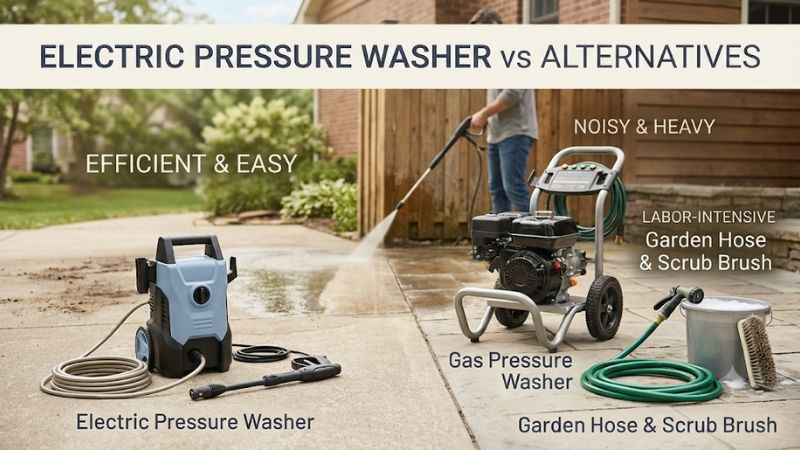
Comparing an electric pressure washer vs alternatives helps homeowners choose the right cleaning method for vehicles, patios, siding, concrete, and outdoor equipment. Gas pressure washers, garden hoses, steam cleaners, manual scrubbers, and professional services each offer different advantages. Understanding cleaning power, water use, maintenance, cost, and surface safety helps prevent unnecessary purchases.
Quick Verdict: Which Cleaning Method Should You Choose?
An electric pressure washer is a versatile choice for homeowners who regularly clean compatible outdoor surfaces.
It provides more concentrated cleaning force than an ordinary garden hose while avoiding the fuel, exhaust, and combustion-engine maintenance associated with a gas pressure washer.
However, it is not automatically the best method for every material.
A garden hose and gentle cleaning solution may be preferable for delicate vehicle components, outdoor furniture, and routine rinsing.
A gas pressure washer can be more practical for extensive demanding work where greater flow and sustained output are required.
A steam cleaner is useful for certain temperature-sensitive cleaning applications when the surface and equipment are compatible, but it is not a general replacement for outdoor pressure washing.
Manual scrubbing may provide better control on fragile finishes.
Professional cleaning services may be more economical or safer when the job requires specialized equipment, access, or contamination management.
The correct choice depends on what must be removed, the condition of the surface, and the risk of causing damage.
Quick Comparison Table
| Method | Main advantage | Primary limitation | Best application |
|---|---|---|---|
| Electric pressure washer | Convenient outdoor cleaning | Limited by cord, water supply, and output | Residential maintenance |
| Gas pressure washer | High output for demanding work | Engine maintenance, exhaust, noise | Large hardscape areas |
| Garden hose | Gentle rinsing | Less concentrated force | Routine rinsing and delicate surfaces |
| Steam cleaner | Heat-assisted cleaning | Limited outdoor coverage | Compatible localized cleaning |
| Manual scrubber | Direct surface control | Labor-intensive | Fragile finishes and small areas |
| Professional cleaning service | Specialized equipment and expertise | Recurring service cost | Large or complex jobs |
Electric Pressure Washer vs Gas Pressure Washer
Power Source Differences
An electric pressure washer uses an electric motor to drive a pump.
A gas pressure washer uses an internal-combustion engine.
The electric design avoids fuel handling, engine oil maintenance, and exhaust emissions at the point of operation.
Gas machines can provide higher output in many consumer and professional categories.
However, individual models vary substantially.
The appropriate comparison is between specific machines, not merely their power sources.
Pressure and Water Flow
Gas pressure washers often offer greater water flow than compact residential electric models.
This can improve productivity when rinsing large surfaces.
However, advertised maximum pressure does not fully describe cleaning performance.
Both PSI and GPM must be considered.
A high-pressure machine with insufficient water flow may not clean a large area as efficiently as expected.
Cleaning Large Driveways
A gas washer can be useful for cleaning extensive concrete driveways.
Its higher-flow configurations may support larger compatible surface-cleaning attachments.
However, strong pressure can damage weak concrete, coatings, or mortar.
Use a suitable method for the surface condition.
An electric washer may still be sufficient for a smaller driveway or occasional maintenance.
Noise
Gas engines generally produce substantial operating noise.
Electric machines avoid engine noise but still generate pump and spray noise.
For residential neighborhoods, electric operation may be more convenient.
However, actual sound levels vary by model.
Maintenance Requirements
Gas machines require engine-related maintenance such as oil care and fuel-system attention.
Electric machines eliminate those tasks but still require pump protection, filters, hoses, and correct storage.
Neither type should be considered completely maintenance-free.
Storage
Gas washers require appropriate fuel handling and storage procedures.
Electric washers can be more convenient for small garages.
However, both need protection from freezing conditions.
Indoor Operation
Gas pressure washers should not be operated indoors or in enclosed spaces because combustion exhaust can cause deadly carbon monoxide exposure.
Electric washers avoid combustion exhaust but still create serious electrical, water-intrusion, and drainage hazards.
Neither should be used inside an ordinary living space without an appropriate approved setup.
Which Is Better for Homeowners?
An electric pressure washer is usually practical for routine residential cleaning.
A gas model becomes attractive when large demanding jobs justify its additional output and maintenance requirements.
Electric Pressure Washer vs Garden Hose
Water Delivery
A garden hose delivers water at normal supply pressure.
A pressure washer uses a pump to increase spray pressure.
The pressure washer can loosen certain deposits more effectively.
However, the garden hose may provide a gentler cleaning method.
Cleaning Force
A garden hose with an appropriate nozzle can remove loose dirt and rinse surfaces.
A pressure washer concentrates force and may remove more resistant deposits.
However, greater force also increases damage risk.
Water Consumption
A pressure washer often uses less water per minute than a freely flowing garden hose.
However, actual total water use depends on cleaning duration.
A longer pressure-washing session may still consume substantial water.
Vehicle Washing
A garden hose is often sufficient for routine rinsing and can be preferable around sensitive components.
An electric pressure washer can be useful when controlled carefully.
Avoid concentrated spray on seals, electrical connectors, and damaged paint.
Patio Furniture
Gentle hose rinsing is often adequate for furniture.
A pressure washer may damage paint, wicker, or other vulnerable materials.
Use the furniture manufacturer’s cleaning instructions.
Removing Resistant Dirt
Pressure washing can remove some stubborn deposits that ordinary rinsing cannot.
However, suitable detergent and manual agitation may still be necessary.
Which Is Better for Everyday Cleaning?
A garden hose is generally the simpler option for light rinsing.
An electric pressure washer becomes useful when dirt requires more concentrated cleaning force.
Electric Pressure Washer vs Steam Cleaner
Cleaning Mechanism
A pressure washer uses pressurized water.
A steam cleaner uses heated water vapor or high-temperature moisture, depending on the device.
These mechanisms address different cleaning problems.
Outdoor Surface Cleaning
Pressure washers are generally better suited to cleaning larger outdoor surfaces.
Steam cleaners typically have smaller working attachments and different water-delivery characteristics.
Heat-Assisted Cleaning
Steam can help loosen certain residues.
However, high temperature may damage sensitive surfaces, coatings, adhesives, or seals.
The surface must be compatible with the cleaner.
Water Use
Steam cleaners may use relatively little water during some operations.
However, their working coverage may be smaller.
The better method depends on the contamination and surface.
Sanitizing Claims
High-temperature cleaning may reduce certain microorganisms under controlled conditions.
However, steam exposure time, temperature, and surface conditions matter.
Do not assume that any steam cleaner automatically disinfects every surface.
Electrical Safety
Both types of equipment use electricity near water.
Steam cleaners also introduce burn hazards.
Follow the manufacturer’s safety instructions.
Which Is Better for Garage Cleaning?
A pressure washer is usually more useful for outdoor garage floors and driveways.
A steam cleaner may be appropriate for certain localized residues on compatible surfaces.
Electric Pressure Washer vs Manual Scrubbing
Control
Manual brushes and sponges provide direct control over contact pressure.
This can be valuable for delicate materials.
A pressure washer delivers force through a water jet, making operator distance and nozzle selection important.
Cleaning Small Areas
Manual scrubbing can be efficient for small, localized stains.
Setting up a pressure washer may take longer than cleaning a small area by hand.
Large-Area Cleaning
Pressure washers can reduce labor on suitable large outdoor surfaces.
However, rinsing and chemical dwell time remain necessary.
Manual scrubbing may still be needed for resistant contamination.
Surface Damage
A manual brush can damage finishes if overly abrasive.
A pressure washer can also cause damage through excessive force.
Choose the gentlest effective method.
Detergent Use
Both approaches can benefit from suitable cleaning solutions.
Use chemicals approved for the surface.
Do not mix incompatible products.
Water Consumption
Manual cleaning may use relatively little water when performed carefully.
However, total consumption depends on technique.
Which Is Better for Delicate Surfaces?
Manual cleaning is often preferable when precise control matters more than speed.
Pressure washing is more useful for suitable larger surfaces with resistant dirt.
Electric Pressure Washer vs Professional Cleaning Service
Upfront Cost
Buying an electric pressure washer requires an initial equipment investment.
Professional cleaning generally charges per project or service visit.
The better financial choice depends on cleaning frequency and job complexity.
Recurring Maintenance
Homeowners who clean several times a year may benefit from owning a washer.
However, equipment storage, maintenance, and replacement accessories add ongoing costs.
Large Properties
Professional services may use higher-output equipment and specialized attachments.
This can improve efficiency on extensive areas.
However, service quality and methods vary.
Hazardous Surfaces
Some jobs involve height, fragile materials, contaminated runoff, or difficult access.
Professional assistance may be safer.
For example, cleaning upper-story siding or roofs can involve serious fall risks.
Water Runoff
Professional cleaners may have systems for managing certain contaminated wash water.
However, the homeowner should verify that appropriate practices are followed.
Convenience
Hiring a service eliminates much of the setup and equipment handling.
However, scheduling and recurring cost are considerations.
Which Is Better?
Buying a washer can be economical for frequent manageable jobs.
Professional cleaning is attractive for occasional large or hazardous projects.
Electric Pressure Washer vs Surface Scrubber
What Is a Surface Scrubber?
A manual or powered surface scrubber uses brushes or pads to remove material through mechanical contact.
Some use cleaning solutions and water recovery systems.
Concrete Cleaning
A pressure washer uses hydraulic force to remove dirt.
A scrubber uses physical contact and agitation.
The better method depends on contamination and surface construction.
Indoor Floors
Pressure washing is generally inappropriate for ordinary indoor floors because of water intrusion and electrical hazards.
A suitable floor scrubber may be preferable.
Outdoor Hardscapes
Pressure washing can be useful for compatible concrete and pavers.
A scrubber may offer advantages for certain stains.
Chemical Requirements
Both methods may require appropriate detergent.
The chemical must be compatible with the surface and equipment.
Which Is Better for Garage Floors?
For an outdoor or appropriately drained garage surface, pressure washing may be effective.
For enclosed areas without suitable drainage, a floor scrubber or another controlled cleaning method may be preferable.
Electric Pressure Washer vs Portable Cordless Power Cleaner
Power Differences
A conventional corded electric pressure washer uses household electrical power.
A portable cordless cleaner uses a rechargeable battery.
Many cordless portable cleaners provide lower output.
However, specifications vary.
Water Supply
Some portable cordless cleaners can draw water from containers.
This may be useful where a garden-hose connection is unavailable.
Conventional pressure washers usually require a suitable pressurized supply.
Portability
Battery-powered cleaners are convenient for small tasks away from electrical outlets.
However, they are not automatically equivalent to full-size pressure washers.
Cleaning Bicycles
A portable cleaner may provide a gentler rinse.
However, care is still required around bearings and electrical components.
Cleaning Concrete
A low-pressure cordless cleaner may struggle with deeply embedded outdoor dirt.
A conventional electric washer may be more effective.
Battery Runtime
Cordless operation introduces battery-capacity and charging considerations.
Runtime depends on operating mode and workload.
Which Is Better for Small Tasks?
A portable cordless cleaner can be practical for quick rinsing.
A conventional electric pressure washer is more suitable for many demanding residential cleaning applications.
Compare Methods by Common Home Projects
Washing a Car
A garden hose, hand-washing method, or carefully controlled electric washer can be appropriate.
The correct choice depends on the vehicle’s condition and cleaning requirements.
Avoid aggressive pressure near vulnerable components.
Cleaning a Concrete Driveway
An electric or gas pressure washer may be suitable.
The size of the driveway, stain severity, and surface condition determine the required capability.
Cleaning Wood Decking
Gentle cleaning is important because excessive pressure can damage wood.
Manual scrubbing or manufacturer-approved low-pressure washing may be preferable.
Cleaning Vinyl Siding
Follow siding-specific recommendations.
High-pressure water can enter behind panels.
A soft-washing method may be more appropriate.
Cleaning Outdoor Furniture
Manual washing or gentle hose rinsing is often sufficient.
Pressure washing should be used only when the furniture material permits it.
Cleaning Pavers
Pressure washing can displace joint sand and damage weak materials.
Use appropriate methods.
Removing Oil Stains
Oil may require specialized cleaning chemistry and agitation.
Pressure alone may spread contamination.
Manage runoff appropriately.
Cleaning Boats
Boat materials, coatings, hardware, and environmental regulations require careful consideration.
Use manufacturer-approved cleaning methods and prevent contaminated discharge.
How to Choose the Right Cleaning Method
Identify the Surface
Begin with the material.
Concrete, painted metal, wood, vinyl, and composite decking have different cleaning requirements.
Consider the Type of Dirt
Loose dust requires a different approach from grease, algae, or embedded staining.
Suitable detergent may be more important than high pressure.
Evaluate Surface Condition
A damaged or weathered surface may not tolerate pressure washing.
Test carefully.
Consider Cleaning Area
Large areas often favor equipment with greater rinsing productivity.
Small areas may be easier to clean manually.
Check Water Availability
Most pressure washers require a suitable water supply.
If water access is limited, another method may be preferable.
Consider Electrical Access
Corded equipment requires a safe power supply.
Portable cordless cleaners may be convenient where outlets are unavailable.
Evaluate Storage
Owning equipment requires storage space.
Small homes may benefit from compact machines or occasional professional services.
Compare Total Costs
Include equipment, detergents, accessories, maintenance, water, electricity, and labor.
Consider Safety
Pressurized water can cause injection injuries and damage surfaces.
Gas machines introduce combustion-exhaust hazards.
Steam cleaners introduce burn risks.
Choose an appropriate method for the complete working environment.
Common Comparison Mistakes
Assuming Higher Pressure Is Always Better
Excessive pressure can damage surfaces.
Choose appropriate force.
Ignoring Flow Rate
Water flow contributes to rinsing productivity.
Compare rated operating conditions.
Using Gas Machines in Enclosed Spaces
Gas-powered equipment can produce deadly carbon monoxide.
Never use it indoors or in partially enclosed spaces.
Expecting Pressure to Replace Detergent
Some contamination requires chemical treatment and agitation.
Ignoring Runoff
Wash water may carry oil, detergents, or other pollutants.
Manage discharge appropriately.
Choosing Equipment Without Considering Storage
A machine that is difficult to store may be inconvenient despite strong specifications.
Frequently Asked Questions
Is an electric pressure washer better than a gas pressure washer?
For many routine residential jobs, electric models offer convenient operation and less engine maintenance. Gas models may be more suitable for larger demanding cleaning tasks.
Does a pressure washer use less water than a hose?
It often uses less water per minute, but total water consumption depends on cleaning time and method.
Can a steam cleaner replace an electric pressure washer?
Not for most broad outdoor cleaning. Steam cleaners are more appropriate for particular localized heat-assisted applications.
Is hand scrubbing safer for painted surfaces?
It may offer greater control, but abrasive brushes and unsuitable chemicals can also cause damage. Follow the surface manufacturer’s guidance.
Should I buy a washer or hire a professional?
Ownership can be economical for frequent manageable cleaning. Professional services may be preferable for large, hazardous, or specialized projects.
Are cordless power cleaners the same as electric pressure washers?
Not necessarily. Portable cordless cleaners often have different pressure, flow, and water-supply capabilities.
Conclusion
When comparing an electric pressure washer vs alternatives, choose an electric washer for convenient routine outdoor cleaning, a gas model for suitable demanding large-area work, and a garden hose or manual scrubber for gentler tasks. Steam cleaners, portable cordless cleaners, and professional services serve different needs. The best method is the one that removes dirt effectively while protecting the surface, controlling runoff, and avoiding unnecessary safety risks.
More from Amazon
Programs that pair well with the guide above. Offers and eligibility are set by Amazon and may change.
Collect the home and kitchen items you want in one registry that guests can shop from.
Create a wedding registrySet up recurring deliveries of everyday items on eligible products. Terms and savings are set by Amazon.
Explore Subscribe & SaveFree shipping on eligible items, Prime Video and more. Eligible new members can start with a free trial.
Start a Prime free trialAudiobooks and podcasts to listen to on the go. Eligible new members can start with a free trial.
Try Audible freeAs an Amazon Associate we earn from qualifying purchases.