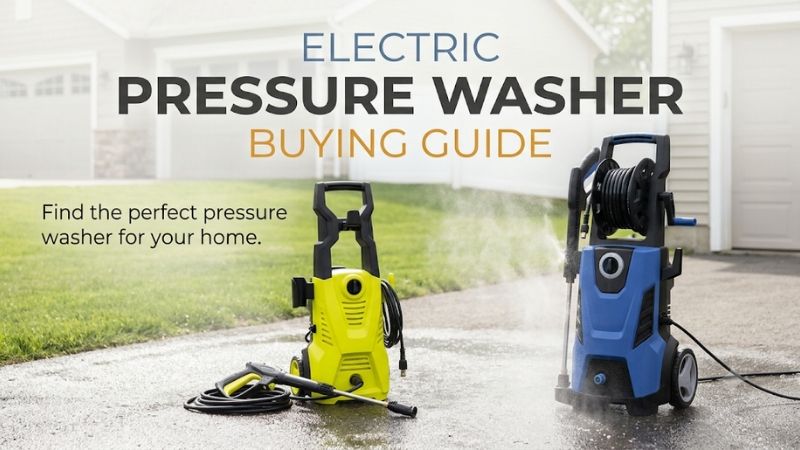
This electric pressure washer buying guide explains how to choose a machine for cleaning vehicles, patios, sidewalks, siding, and outdoor furniture. Pressure, water flow, nozzle design, motor type, electrical requirements, and storage features all influence results. Understanding these factors helps homeowners choose suitable equipment while avoiding unnecessary expense and surface damage.
What Should You Look for in an Electric Pressure Washer?
The first step is identifying the surfaces you intend to clean most frequently.
A homeowner primarily washing cars may prefer a moderate-pressure machine with gentle spray options and an effective detergent system.
Someone maintaining a large concrete driveway may benefit from greater water flow and a suitable surface-cleaning accessory.
A user with limited garage storage may prioritize a compact cube-style washer.
These requirements lead to different purchasing decisions.
The most important technical specifications are pressure, water flow, motor design, hose length, nozzle compatibility, and the electrical and water supplies required.
However, specifications do not tell the entire story.
The quality of hoses, fittings, spray guns, pump construction, and accessory connections can determine whether a washer remains convenient over several years.
Choose according to your expected workload, not simply the largest advertised PSI.
Understand How Electric Pressure Washers Work
The Electric Motor
An electric motor powers the pump.
The motor may use a universal or induction design, depending on the machine.
Universal motors are common in compact consumer models.
Induction-style motors are often used in larger or more substantial electric washers.
However, motor type alone does not guarantee superior durability or cleaning performance.
The complete motor, pump, cooling, and control system must be evaluated.
The Water Pump
The pump pressurizes water supplied through the inlet hose.
The pressurized water travels through the high-pressure hose and spray gun.
The nozzle then influences the shape and velocity of the spray.
However, pressure depends on both the pump and the flow restriction created by the nozzle.
This is why different nozzles can produce different operating conditions.
The Spray Gun
The spray gun controls water delivery.
Releasing the trigger usually stops the spray.
Many electric washers also incorporate a total-stop system that switches off the motor when the trigger is released.
However, pressure may remain trapped in the hose.
The machine must be depressurized according to the manufacturer’s instructions before disconnecting components.
The Nozzle
The nozzle changes how water is distributed across the surface.
A narrow spray concentrates force.
A wider spray spreads water over a larger area.
Choosing an appropriate nozzle is essential for effective cleaning without unnecessary surface damage.
Understand PSI
What PSI Means
PSI stands for pounds per square inch.
It measures pressure.
In a pressure washer, this specification helps describe the force available to the spray system.
However, advertised PSI is not equivalent to cleaning performance in every application.
Maximum PSI
Maximum PSI may describe the highest pressure measured under particular test conditions.
This may occur at a specific nozzle setting.
The machine may not deliver that value continuously during ordinary cleaning.
Rated PSI
Rated PSI describes a manufacturer-defined operating condition.
It can provide useful context when comparing machines.
However, rating methods and test conditions may differ.
Why PSI Alone Is Insufficient
A washer with high pressure but relatively low water flow may loosen dirt effectively but take longer to rinse it away.
A machine with slightly lower pressure and greater flow may clean a broad area more efficiently.
Evaluate both values.
Surface Damage Risk
High-pressure water can damage paint, softwood, mortar, siding, and other vulnerable materials.
Even a moderate-pressure machine can cause damage when used too close to the surface.
Use the least aggressive appropriate cleaning method.
Understand GPM
What GPM Means
GPM stands for gallons per minute.
It measures water flow.
Higher flow can help carry loosened dirt away and rinse larger areas.
However, higher flow also increases water consumption per minute.
Maximum GPM
Maximum flow may occur at relatively low pressure.
It should not automatically be paired with maximum PSI.
For example, a machine might advertise its greatest flow when using a low-restriction nozzle.
Rated GPM
Rated GPM describes a specified operating condition.
It can be more informative than a maximum figure when the test conditions are clear.
Why Water Flow Matters for Driveways
Large outdoor surfaces require substantial rinsing.
A washer with limited flow may take longer to cover the area.
However, cleaning efficiency also depends on detergent, surface condition, and accessories.
Balancing Water Use and Cleaning Time
A lower-flow washer uses less water each minute but may require more time.
A higher-flow machine may complete the job faster.
Total consumption depends on the complete cleaning process.
Understand Cleaning Units
What Are Cleaning Units?
Some product comparisons multiply PSI by GPM to create a simplified cleaning-power figure.
However, this calculation can be misleading.
The Problem With Maximum Values
If maximum PSI and maximum GPM occur at different operating conditions, multiplying them does not describe an actual simultaneous operating point.
This can exaggerate apparent performance.
When Calculations Are Useful
A pressure-flow product may offer limited context when both figures are measured at the same operating condition.
However, it does not replace real cleaning tests.
Better Comparison Methods
Compare rated pressure and flow, nozzle selection, and performance on equivalent surfaces.
Look for standardized independent tests when available.
Choose the Correct Pressure Range
Light Residential Cleaning
Light cleaning includes patio furniture, bicycles, and ordinary outdoor equipment.
A moderate-output washer may be sufficient.
However, sensitive surfaces require careful technique.
Vehicle Washing
Vehicle washing generally requires controlled pressure rather than maximum cleaning force.
A wide fan nozzle and appropriate distance help reduce damage risk.
Avoid directing concentrated spray at vulnerable components.
Patio and Walkway Cleaning
Concrete and certain pavers may tolerate stronger cleaning than painted or wooden surfaces.
However, surface condition matters.
Older concrete or loose joints may be damaged by aggressive pressure.
Large Driveway Cleaning
A larger driveway may justify greater water flow and compatible surface-cleaning equipment.
However, pressure alone does not guarantee efficient results.
Siding and Decking
These surfaces can be vulnerable to damage or water intrusion.
Follow material-specific cleaning guidance.
Low-pressure application of appropriate cleaners may be preferable.
Understand Nozzle Angles
Zero-Degree Nozzles
A zero-degree nozzle produces a highly concentrated jet.
This can cause severe injury and surface damage.
It is generally unsuitable for casual household cleaning.
15-Degree Nozzles
A 15-degree nozzle produces a relatively narrow fan.
It may be appropriate for certain resistant deposits on durable surfaces.
However, it can damage paint, softwood, and vulnerable masonry.
25-Degree Nozzles
A 25-degree nozzle is a common general-purpose option.
It provides a broader spray than a 15-degree nozzle.
However, it is not automatically safe for every surface.
40-Degree Nozzles
A 40-degree nozzle produces a wider fan.
It is often a conservative starting option for compatible delicate surfaces.
Maintain suitable distance.
Soap Nozzles
Soap nozzles are designed for applying compatible detergent under the appropriate operating conditions.
Use them according to the washer’s instructions.
Turbo Nozzles
Turbo nozzles can improve aggressive cleaning of suitable hard surfaces.
They may also cause rapid damage when misused.
Understand Motor Types
Universal Motors
Universal motors are common in consumer electric washers.
They can provide compact construction and accessible pricing.
However, they may produce more noise than some induction-style designs.
Induction Motors
Induction motors are often used in higher-end machines.
They may offer advantages in noise and durability depending on construction.
However, they can increase machine weight.
Brushless Technology
Some manufacturers market induction-style or electronically controlled motors as brushless.
The term alone does not establish output or service life.
Choosing the Right Motor
For occasional light cleaning, a compact universal-motor washer may be sufficient.
For frequent demanding work, a more substantial motor and pump system may be worth considering.
Understand Pump Design
Why Pump Quality Matters
The pump is essential to pressure-washer operation.
Its components operate under pressure and require adequate water supply.
Poor inlet conditions can damage the system.
Water Starvation
Insufficient inlet flow can cause cavitation, overheating, or other damage.
Check the water source before operation.
Inlet Filters
Filters help prevent certain debris from entering the pump.
Inspect and clean them according to the manual.
Pump Cooling
Some washers rely on water flow and other design features to manage pump temperature.
Do not leave the machine running without water.
Pump Protection
Follow the manufacturer’s storage and winterizing procedures.
Do not assume that an electric washer requires no maintenance.
Choose the Right Hose
Hose Length
A longer hose can increase cleaning reach.
However, it may be more difficult to store.
Choose according to the size of the cleaning area.
Hose Flexibility
A flexible hose can be easier to maneuver.
However, it must have the correct pressure rating.
Hose Connections
Some systems use common M22-style connections or quick-connect couplers.
Others use proprietary fittings.
Compatibility must be verified.
Hose Extensions
Extensions may affect performance and are not universally approved.
Follow the machine manufacturer’s requirements.
Inspecting Hoses
Replace damaged high-pressure hoses.
Do not attempt improvised repairs.
Evaluate Electrical Requirements
Household Voltage
Many US-market electric pressure washers are designed for 120V AC power.
However, exact voltage and current requirements vary.
Use only the specified supply.
GFCI Protection
GFCI protection reduces certain electrical-shock risks.
Inspect and test the protective device according to the manufacturer’s instructions.
Extension Cords
Some manufacturers prohibit extension cords.
Others specify particular lengths and ratings.
Follow the exact manual.
Wet Conditions
Keep plugs and connections away from standing water.
Never operate a machine with damaged electrical equipment.
Outdoor Outlets
Use suitable outdoor electrical infrastructure.
Avoid unsafe adapters and overloaded circuits.
Understand Detergent Systems
Integrated Tanks
An integrated tank provides a convenient location for suitable cleaning solution.
However, it must be flushed as instructed.
Foam Cannons
Foam cannons help apply detergent.
However, thick foam does not automatically guarantee effective cleaning.
Downstream Injection
Some washers apply detergent through a low-pressure chemical-injection system.
The system may require a specific nozzle.
Chemical Compatibility
Use approved pressure-washer detergents.
Avoid mixing chemicals.
Never use flammable or corrosive solutions unless specifically approved.
Dwell Time
Allow suitable detergent to work according to its instructions.
Do not let cleaning solutions dry on vulnerable surfaces.
Evaluate Portability
Cube-Style Washers
Compact cube designs are useful for limited storage.
However, they may have shorter hoses or fewer integrated storage features.
Wheeled Upright Models
Wheeled models are convenient for driveways and larger patios.
They may also provide organized accessory storage.
Open-Frame Machines
Open-frame washers may offer larger wheels and more substantial construction.
However, they occupy more space.
Machine Weight
Weight affects transport.
A heavy machine may be inconvenient to move up stairs.
Storage Dimensions
Measure the complete stored arrangement, including hose and accessories.
Understand Surface-Cleaning Accessories
What Is a Surface Cleaner?
A surface cleaner is an attachment designed to clean suitable flat areas using a rotating spray assembly enclosed within a housing.
It can improve consistency on appropriate patios and driveways.
Matching the Washer
Surface cleaners have pressure and flow requirements.
A large attachment may perform poorly with a low-flow washer.
Surface Compatibility
Not every surface is suitable.
Old coatings, weak mortar, and damaged concrete may be vulnerable.
Cleaning Technique
Move at the recommended speed.
Avoid holding the attachment stationary on vulnerable surfaces.
Maintenance
Inspect nozzles and moving components according to the manufacturer.
Cleaning Common Household Surfaces
Cars
Use automotive-safe detergent, an appropriate nozzle, and suitable distance.
Avoid concentrated spray near sensitive parts.
Concrete
Use a suitable spray pattern and test an inconspicuous area.
Avoid damaging weak or decorative surfaces.
Pavers
Pressure washing can remove joint sand.
Follow the paver manufacturer’s guidance.
Wood Decks
Excessive pressure can damage wood fibers.
Use approved cleaning methods.
Composite Decking
Some composite products have specific pressure limits.
Follow the decking manufacturer’s instructions.
Vinyl Siding
Avoid forcing water behind panels.
Use appropriate low-pressure techniques.
Outdoor Furniture
Material compatibility varies.
Gentle cleaning is often preferable.
Maintaining an Electric Pressure Washer
Before Each Use
Inspect cords, hoses, nozzles, and fittings.
Confirm adequate water supply.
During Operation
Avoid running the pump dry.
Monitor unusual noise and leaks.
After Cleaning
Flush detergent as instructed.
Turn off the machine and release pressure safely.
Before Storage
Drain and store components according to the manual.
Keep the washer away from freezing temperatures.
Winterization
Use manufacturer-approved procedures and products.
Freezing water can damage pumps.
Long-Term Care
Inspect seals, connectors, and filters.
Replace damaged components.
Common Purchasing Mistakes
Comparing Maximum PSI Without GPM
This can create misleading rankings.
Evaluate operating conditions.
Ignoring Water Supply
Inadequate inlet flow can damage the pump.
Choosing Only by Price
A cheap washer with difficult-to-find accessories may have poor long-term value.
Overlooking Storage
Large washers can be inconvenient in small garages.
Using the Wrong Detergent
Incompatible chemicals can damage equipment and surfaces.
Ignoring Electrical Safety
Water and electricity create serious hazards.
Follow the manufacturer’s requirements.
Frequently Asked Questions
How much PSI should an electric pressure washer have?
The appropriate pressure depends on the surfaces and cleaning method. Many ordinary household tasks can be handled by moderate-output residential washers.
Is GPM more important than PSI?
Both are important. Pressure loosens dirt, while flow helps rinse it away.
Should I buy a brushless electric pressure washer?
A brushless design may offer efficiency and maintenance advantages, but overall pump and motor quality matter more than the label alone.
Can an electric pressure washer clean a deck?
Only when the decking material and manufacturer permit pressure washing. Excessive pressure can cause permanent damage.
Do I need a detergent tank?
No. It is convenient, but appropriate cleaning chemistry can be applied using other approved methods.
Can I leave water in my pressure washer?
Follow the manufacturer’s storage instructions. Water left in the pump can cause damage, especially in freezing conditions.
Conclusion
This electric pressure washer buying guide recommends selecting a machine by evaluating rated pressure and flow, surface compatibility, nozzle selection, hose reach, and storage requirements. A moderate-output compact washer is suitable for many household tasks, while larger brushless electric models can provide additional capability for regular hardscape cleaning. Prioritize safe electrical connections, adequate water supply, and correct maintenance over the highest advertised maximum PSI.
More from Amazon
Programs that pair well with the guide above. Offers and eligibility are set by Amazon and may change.
Collect the home and kitchen items you want in one registry that guests can shop from.
Create a wedding registrySet up recurring deliveries of everyday items on eligible products. Terms and savings are set by Amazon.
Explore Subscribe & SaveFree shipping on eligible items, Prime Video and more. Eligible new members can start with a free trial.
Start a Prime free trialAudiobooks and podcasts to listen to on the go. Eligible new members can start with a free trial.
Try Audible freeAs an Amazon Associate we earn from qualifying purchases.