Comparing a cordless angle grinder vs alternatives helps homeowners choose appropriate equipment for cutting metal, removing rust, preparing welds, and completing workshop repairs. Corded grinders, die grinders, cut-off tools, reciprocating saws, and oscillating tools each serve different purposes. Understanding their capabilities and limitations helps buyers select safer, more practical equipment.
Quick Verdict: Which Tool Should You Choose?
A cordless angle grinder is a versatile option for mobile metalworking because it can perform suitable grinding, cutting, and surface-preparation operations using different approved accessories.
However, it is not the best tool for every situation.
A corded angle grinder can be more practical for prolonged stationary work because it eliminates battery charging interruptions.
A die grinder is useful for certain small internal features and detailed material removal.
A dedicated cut-off tool may be more convenient for cutting suitable metal stock when grinding is not required.
A reciprocating saw is useful for some demolition and pipe-cutting operations, while an oscillating multitool can perform localized cuts in restricted spaces.
The best choice depends on material type, workpiece size, required finish, access, and safety conditions.
Quick Comparison Table
| Tool | Main strength | Main limitation | Best application |
|---|---|---|---|
| Cordless angle grinder | Portable grinding and cutting | Battery runtime | Mobile metalworking |
| Corded angle grinder | Continuous electrical supply | Power cord | Stationary workshop use |
| Die grinder | Small-area access and detail work | Limited large-scale removal | Internal finishing |
| Dedicated cut-off tool | Focused cutting capability | Less versatile for grinding | Metal stock cutting |
| Reciprocating saw | Cutting suitable pipes and demolition material | Less precise surface finishing | Demolition |
| Oscillating multitool | Localized cutting in confined areas | Slow for substantial material removal | Detail repairs |
Cordless Angle Grinder vs Corded Angle Grinder
Power Source Differences
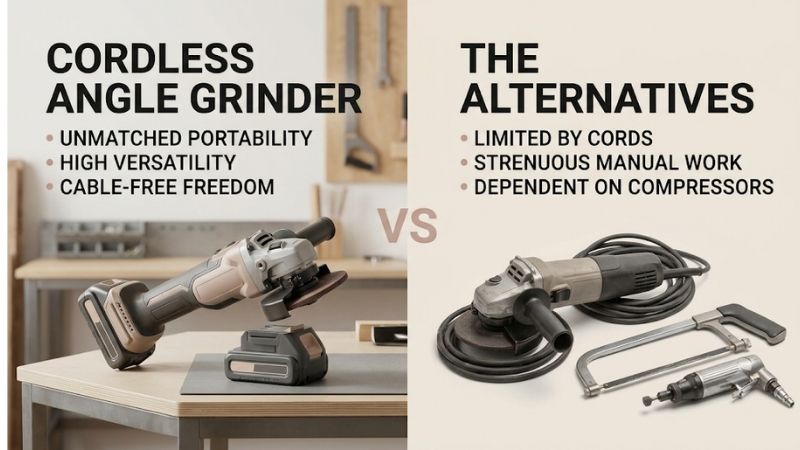
A cordless angle grinder receives energy from a rechargeable battery.
A corded angle grinder uses an electrical connection.
The cordless design eliminates the power cable and improves mobility.
However, runtime depends on battery capacity and workload.
The corded design avoids battery depletion but requires access to a suitable electrical supply.
Neither power source automatically guarantees superior cutting performance.
Cutting Performance
Cordless grinders can provide substantial output, particularly when paired with suitable high-capacity batteries.
Some manufacturers advertise performance comparable to specific corded grinders under controlled conditions.
However, those claims do not establish universal equivalence.
Motor design, gearing, accessory, material, and operating load all affect performance.
Continuous Grinding
Corded grinders are convenient for prolonged stationary work because they do not require battery changes.
However, they still have thermal limits and maintenance requirements.
Cordless grinders may need battery swaps during demanding work.
For occasional short operations, this difference may be relatively unimportant.
Portability
Cordless grinders are useful away from fixed electrical outlets.
They also eliminate one potential snagging or cutting hazard associated with cords.
Corded grinders may be more convenient at permanent workstations.
Operating Weight
A cordless grinder’s battery adds weight.
However, individual tool designs vary.
Compare complete operating configurations, including guard, handle, and accessory.
Total Ownership Cost
Cordless systems require compatible batteries and charging equipment.
Corded tools avoid those particular costs.
However, both require wheels, protective equipment, and maintenance.
Compare complete ownership costs.
Which Is Better for a Home Garage?
A cordless grinder is convenient for varied repairs and mobile use.
A corded grinder may provide better value for occasional work near an outlet.
Choose according to operating frequency, mobility, and existing equipment.
Cordless Angle Grinder vs Die Grinder
Tool Configuration
An angle grinder generally uses a disc or wheel mounted at an angle to the main body.
A die grinder typically uses a straight or angled spindle designed for smaller compatible accessories.
This difference affects access and material-removal methods.
Restricted-Space Work
Die grinders can be useful for internal features, small recesses, and narrow mechanical components.
Their smaller accessories may reach locations where a conventional angle grinder cannot fit.
However, accessory compatibility and operating speed are critical.
Surface Grinding
Angle grinders are generally more suitable for broader metal surface preparation.
They can use approved grinding wheels and flap discs for material removal.
Die grinders are often better for localized shaping and detail finishing.
Cutting Applications
Some die grinders support specialized cutting accessories.
However, they should not be treated as universal replacements for angle grinders.
Use only approved accessories.
Speed Differences
Die grinders may operate at much higher spindle speeds than conventional angle grinders.
Accessories must be rated appropriately.
Never transfer a wheel between tools based only on apparent physical fit.
Which Is Better for Metal Fabrication?
Choose an angle grinder for suitable broader cutting and grinding tasks.
Choose a die grinder for detail access and internal finishing.
Many fabrication workshops benefit from both.
Cordless Angle Grinder vs Dedicated Cut-Off Tool
Primary Purpose
An angle grinder is designed for multiple approved grinding and cutting applications.
A dedicated cut-off tool focuses on cutting operations.
This can make a cut-off tool more convenient for certain materials and cutting positions.
Wheel Size
Some compact cut-off tools use smaller wheels than conventional angle grinders.
This can improve access.
However, cutting depth may be limited.
Guarding
Dedicated cut-off tools have guarding designed for their approved accessories.
Angle grinders may require different guard configurations for cutting and grinding.
Never substitute one guard type for another without manufacturer approval.
Metal Cutting
Both tools can cut suitable metal with compatible accessories.
The better option depends on material thickness, workpiece support, cutting direction, and tool geometry.
Grinding Capability
A dedicated cut-off tool is not necessarily designed for side grinding.
Do not apply prohibited forces to a cut-off wheel.
An angle grinder is more versatile when both grinding and cutting are regularly required.
Which Should You Buy?
Choose a cut-off tool when a narrow range of cutting tasks dominates.
Choose an angle grinder when you need appropriate grinding, surface preparation, and cutting capabilities.
Cordless Angle Grinder vs Reciprocating Saw
Cutting Mechanism
A reciprocating saw moves a blade back and forth.
An angle grinder uses a high-speed rotating accessory.
These mechanisms create different cutting behaviors.
Metal Pipe Cutting
A reciprocating saw can be useful for cutting suitable metal pipes with an appropriate blade.
It may be preferable when the cutting geometry makes a rotating abrasive wheel difficult to use.
However, the pipe must be secured and its contents identified.
Demolition
Reciprocating saws are commonly used for demolition involving appropriate wood, metal, and mixed materials.
They are less suitable for grinding or surface finishing.
Weld Cleanup
An angle grinder is generally more suitable for smoothing and blending appropriate welded surfaces.
A reciprocating saw is not designed for that purpose.
Sparks and Debris
Abrasive cutting can produce substantial sparks and hot particles.
Reciprocating saws create different debris and mechanical hazards.
Neither tool is inherently safe around flammable materials.
Which Is Better for Repairs?
Choose a reciprocating saw for suitable demolition and pipe-cutting operations.
Choose an angle grinder for grinding, surface preparation, and approved abrasive cutting.
Cordless Angle Grinder vs Oscillating Multitool
Movement Differences
An oscillating multitool moves its accessory through a small angular arc.
An angle grinder rotates an accessory continuously at high speed.
This difference affects cutting capability and control.
Confined-Space Cutting
Oscillating tools can be useful for localized cuts near installed surfaces.
A grinder may be too large or aggressive for certain locations.
However, oscillating tools generally remove material more slowly.
Metal Cutting
Some oscillating blades are designed for compatible metals.
However, they may be inefficient for cutting thick stock.
An angle grinder can be more suitable for demanding metal cutting when the workspace allows safe operation.
Surface Preparation
Angle grinders can remove substantial material using suitable grinding accessories.
Oscillating tools are useful for localized scraping and sanding.
They serve different application needs.
Which Is Better for Renovations?
An oscillating multitool is useful for localized cutting and detailed repairs.
An angle grinder is better suited to appropriate metal cutting and surface preparation.
Cordless Angle Grinder vs Bench Grinder
Tool Position
A cordless angle grinder is handheld and portable.
A bench grinder is stationary and generally holds rotating abrasive wheels on a fixed machine.
Sharpening and Maintenance
Bench grinders can be useful for certain sharpening and metalworking operations.
However, not every tool or blade should be sharpened with a conventional bench grinder.
Follow the accessory manufacturer’s instructions.
Large Workpieces
An angle grinder can be brought to an appropriately secured large workpiece.
A bench grinder requires the workpiece to be positioned at the machine.
Precision
A stable bench grinder setup can support certain repeatable operations.
However, precision depends on the machine, rests, wheel condition, and technique.
Which Is Better for a Garage?
Choose a bench grinder for suitable stationary sharpening and shaping tasks.
Choose a cordless angle grinder for portable metalworking and surface preparation.
Compare Common Garage Applications
Removing Rust
An angle grinder can remove corrosion with appropriate wire or abrasive accessories.
For small localized areas, a die grinder may provide better access.
For delicate surfaces, manual methods may be preferable.
Cutting Steel Bar
An angle grinder or dedicated cut-off tool may be appropriate.
Secure the workpiece and use the correct wheel.
A reciprocating saw may also be suitable with the appropriate blade.
Preparing Welds
An angle grinder is commonly useful for suitable weld preparation and blending.
A die grinder may help with detail finishing.
Avoid damaging structural joints.
Cutting Metal Pipes
A reciprocating saw or appropriate cut-off tool may be convenient.
The correct choice depends on pipe material, access, and contents.
Never cut an unknown or pressurized line.
Removing Damaged Fasteners
An angle grinder may be used for certain accessible fasteners when cutting is appropriate.
However, sparks and nearby components can create hazards.
Manual or specialized extraction methods may be preferable.
Working Inside Machinery
A die grinder or compact specialty tool may provide better access than a conventional angle grinder.
Never operate around moving machinery or stored energy without proper isolation.
Outdoor Equipment Repairs
Cordless grinders are useful where electrical outlets are unavailable.
However, outdoor conditions introduce moisture and environmental hazards.
Use equipment within its approved operating conditions.
How to Choose the Right Tool
Identify the Primary Operation
Determine whether you mainly need cutting, grinding, shaping, sanding, or demolition.
A versatile angle grinder is appropriate when several metalworking operations are required.
A specialized tool may be more efficient when one task dominates.
Consider Material Type
Different metals and other materials require different accessories.
Choose a tool and attachment approved for the workpiece.
Evaluate Workpiece Size
Large accessible metal surfaces may suit an angle grinder.
Small internal features may require a die grinder.
Long pipes may be more convenient to cut with another tool.
Check Working Clearance
A grinder must have enough room for its guard, handle, and full wheel path.
If the required guard cannot fit, use another method.
Compare Power Sources
Cordless tools offer mobility.
Corded tools avoid battery charging interruptions.
Choose according to work location and duration.
Evaluate Accessory Costs
Grinding wheels, cut-off wheels, saw blades, and other accessories are consumables.
Compare their compatibility, availability, and expected replacement needs.
Prioritize Safe Operation
Every tool presents distinct hazards.
Choose the tool that allows proper guarding, secure workpiece support, and stable operator positioning.
Common Comparison Mistakes
Assuming an Angle Grinder Can Replace Every Metalworking Tool
An angle grinder is versatile but not universally appropriate.
Specialized tools may offer better control or access.
Ignoring Wheel Speed Ratings
Every rotating accessory must be approved for the tool’s operating speed.
Incorrect accessories can fail.
Using Cutting Wheels for Side Grinding
Thin cut-off wheels are generally not designed for lateral grinding loads.
Use the correct accessory.
Choosing Tool Size Without Considering Guards
The guard affects usable clearance.
Never remove required guarding to improve access.
Forgetting Battery Costs
A cordless tool’s full cost includes compatible power equipment.
Compare complete systems.
Ignoring Fire and Dust Hazards
Grinding can generate sparks, airborne particles, and hazardous dust.
Use appropriate controls.
Frequently Asked Questions
Is a cordless angle grinder better than a corded grinder?
Cordless models offer mobility and eliminate the power cord. Corded models avoid battery-runtime limitations. The better choice depends on workload, location, and total cost.
Can a die grinder replace an angle grinder?
Not for every application. Die grinders are useful for small-area access and detailed shaping, while angle grinders are generally more suitable for broader grinding and cutting.
Is a cut-off tool safer than an angle grinder?
Safety depends on the specific tool, accessory, guard, workpiece, and technique. Neither is inherently safe for every cutting operation.
Can a reciprocating saw cut metal better than an angle grinder?
It can be more suitable for certain pipes and demolition tasks. An angle grinder may be more appropriate for abrasive cutting and surface preparation.
Can an oscillating multitool cut steel?
Some blades are approved for certain steel applications. However, an oscillating tool may be inefficient for substantial metal cutting.
Should I buy a bench grinder or handheld angle grinder?
Choose a bench grinder for appropriate stationary operations and a handheld angle grinder for portable cutting and surface preparation.
Conclusion
When comparing a cordless angle grinder vs alternatives, choose the cordless grinder for versatile mobile metalworking, a corded grinder for prolonged stationary use, a die grinder for detailed access, and a dedicated cut-off tool for focused cutting tasks. Reciprocating saws, oscillating tools, and bench grinders offer advantages in specific applications. The right purchase depends on material, clearance, operating duration, accessory compatibility, and safe control.
More from Amazon
Programs that pair well with the guide above. Offers and eligibility are set by Amazon and may change.
Collect the home and kitchen items you want in one registry that guests can shop from.
Create a wedding registrySet up recurring deliveries of everyday items on eligible products. Terms and savings are set by Amazon.
Explore Subscribe & SaveFree shipping on eligible items, Prime Video and more. Eligible new members can start with a free trial.
Start a Prime free trialAudiobooks and podcasts to listen to on the go. Eligible new members can start with a free trial.
Try Audible freeAs an Amazon Associate we earn from qualifying purchases.