Choose a bedside sleeper bassinet for small spaces by comparing dimensions, bed compatibility, attachment safety, mattress design, storage, and newborn sleep requirements.
Choosing a bedside sleeper bassinet for small spaces requires more than comparing compact dimensions and attractive nursery features. A product must provide a separate, firm, flat infant sleep surface and, if designed to attach to an adult bed, use an approved and compatible attachment system. In a small apartment or bedroom, the frame footprint, adult-bed height, access route, and storage arrangements become equally important. This guide explains how to evaluate those practical needs without compromising newborn sleep safety.
First, Understand the Difference Between Bedside Sleepers and Bassinets
The terms bedside sleeper and bedside bassinet are frequently used interchangeably in retail listings. In the United States, however, a bedside sleeper is a specific type of infant sleep product designed to secure to an adult bed. An ordinary bassinet may be positioned next to the adult bed without being attached to it.
This distinction is especially important in small bedrooms, where parents may be tempted to position a freestanding bassinet tightly against the mattress or alter its side panel to save space. A product that has not been designed for attached bedside use must not be modified into an open-sided sleeper.
Attached Bedside Sleepers
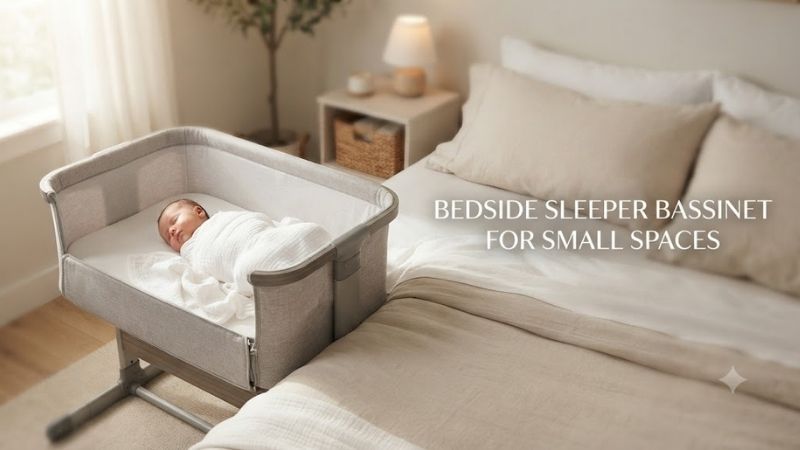
An attached bedside sleeper is designed to connect securely to a compatible adult bed. Its attachment system is part of the product’s safety design, not an optional convenience feature.
Applicable US requirements address issues such as mattress-to-sleeper separation, attachment security, barrier height, structural integrity, and possible infant entrapment. These requirements are covered under 16 CFR Part 1222, alongside the applicable bassinet requirements.
An attached sleeper should be considered only when the exact product is compatible with the adult bed and can be installed using every required component.
Freestanding Bedside Bassinets
A freestanding bassinet provides a separate infant sleep space positioned near the caregiver’s bed. It may offer height adjustment, mesh viewing panels, a storage shelf, or wheels.
Its main advantage is that it does not necessarily require attachment to the adult bed.
However, a freestanding bassinet must remain in its approved configuration. A lowering side panel or removable wall should never be operated in an unapproved open-side sleeping arrangement.
Why Retail Labels Can Be Misleading
A product listing may use phrases such as co-sleeper, bedside cradle, or next-to-me bassinet. These labels do not establish that the product is legally or mechanically suitable for attachment to an adult bed.
Before purchase, identify the exact model and read the manufacturer’s approved configurations.
If the listing does not clearly explain attachment requirements, it is not a reliable basis for deciding that open-sided use is appropriate.
The Non-Negotiable Safe Sleep Requirements
Infant sleep safety takes priority over bedroom size, portability, and convenience features. A bassinet that fits perfectly beside the adult bed is not an appropriate choice if its construction, mattress, or assembly creates an unsafe sleep environment.
The American Academy of Pediatrics recommends that infants sleep on their backs in their own sleep space with a firm, flat, non-inclined surface and a properly fitted sheet. Loose blankets, pillows, stuffed toys, sleep positioners, and other soft objects should remain outside the sleep space.
A Firm, Flat Mattress
An infant mattress is intentionally firmer than the sleeping surfaces many adults prefer. It should return promptly toward its original shape rather than allowing the baby’s head to sink deeply.
Do not add an aftermarket memory-foam topper, folded blanket, ordinary pillow, or additional padding to make the bassinet feel softer.
The supplied or specifically approved mattress must fit the product correctly, with no dangerous gaps around its perimeter.
A Level, Non-Inclined Surface
An infant should not be placed on an adult wedge pillow or an inclined bassinet arrangement to address reflux, congestion, or ordinary fussiness.
Sleep surfaces with inclines exceeding 10 degrees are considered unsafe for infant sleep, and the general recommendation is a firm, flat, level sleeping surface.
If an infant has a medical condition that raises positioning concerns, parents should seek specific guidance from the child’s clinician rather than modifying the bassinet.
Back Sleeping for Every Sleep
Infants should be placed on their backs for naps and nighttime sleep.
The availability of breathable mesh sides or a specially marketed mattress does not change this recommendation.
A product’s construction should never be interpreted as permission to place a newborn face-down or surrounded by soft bedding.
Room Sharing Without Bed Sharing
Keeping a baby’s separate sleep space close to the caregiver can make feeding, monitoring, and comforting more convenient.
However, proximity does not mean the baby should share the adult mattress.
A bedside sleeper is designed to provide a separate infant sleeping environment, even when secured to the adult bed.
Measure the Available Bedroom Space Before Shopping
Small-bedroom buyers often measure the empty area beside the bed but overlook the space required by the bassinet’s legs, moving components, and caregiver access.
A product can fit between a bed and wall while leaving too little room to enter or exit the bed safely.
The goal is to choose the smallest appropriate product that still offers a suitable sleeping area and stable installation.
Measure the Floor Footprint
Look for the bassinet’s complete exterior width and depth, including any legs that extend beyond the sleeping compartment.
The mattress dimensions alone do not describe the floor area required.
Some bedside bassinets have bases that extend underneath the adult bed. This can be useful, but only when the bed frame provides enough clearance and the manufacturer supports that placement.
Check Bedside Walking Clearance
Consider how a caregiver gets out of bed during the night.
A bassinet positioned between the bed and a wall should not create a hazardous obstacle or prevent safe movement.
There is no universal clearance number that guarantees suitability for every bedroom. Evaluate the actual walking route, furniture placement, and household mobility needs.
Account for Drawers and Doors
A bassinet may obstruct a nightstand drawer, wardrobe door, or bedroom entrance.
Measure the clearance needed to open those features.
Do not assume that the bassinet can simply be pushed out of the way while occupied. Follow its movement and wheel-locking instructions.
Consider Nighttime Lighting
A room should allow caregivers to see what they are doing during nighttime care without relying on unsafe extension-cord arrangements or unstable furniture.
Keep electrical cords, monitor cables, curtain cords, and other potential hazards away from the infant sleeping area.
A Small-Bedroom Planning Example
Consider a hypothetical bedroom that measures 10 × 10 feet and contains a queen mattress. The queen mattress itself is approximately 60 × 80 inches, but the actual bed frame may be wider and longer.
The room also contains a narrow nightstand, a dresser, and a door that opens inward.
A parent considering a bedside bassinet should not begin by selecting the narrowest advertised mattress.
Instead, measure the actual floor area between the bed and nearby furniture. Then check whether the complete bassinet base fits without obstructing walking routes, drawers, or the bedroom door.
Finally, verify the permitted position of the bassinet relative to the adult bed.
A freestanding bassinet that fits securely and maintains a separate enclosed sleeping area may be more suitable than an attached sleeper whose securing straps cannot be installed on that particular frame.
This example illustrates the decision process rather than prescribing a universal room layout.
Adult Bed Height and Frame Compatibility
Attachment compatibility is one of the most important differences between ordinary bassinets and true bedside sleepers.
Retail descriptions such as adjustable height or fits most beds should not be treated as guarantees of universal compatibility.
Measure the Adult Mattress Height
Measure the height of the adult mattress’s upper sleeping surface from the floor.
For an attached sleeper, compare this with the exact installation range provided by the manufacturer.
Do not confuse mattress height with bed-frame height. A thick mattress on a relatively low frame may have a different final sleeping height from a thin mattress on a taller foundation.
Understand Height-Adjustment Settings
Some bedside sleepers offer several fixed height positions.
Others have a more limited adjustment range.
The number of positions does not determine whether the product fits your bed. The actual supported height range and correct alignment are what matter.
Platform Beds
Platform beds may have solid bases, recessed frames, or unusual support arrangements.
Some attached sleeper systems require access beneath the mattress or particular attachment points.
A platform design that appears visually compatible may still prevent correct installation.
Storage Beds
Beds with drawers or enclosed lower frames can create additional restrictions.
An attachment strap may need to pass through an area blocked by built-in storage.
Do not modify the storage bed, drill into unsupported components, or improvise attachments to make the sleeper fit.
Adjustable Beds
An adjustable bed changes its geometry as the mattress moves.
That motion can affect the relationship between an attached sleeper and the adult mattress.
Use an attached bedside sleeper with an adjustable bed only when the manufacturer explicitly supports that exact configuration and all required conditions can be maintained.
Why an Unsafe Gap Matters
If an attached sleeper can separate from the adult bed, an infant may face an entrapment hazard.
This is why secure attachment and maximum separation requirements are central to bedside sleeper safety standards.
Never rely on the bassinet being pressed tightly against the mattress without the required attachment system.
Choosing a Suitable Bassinet Design for a Small Bedroom
Different bassinet configurations can address specific space limitations, but each offers trade-offs.
| Design | Potential advantage | Main limitation | Best purchasing priority |
|---|---|---|---|
| Compact freestanding bassinet | Straightforward bedside placement | Requires floor space | Safe enclosed sleeping area |
| Attached bedside sleeper | Approved bedside access | Strict adult-bed compatibility | Secure attachment |
| Swivel-style bassinet | Adjustable access position | Base may extend widely | Clear floor space |
| Portable folding bassinet | Easier storage between approved uses | Requires assembly checks | Correct setup every time |
| Bassinet with integrated storage | Reduces separate supply storage | Shelf can add footprint | Keep items outside sleep surface |
| Wheeled freestanding bassinet | Repositioning convenience | Wheel locks and movement restrictions | Stable placement during sleep |
Compact Freestanding Bassinets
A compact freestanding bassinet is often a practical option for apartment bedrooms because it does not require the same attachment arrangement as a true bedside sleeper.
However, compact does not mean that the infant sleeping area can be arbitrarily reduced. The product must still comply with applicable requirements and remain appropriate for the baby’s size and developmental stage.
Why Simple Construction Can Be an Advantage
A straightforward freestanding bassinet may have fewer adjustments and accessories to manage.
For tired caregivers, simpler assembly and operation can be useful.
However, fewer features do not guarantee safety. Compliance, stability, and correct installation remain essential.
What to Check Before Buying
Review the exterior dimensions, sleeping-area dimensions, manufacturer instructions, included mattress, and applicable infant weight and developmental limits.
Also check whether the bassinet fits on the floor without needing to be placed on an adult bed, sofa, table, or other elevated surface.
Swivel and Height-Adjustable Bassinets
Swivel bassinets can allow the infant sleeping compartment to move relative to the frame. This can improve caregiver access in certain bedroom layouts.
However, the mechanism does not eliminate the need for sufficient floor clearance.
Why the Base Footprint Matters
A swivel bassinet may have a relatively compact sleeping compartment but a wider supporting base.
That base can extend into a walking route or beneath nearby furniture.
Measure the complete footprint before purchasing.
Height Adjustment
Adjustable height may make the bassinet easier to position relative to the adult bed.
However, the selected position must remain within the manufacturer’s intended use.
Do not use height adjustment to create an inclined infant sleeping surface unless a specific approved configuration explicitly permits the arrangement—and do not use an inclined surface for ordinary infant sleep.
Moving Components
A swivel or adjustable mechanism must be properly locked or secured as required.
Inspect it regularly and stop using the product if a component becomes damaged or does not function correctly.
Folding and Travel-Oriented Bassinets
A folding bassinet may seem especially attractive in a small apartment because it can be stored when no longer needed.
However, folding capability does not establish that a product is suitable for all infant sleeping situations.
Confirm That It Is an Approved Sleep Product
Some portable baby products are intended for supervised play or resting rather than unattended overnight sleep.
A product should not be used as a bassinet unless its intended use and applicable compliance support infant sleep.
Assembly After Storage
A folded product must be reassembled completely before use.
Check that all locking mechanisms and support components are correctly engaged.
Missing parts or damaged hinges can create serious hazards.
Why Portability Does Not Mean Any Surface Is Safe
A portable bassinet should not be placed on an adult bed, sofa, countertop, or another unsupported elevated surface merely because it is lightweight.
Use only the support arrangement specified by the manufacturer.
Bassinet Storage Features: What Is Actually Useful?
Small bedrooms often have limited room for a changing station, dresser, or separate supply cart.
A bassinet with integrated storage can therefore be attractive.
However, storage convenience must not interfere with the infant sleeping area or the product’s stability.
Under-Bassinet Storage Shelves
An integrated lower basket or shelf can provide space for clean diapers, wipes, and spare clothing.
This may reduce the need for a separate bedside organizer.
Check the stated storage capacity and avoid placing heavy items on components not designed to support them.
Side Pockets
Small pockets may hold lightweight caregiver supplies.
Do not place objects where they can fall into the sleeping area or become accessible to the infant.
Avoid Overloading the Frame
Additional weight on storage shelves can change how a product behaves if the manufacturer has not designed it for that load.
Follow the stated limits rather than treating the bassinet as general bedroom furniture.
Keep the Sleep Space Empty
Storage compartments are separate from the infant mattress.
Diapers, toys, blankets, bottles, and other belongings should never be stored next to the sleeping infant.
Mattress, Fitted Sheet, and Cleaning Requirements
Newborn bedding often needs frequent attention because of spit-up, diaper leaks, and ordinary household use.
A practical bassinet should be easy to clean without requiring unsafe mattress substitutions or added padding.
Use the Approved Mattress
The mattress must be designed and approved for the specific bassinet.
Do not purchase a thicker replacement because the original feels too firm.
Infant firmness requirements differ from adult comfort preferences.
Fitted Sheets
Use a fitted sheet intended for the mattress dimensions and approved by the manufacturer.
A loosely fitting sheet can bunch or create hazards.
Do not substitute oversized sheets simply because they stretch around the mattress.
Washable Fabric Components
Removable washable panels can simplify cleaning.
However, not every fabric panel is designed to be removed, and some components require specific assembly procedures after washing.
Follow the manufacturer’s instructions carefully.
Thorough Drying
All washed fabric and mattress components must be completely dry before reassembly and use.
Damp sleeping surfaces can create hygiene problems.
Replacement Parts
Check whether compatible fitted sheets, mattress components, and other necessary replacement parts are available.
Do not improvise missing hardware or substitute incompatible parts.
How Long Will a Newborn Use a Bedside Sleeper?
A bassinet’s useful life is limited by the manufacturer’s stated restrictions and the infant’s development.
These limits may include maximum weight and milestones such as pushing up or other forms of increasing mobility.
Do not rely only on age.
Weight Limits
The published weight limit is model-specific.
A product rated for one maximum weight should not be assumed equivalent to another.
Developmental Milestones
The need to discontinue use can occur before reaching the maximum weight.
Follow the manufacturer’s warnings about rolling, pushing up, or other relevant abilities.
Why Long-Term Value Matters
A premium bassinet may provide convenient features but still be used for a relatively short period.
For budget-conscious families, it is important to plan for the next approved sleep space rather than spending the entire nursery budget on features that may be used only during early infancy.
Planning the Transition
A suitable crib or other approved sleep product will eventually be needed.
The next product should be selected according to current safety requirements and the child’s developmental stage.
Choosing Between a Bedside Sleeper and a Mini Crib
A mini crib is another option for small bedrooms, but it serves a different practical purpose.
A compliant mini crib may offer a longer useful period than a typical bassinet, depending on the child’s size and developmental stage.
However, it generally does not provide the same attached bedside access as a true bedside sleeper.
When a Bassinet Makes Sense
A bassinet may be appropriate when close nighttime access and early-infant convenience are the main priorities.
Its portability or height may make it easier to fit into certain room arrangements.
When a Mini Crib May Be Better
A mini crib may be worth considering when floor space is limited and the family wants a sleep product suitable for a longer period.
However, mini cribs still require appropriate mattresses, assembly, and compliance with their own applicable requirements.
Compare Total Ownership Cost
A bassinet that is replaced quickly may cost more overall than a longer-use crib arrangement.
However, the convenience of early-infant bedside access may justify the bassinet for some households.
Neither category is universally better.
Should You Buy a Used Bedside Sleeper Bassinet?
Secondhand infant sleep products require careful evaluation.
A used bassinet may appear undamaged while missing original hardware, attachment straps, or critical instructions.
For attached bedside sleepers, missing attachment components are particularly concerning because they can compromise the product’s intended safety arrangement.
Verify the Exact Model
Look for a permanent model label and manufacturer identification.
A generic photograph or verbal description is not sufficient.
Check Recall Status
Verify whether the exact product has been recalled or subject to a safety warning.
Do not assume that every product from the same brand has identical safety status.
Inspect All Hardware
Check the frame, locks, fabric, attachment system, mattress, and supporting components.
Do not use a product with missing or improvised parts.
Confirm the Instructions
You need the correct instructions for the exact model.
A similar model may use a different attachment or height-adjustment system.
When to Walk Away
Avoid secondhand products with unknown history, missing model identification, substituted mattresses, damaged structural components, or incomplete attachment systems.
Saving money does not justify an unverified infant sleep setup.
Buying Scenarios for Small Bedrooms
A Studio Apartment With a Platform Bed
An attached bedside sleeper may appear convenient because it can be placed close to the mattress.
However, platform beds can have enclosed or recessed frames that prevent the required straps from being installed.
In this situation, a compact compliant freestanding bassinet may be more appropriate if its base fits safely beside the bed.
A Bedroom With Very Little Walking Space
A large swivel bassinet may interfere with the only practical route around the bed.
A narrower freestanding design may reduce obstruction.
However, the baby still needs an appropriately sized compliant sleep surface, and the caregiver must retain safe access to the room.
A Family Planning to Move Soon
A portable or folding bassinet may offer convenience, but its approved configuration must be restored correctly after each move.
Choose a product with clear assembly instructions and a suitable carrying system rather than prioritizing folding speed alone.
Parents Wanting Easy Nighttime Feeding Access
A true bedside sleeper with an approved attachment system may be attractive, provided the adult bed is compatible.
The separate infant sleep surface remains essential.
After feeding or comforting the baby, return the infant to the approved sleep area before the caregiver sleeps.
Common Small-Space Bassinet Buying Mistakes
Measuring Only the Sleeping Compartment
The outside frame may extend farther than the mattress.
A bassinet with a narrow sleeping compartment may still have broad support legs that obstruct the room. Check total exterior dimensions, and compare them with the actual floor plan.
Assuming an Open Side Is Always Permitted
Some products have lowering panels for caregiver access, while others operate as true attached bedside sleepers. The visible presence of a zipper or hinged wall does not prove that leaving it open during sleep is permitted.
Use only the configurations specifically authorized by the manufacturer, and secure required attachments exactly as instructed.
Choosing an Inclined Mattress for Reflux
Infant sleep recommendations call for a firm, flat, non-inclined surface. Do not add a wedge, rolled towel, or other object beneath the mattress to raise the baby’s head.
Reflux or breathing concerns should be discussed with the child’s clinician rather than managed through an improvised incline.
Paying More for Breathability Claims
Mesh sides and specialized mattress materials may offer design features, but they do not replace back sleeping or justify adding soft bedding.
Evaluate the entire product’s compliance, construction, and permitted use instead of treating one marketed feature as a universal safety guarantee.
Frequently Asked Questions
What Is the Best Bedside Sleeper Bassinet for a Small Bedroom?
The best choice is a compliant product whose full exterior dimensions fit the room and whose sleeping configuration is appropriate for the adult bed. A compact freestanding bassinet may be preferable when an attached sleeper cannot be installed safely. If an attached design is essential, verify the exact bed-frame and mattress-height requirements first.
Can a Bedside Sleeper Fit Against a Platform Bed?
Some models may be compatible with certain platform beds, but compatibility is not universal. A platform frame may obstruct securing straps or prevent correct alignment. Use the product only when the manufacturer explicitly supports the bed configuration and all required attachment components can be installed correctly.
Is a Freestanding Bassinet Safer Than an Attached Sleeper?
Neither category is automatically safer in every household. Both must meet applicable requirements and be used correctly. A freestanding bassinet avoids attachment requirements, while a compliant attached sleeper includes specific provisions addressing separation and entrapment. The appropriate choice depends on the exact product and installation environment.
Can I Put a Wedge Pillow in a Bassinet for Infant Reflux?
No. Do not place a wedge pillow, sleep positioner, rolled blanket, or other incline accessory beneath or around an infant. Babies should sleep on a firm, flat, non-inclined surface with the approved mattress and fitted sheet. Seek pediatric guidance for reflux concerns rather than modifying the sleep surface.
Are Folding Bassinets Suitable for Overnight Sleep?
Only when the specific product is intended and approved for overnight infant sleep and used in its correct assembled configuration. A folding feature does not establish sleep safety. Check the model’s instructions, hardware, stability, and applicable compliance before use.
How Do I Know When My Baby Has Outgrown the Bassinet?
Follow the manufacturer’s exact weight and developmental limits. Some infants may reach a relevant movement milestone before reaching the maximum listed weight. Do not continue use beyond any stated restriction; transition to another appropriate infant sleep product.
Conclusion
The best bedside sleeper bassinet for small spaces provides a compliant, firm, flat infant sleep surface while fitting the room and the caregiver’s actual bed configuration. Choose a compact freestanding bassinet when secure adult-bed attachment is not possible, or a true attached bedside sleeper only when the required straps, barriers, and height alignment can be installed correctly. Prioritize exterior dimensions, safe access, approved mattress components, and developmental limits over decorative features or promises of universal compatibility.