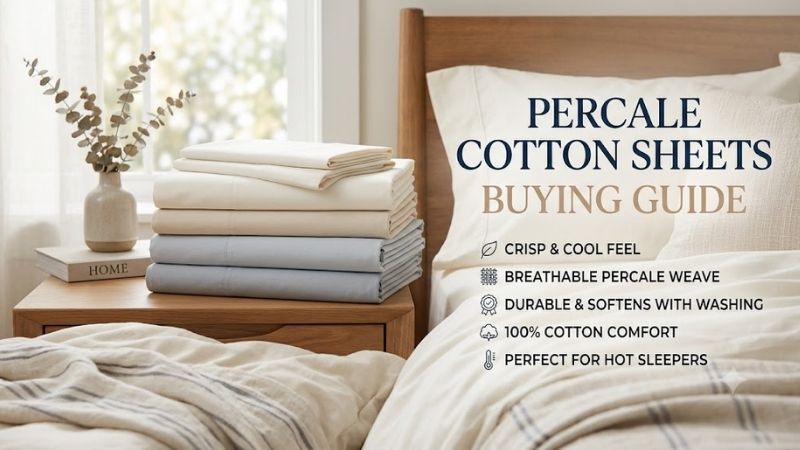
Percale cotton sheets are popular with sleepers who want crisp, lightweight bedding instead of a silky, draping fabric. But two percale sets can differ substantially in smoothness, breathability, construction, and durability. Cotton fiber quality, yarn design, thread count, finishing, and washing instructions all influence the finished product. This buying guide explains what matters, what marketing claims to question, and how to select percale sheets that suit your mattress and sleeping preferences.
What Are Percale Cotton Sheets?
Percale is a fabric weave rather than a type of cotton.
It uses a balanced plain-weave structure in which the weft yarn passes over one warp yarn and under the next, creating a repeating one-over-one-under pattern.
The result is commonly associated with a crisp texture, matte surface, and relatively structured drape.
However, the weave alone does not determine the finished sheet’s quality.
Fiber length, yarn thickness, fabric density, and textile finishing remain important.
Percale Is Not Automatically 100% Cotton
Although cotton percale is common, percale can also be woven from blends or other fibers.
A product described as cotton percale should have clear fiber-content labeling.
If you specifically want 100% cotton, check the actual composition rather than assuming the word percale guarantees it.
Why Percale Feels Different From Other Bedding
The balanced weave produces relatively little of the extended yarn floating associated with sateen construction.
This contributes to percale’s familiar crispness and matte appearance.
However, fabric weight and finishing can soften or modify that feel.
Some percale products are especially crisp when new, while others are prewashed for a more relaxed texture.
Understand Cotton Quality Before Comparing Prices
Cotton is not one uniform textile ingredient.
Different cotton varieties and manufacturing processes can produce substantially different yarns.
Conventional Cotton
Conventional cotton can be used to produce comfortable, durable sheets.
Its quality depends on fiber characteristics and processing.
A product made from conventional cotton is not automatically inferior to one using a premium cotton name.
Long-Staple Cotton
Long-staple cotton fibers can be spun into relatively smooth, strong yarns when properly processed.
These characteristics may help produce refined bedding.
However, a long-staple claim should be evaluated alongside fabric construction and finishing.
Pima Cotton
Pima cotton is associated with extra-long-staple cotton fibers.
It can provide a strong foundation for smooth bedding.
However, not every product using the name Pima has identical yarn or manufacturing quality.
Egyptian Cotton
Egyptian cotton is often associated with premium bedding.
The name can refer to cotton origin, but the actual staple length and quality should not be assumed solely from marketing.
A clearly documented long-staple Egyptian cotton sheet is more informative than a vague luxury claim.
Organic Cotton
Organic cotton describes production under particular agricultural and certification requirements.
It is not a guarantee of superior softness, durability, or sleeping temperature.
Choose certified organic cotton when its sourcing requirements matter to you, rather than expecting the certification alone to determine comfort.
How Much Does Thread Count Matter?
Thread count is frequently advertised as a headline specification.
It should be treated as one piece of information, not a complete quality score.
What Thread Count Measures
Thread count usually represents the number of lengthwise and crosswise yarns counted within a square inch of woven fabric.
However, different yarn structures and counting approaches can complicate comparisons.
Why Extremely High Numbers Can Be Misleading
A sheet advertising an unusually high count may use multi-ply yarns or other counting methods that make comparison difficult.
More threads do not automatically mean more airflow, durability, or comfort.
An excessively dense fabric may feel different from the lightweight percale a buyer expects.
Practical Buying Range
Many traditional cotton percale sheets are sold around 200–400 thread count.
This is a familiar category range rather than a universal requirement.
A well-made 200-thread-count percale can outperform a poorly manufactured sheet with a substantially higher advertised count.
Compare Similar Fabrics
Thread count is most useful when comparing products with similar fiber types, yarn construction, and weave.
It is less meaningful when comparing cotton percale directly with linen or knitted fabrics.
Percale Versus Sateen: Which Should You Choose?
The decision between percale and sateen is one of the most important bedding choices.
Both can be made from cotton, but their weave structures produce different sensations.
| Feature | Percale cotton | Sateen cotton |
|---|---|---|
| Weave | Balanced plain weave | Satin-style weave |
| Surface | Generally matte | Often more lustrous |
| Feel | Crisp, structured | Smooth, fluid |
| Drape | Relatively firm | More flexible |
| Initial softness | Can feel crisp | Often feels smooth |
| Wrinkles | Common | Depends on construction |
| Temperature | Fabric-specific | Fabric-specific |
Choose Percale for Crispness
Percale is a logical choice if you prefer sheets that feel fresh, light, and structured.
Some sleepers describe this as a traditional hotel-sheet sensation.
Choose Sateen for Smoothness
Cotton sateen may be preferable if you want a softer, more fluid surface.
It can feel more enveloping than percale.
Do Not Choose Based on Cooling Marketing Alone
Neither weave is guaranteed to be cooler in every finished product.
Fabric weight, yarn density, finishing, and bedding layers influence the actual result.
Are Percale Cotton Sheets Good for Hot Sleepers?
Cotton percale is frequently recommended for people who dislike heavy bedding.
Its typical lightweight construction and crisp feel can be comfortable in warm bedrooms.
However, a complete explanation requires looking beyond the weave.
Air Permeability
Air permeability describes how easily air can move through the fabric.
It depends on yarn size, density, weave, and finishing.
A percale sheet made from thick yarns may behave differently from a lightweight percale.
Moisture Absorption
Cotton can absorb moisture.
That may influence comfort during ordinary sweating.
However, moisture absorption is not identical to rapid moisture evaporation.
Humidity and ventilation affect how quickly bedding dries.
Mattress Construction
A heat-retaining mattress may contribute more to nighttime warmth than the difference between two similarly lightweight sheet sets.
Mattress Protectors
Some protectors add relatively insulating layers beneath the fitted sheet.
This can influence the sleeping environment.
Top Bedding
A thick comforter can create substantial warmth even when the sheets are lightweight.
Practical Recommendation
For warm sleepers, prioritize lightweight percale and assess the complete bedding arrangement.
Do not assume that a sheet marketed as cooling has independently demonstrated superior temperature control.
How to Evaluate Softness Without Being Misled
Softness is subjective.
A sheet that feels luxurious to one person may feel overly smooth or insufficiently crisp to another.
Initial Hand-Feel
New percale can feel relatively crisp.
This is not necessarily evidence of poor quality.
Washed Percale
Some manufacturers prewash or soften fabric before sale.
That can produce a more relaxed initial sensation.
Softening With Use
Cotton percale may become softer after repeated laundering.
The degree of change depends on fabric construction and finishing.
Why Fabric Softener Is Not Always the Answer
Excessive fabric softener use can leave residues and may affect some textile properties.
Follow the sheet manufacturer’s instructions.
Avoid assuming that every stiff sheet requires chemical softener.
Understanding Fabric Weight
Fabric weight can influence how sheets feel and drape.
However, heavier does not automatically mean better.
Lightweight Percale
A lighter fabric may feel less substantial and can be comfortable in warmer conditions.
Its durability still depends on yarn and construction quality.
Heavier Percale
A heavier fabric may feel more structured.
It can also take longer to dry under some conditions.
Why Weight Alone Is Insufficient
Two fabrics with similar weight may use different fibers and yarn structures.
Evaluate weight alongside composition and weave.
How to Choose the Correct Fitted Sheet
Proper fit is essential for comfortable bedding.
Even premium sheets can be frustrating when they pull loose or bunch around the corners.
Measure Mattress Width and Length
Use the actual mattress dimensions.
Do not rely entirely on nominal categories.
Measure Mattress Height
Include an installed topper if it sits beneath the fitted sheet.
Check the entire height from the bottom to the top of the mattress.
Evaluate Pocket Depth
Compare mattress height with the stated fitted-sheet pocket specification.
Do not assume that deep-pocket labeling guarantees compatibility.
Check Elastic Design
Elastic around the full fitted-sheet perimeter may help maintain a secure fit.
However, proper dimensions remain essential.
Consider Adjustable Bases
Some adjustable beds change the way the mattress bends.
For a split king, two separate twin XL fitted sheets may be appropriate.
Confirm the exact configuration.
Common US Mattress Sizes
| Size | Nominal dimensions | Important consideration |
|---|---|---|
| Twin | 38 × 75 inches | Single sleeper |
| Twin XL | 38 × 80 inches | Longer than twin |
| Full | 54 × 75 inches | Smaller shared mattress |
| Queen | 60 × 80 inches | Common main bedroom |
| King | 76 × 80 inches | Greater width |
| California king | 72 × 84 inches | Additional length |
Actual finished mattress dimensions and manufacturer sheet measurements can vary.
Flat Sheet or No Flat Sheet?
A traditional American sheet set often includes a fitted sheet, flat sheet, and pillowcases.
However, not everyone uses a flat sheet.
Reasons to Use One
A flat sheet can provide a washable layer between the sleeper and the duvet or blanket.
It may also be used as a lightweight covering in warm weather.
Reasons to Skip One
Some sleepers prefer using a duvet cover without a top sheet.
A starter set may reduce laundry and storage.
Package Value
Compare the actual components.
A lower-priced set that excludes the flat sheet is not directly equivalent to a complete set.
What Construction Details Indicate Quality?
Beyond fiber content, several practical details deserve attention.
Seam Stitching
Look for consistent seams and secure stitching.
Loose threads or uneven finishing may suggest quality-control problems.
Fitted-Sheet Elastic
The elastic should be appropriately secured.
A stretched-out elastic edge can cause the sheet to slip even when the fabric remains usable.
Pillowcase Closures
Some pillowcases have open ends.
Others include envelope closures to help contain the pillow.
Choose according to preference.
Color Consistency
Check whether the pieces are intended to match.
Dye lots can vary between separately purchased components.
Finished Measurements
Nominal package sizes are not a substitute for actual measurements.
A sheet can be labeled queen while offering different dimensions from another queen product.
Are Organic Percale Cotton Sheets Worth It?
Organic cotton may be important to shoppers interested in agricultural sourcing and verified production requirements.
However, different certifications address different aspects of the textile.
Organic Fiber Certification
An organic cotton claim should be supported by appropriate documentation.
Chemical Testing Certifications
Some certifications test textile products for specified harmful substances.
That is different from certifying organic cultivation.
Environmental Claims
Statements such as sustainable, eco-friendly, or non-toxic should be evaluated carefully.
These phrases do not automatically establish comprehensive environmental or health performance.
Buying Recommendation
Choose organic percale when documented sourcing is a meaningful priority.
Do not pay extra solely because the packaging implies guaranteed comfort or health benefits.
How Long Should Percale Cotton Sheets Last?
There is no universal lifespan.
The outcome depends on how the sheets are made and maintained.
Fiber Quality
Longer cotton fibers can support strong yarn construction when processed properly.
Fabric Density
Weave consistency and yarn structure influence abrasion resistance.
Washing Frequency
Sheets used every night generally experience more laundering than occasional guest bedding.
Dryer Heat
Excessive heat can contribute to textile wear and may affect elastic components.
Mattress Friction
Movement against a mattress or protector can produce wear over time.
When to Replace
Consider replacing sheets when they develop significant thinning, holes, weakened elastic, persistent odors, or damage that affects comfort.
Washing Percale Cotton Sheets
Follow the Care Label
Different products may specify different temperatures and cycles.
Avoid Overloading
Large sheets need room to move in the washer.
Use Appropriate Detergent
Excessive detergent may leave residue.
Separate Abrasive Items
Exposed zippers and hooks can damage fabric.
Dry According to Instructions
Avoid excessive heat if the label recommends lower temperatures.
Reduce Wrinkling
Removing sheets promptly and smoothing them during bed-making may help reduce creases.
Percale will still have a more naturally wrinkled appearance than some synthetic alternatives.
How to Store Percale Sheets
Store bedding clean and dry.
A closet, dresser drawer, or covered under-bed container can work.
Keep matching sets together.
Avoid excessively tight compression that creates deep wrinkles.
In humid environments, address moisture rather than assuming a closed box will protect the sheets indefinitely.
Buying Percale Sheets for Different Households
Hot Sleepers
Consider lightweight percale and evaluate the mattress, protector, and duvet together.
Families With Children
Prioritize easy laundering and durable construction.
Pet Owners
Consider abrasion and snagging risks.
Apartment Dwellers
Choose manageable sheet sets and practical storage.
Guest Rooms
A straightforward percale set may be sufficient without premium finishing.
Luxury Bedding Shoppers
Evaluate long-staple cotton, construction, finishing, and return policies rather than thread count alone.
Common Percale Shopping Mistakes
Buying Based Only on Thread Count
High numbers do not guarantee quality.
Confusing Percale With Cotton Type
Percale is a weave.
Ignoring Pocket Depth
A poor fit can make sheets uncomfortable.
Expecting a Silky Surface
Traditional percale feels crisper than sateen.
Believing Every Cooling Claim
Cooling performance depends on the complete textile and bedding environment.
Assuming Premium Branding Means Better Durability
Construction and evidence matter more than price alone.
Overlooking Care Instructions
A sheet set must work with your laundering routine.
Frequently Asked Questions
What Thread Count Is Best for Percale Cotton Sheets?
There is no universal ideal. Many traditional products fall around 200–400 thread count, but cotton quality and construction are more important than selecting the highest number.
Are Percale Sheets Cooler Than Sateen?
Some sleepers prefer percale’s lightweight, crisp feel, but actual temperature performance depends on the specific fabrics and bedding conditions.
Do Percale Sheets Get Softer?
Many become more relaxed after laundering and use, although the degree of change varies.
Are Egyptian Cotton Percale Sheets Better?
They can be well made, but the cotton name alone does not guarantee superior quality. Verify the construction and fiber claims.
Why Do Percale Sheets Wrinkle?
Cotton fibers and the fabric’s structure make creasing a normal characteristic.
Are Percale Sheets Good for Year-Round Use?
They can be comfortable throughout the year when paired with suitable blankets or duvets. Personal temperature preferences still matter.
Conclusion
The best percale cotton sheets combine a crisp texture with appropriate cotton quality, reliable construction, and a secure mattress fit. Look beyond thread-count marketing, choose the correct pocket depth, and compare long-staple cotton and finishing details when considering premium sets. Lightweight percale is a strong option for sleepers who prefer structured bedding, while those seeking a silky drape may prefer cotton sateen. Proper laundering and realistic fabric expectations will help you get the most value from your purchase.