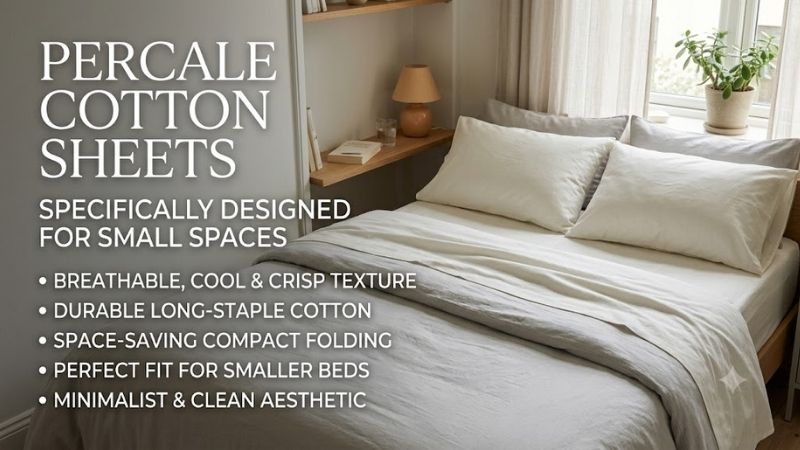
Choosing percale cotton sheets for small spaces involves more than finding crisp, comfortable bedding. Apartment bedrooms, dorm rooms, studios, and compact guest rooms often have limited linen storage, smaller laundry facilities, and less room for drying large sheets. The right percale set should fit your mattress properly, feel comfortable throughout the year, withstand regular laundering, and remain easy to fold and store.
Why Percale Cotton Sheets Make Sense for Small Bedrooms
Percale cotton is a practical bedding option for people who prefer a crisp, lightweight sleeping surface. Unlike sateen, which generally has a smoother and more fluid drape, percale is woven in a balanced one-over-one-under structure.
This construction is associated with a matte appearance, a relatively airy feel, and the crisp texture often found in traditional hotel bedding.
However, not all percale sheets are equally lightweight, breathable, or durable. Cotton fiber quality, yarn thickness, thread count, finishing, and fabric density all influence the finished product.
In a small bedroom, these differences affect more than comfort. They also influence laundering, drying, folding, and storage.
Advantages of Percale in Compact Living Spaces
Percale offers several characteristics that can be useful in smaller homes.
Its crisp construction creates a relatively structured surface that many sleepers enjoy. Lightweight percale can also be manageable during routine washing, provided the sheet size and fabric weight are appropriate.
Cotton percale does not require special cooling technology to provide a comfortable bedding experience.
For apartment dwellers who prefer a simpler sleeping setup, a well-fitting percale fitted sheet, flat sheet if desired, and pillowcases may be sufficient without adding numerous decorative layers.
Limitations Worth Understanding
Percale wrinkles naturally.
This can be more noticeable when sheets are air-dried or stored tightly folded in small drawers.
New percale may also feel firmer than cotton sateen, brushed cotton, or bamboo-derived viscose.
And although many people enjoy percale in warmer environments, no fabric weave guarantees a cool sleeping temperature regardless of the mattress and bedroom conditions.
Start With the Mattress: Finding the Correct Sheet Size
Small bedrooms frequently contain twin, twin XL, full, or queen mattresses.
Selecting the correct size is essential because even high-quality cotton sheets can become uncomfortable when the fit is wrong.
| Mattress size | Standard US dimensions | Common small-space application |
|---|---|---|
| Twin | 38 × 75 inches | Small bedrooms, children’s rooms |
| Twin XL | 38 × 80 inches | College dorms, taller single sleepers |
| Full | 54 × 75 inches | Studio apartments, compact bedrooms |
| Queen | 60 × 80 inches | Main bedrooms in apartments |
| King | 76 × 80 inches | Larger shared bedrooms |
These are nominal dimensions. Actual mattress measurements and finished sheet dimensions should be checked before purchase.
Twin Percale Sheets for Small Bedrooms
Twin bedding occupies less storage space than equivalent fabric constructions in larger sizes.
For someone sleeping alone in a compact bedroom, a twin set may be sufficient if the mattress dimensions and sleeper’s needs are appropriate.
A standard twin fitted sheet should not be substituted for a twin XL.
The additional five inches of mattress length matters, particularly after accounting for mattress thickness.
Twin XL Sheets for Dorm Rooms
Many US college dormitories use twin XL mattresses.
However, mattress sizes are not universal across institutions.
Students should confirm the measurements supplied by their housing provider.
Twin XL percale sheets can be particularly attractive for students who prefer crisp fabric and do not want heavily textured bedding.
Before purchasing, check whether the fitted sheet accommodates any required institutional mattress cover or permitted topper.
Full-Size Sheets for Studio Apartments
A full mattress can preserve walking space compared with a queen in a small bedroom.
It also requires less fabric in each bedding component.
This can make laundering and storage somewhat more manageable.
However, a full sheet set should not be purchased for a queen mattress simply to save money.
Poor fit can produce loose corners, excessive tension, or difficulty making the bed.
Queen Sheets for Compact Shared Bedrooms
A queen bed is common in smaller main bedrooms.
Queen percale sheets offer additional sleeping width compared with a full mattress, but they also create larger laundry loads.
If storage space is limited, it may be more practical to maintain two essential sets than several complete decorative collections.
Mattress Thickness and Fitted-Sheet Pocket Depth
Mattress size alone is not enough to guarantee proper fit.
A fitted sheet must accommodate the mattress’s height.
How to Measure Mattress Height
Measure from the underside of the mattress to its upper sleeping surface.
Include any topper that remains on the mattress beneath the fitted sheet.
Do not include blankets or removable bedding placed above the fitted sheet.
Standard Versus Deep-Pocket Sheets
Some fitted sheets are intended for relatively thin mattresses.
Others accommodate thick mattresses and toppers.
A deep-pocket designation is not a standardized guarantee of universal fit.
Read the actual pocket measurement in inches.
Why Excessively Deep Pockets Can Be Inconvenient
A deep-pocket fitted sheet may fit poorly on a particularly thin mattress.
Extra fabric can bunch beneath the corners.
Although elastic helps retain the sheet, it cannot always compensate for a substantial size mismatch.
Check Elastic Construction
Some fitted sheets use elastic around the entire perimeter.
Others use different corner and edge arrangements.
Full-perimeter elastic can help maintain tension when the sheet dimensions are appropriate.
However, elastic quality and fit remain important.
Understanding Percale Cotton Fabric Quality
A purchasing decision should not depend solely on the word percale.
Percale describes the weave, not the complete quality of the textile.
Cotton Fiber Length
Cotton varieties differ in their average staple length.
Long-staple cotton can support the production of smoother, relatively strong yarns when spun and woven properly.
Pima and certain Egyptian cotton products are examples commonly associated with long-staple fibers.
However, a premium cotton name alone does not guarantee superior construction.
Fiber quality must be considered alongside spinning, weaving, and finishing.
Combed Cotton
Combing removes some shorter fibers and impurities before yarn production.
This can contribute to a smoother, more uniform yarn.
However, labels do not always provide enough information to compare the complete manufacturing process.
Organic Cotton
Organic cotton relates to how cotton is grown under particular certification requirements.
It does not automatically mean that the resulting percale fabric will be softer, cooler, or more durable.
Buyers interested in organic sourcing should verify the specific certification and its scope.
Fabric Finishing
Finishing processes can influence how a sheet feels when new.
Some percale fabrics feel firm and crisp initially.
Others are washed or finished to produce a more relaxed surface.
The initial hand-feel may change after laundering.
What Thread Count Should You Choose?
Thread count is often treated as the primary indicator of sheet quality.
That is a mistake.
The number describes yarns counted within a defined area of fabric, but does not reveal every aspect of the textile.
Why Higher Thread Counts Are Not Always Better
A very high advertised thread count may reflect thinner yarns, particular counting methods, or more complex constructions.
It does not guarantee superior airflow or durability.
Practical Thread-Count Expectations
Many conventional cotton percale products are sold around the 200–400 thread-count range.
That is a useful context for shopping, not a mandatory quality standard.
A well-made 200-thread-count percale can be preferable to an inadequately documented product with an extravagant thread-count claim.
What Matters More
Prioritize cotton composition, yarn quality, weave consistency, fabric finishing, fit, and care requirements.
When comparing two products, thread count should be one supporting detail rather than the deciding factor.
Percale Versus Sateen in Small Bedrooms
Both percale and sateen can be made from cotton.
The important difference is weave construction.
| Feature | Cotton percale | Cotton sateen |
|---|---|---|
| Typical texture | Crisp and structured | Smooth and fluid |
| Visual appearance | Matte | Often subtly lustrous |
| Drape | Relatively structured | More flowing |
| Wrinkling | Often noticeable | Depends on finish and construction |
| Main appeal | Traditional crisp bedding | Silky-feeling cotton bedding |
| Cooling | Depends on fabric construction | Depends on fabric construction |
Why Percale May Appeal to Minimalists
Percale’s clean surface and matte appearance can complement a simple bedroom.
It works well with neutral bedding and uncomplicated duvet arrangements.
When Sateen May Be Better
If you dislike crispness or prefer a more enveloping texture, sateen may be more comfortable.
The best choice is determined by the actual fabric and personal preference, not by small-bedroom size alone.
How Many Percale Sheet Sets Do You Really Need?
In a small apartment, linen storage is a limited resource.
Buying too many sets can create unnecessary clutter.
One-Set Approach
A single set minimizes storage.
However, it requires washing and drying the bedding before remaking the bed.
This is inconvenient when shared laundry facilities are busy or drying takes longer than expected.
Two-Set Rotation
For many households, two fitted sheets and their essential matching components provide a practical balance.
One can be used while the other remains clean or is being washed.
This is particularly useful for dorm rooms and studio apartments.
Three or More Sets
Additional sets may be reasonable for households with children, pets, frequent spills, or limited laundry access.
However, more sets create additional storage requirements.
Buy Only the Pieces You Use
If you never use a flat sheet, a starter package without one may reduce unnecessary fabric.
If you already have sufficient pillowcases, replacing only the fitted sheet may be more economical.
Compare package contents before purchasing.
Storing Percale Sheets Without a Linen Closet
A dedicated linen closet is convenient but not essential.
The goal is to keep bedding clean, dry, organized, and easily accessible.
Fold Each Set Into a Pillowcase
One simple approach is to fold the fitted sheet and flat sheet, then place both inside a matching pillowcase.
This keeps the components together.
It also prevents mismatched bedding sets.
Use Under-Bed Containers
A shallow storage box can hold spare percale sheets without using dresser space.
Select a container that fits the bed’s actual clearance.
Keep the contents clean and fully dry.
Use Shelf Dividers
Shelf dividers can prevent stacks from collapsing when one sheet set is removed.
This is helpful in narrow wardrobes.
Avoid Excessive Compression
Percale wrinkles naturally, and tight compression can create pronounced creases.
Fold the fabric neatly rather than forcing it into an undersized container.
Consider Accessible Storage
Frequently used bedding should be easier to retrieve than seasonal accessories.
Do not store an everyday sheet set behind numerous rarely used items.
Washing Percale Sheets in Small Apartments
Laundry access strongly influences which bedding products are practical.
Compact Washing Machines
A small machine may struggle with large queen or king sheets.
Overloading can reduce cleaning effectiveness and leave fabric poorly rinsed.
Follow the machine’s capacity guidance.
Shared Laundry Facilities
Students and apartment residents often use communal machines.
Choose percale sheets with clear, manageable laundering requirements.
Always read the care label.
Washing Frequency
Weekly washing is a common household routine, although actual needs vary based on sweating, allergies, illness, pets, and other factors.
More frequent changes may be appropriate in some circumstances.
Detergent Use
Excessive detergent can leave residue.
Use a suitable detergent and follow the manufacturer’s dosing instructions.
Avoid Rough Laundry Items
Exposed zippers, hooks, and abrasive fabrics may snag cotton sheets.
Separate delicate bedding when practical.
Drying Percale Without a Large Laundry Room
Drying can be a challenge in a studio or dorm.
Machine Drying
Follow the sheet’s care label.
Avoid excessive heat when the manufacturer recommends lower temperatures.
Removing sheets promptly may help reduce wrinkling.
Air Drying
Air drying requires sufficient airflow.
Do not leave large sections tightly folded over a rack.
A sheet needs space for moisture to evaporate.
Humidity Considerations
Drying wet bedding indoors raises room humidity.
In already humid apartments, appropriate ventilation or moisture control may be necessary.
Avoid Storing Damp Sheets
Bedding must be thoroughly dry before storage.
A closed drawer can trap moisture remaining in a folded section.
Choosing Percale for Hot Small Bedrooms
Small bedrooms may become warm due to sunlight exposure, limited ventilation, or building insulation.
Percale is frequently associated with a cool, crisp sensation.
However, the material cannot lower room temperature on its own.
Consider the Mattress
Some mattresses retain more warmth than others.
A breathable-feeling sheet may not fully compensate for a heat-retaining mattress surface.
Consider the Mattress Protector
A thick or poorly ventilated protector can influence temperature comfort.
Choose bedding as a complete system.
Use Appropriate Blanket Weight
Heavy comforters add insulation.
A lighter top layer may be more suitable in a warm bedroom.
Avoid Unsupported Cooling Claims
Cotton percale can be comfortable for warm sleepers, but there is no universal guarantee that it is cooler than all linen, sateen, or regenerated cellulose alternatives.
Best Percale Sheet Features for Specific Small-Space Situations
College Dorms
Prioritize correct twin XL sizing, manageable laundering, and limited storage requirements.
Two practical sets may be more useful than multiple decorative packages.
Studio Apartments
Choose bedding that is easy to fold and coordinate with the room.
A simple neutral color palette may reduce the need for additional decorative textiles.
Guest Rooms
Focus on appropriate mattress fit, easy cleaning, and storage.
A guest bed used occasionally does not necessarily need the most expensive percale set.
Compact Shared Bedrooms
Check mattress size and laundry capacity.
Avoid buying more sheet sets than the storage area can reasonably accommodate.
Murphy Beds and Foldaway Beds
Verify the mattress dimensions and whether bedding can remain in place while the bed is folded.
Follow the furniture manufacturer’s guidance.
Do not assume thick bedding will fit inside a folding mechanism.
Common Mistakes When Buying Percale for Small Spaces
Buying Standard Twin for a Twin XL Mattress
The five-inch length difference can prevent proper fit.
Choosing Deep Pockets Without Measuring
Oversized pockets can create loose fabric.
Buying Too Many Complete Sets
Extra sheets consume storage and may never be used.
Ignoring Laundry Capacity
A large sheet set can be inconvenient in compact machines.
Assuming All Percale Feels Identical
Cotton quality, finishing, and weave density create meaningful differences.
Expecting Wrinkle-Free Bedding
Traditional cotton percale wrinkles.
A perfectly smooth appearance may require additional care.
Paying Extra for Thread Count Alone
Very high thread counts are not a universal quality indicator.
Frequently Asked Questions
Are Percale Cotton Sheets Good for Small Apartments?
Yes. They can provide crisp, comfortable bedding, but the right choice depends on mattress size, storage, and available laundry facilities.
How Many Sets Should I Keep in a Studio?
Two sets are a practical starting point for many people, allowing one to be used while the other is clean or being laundered.
Do Percale Sheets Take Up Less Space Than Sateen?
Not inherently. Storage volume depends on sheet size, fabric thickness, weight, and folding method.
Are Percale Sheets Good for Dorm Rooms?
They can be, especially when available in the correct twin XL size and compatible with shared laundry facilities.
Can Percale Sheets Be Air-Dried?
Yes, when permitted by the care label. Allow sufficient airflow and make sure they are fully dry before storage.
Are More Expensive Percale Sheets Worth It?
They may offer better materials or finishing, but price alone does not establish comfort or durability. Evaluate the actual specifications and your needs.
Conclusion
Percale cotton sheets for small spaces work best when they fit the mattress correctly, require manageable laundry care, and can be stored without clutter. A two-set rotation is practical for many apartments and dorm rooms, while fitted sheets with appropriate pocket depth help prevent bunching and slipping. Prioritize cotton quality, accurate sizing, and useful package contents over unusually high thread counts or decorative extras.