Key takeaways
-
Generic fiber name
-
Fiber percentages
-
Country of origin
-
Manufacturer or responsible company identification
-
Care instructions
-
Applicable certification details
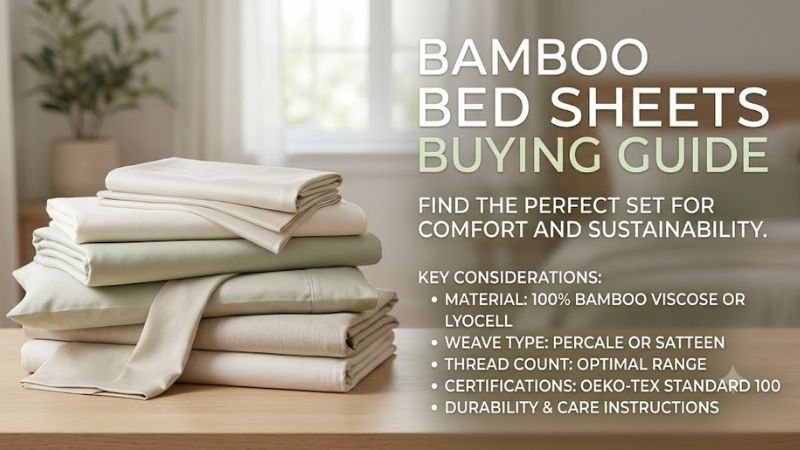
Buying bamboo bed sheets can be confusing because products marketed under the same category may use different fibers, manufacturing methods, weaves, and fabric finishes. One sheet set may contain viscose derived from bamboo, while another uses lyocell or a blend with cotton. These differences affect texture, care, and purchasing value. This buying guide explains how to evaluate materials, mattress fit, construction quality, durability, temperature comfort, and practical household needs before choosing your next set.
Understanding What Bamboo Bed Sheets Really Are
The first step in evaluating bamboo bedding is understanding its fiber composition.
Although shoppers commonly use the phrase bamboo sheets, most soft fabrics marketed under that name are made from regenerated cellulose.
The plant supplies the cellulose, but the final fiber is manufactured through industrial processing.
This distinction matters because the characteristics of the finished fabric do not necessarily match the natural properties of the bamboo plant.
Natural Bamboo Fiber Versus Regenerated Cellulose
Natural bamboo fiber can be produced through mechanical processing.
However, this is not the material commonly used in silky-soft bedding.
Most smooth bamboo-marketed sheets contain rayon, viscose, or lyocell made using bamboo-derived cellulose.
The manufacturing process changes the original plant material substantially.
Therefore, a seller should not claim that ordinary bamboo-derived viscose retains every natural characteristic of the bamboo plant.
Why Accurate Material Labels Matter
In the United States, textile labeling requirements distinguish genuine mechanically processed bamboo fiber from manufactured rayon or viscose.
Products made from bamboo-derived cellulose should identify the appropriate manufactured fiber.
For example, a label may describe a product as viscose derived from bamboo.
This is more informative than a vague claim that the sheet contains pure natural bamboo fiber.
What to Look for on the Label
Check the following information:
-
Generic fiber name
-
Fiber percentages
-
Country of origin
-
Manufacturer or responsible company identification
-
Care instructions
-
Applicable certification details
A clear composition label is one of the simplest indicators that a seller is providing useful product information.
Bamboo Viscose, Bamboo Rayon, and Bamboo Lyocell
These terms are frequently used in bedding marketing, but they are not entirely interchangeable.
Bamboo Viscose
Viscose is a manufactured cellulose fiber produced through a chemical process.
When bamboo provides the source cellulose, the resulting material may be described as viscose made from bamboo.
Viscose fabrics often have a smooth surface and fluid drape.
This makes them attractive to sleepers who prefer soft bedding rather than crisp cotton.
However, viscose fabric characteristics vary according to yarn construction, weave, finishing, and fabric weight.
Bamboo Rayon
Rayon is a broader manufactured-fiber category.
In common textile terminology, viscose is a form of rayon.
Some US bedding labels use the term rayon made from bamboo.
The practical importance is understanding that the product contains regenerated cellulose rather than mechanically extracted natural bamboo fiber.
Bamboo Lyocell
Lyocell is another manufactured cellulose fiber produced using a different process.
Certain lyocell systems recover and reuse processing solvents, which can reduce particular manufacturing impacts.
However, the sustainability of the finished product depends on the actual production system.
A lyocell label does not automatically establish that the product is environmentally superior to all viscose or cotton alternatives.
Which Fiber Is Best?
There is no universal winner.
Viscose may appeal to shoppers prioritizing a fluid, silky feel.
Lyocell may appeal to those interested in its manufacturing method and textile characteristics.
The actual finished fabric is more important than the fiber category alone.
Compare the Main Bamboo-Derived Fabric Types
| Fabric | Main Characteristics | Potential Advantage | Important Limitation |
|---|---|---|---|
| Viscose derived from bamboo | Smooth, flexible, fluid drape | Soft-feeling bedding | Care and strength depend on construction |
| Rayon made from bamboo | Regenerated cellulose | Similar soft fabric potential | Broad category requiring label clarity |
| Lyocell derived from bamboo | Regenerated cellulose using a different process | Smoothness and potentially efficient solvent recovery | Environmental claims need verification |
| Bamboo-derived viscose and cotton blend | Combination of manufactured cellulose and cotton | Different texture and construction possibilities | Properties depend on blend ratio |
| Bamboo-derived viscose and polyester blend | Mixed cellulose and synthetic fibers | Can modify fabric behavior | Not equivalent to pure viscose |
Why Weave Matters as Much as Fiber
A sheet’s weave affects how yarns interact, how the fabric drapes, and how the surface feels against the skin.
Two products containing the same fiber can feel noticeably different because they use different constructions.
Sateen Weave
Sateen is common in soft bamboo-derived bedding.
It generally creates a smooth surface and fluid drape.
The fabric may feel less crisp than cotton percale.
This can appeal to sleepers who like silky bedding.
However, sateen is not automatically cooler or more durable than every other weave.
Twill Weave
Twill uses a pattern that creates diagonal lines in the woven structure.
It can produce a different surface texture and drape from sateen.
Some bamboo-derived bedding products use twill construction.
The practical result depends on yarn quality, fabric weight, and finishing.
Knit Construction
Some products marketed as bamboo bedding use knitted fabric.
Knits can provide additional stretch and a softer, more casual feel.
However, they differ from woven sheet sets in dimensional stability and surface behavior.
Which Weave Should You Choose?
For a smooth, silky sensation, sateen is a reasonable starting point.
For a different texture, twill may be worth exploring.
For stretch and a casual surface, knit fabrics may be appealing.
Choose according to the finished textile rather than assuming one weave is universally superior.
Thread Count: What It Means and What It Does Not
Thread count is frequently used as a marketing tool.
It describes the number of yarns counted within a defined area of woven fabric.
However, thread count is not a complete measure of quality.
Why Higher Is Not Always Better
A high advertised number does not guarantee superior softness, breathability, or durability.
Different counting methods and yarn constructions can produce different results.
A well-made fabric with a moderate thread count may perform better than a poorly constructed fabric advertising an extreme number.
Fiber Quality Matters
Yarn strength and consistency influence the finished sheet.
Smoothness also depends on finishing processes.
A product should not be selected solely because it advertises a particular thread count.
Comparing Different Fiber Categories
Thread-count comparisons are especially difficult when fabrics use different yarn types or weave constructions.
A bamboo-derived viscose sateen sheet should not automatically be evaluated using the same expectations as cotton percale.
Better Questions to Ask
Instead of asking which product has the highest thread count, ask:
-
What is the actual fiber composition?
-
What weave does the fabric use?
-
Are the yarn and construction details clear?
-
Does the manufacturer provide realistic care instructions?
-
Does the product fit the mattress?
-
Are durability claims supported?
Are Bamboo Sheets Actually Cooling?
Cooling is one of the most common selling points in bamboo bedding.
However, the term can describe several different sensations or mechanisms.
Cool-to-the-Touch Feel
Some smooth fabrics feel cool during initial contact.
This can depend on heat transfer between the skin and fabric.
However, the initial sensation may change as the material warms.
Breathability
Breathability refers to how easily air can pass through a material.
It depends on fabric construction, thickness, and density.
Fiber type alone does not determine air permeability.
Moisture Management
A fabric may absorb moisture or transport it across its structure.
These behaviors can affect perceived comfort.
However, moisture absorption is not identical to rapid drying.
A material that holds moisture may not necessarily feel comfortable in every humid environment.
The Role of Other Bedding
A cooling-oriented sheet may provide limited benefit when paired with a thick, insulating mattress protector or heavy comforter.
The sleeping environment should be evaluated as a system.
Are Bamboo Sheets Better for Hot Sleepers?
They can be comfortable for some hot sleepers, particularly those who prefer smooth, lightweight fabrics.
However, no bamboo-derived textile guarantees a cooler night than every cotton or linen alternative.
The appropriate product depends on the finished fabric and surrounding conditions.
Bamboo Sheets Versus Cotton Sheets
Cotton and bamboo-derived regenerated cellulose differ in both fiber structure and common fabric behavior.
However, the comparison depends on the actual products.
Texture
Bamboo-derived viscose sateen often has a fluid, silky feel.
Cotton percale tends to feel crisper and more structured.
Cotton sateen may be smoother than percale and can provide an alternative to regenerated cellulose.
Breathability
Both cotton and regenerated cellulose can be used to create breathable fabrics.
Actual airflow depends on weave, density, and finishing.
Durability
Durability depends on fiber strength, yarn quality, abrasion, laundering, and fabric construction.
It is not possible to declare that all cotton sheets last longer than all bamboo-derived sheets or vice versa.
Care Requirements
Cotton sheets may tolerate a wider range of laundering conditions depending on their construction.
Some bamboo-derived fabrics require gentler handling.
Always follow the product-specific instructions.
Which Should You Buy?
Choose bamboo-derived viscose or lyocell when you prefer a smooth, fluid texture.
Choose cotton percale when you want a crisp, structured feel.
Consider cotton sateen when you want smoothness but prefer cotton fibers.
Bamboo Sheets Versus Linen Sheets
Linen is produced from flax fibers.
It often has a more textured surface than bamboo-derived viscose.
Initial Feel
Linen may feel comparatively firm or textured when new.
Bamboo-derived viscose often feels smoother immediately.
Appearance
Linen has a naturally relaxed, wrinkled appearance.
Bamboo-derived sateen generally has a more fluid, polished drape.
Laundry and Maintenance
Both materials require appropriate care.
Linen and regenerated cellulose respond differently to moisture, abrasion, and heat.
Which Is Better for Warm Bedrooms?
Neither material is universally cooler.
Fabric weight, construction, and the sleeping environment influence comfort.
How to Choose the Correct Mattress Fit
An expensive sheet set can become frustrating when the fitted sheet repeatedly slips off the mattress.
Proper fit begins with measurements.
Measure Mattress Width and Length
Use the actual dimensions of the mattress.
Standard US sizes provide a starting point, but finished dimensions can vary.
Measure Total Mattress Height
Include any permanent topper or mattress pad that sits beneath the fitted sheet.
Compare the result with the manufacturer’s stated pocket depth.
Understand Deep-Pocket Sheets
Deep-pocket designs are intended to accommodate thicker mattresses.
However, an excessively deep fitted sheet may fit loosely on a thin mattress.
Consider Elastic Construction
Fitted sheets use elastic to grip the mattress.
Some products use elastic around the full perimeter.
Others use different constructions.
Full-perimeter elastic may help maintain fit, but performance still depends on the overall dimensions and material.
Adjustable Beds
Adjustable bed bases can change the mattress’s position.
For split-king arrangements, two separate fitted sheets may be needed.
Check the exact mattress configuration before purchasing.
Mattress Size Reference
| US Mattress Size | Typical Dimensions | Main Consideration |
|---|---|---|
| Twin | 38 × 75 inches | Standard single sleeping space |
| Twin XL | 38 × 80 inches | Five inches longer than twin |
| Full | 54 × 75 inches | Smaller shared or single bed |
| Queen | 60 × 80 inches | Common main-bedroom size |
| King | 76 × 80 inches | Wider shared sleeping space |
| California King | 72 × 84 inches | Longer but narrower than standard king |
These are nominal dimensions. Measure the actual mattress and check the sheet manufacturer’s sizing.
How to Evaluate Bamboo Sheet Quality
Fiber Composition
Clear material labeling is essential.
Avoid assuming that every product using the word bamboo contains the same textile.
Weave Consistency
Look for clear construction descriptions.
The weave should match the feel you want.
Seam Construction
Inspect the seams and elastic housing.
Loose stitching can indicate finishing problems.
Fabric Weight
Heavier fabric is not automatically better.
A lightweight sheet may feel more comfortable in warm conditions.
A thicker fabric may create a different drape and durability profile.
Surface Finish
A very smooth initial feel may result partly from textile finishing.
The fabric’s appearance and texture can change after laundering.
Size Accuracy
A sheet set should match its stated measurements and intended mattress configuration.
Care Instructions
A manufacturer should provide understandable cleaning guidance.
Unclear or missing instructions make long-term ownership more difficult.
Understanding Certifications
Textile certifications can provide useful information, but they are often misunderstood.
OEKO-TEX STANDARD 100
This certification concerns testing textile products for specified harmful substances under the program’s requirements.
It does not automatically certify organic sourcing, low carbon emissions, or superior fabric durability.
Organic Claims
Organic certification is associated with particular agricultural or textile production standards.
A product described as bamboo-derived viscose should not automatically be treated as organic bamboo fabric.
Check the specific certification and its scope.
Environmental Manufacturing Claims
Manufacturers sometimes describe closed-loop production, recycled water, reduced chemical use, or responsible sourcing.
These claims should be supported by relevant documentation.
Avoid Assuming All Certifications Mean the Same Thing
A safety-related chemical testing program, an organic agricultural standard, and an environmental management certification address different concerns.
Choose based on which evidence matters to your purchasing decision.
Are Bamboo Sheets Hypoallergenic?
Hypoallergenic is a common marketing term.
However, it does not guarantee that a product cannot cause irritation or allergic reactions.
Fabric comfort depends on the textile, finishes, detergents, and individual skin response.
A smooth surface may feel pleasant to someone who dislikes rough bedding.
That is different from proving medical suitability.
People with persistent skin irritation should consider detergents, dyes, textile finishes, and other possible causes with appropriate medical guidance.
Do Bamboo Sheets Have Antibacterial Properties?
Bamboo plants may have natural characteristics discussed in marketing.
However, regenerated cellulose fibers are not equivalent to the original plant.
The manufacturing process substantially changes the material.
Claims that bamboo-derived viscose sheets are naturally antibacterial require product-specific evidence.
Do not assume that the finished textile has antimicrobial performance simply because bamboo was the cellulose source.
Are Bamboo Sheets Environmentally Friendly?
Bamboo is a fast-growing plant, but that fact alone does not establish the environmental performance of a finished textile.
Manufacturing processes can involve chemicals, energy, water, and transportation.
Raw Material Sourcing
The source of cellulose matters.
Responsible sourcing can influence environmental impacts.
Chemical Processing
Viscose production may involve chemicals with environmental and occupational implications.
The actual controls and recovery systems used by a manufacturer are important.
Lyocell Production
Some lyocell production methods recover substantial amounts of processing solvent.
However, environmental results vary by facility.
Transportation and Packaging
Long-distance shipping and packaging contribute to the overall product footprint.
Durability and Replacement
A product that remains useful for longer may reduce replacement frequency.
However, durability should be evaluated through evidence rather than assumed from a sustainability label.
Washing Bamboo Sheets Correctly
Read the Care Label First
Different manufacturers specify different laundering requirements.
A general recommendation should never override the product label.
Select an Appropriate Cycle
Many bamboo-derived textile products benefit from gentle handling.
Aggressive agitation may contribute to wear.
Avoid Excessive Heat
High drying temperatures can affect some regenerated cellulose fabrics.
Use the manufacturer’s recommended setting.
Separate Rough Laundry
Items with exposed zippers, hooks, and abrasive surfaces may snag delicate sheets.
Avoid Overloading the Washer
Sheets need sufficient space for water circulation and rinsing.
An overloaded machine may leave detergent residue and produce uneven cleaning.
Dry Thoroughly
Do not store sheets while damp.
Moisture trapped in folded bedding can create odors and other problems.
How to Store Bamboo Sheets
Store clean, dry bedding in a suitable location away from excessive moisture.
A linen closet, drawer, or clean under-bed container can work.
Keep Sets Together
Store matching components as a group.
This makes it easier to change bedding.
Avoid Excessive Compression
Tightly compressing delicate fabric can create deep creases and complicate retrieval.
Protect Against Dust
Covered storage can reduce dust accumulation.
However, fabric storage bags and ordinary boxes are not necessarily airtight.
How Long Do Bamboo Sheets Last?
There is no universally reliable lifespan for all bamboo-derived sheets.
Durability depends on several factors.
Fabric Construction
Fiber quality, yarn structure, and weave influence wear.
Frequency of Use
A set used every night experiences more washing and abrasion than an occasional guest-room set.
Washing Conditions
High heat and aggressive handling may increase wear.
Mattress Friction
The sleeping surface, mattress protector, and movement during sleep can affect abrasion.
Signs It Is Time to Replace Sheets
Consider replacement when fabric develops significant thinning, persistent tears, failing elastic, or damage that affects comfort or fit.
Do not use a fixed replacement schedule as a substitute for checking the condition of the sheets.
How Much Should You Spend?
The appropriate budget depends on how frequently the sheets will be used and which features matter.
Entry-Level Options
Affordable sheets may provide comfortable fabric without premium finishing or packaging.
Check the fiber composition carefully.
Midrange Options
Midrange products may offer improved construction details, additional sizes, or more refined finishes.
However, these features should be verified rather than assumed from price.
Premium Options
Luxury brands may emphasize fabric feel, packaging, color selection, and additional customer-service benefits.
A premium price does not guarantee superior thermal performance or longevity.
Calculate Real Value
Compare:
-
Included pieces
-
Fabric composition
-
Size compatibility
-
Care requirements
-
Return policy
-
Replacement availability
-
Expected frequency of use
A lower-priced set may be the better purchase when it meets your needs without unnecessary extras.
Choosing Bamboo Sheets for Different Sleepers
Hot Sleepers
Prioritize lightweight construction and consider the complete bedding system.
Do not rely on unsupported cooling claims.
Side Sleepers
A smooth fabric surface may feel comfortable against the arms and legs.
However, sleep position alone does not determine the best sheet material.
Sensitive Skin
Consider fabric texture, detergents, finishes, and individual skin response.
Avoid assuming hypoallergenic marketing guarantees suitability.
Families With Children
Practical laundering, replacement availability, and fit may matter more than premium texture.
Pet Owners
Claws can snag some fabrics.
Evaluate weave, abrasion resistance, and washing needs.
Apartment Dwellers
Choose manageable care requirements and avoid purchasing more sheet sets than can be stored comfortably.
Common Mistakes When Buying Bamboo Sheets
Believing Bamboo Means Natural Fiber
Most silky bamboo-marketed bedding contains manufactured cellulose fibers.
Check the label.
Choosing Based on Thread Count Alone
Thread count does not establish total quality.
Ignoring Mattress Height
A poorly fitted sheet can make even premium bedding frustrating.
Assuming Every Sheet Is Cooling
Cooling performance depends on fabric and the sleeping environment.
Paying More for Unsupported Health Claims
Antibacterial, hypoallergenic, and therapeutic claims require appropriate evidence.
Confusing Certifications
Different certifications address different aspects of textile production.
Overlooking Care Requirements
A sheet set that cannot be maintained with your available laundry equipment may be a poor purchase.
Frequently Asked Questions
Are Bamboo Sheets Better Than Cotton?
Neither is universally better. Bamboo-derived viscose often has a smooth, fluid texture, while cotton offers many different finishes and constructions. The better choice depends on personal preference and practical needs.
What Is the Best Type of Bamboo Sheet Fabric?
There is no single best type. Viscose and lyocell each have different manufacturing characteristics, and finished fabric quality depends on weave, yarn, and processing.
Are Bamboo Sheets Good for Hot Sleepers?
They may feel comfortable, but cooling depends on fabric construction, mattress, bedding layers, and room conditions. No bamboo sheet guarantees a cooler night.
Do Bamboo Sheets Shrink?
Some regenerated cellulose fabrics can shrink when washed or dried improperly. Follow the manufacturer’s care instructions.
Are Bamboo Sheets Durable?
They can provide useful service life when well constructed and properly maintained. Durability varies considerably between products.
What Thread Count Should Bamboo Sheets Have?
There is no universally ideal thread count. Fiber quality, weave, finishing, and construction matter more than a single number.
Conclusion
The best way to choose bamboo bed sheets is to verify the actual fiber composition, select a comfortable weave, measure mattress dimensions carefully, and evaluate cleaning requirements before buying. Bamboo-derived viscose can appeal to sleepers who prefer a silky drape, while lyocell offers an alternative manufacturing approach. Neither fiber guarantees superior cooling, sustainability, or durability. Prioritize clearly labeled materials, suitable mattress fit, realistic product claims, and long-term household value rather than thread count or marketing language alone.