Key takeaways
- “Fits up to 75-inch TVs” on a stand under 60 inches wide. The TV may physically balance on it, but it will look and be unstable.
- Height over 26 inches for a 65-inch or larger TV with a standard sofa. Screen center will be at 50 inches or higher.
- No weight rating listed. Assume under 80 pounds.
- Top thickness under 0.6 inch with a span over 60 inches. It will bow.
- Plastic legs on a stand meant for a 75-inch TV.
- No anti-tip strap or wall anchor included in a home with children.
- Mount stands with a base under 20 inches wide for TVs over 55 inches.
- No VESA pattern list on an integrated mount. Large TVs often use 400 by 400 or 600 by 400 millimeters, and some mounts stop at 400 by 200.
A large television makes stand height unforgiving. With a 43-inch screen, a stand that is 4 inches too tall barely registers. With a 75-inch screen, the same mistake puts the center of the picture at eye level for someone standing and forces everyone on the sofa to tilt their heads back. The common errors are buying a stand designed for a smaller TV and not accounting for how much taller a big panel is, forgetting that the TV’s own feet or a tabletop mount add 2 to 5 inches, choosing a stand that is narrower than the screen so the whole wall looks top-heavy, and ignoring the height of the sofa the viewers are sitting on. Every one of those is fixable with a tape measure before you order.
Decide These 3 Things First
1. Your seated eye height. Sit on your sofa the way you actually watch TV and measure from the floor to your eyes. On a standard sofa with an 18-inch seat, most adults land at 40 to 44 inches. On a low lounge sofa or a recliner in the reclined position, it drops to 36 to 40 inches. This number, not a generic rule, sets the target for the center of the screen.
Our top picks


As an Amazon Associate we earn from qualifying purchases at no extra cost to you.
2. Your TV’s height and mounting. A 65-inch TV panel is about 32 to 33 inches tall; a 75-inch is about 37 to 38 inches; an 85-inch is about 42 to 43 inches. If it sits on its factory feet, add 2 to 4 inches from the bottom of the panel to the surface. On a tabletop mount with adjustable legs, that offset can range from 3 to 8 inches depending on the setting.
3. Whether the stand needs to hold equipment. A soundbar in front of the TV needs 2.5 to 4 inches of clearance under the screen; a receiver and console need a shelf 6 to 8 inches tall. Equipment needs can push you toward a taller cabinet or toward a mount that lifts the TV above a soundbar.
Height: The Core Calculation
The target is screen center at or slightly below seated eye height, within about 5 inches. Stand height equals eye height minus half the panel height minus the foot or mount offset. For a 75-inch TV (38-inch panel, center at 19 inches above the panel bottom) on factory feet (3-inch offset) with a 42-inch eye height, the stand should be 42 minus 19 minus 3, or about 20 inches tall. For a 65-inch TV in the same room, the stand can be 22 to 23 inches. For an 85-inch, it drops to 17 to 18 inches.
This is why stands for large TVs run lower than people expect. Media consoles sold as “for 75-inch TVs” range from 16 to 26 inches tall, and the 16-to-22-inch end is correct for most sofas. A 28-to-30-inch console under a 75-inch panel puts the screen center at 50 inches or higher, which is standing eye height.
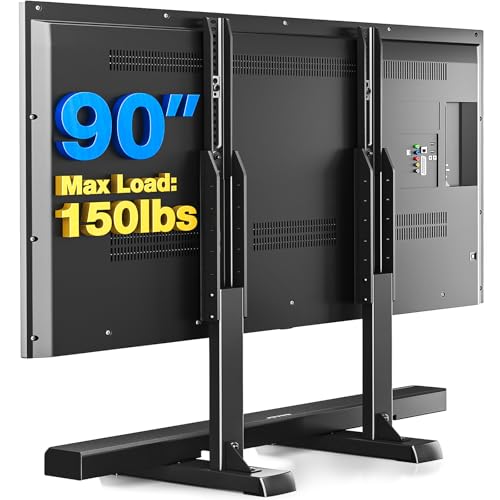
Adjustable-height tabletop stands solve the problem when the cabinet is already in the house. A tabletop stand with height-adjustable legs rated for 37-to-90-inch TVs, such as the Rfiver model at about $30, lets you drop the panel 2 to 4 inches lower than the factory feet or raise it over a soundbar. Universal replacement legs like the PERLESMITH set for 32-to-70-inch TVs up to 99 pounds, around $40, do the same on a mount-pattern bracket.
Width and Depth
The stand should be at least as wide as the TV and ideally 6 to 12 inches wider. A 65-inch TV is about 57 inches wide; a 75-inch is about 66 inches; an 85-inch is about 75 inches. That means stands of 60 to 70 inches for a 65-inch set, 70 to 80 inches for a 75-inch set, and 80 to 90 inches for an 85-inch. Narrower stands work only with a mount that holds the TV above the cabinet rather than resting on it.
Depth of 15 to 20 inches suits most large TVs on feet, which spread 8 to 12 inches front to back on modern panels but as much as 14 inches on older or center-pedestal designs. Measure your TV’s foot spread. Floor stands with a mount, such as the Rfiver swivel floor stand for 32-to-65-inch TVs at about $59, need only a 20-to-24-inch footprint because the TV hangs on a column rather than resting on a shelf, and a mobile version for 23-to-65-inch TVs up to 88 pounds, around $40, rolls on casters for rooms where the TV moves.
Material and Load Capacity
Large TVs are heavy: a 65-inch panel weighs 45 to 65 pounds, a 75-inch 65 to 90 pounds, an 85-inch 90 to 120 pounds. Stands should be rated for at least 1.5 times the TV’s weight. Particleboard tops of 0.6 inch sag over time under 80 pounds; look for 0.75-to-1-inch tops in MDF, plywood, or solid wood, or a steel-framed stand. Solid wood consoles weigh 80 to 150 pounds themselves and can hold 200 pounds or more. Tempered glass shelves should be at least 8 millimeters (about 0.3 inch) and rated on the listing.
Mount-style floor stands and tabletop mounts list a maximum TV size and weight; for a 75-inch TV you want a mount rated for at least 100 pounds and VESA patterns up to 600 by 400 millimeters.
Construction and Stability
A tall, narrow stand with a heavy TV on top is a tipping risk, especially with children. Look for stands with a wide base, anti-tip straps included, and back panels that are screwed rather than nailed. Legs should be metal or hardwood, not plastic, when the total load exceeds 100 pounds. On floor stands with a column mount, the base should be 24 inches or wider and weigh 20 pounds or more, and the column should have a locking height adjustment, typically in 2-inch steps between about 42 and 60 inches to screen center.
Cable management is a construction feature, not a luxury. Grommets of 2 inches or more and an open back let a soundbar, console, and streaming box connect without pulling the stand away from the wall.
Comfort and Viewing Angle
Once the center is at eye height, check the tilt. If the stand is slightly tall, a mount with 5 to 10 degrees of downward tilt fixes reflections and neck strain. Swivel of 30 to 60 degrees is worth having if the sofa is off-center. Viewing distance affects height tolerance: at 10 feet from a 75-inch screen, a 4-inch error in center height is a 2-degree change and barely noticeable; at 7 feet, the same error is closer to 3 degrees and starts to feel high.
Price Tiers
Under $150 buys engineered-wood consoles 16 to 22 inches tall and 60 to 70 inches wide, rated for 80 to 100 pounds, or tabletop and floor mounts for $30 to $60 that fix height on an existing cabinet. From $200 to $500 you get thicker tops, metal legs, cable management, ratings of 120 to 200 pounds, and widths up to 80 inches. Above $600, expect solid wood or steel frames, widths to 90 inches, weight ratings of 200 pounds or more, and matched storage for receivers and consoles.
Warranty and Assembly
Budget stands carry 1-year warranties and ship flat-packed in one or two boxes totaling 60 to 120 pounds; assembly takes 45 to 90 minutes with two people. Mid-range brands offer 2 to 5 years. Solid wood consoles often have 5-to-10-year warranties and arrive assembled by freight, which means measuring doorways for a 70-to-80-inch-long piece. Tabletop mounts and floor stands assemble in 15 to 30 minutes and usually carry 3-to-5-year warranties on the hardware.
Spec Checklist
| Spec | Budget (under $150) | Mid ($200 to $500) | Premium ($600 and up) |
|---|---|---|---|
| Stand height | 16 to 24 in, fixed | 16 to 24 in, some adjustable feet | Custom or 14 to 26 in |
| Width | 58 to 70 in | 65 to 80 in | 70 to 90 in or more |
| Top thickness | 0.6 in particleboard | 0.75 to 1 in MDF or plywood | 1 to 1.5 in solid wood or steel |
| Weight capacity | 80 to 110 lb | 120 to 200 lb | 200 lb or more |
| Anti-tip hardware | Sometimes | Included | Included |
| Cable management | One grommet | Multiple grommets, open back | Channels and power strip space |
| Soundbar clearance | Often none | 2 to 4 in under TV | Dedicated soundbar shelf |
| Mount option | Separate $30 to $60 mount | Integrated mount on some | Integrated mount with tilt and swivel |
| Warranty | 1 year | 2 to 5 years | 5 to 10 years |
| Assembly | 45 to 90 min, two people | 30 to 60 min | Arrives assembled |
Red Flags
- “Fits up to 75-inch TVs” on a stand under 60 inches wide. The TV may physically balance on it, but it will look and be unstable.
- Height over 26 inches for a 65-inch or larger TV with a standard sofa. Screen center will be at 50 inches or higher.
- No weight rating listed. Assume under 80 pounds.
- Top thickness under 0.6 inch with a span over 60 inches. It will bow.
- Plastic legs on a stand meant for a 75-inch TV.
- No anti-tip strap or wall anchor included in a home with children.
- Mount stands with a base under 20 inches wide for TVs over 55 inches.
- No VESA pattern list on an integrated mount. Large TVs often use 400 by 400 or 600 by 400 millimeters, and some mounts stop at 400 by 200.
FAQ
How tall should a TV stand be for a 75-inch TV?
Usually 16 to 22 inches. A 75-inch panel is about 38 inches tall, so its center sits 19 inches above the panel bottom. With 3 inches of foot offset and a seated eye height of 42 inches, the math gives a stand of about 20 inches. Adjust up or down 2 inches based on your own measured eye height.
Is it better to mount a large TV or put it on a stand?
For height control, a wall mount or a column-style floor stand is more precise because you set the center exactly. A cabinet stand wins for storage and for renters who cannot drill. A common compromise is a low cabinet at 16 to 20 inches with a wall mount or tabletop mount holding the TV 2 to 4 inches above it for a soundbar.
Can I lower a TV that is too high on my current stand?
Yes, without replacing the stand. Adjustable tabletop mounts and replacement legs let you drop the panel bottom to within 1 to 2 inches of the surface, gaining 2 to 4 inches over factory feet. If you need more, cut the stand’s legs if they are solid wood, or replace the console with one 4 to 6 inches shorter.
What is the ideal viewing height for an 85-inch TV in 2026?
Screen center at 40 to 44 inches from the floor for a standard sofa, the same as any size. Because an 85-inch panel is 42 to 43 inches tall, that means the panel bottom sits at about 19 to 23 inches, which calls for a stand of 15 to 19 inches or a wall mount. Many 85-inch owners end up with a 16-inch low console or a mount with the panel bottom just above a soundbar.