Key takeaways
- No seat height or seat depth listed anywhere in the specs; the seller does not expect you to fit the chair to a person.
- Weight capacity listed as exactly the user’s weight or below; the actuator will be working at its limit.
- “Infinite position” claimed on a single-motor chair; one motor cannot move the back and footrest independently.
- Lay-flat advertised without a stated reclined length; a true lay-flat chair extends 65 to 72 inches and needs that floor space.
- Warranty covers “manufacturing defects” for 30 or 90 days only, with no separate motor coverage.
- Hand control on a cord shorter than 24 inches or with no backlit buttons; hard to use in the dark or from a reclined position.
- Reviews mentioning the chair tipping forward during lift, which points to a short seat or a lift angle steeper than about 35 degrees.
- Shipping weight under 90 pounds for a full-size chair, which usually means a light frame and thin foam.
Most people buy a power lift recliner the same way they buy a regular recliner: they look at the fabric, check that it has heat and massage, and pick the cheapest one that ships fast. Then it arrives and the seat is 2 inches too tall for a 5-foot-2 grandmother, so her feet dangle and the lift function tips her forward instead of standing her up. Or the chair is rated for 300 pounds and the user weighs 310. Or the single motor means the footrest and backrest move together, so the chair cannot sit upright with the legs elevated, which is the one position a person with swollen ankles actually needs. A lift chair is a piece of mobility equipment first and a piece of furniture second, and the specs that matter are the ones about fit, motors, and load, not the cup holders.
Decide These 3 Things First
Who is sitting in it, exactly. Measure the user’s height and weight, and measure the distance from the back of their knee to the floor while seated with feet flat, which is usually 16 to 20 inches. The chair’s seat height and depth must match that person, not an average.
Our top picks

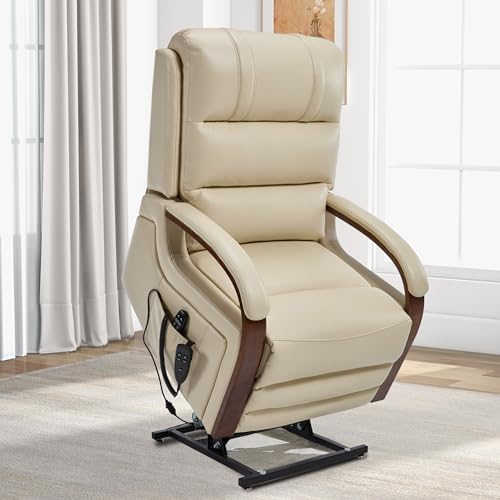

 Power Lift Recliner Chair for Elderly
Power lift helps users rise without straining joints
Built-in massage and lumbar heating add relaxation
Side pockets and cup holders keep items within reach
Cushions need about 72 hours to fully expand
Oversized footprint demands significant living-room space
As an Amazon Associate we earn from qualifying purchases at no extra cost to you.
How the chair will be used besides standing up. If the user naps in it, eats in it, or sleeps in it after surgery, you need a dual-motor infinite-position chair. If they only want help getting in and out and will recline briefly, a single-motor two-position or three-position chair is enough and costs $150 to $300 less.
Where it will sit and who will assemble it. A lift chair is 34 to 40 inches wide, 36 to 42 inches deep upright, and extends to 60 to 70 inches when fully reclined. It needs to sit 12 to 18 inches from the wall, near an outlet, and it arrives in a 100- to 160-pound box that usually needs two people to unpack and attach the backrest.
Size and Fit
Lift chairs are sold in small, medium, and large, and the difference is real. Small chairs have seat heights around 17 to 19 inches and seat depths of 18 to 20 inches, suited to users under about 5 feet 4 inches. Medium chairs run 19 to 21 inches high and 20 to 22 inches deep for users from 5 feet 4 to 5 feet 10. Large and tall chairs go to 21 to 23 inches high and 22 to 24 inches deep for users over 5 feet 10 or above about 250 pounds. The MCombo Power Lift Recliner in the 7040 Medium size, about $549.90, is an example of a chair sold by size class rather than one-size-fits-all, which is the right way to shop. Seat width between the arms should be 20 to 22 inches for average adults and 24 inches or more for larger users. If the seat is too deep, the user’s back does not reach the backrest and the lift pushes them off the front edge rather than up.
Motors and Positions
A single-motor chair moves the backrest and footrest together on one actuator. It typically offers two positions (upright and a partial recline of about 135 degrees) or three (adding a deeper recline). It is fine for someone who mainly needs the lift and a TV recline. Chairs in this class start around $280; the BOSMILLER Electric Power Lift Recliner with massage and heat, about $279.99, and a similarly priced overstuffed Power Lift Recliner with cup holders, pockets, and a USB port, also about $279.99, are typical of the tier. A dual-motor chair uses separate actuators for the back and footrest, allowing infinite positions including upright with legs raised, a zero-gravity tilt, and on some models a full 180-degree lay-flat for sleeping. The Trustyue Dual Motor Power Lift Recliner with 180-degree lay-flat, about $479.99, shows the price jump: roughly $150 to $250 over a single-motor chair. For anyone recovering from surgery, managing edema, or sleeping in the chair, dual motors are not a luxury.
Weight Capacity and Frame
Most consumer lift chairs are rated for 300 to 330 pounds. Heavy-duty models are rated 375 to 500 pounds and cost $700 to $1,500 more. Choose a rating at least 50 pounds above the user’s weight, because the lift actuator works hardest at the start of the lift cycle and a chair at its limit wears out early. The frame should be hardwood or steel; particleboard frames on chairs under $250 are the most common failure point after the motor. Lift actuators draw 50 to 100 watts while moving and almost nothing at rest, so power draw is not a concern, but a battery backup that lets the chair lower in a power outage is worth having and is often a $30 to $60 add-on.
Comfort and Cushioning
Because the user may spend 6 to 12 hours a day in the chair, foam density matters more here than on a living room sofa. Look for seat foam of at least 1.8 pounds per cubic foot, and ideally 2.0 or higher, with a layer of memory foam or fiber on top. Chairs under $300 typically use 1.5- to 1.8-pound foam that develops a permanent dip within a year of daily use. Heat pads are almost always 40 to 60 watts and warm the lumbar area only; massage is vibration from 4 to 8 small motors rather than kneading rollers, so treat both as pleasant extras rather than therapy. Armrest height of 8 to 10 inches above the seat is right for pushing up; padded arms are easier on elbows than hard wood. A chaise-style footrest that runs continuously from seat to footrest supports the calves better than a gap-style footrest.
Price Tiers
Under $350 buys a single-motor chair with basic heat and vibration, 300-pound capacity, and a 1-year warranty; it works well for occasional use and light users. From $400 to $700 you get dual motors, infinite positioning, lay-flat on some models, better foam, and 2- to 3-year warranties on parts. From $800 to $1,500 the frames become hardwood or steel, capacities rise to 375 to 500 pounds, foam density improves, and features like power lumbar, power headrest, and lithium battery backup appear. Above $1,500 you are paying for leather, made-to-order sizing, and medical-grade actuators with 5-year or lifetime warranties.
Warranty and Support
Read the warranty by component. A good chair carries at least 1 year on the motor and electronics, 3 years on the mechanism, and a lifetime or 5-year guarantee on the frame. Actuators are the part that fails, and a replacement runs $80 to $200 plus labor if not covered. Confirm that the seller will ship replacement parts to the home, because returning a 140-pound chair is impractical, and check whether in-home service is included or you are expected to swap the motor yourself.
Delivery and Assembly
Most lift chairs arrive in one or two boxes weighing 100 to 160 pounds total and require sliding the backrest onto the frame brackets, plugging in two to four connectors, and attaching the transformer. Budget 30 to 60 minutes and two people. Measure doorways: the base alone is often 33 to 38 inches wide, so a 32-inch interior door may require removing the door or bringing the chair through on its side. Threshold delivery drops the box at the door; white-glove delivery with assembly and packaging removal adds $75 to $200 and is usually worth it when the user lives alone.
Spec Checklist
| Spec | Budget ($250 to $400) | Mid ($400 to $800) | Premium ($800 to $2,000) |
|---|---|---|---|
| Motors | Single, 2 or 3 positions | Dual, infinite position, often lay-flat | Dual or triple, power lumbar and headrest |
| Weight capacity | 300 to 330 lb | 330 to 375 lb | 375 to 500 lb |
| Seat height | 19 to 21 in, one size | Two or three size classes | Petite to tall, sometimes custom |
| Frame | Plywood or particleboard with steel mechanism | Hardwood or plywood with steel | Kiln-dried hardwood or full steel |
| Seat foam | 1.5 to 1.8 lb/cu ft | 1.8 to 2.0 lb/cu ft plus memory foam | 2.0 lb/cu ft and up, layered |
| Heat and massage | Lumbar heat, 4 to 6 vibration motors | Lumbar heat, 8 vibration motors, remote presets | Zoned heat, optional roller massage |
| Battery backup | Rarely included | Optional, 9-volt pack | Lithium backup included |
| Upholstery | Polyester or faux leather | Chenille, microfiber, better faux leather | Top-grain leather or performance fabric |
| Warranty | 1 year parts | 1 to 3 years parts, frame longer | 3 to 5 years parts, lifetime frame |
| Assembly | Backrest slide-on, 30 to 60 min | Backrest slide-on, 30 to 45 min | White-glove often included |
Red Flags
- No seat height or seat depth listed anywhere in the specs; the seller does not expect you to fit the chair to a person.
- Weight capacity listed as exactly the user’s weight or below; the actuator will be working at its limit.
- “Infinite position” claimed on a single-motor chair; one motor cannot move the back and footrest independently.
- Lay-flat advertised without a stated reclined length; a true lay-flat chair extends 65 to 72 inches and needs that floor space.
- Warranty covers “manufacturing defects” for 30 or 90 days only, with no separate motor coverage.
- Hand control on a cord shorter than 24 inches or with no backlit buttons; hard to use in the dark or from a reclined position.
- Reviews mentioning the chair tipping forward during lift, which points to a short seat or a lift angle steeper than about 35 degrees.
- Shipping weight under 90 pounds for a full-size chair, which usually means a light frame and thin foam.
FAQ
What is the difference between a two-position, three-position, and infinite-position lift chair?
Two-position chairs lift and recline to about 135 degrees with the back and footrest linked. Three-position chairs add a deeper recline near 160 degrees, still linked. Infinite-position chairs use two motors so the back and footrest move independently, allowing any combination, including upright with legs raised and full lay-flat on some models.
How do I know what size lift chair to buy?
Measure the user seated: floor to the back of the knee for seat height, back of the knee to the back of the hips for seat depth, and hip width plus 2 to 4 inches for seat width. Match those to the chair’s listed dimensions within about an inch. When in doubt between two sizes, the smaller seat depth is usually the better choice because it lets the user’s back reach the backrest.
Do lift chairs use a lot of electricity?
No. The actuators draw 50 to 100 watts only while moving, for a few seconds per cycle. Heat pads use 40 to 60 watts when on. Over a month of normal use the chair adds well under a dollar to a typical electric bill.
Is a power lift recliner covered by insurance?
In the United States, Medicare Part B may cover the lift mechanism only, not the chair itself, and only with a physician’s order stating medical necessity. The reimbursement is typically a few hundred dollars toward the mechanism. In 2026 most retailers still sell the full chair and let you file separately, so plan to pay the full price up front.