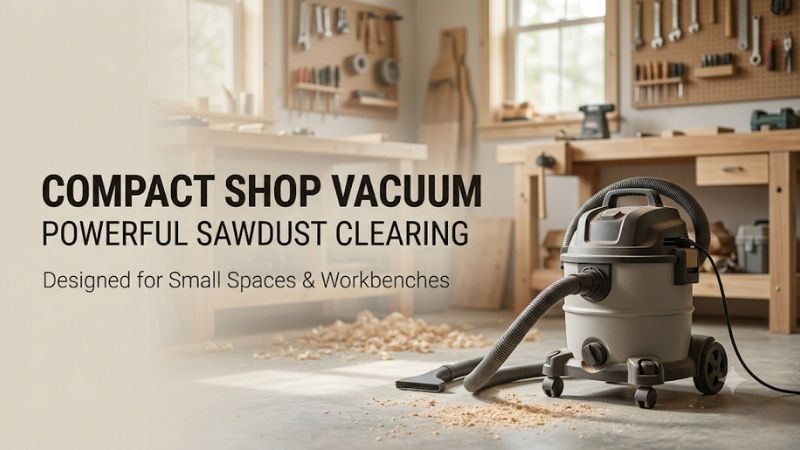
A shop vacuum for sawdust for small spaces should collect woodworking debris without consuming valuable floor space or compromising fine-dust control. Small garages and basement workshops require thoughtful decisions about tank capacity, hose length, filtration, accessory storage, and tool connections. This guide explains how to choose a compact vacuum that fits your workspace and your woodworking habits.
Quick Answer: What Makes a Shop Vacuum Good for Small Spaces?
A compact woodworking vacuum should be easy to store, move, empty, and connect to the tools used in the workshop.
A smaller tank may be convenient for an occasional hobbyist who builds shelves or repairs furniture.
However, a small drum fills quickly when collecting large wood shavings.
A larger vacuum can reduce emptying frequency but occupy substantial space beneath a workbench.
The ideal machine should therefore match the amount and type of debris generated.
For general cleanup, compact wet/dry vacuums such as the Vacmaster Beast five-gallon model offer practical portability.
For tool-connected extraction, the FEIN Turbo I provides a compact five-gallon-class extractor with automatic tool activation and a long suction hose.
For mobile workshops, the Milwaukee M18 FUEL 0910-20 provides cordless operation and a six-gallon collection container.
However, size should never outweigh filtration requirements.
Fine wood dust can remain airborne long after visible sawdust has settled.
A small vacuum that leaks fine particles through an unsuitable filter may create an unacceptable dust-control arrangement even if it keeps the floor clean.
Understanding Space Limitations in Home Woodworking
Small Garage Workshops
A one-car garage may serve as a woodworking area, storage room, and vehicle parking space.
This creates competing demands for floor space.
A large rolling shop vacuum can be inconvenient when it must be moved repeatedly to make room for cutting or assembly.
A compact machine that fits beneath a bench may be more practical.
However, the storage location must remain accessible for filter changes and drum emptying.
Do not store the vacuum in a location that blocks ventilation openings or creates an unsafe electrical arrangement.
Basement Workshops
Basement workshops often have limited ventilation and restricted exits.
Fine wood dust can accumulate on shelving, equipment, and other surfaces.
A vacuum with appropriate filtration can assist with housekeeping, but it is not a substitute for effective dust capture at the machine.
In enclosed workspaces, filtration and containment become particularly important.
Avoid sweeping or using compressed air in ways that resuspend accumulated fine dust.
Apartment Hobby Areas
Some hobbyists perform small woodworking tasks in utility rooms or other limited areas.
However, powered cutting and sanding can create significant dust and noise.
The suitability of the space must be assessed before operating tools.
A compact vacuum does not make an ordinary living area automatically appropriate for woodworking.
Consider building restrictions, ventilation, electrical requirements, and the potential exposure of other occupants.
Shared Workbenches
A workbench may be used for woodworking, household repairs, and other projects.
A compact shop vacuum can help remove debris between tasks.
However, fine dust may settle in drawers, equipment openings, and storage containers.
Routine cleaning should include appropriate collection methods rather than blowing dust into the air.
Choosing the Right Tank Capacity
Two- to Four-Gallon Vacuums
Very small wet/dry vacuums are convenient for occasional cleanup.
They may be suitable for collecting dust from a small sanding project or cleaning a workbench.
However, their limited capacity makes them less appropriate for large piles of wood chips.
Frequent emptying can also increase the opportunities for dust exposure.
Use a suitable collection bag where supported.
Five- to Six-Gallon Vacuums
Five- and six-gallon machines provide a practical compromise between capacity and portability.
They can handle moderate amounts of sawdust while remaining manageable for storage.
The FEIN Turbo I, with a 5.8-gallon container, is especially relevant to tool-connected extraction.
The Milwaukee M18 FUEL 0910-20 uses a six-gallon configuration for mobile cleanup.
However, collection capacity is only one factor.
The hose, filtration, and power system must also suit the intended operation.
Nine-Gallon Vacuums
Nine-gallon vacuums provide additional capacity without reaching the size of the largest shop models.
The DEWALT DXV09P and Bosch VAC090AH represent two different approaches.
The DEWALT is primarily a versatile wet/dry cleanup vacuum.
The Bosch is a more specialized fine-dust extractor.
Although both have nine-gallon containers, their intended uses and filtration systems differ.
Tank volume alone does not determine which is better.
Twelve-Gallon and Larger Vacuums
Larger vacuums are useful for substantial debris collection.
However, they occupy more storage space and may be less convenient to move through narrow workshop layouts.
A twelve-gallon model may still be appropriate for a small garage if it can be stored in a dedicated corner or beneath a suitable work surface.
Evaluate the complete dimensions rather than relying solely on capacity.
Hose Diameter and Small-Space Handling
One-Inch-Class Hoses
Narrow hoses are convenient for detailed cleanup and certain small power tools.
They can be routed around benches and cabinets with less bulk.
However, they are more likely to clog when transporting large shavings.
Choose according to the debris type.
One-and-Three-Eighths-Inch Hoses
This size is common among certain dust extractors.
It offers a compromise between flexibility and airflow.
The FEIN Turbo I includes a hose in this general size class.
It is useful for connecting compatible handheld power tools.
However, actual connection depends on the tool’s dust-port dimensions.
One-and-Seven-Eighths-Inch Hoses
This intermediate hose diameter is common on some general-purpose wet/dry vacuums.
The DEWALT DXV09P includes a hose of this approximate size.
It can handle ordinary sawdust and miscellaneous debris.
However, adapters may be required for smaller sanding tools.
Two-and-One-Half-Inch Hoses
A larger hose is useful for bulky woodworking debris.
The RIDGID HD1200 includes a 2-1/2-inch hose.
This helps collect wood chips and shavings with reduced clogging risk compared with narrow hoses.
However, the hose can be cumbersome when attached to lightweight handheld tools.
Hose Length
A longer hose allows the vacuum to remain stationary while the operator moves around the workbench.
However, increased length introduces airflow resistance.
Very long or sharply bent hoses can reduce effective collection at the tool.
Choose a length that provides useful reach without unnecessary restriction.
Hose Flexibility
A flexible hose is less likely to interfere with precision work.
Stiff hoses can pull on handheld sanders or small saws.
However, flexibility must be balanced with durability and collapse resistance.
Choose a hose approved for the vacuum and application.
Filtration Requirements in Compact Workshops
Why Fine Dust Is a Concern
Woodworking operations generate particles too small to remain visible as ordinary sawdust.
Some can remain suspended in the air.
Wood dust exposure can cause respiratory irritation and allergic effects.
Certain wood dust exposures are associated with more serious health risks.
A compact workshop can accumulate fine dust rapidly if source collection is inadequate.
Standard Cartridge Filters
General-purpose cartridge filters are designed for ordinary debris.
They may capture visible sawdust effectively.
However, performance with very fine particles depends on the filter construction and sealing arrangement.
Do not assume a standard cartridge provides HEPA-level filtration.
Fine-Dust Filters
Fine-dust filters may improve particle collection.
However, the filter must fit correctly and be approved for the vacuum.
A leaking seal or damaged housing can allow particles to escape.
HEPA Filters
HEPA filters are designed for high-efficiency particle capture.
However, the complete vacuum system must prevent leakage.
A filter advertised as HEPA does not necessarily establish that the entire machine meets a particular HEPA system standard.
Disposable Dust Bags
Disposable bags can simplify cleanup and reduce filter loading.
They may also help contain dust during disposal.
However, bags must be compatible with the vacuum and material.
Do not use ordinary household trash bags inside the machine unless the manufacturer expressly permits that arrangement.
Automatic Filter Cleaning
Some dust extractors include automatic filter-cleaning systems.
These periodically clear accumulated dust from the filter surface.
This can help maintain airflow during fine-dust operation.
However, the system does not eliminate filter maintenance or replacement.
Power Sources for Small Workshops
Corded Wet/Dry Vacuums
Corded machines provide sustained electrical power.
They are useful for workshops with accessible outlets.
However, the power cord must be managed around benches, saws, and walking paths.
Avoid overloading circuits.
Cordless Shop Vacuums
Cordless vacuums eliminate the power cable.
They can be useful for quick cleanup and mobile woodworking.
However, runtime depends on battery capacity and operating load.
A cordless vacuum may be less convenient for long sanding sessions requiring continuous extraction.
Battery Compatibility
Existing battery ownership can reduce purchase cost.
However, batteries are manufacturer-specific.
Use only approved batteries and charging equipment.
Automatic Tool Activation
Certain dust extractors include outlets that activate suction when a connected power tool starts.
This can improve convenience during woodworking.
However, the outlet has electrical load limits.
The total connected power must remain within the manufacturer’s specifications.
Remote Switching
Some workshop vacuums support remote switching or compatible accessory control.
This can be convenient when the vacuum is stored beneath a bench.
However, remote activation does not replace electrical safety or proper dust extraction.
Under-Bench and Wall-Mounted Storage
Under-Bench Storage
Placing a vacuum beneath a workbench can conserve floor space.
However, the machine must remain accessible for emptying and maintenance.
Check ventilation requirements.
Avoid sharp hose bends.
Wall-Mounted Vacuums
Wall-mounted machines can free floor space.
They may be useful for garages where cleanup is concentrated near a workbench.
However, the mounting surface must support the equipment.
Follow the manufacturer’s installation instructions.
Mobile Carts
A mobile cart can combine vacuum storage with tool and accessory organization.
However, it occupies floor area.
Wheels should lock when required.
Vertical Storage
Some compact vacuums are designed for upright storage.
This can reduce the footprint.
However, ensure the machine is stable and cannot tip.
Accessory Hooks
Storage hooks can organize hoses and nozzles.
Avoid tightly kinking the hose.
Inspect hoses periodically for damage.
Connecting Compact Vacuums to Tools
Random-Orbit Sanders
A random-orbit sander can generate fine airborne dust.
A suitable extractor connected directly to the sander can improve capture.
However, the tool may require a specific adapter.
Some sanders also require suction adjustment to avoid excessive drag.
Compact Circular Saws
Portable circular saws may provide dust ports suitable for vacuum connection.
However, effectiveness varies.
A vacuum can collect some debris, but dust may still escape near the blade.
Miter Saws
Miter saws can eject dust in multiple directions.
A compact vacuum connected to the factory port may capture only part of the total debris.
Additional manufacturer-approved collection methods may improve results.
Routers
Routers generate chips and fine dust.
Some routers include dust-collection attachments.
However, the appropriate hose and airflow depend on the router configuration.
Drills and Drivers
Drilling wood generates localized debris.
A compact vacuum is useful for cleaning the work area afterward.
For overhead drilling, a suitable collection attachment may help reduce falling dust.
Dust Separators for Small Shops
What a Cyclone Separator Does
A cyclone separator uses airflow movement to separate some heavier debris before it reaches the vacuum.
It can reduce filter loading and extend the interval between filter cleaning.
Why It Helps With Sawdust
Woodworking generates large quantities of chips.
A separator can collect much of this material in a separate container.
However, fine particles may still reach the vacuum filter.
Space Requirements
A separator adds another container and additional hose connections.
In a small workshop, this can increase the storage footprint.
Choose a configuration that does not obstruct safe movement.
Airflow Resistance
A separator introduces additional resistance.
Poorly sized hoses or fittings can reduce airflow.
Use an appropriate setup.
Filtration Still Matters
A cyclone is not a replacement for final filtration.
The vacuum must still contain fine dust effectively.
Cleaning a Small Workshop Safely
Start at the Source
The most effective approach is to collect dust where the tool generates it.
This reduces the amount of debris released into the room.
However, source capture efficiency depends on the tool’s design and collection system.
Clean Benches Regularly
Use a suitable vacuum attachment to collect settled dust.
Avoid blowing debris across the work surface.
Clean Floors
A floor nozzle can collect accumulated sawdust.
Check whether the floor contains nails or other debris that may damage the hose.
Clean Around Machines
Disconnect equipment before cleaning.
Avoid placing hands near blades or moving components.
Empty Bags Carefully
Use the manufacturer’s disposal procedure.
Avoid shaking bags or filters indoors.
Manage Respiratory Exposure
Dust collection is one part of exposure control.
Appropriate ventilation and respiratory protection may also be needed.
Common Mistakes When Buying for Small Spaces
Buying the Smallest Tank
A tiny drum may require constant emptying.
Choose capacity according to actual debris volume.
Ignoring Hose Bulk
A compact vacuum with a stiff hose can still be inconvenient.
Evaluate the complete setup.
Overlooking Filters
Fine dust requires appropriate filtration.
Do not choose solely by size.
Using Long Improvised Hoses
Excessively long or narrow hoses can reduce airflow.
Choose appropriate connections.
Storing the Vacuum Without Maintenance Access
A hidden vacuum can become difficult to empty.
Plan a practical storage layout.
Using One Small Vacuum for Every Machine
Some stationary woodworking equipment requires higher airflow than a shop vacuum can provide.
Match collection equipment to each tool.
Frequently Asked Questions
What size shop vacuum is best for a small woodworking shop?
A five- to nine-gallon model can be practical for many hobby workshops, but the right capacity depends on debris volume and cleaning frequency.
Can a small shop vacuum handle sawdust?
Yes, when equipped with suitable filters and accessories. However, large wood shavings may clog narrow hoses.
Should I buy a cordless vacuum?
Cordless models are useful for mobile cleanup, but continuous tool-connected extraction may be more practical with a corded machine.
Is HEPA filtration necessary in a small shop?
Fine-dust control is especially important in enclosed spaces. The required filtration depends on the material, equipment, and exposure conditions.
Can I mount a shop vacuum under a workbench?
Some models can be stored beneath a bench if ventilation, access, and electrical requirements are satisfied. Follow the manufacturer’s instructions.
Does a cyclone separator save space?
Not necessarily. It can reduce filter loading but adds another collection container.
Conclusion
A shop vacuum for sawdust for small spaces should balance storage dimensions, tank capacity, hose flexibility, and appropriate fine-dust filtration. A five- or six-gallon vacuum may be sufficient for occasional cleanup, while a compact extractor such as the FEIN Turbo I is more suitable for tool-connected work. Choose a larger model only when debris volume justifies it, and ensure that the complete collection system addresses the hazards of fine airborne wood dust.
More from Amazon
Programs that pair well with the guide above. Offers and eligibility are set by Amazon and may change.
Collect the home and kitchen items you want in one registry that guests can shop from.
Create a wedding registrySet up recurring deliveries of everyday items on eligible products. Terms and savings are set by Amazon.
Explore Subscribe & SaveFree shipping on eligible items, Prime Video and more. Eligible new members can start with a free trial.
Start a Prime free trialAudiobooks and podcasts to listen to on the go. Eligible new members can start with a free trial.
Try Audible freeAs an Amazon Associate we earn from qualifying purchases.