Comparing a portable air compressor vs alternatives helps homeowners decide whether they really need a compressed-air system. Dedicated tire inflators, cordless nailers, electric impact wrenches, stationary compressors, and manual pumps can perform overlapping tasks. Understanding airflow, power requirements, portability, operating cost, and limitations helps you choose the most practical equipment.
Quick Verdict: Which Option Should You Choose?
A portable tank air compressor is useful when you need compressed air for multiple applications, including pneumatic nailers, tire inflation, and suitable workshop tools.
However, it is not always the most convenient purchase.
If your only goal is maintaining vehicle tire pressure, a dedicated portable tire inflator is often smaller, easier to store, and simpler to use.
If you primarily install trim or assemble projects with a nailer, a cordless electric nailer may eliminate the need for a compressor, air hose, and fittings.
If you need to remove automotive fasteners, a cordless electric impact wrench may provide a simpler setup than a pneumatic impact wrench and compressor.
For demanding continuous air tools, a larger stationary compressor may be more appropriate because small portable compressors often lack sufficient sustained airflow.
Manual pumps remain useful for certain low-volume inflation tasks without requiring electricity.
The right choice depends on whether compressed air is the central requirement or merely one possible way to complete the job.
Quick Comparison Table
| Equipment | Main advantage | Main limitation | Best use |
|---|---|---|---|
| Portable tank compressor | Powers compatible pneumatic tools | Noise, tank maintenance, airflow limits | General garage air supply |
| Portable tire inflator | Small and easy to store | Not suitable for most air tools | Vehicle tires |
| Cordless electric nailer | No compressor or hose | Tool-specific fastening capability | Trim and framing |
| Cordless impact wrench | Direct electric fastening power | Cannot supply compressed air | Automotive fasteners |
| Stationary compressor | Greater airflow potential | Large footprint and higher cost | Demanding pneumatic equipment |
| Manual pump | No electrical supply | High physical effort | Low-volume inflation |
Portable Air Compressor vs Portable Tire Inflator
Purpose and Design
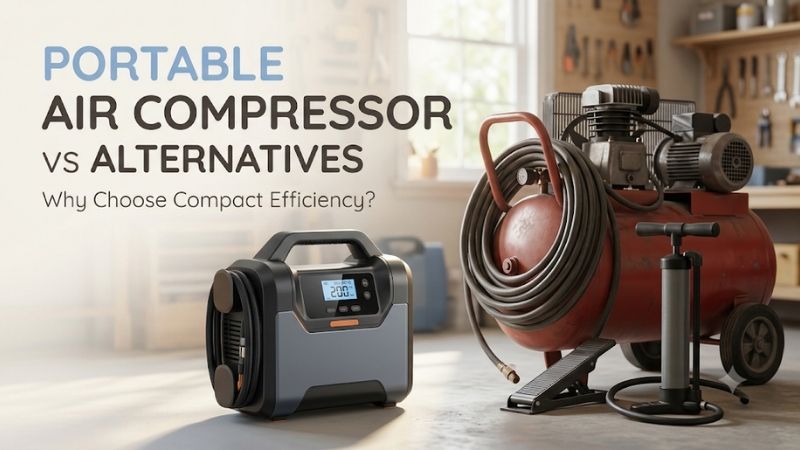
A portable tank compressor is designed to store compressed air and supply it through regulated outlets.
A dedicated tire inflator is generally designed to deliver air directly into a tire without a large storage tank.
This distinction affects portability and equipment compatibility.
A tank compressor can support appropriate pneumatic tools.
A tire inflator usually cannot.
Size and Storage
Dedicated tire inflators can be small enough to store in a vehicle trunk or garage drawer.
Tank compressors require room for the pump, motor, reservoir, gauges, and fittings.
For buyers with limited storage, the difference can be substantial.
A small inflator is often more convenient when tire maintenance is the only objective.
Tire Inflation Performance
Both types can inflate vehicle tires when used correctly.
However, inflation speed depends on actual airflow, tire volume, and pressure difference.
A high maximum PSI rating does not establish faster tire inflation.
Compare actual inflation performance where reliable testing is available.
Power Sources
Portable tire inflators may use rechargeable batteries, vehicle electrical connections, or household power.
Tank compressors commonly use household electricity, although cordless and engine-driven models also exist.
Choose the power source according to where the equipment will be used.
Pressure Monitoring
Many tire inflators include built-in pressure displays and automatic shutoff features.
Tank compressors may require separate tire gauges or inflation tools.
Regardless of equipment, use the vehicle manufacturer’s recommended cold tire pressure.
Which Is Better for Roadside Emergencies?
A compact tire inflator is generally more convenient to keep in a vehicle.
A six-gallon tank compressor is bulkier and usually requires an appropriate electrical supply.
For roadside use, portability and power availability are major advantages.
Which Is Better for a Garage?
A tank compressor is more versatile when pneumatic tools are part of the workshop.
For tire-only maintenance, the inflator may offer better value.
Portable Air Compressor vs Cordless Electric Nailer
How Pneumatic Nailers Work
A pneumatic nailer uses compressed air to drive fasteners.
The compressor supplies air through a hose.
The tool requires a specified operating pressure and adequate air delivery.
How Cordless Nailers Work
Cordless electric nailers use a battery-powered mechanism to drive fasteners.
Different models use flywheels, gas-assisted mechanisms, or other designs.
They generally eliminate the need for an external air hose and conventional shop compressor.
Setup Time
A pneumatic system requires connecting a hose, checking pressure, and preparing the compressor.
A cordless nailer may be quicker to deploy for occasional fastening.
However, the battery must be charged and the tool must be maintained appropriately.
Tool Weight
Pneumatic nailers can be relatively light because the air supply remains outside the tool.
Cordless nailers include additional internal components and batteries.
They may therefore be heavier.
However, the absence of an air hose can improve maneuverability.
Working in Tight Spaces
A cordless nailer avoids hose management.
This can be useful inside cabinets or during repeated movement between rooms.
However, its housing may be larger than that of some pneumatic models.
Repeated Fastening
Pneumatic systems can be efficient for repeated fastening when the compressor supplies enough air.
Cordless models vary in firing rate, battery life, and operating mechanism.
Choose according to the specific task.
Ownership Cost
A pneumatic setup may require a compressor, hose, fittings, and nailer.
A cordless setup requires a compatible nailer, battery, and charger.
Existing tool ownership influences the economic comparison.
Which Is Better for Trim Work?
For users already owning a compressor, a pneumatic finish nailer can be attractive.
For users who need only occasional trim fastening, a cordless electric nailer may offer simpler operation.
Portable Air Compressor vs Cordless Impact Wrench
Pneumatic Impact Wrenches
Pneumatic impact wrenches use compressed air to generate rotational impacts.
They require suitable pressure and airflow.
A small compressor may operate some models intermittently but struggle with demanding or repeated use.
Cordless Electric Impact Wrenches
Cordless impact wrenches use a battery-powered motor and internal impact mechanism.
They do not require compressed air.
This makes them convenient for mobile automotive work.
Setup and Mobility
A cordless impact wrench can operate without an air hose.
A pneumatic impact wrench requires the compressor and suitable hose.
For driveway repairs, cordless equipment may be easier to move.
Performance
Both types can provide substantial fastening capability.
However, performance varies by model.
Do not assume one technology is universally stronger.
Compare manufacturer ratings and credible independent testing.
Runtime
A pneumatic wrench depends on compressor airflow and stored air.
A cordless wrench depends on battery capacity and tool efficiency.
Both have operating limitations.
Total Cost
A pneumatic impact wrench may be inexpensive when a suitable compressor already exists.
A cordless impact wrench may be more economical when the user would otherwise need to purchase an entire air system.
Automotive Safety
Impact wrenches are useful for loosening certain fasteners, but final tightening of safety-critical fasteners should follow the vehicle manufacturer’s torque specifications using an appropriate calibrated torque wrench.
Do not use impact output as a substitute for precise tightening.
Portable Air Compressor vs Stationary Air Compressor
Portability
Portable compressors can be moved between work locations.
Stationary compressors are generally larger and may be installed permanently.
This affects storage and workshop layout.
Airflow Capacity
Stationary compressors often offer greater sustained airflow, depending on the model.
This can be beneficial for air sanders, spray guns, and demanding pneumatic tools.
However, the actual CFM rating matters more than the stationary designation.
Tank Size
Stationary compressors commonly use larger air reservoirs.
These provide more stored air between compressor cycles.
However, a large tank does not replace adequate pump output.
Electrical Requirements
Larger compressors may require dedicated electrical circuits or higher-voltage supplies.
Installation should follow manufacturer instructions and applicable electrical requirements.
Maintenance
Both portable and stationary compressors require tank inspection and moisture drainage.
Oil-lubricated models also require appropriate lubricant servicing.
Workshop Space
A stationary compressor occupies permanent space.
A portable unit can be moved or stored elsewhere.
For a small home garage, this flexibility may be valuable.
Which Is Better for Continuous Air Tools?
A properly sized stationary compressor is often more suitable for demanding continuous pneumatic applications.
However, the choice must be based on delivered airflow, pressure, duty cycle, and the intended equipment.
Portable Air Compressor vs Manual Air Pump
Power Requirements
A manual pump operates through physical effort.
It does not require electricity or batteries.
This makes it useful in certain low-volume inflation situations.
Inflation Speed
Manual pumps can be practical for bicycle tires and similar applications.
For larger vehicle tires, the required effort may be substantial.
A powered inflator is usually more convenient.
Pressure Capability
Some manual pumps can reach high pressures suitable for specific bicycle tires.
However, pressure capability does not mean high airflow.
Large-volume inflation can be slow.
Storage
Manual pumps are often compact and inexpensive.
They can be useful as backup equipment.
Maintenance
Manual pumps have seals and mechanical components that can wear.
However, they avoid motor and battery maintenance.
Which Is Better for Homeowners?
A manual pump is practical for occasional bicycle inflation.
A powered inflator is generally more convenient for car tires.
A tank compressor is appropriate when pneumatic tools are also needed.
Portable Air Compressor vs Cordless Air Compressor
Electrical Power Versus Battery Power
Traditional portable compressors commonly use household electricity.
Cordless compressors draw energy from rechargeable batteries.
This can improve mobility at work sites without electrical outlets.
Runtime
Cordless runtime depends on battery capacity, compressor workload, and operating pressure.
A corded compressor avoids battery depletion but still has duty-cycle and thermal limitations.
Airflow
Some cordless compressors offer useful airflow for compatible pneumatic nailers.
However, not every cordless compressor can support high-demand continuous tools.
Compare published output at the required pressure.
Battery Cost
Cordless compressors can require expensive batteries.
For existing battery-platform owners, the additional cost may be lower.
Worksite Convenience
Cordless models are particularly useful for remote repairs and installation work.
However, battery charging and spare-pack requirements should be considered.
Which Is Better?
Choose cordless when mobility without an outlet is essential.
Choose corded when a suitable electrical supply is available and long operating sessions are common.
Portable Air Compressor vs Airless Paint Sprayer
Different Paint Delivery Systems
Conventional pneumatic spray guns use compressed air to atomize paint.
Airless paint sprayers use a different pumping system to pressurize coating material.
They do not require a conventional workshop air compressor to perform their primary spraying function.
Air Requirements
A pneumatic spray gun can require substantial continuous airflow.
A small pancake compressor may be unable to maintain the required supply.
An airless sprayer avoids this particular requirement.
Finish Characteristics
Both systems can produce suitable finishes when used correctly.
However, finish quality depends on the coating, equipment, nozzle, setup, and technique.
Overspray and Safety
Spraying can create airborne coating particles and hazardous exposure.
Use appropriate ventilation and protective equipment.
High-pressure airless spray equipment also introduces serious injection hazards.
Which Is Better for Painting Projects?
Choose according to coating type, project size, finish requirements, and equipment specifications.
Do not assume that owning a small air compressor makes every spray gun practical.
Compare the Options by Common Projects
Inflating Car Tires
A dedicated tire inflator is often the simplest option.
A tank compressor can also work through a suitable inflation accessory.
Choose according to storage and convenience.
Installing Baseboards
Both pneumatic finish nailers and cordless electric nailers can be appropriate.
A compressor becomes attractive when it will also support other tools.
Building a Workbench
Pneumatic nailers may assist with suitable assembly tasks.
However, many workbench designs rely primarily on screws or bolts.
A compressor is not necessarily required.
Removing Wheel Lug Nuts
A cordless impact wrench may be more practical than purchasing a compressor solely for a pneumatic wrench.
Final tightening requires the correct torque procedure.
Spray Painting Furniture
A suitable pneumatic spray system may require more airflow than a small portable compressor supplies.
An alternative painting method may be more practical.
Airbrushing Models
A small quiet compressor can be suitable for airbrushing with appropriate regulation and moisture control.
A large garage compressor may be unnecessary.
Cleaning Workshop Equipment
Compressed air can remove appropriate debris, but it creates flying-particle and dust hazards.
Other cleaning methods, such as a suitable vacuum, may be preferable for fine dust.
How to Choose the Right Equipment
Identify the Primary Task
Start with the job you perform most often.
Do not buy a full compressed-air system simply because it can perform a task that a smaller dedicated tool can handle.
Check Airflow Requirements
When pneumatic tools are involved, compare CFM at the required pressure.
Maximum PSI alone is insufficient.
Consider Frequency of Use
Occasional inflation may not justify a tank compressor.
Frequent pneumatic fastening may.
Continuous air tools require sufficient sustained airflow.
Evaluate Storage Space
A compressor and hose system occupies more room than a compact inflator or some cordless tools.
Measure the available workspace.
Compare Operating Noise
Compressors can be loud.
A cordless nailer or impact wrench may eliminate compressor cycling noise, although the tool itself still generates sound.
Consider Maintenance
Tank compressors require drainage and pressure-system inspection.
Cordless alternatives require battery care.
Manual tools have different maintenance needs.
Compare Complete Costs
The price of a compressor does not include every accessory.
Similarly, cordless tools may require batteries and chargers.
Calculate the complete working setup.
Consider Long-Term Flexibility
A compressor can support many different pneumatic tools.
This versatility may justify the investment for a growing workshop.
However, it may be unnecessary when the buyer only needs one specific function.
Common Comparison Mistakes
Assuming a Tire Inflator Can Run Pneumatic Tools
Most dedicated tire inflators are not designed to supply nailers or air sanders.
Assuming Every Compressor Can Run an Impact Wrench
Air demand varies widely.
Check CFM and duty cycle.
Buying a Large Tank Instead of More Airflow
A bigger tank provides stored air, not necessarily higher continuous delivery.
Ignoring Accessory Costs
Hoses, filters, regulators, and fittings can add substantially to the purchase.
Overlooking Maintenance
A compressor tank must be maintained safely.
Confusing Maximum PSI With Working Pressure
The compressor’s tank pressure is not automatically the correct pressure for the connected tool.
Frequently Asked Questions
Do I need an air compressor if I only inflate tires?
Usually not. A suitable dedicated tire inflator may be smaller and more convenient.
Is a cordless nailer better than a pneumatic nailer?
It depends on workload, tool weight, existing equipment, and total cost. Both can be effective for suitable fastening applications.
Can a cordless impact wrench replace an air impact wrench?
For many automotive applications, a capable cordless impact wrench can provide a practical alternative. Compare specific tool performance and fastening requirements.
Is a stationary compressor more powerful?
Many stationary models offer greater airflow, but the exact CFM and duty cycle determine performance.
Can a portable compressor run a paint sprayer?
Only if it supplies the pressure and sustained airflow required by the specific spray gun.
Is a manual pump enough for car tires?
It may be possible with suitable equipment, but a powered inflator is generally more convenient for larger-volume vehicle tires.
Are cordless compressors worth buying?
They can be valuable when electrical outlets are unavailable and the required airflow is within their capabilities.
Conclusion
When comparing a portable air compressor vs alternatives, choose a tank compressor when you need a shared compressed-air supply for several compatible tools. A tire inflator is more convenient for vehicle inflation alone, a cordless nailer simplifies fastening without a hose, and a cordless impact wrench may be better for mobile automotive work. Larger stationary compressors suit demanding sustained air consumption, while manual pumps remain useful for simple inflation. Match the equipment to the task rather than purchasing a compressor solely for its versatility.
More from Amazon
Programs that pair well with the guide above. Offers and eligibility are set by Amazon and may change.
Collect the home and kitchen items you want in one registry that guests can shop from.
Create a wedding registrySet up recurring deliveries of everyday items on eligible products. Terms and savings are set by Amazon.
Explore Subscribe & SaveFree shipping on eligible items, Prime Video and more. Eligible new members can start with a free trial.
Start a Prime free trialAudiobooks and podcasts to listen to on the go. Eligible new members can start with a free trial.
Try Audible freeAs an Amazon Associate we earn from qualifying purchases.