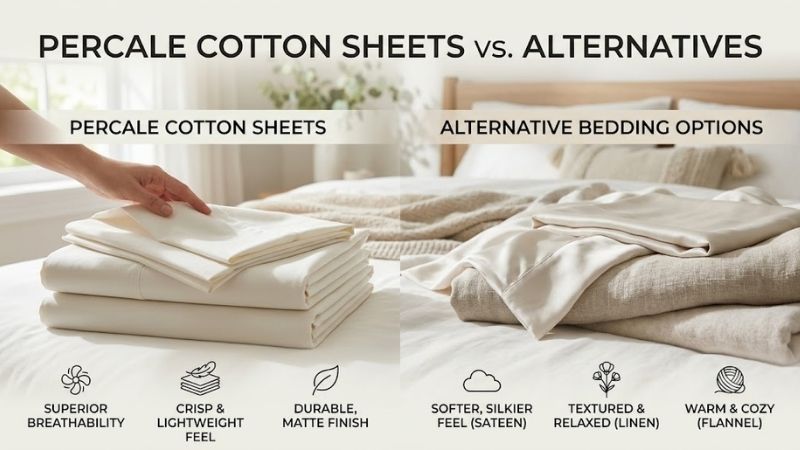
Percale cotton sheets are known for their crisp texture, matte appearance, and traditional bedding feel, but they are not the best choice for every sleeper. Cotton sateen offers a smoother surface, linen provides distinctive texture, bamboo-derived viscose and lyocell create more fluid draping fabrics, and microfiber or jersey may appeal to shoppers prioritizing affordability or softness. The differences go beyond how each material feels when new: weave construction, fabric weight, moisture behavior, laundering, and resistance to wear all influence long-term satisfaction.
Quick Verdict: Who Should Buy Percale Cotton Sheets?
Percale cotton is an excellent starting point for sleepers who enjoy a fresh, crisp, relatively structured sheet rather than a silky or stretchy surface. Many percale fabrics have a lightweight construction and matte finish, making them appealing for everyday bedding and warm bedrooms. However, the material can wrinkle noticeably, and new sets sometimes feel firmer than shoppers expect.
Cotton sateen is a logical alternative when immediate smoothness matters more than crispness. Linen suits buyers who enjoy a textured, relaxed appearance. Bamboo-derived viscose and lyocell are worth considering when a flowing drape is the priority, while jersey offers a softer, stretchy knit feel. Microfiber may suit shoppers with limited budgets, although temperature comfort and fabric quality vary.
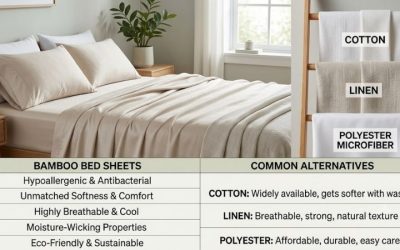
| Fabric | Typical feel | Main advantage | Common drawback | Best starting buyer |
|---|---|---|---|---|
| Cotton percale | Crisp and structured | Traditional matte bedding | Wrinkles and may feel firm initially | Enjoys crisp sheets |
| Cotton sateen | Smooth and flowing | Soft cotton sensation | Snagging and warmth vary | Wants silky cotton |
| Linen | Textured and relaxed | Distinctive casual feel | Wrinkles and can cost more | Prefers textured bedding |
| Bamboo-derived viscose | Smooth and fluid | Soft drape | Care sensitivity and marketing confusion | Likes silky-feeling fabric |
| Lyocell | Smooth and flexible | Soft regenerated-cellulose textile | Performance varies by construction | Wants a smooth alternative |
| Cotton jersey | Stretchy and T-shirt-like | Casual softness | Can stretch or lose shape | Prefers knit bedding |
| Polyester microfiber | Smooth or brushed | Accessible price | Temperature and pilling vary | Prioritizes affordability |
These comparisons describe common characteristics, not guaranteed performance for every product.
What Makes Percale Different From Other Sheets?
Percale is a weave rather than a specific type of cotton. Its defining structure is a balanced one-over-one-under arrangement of warp and weft yarns. This plain weave contributes to the relatively crisp surface associated with traditional cotton percale.
The fiber itself also matters. Percale can be made using cotton, polyester, or other fibers, but shoppers specifically looking for cotton percale should verify the composition.
Why Weave Structure Matters
In a plain weave, yarns cross frequently. This gives percale a comparatively structured surface and usually a matte appearance.
Sateen uses longer yarn floats, which tend to create a smoother and more flexible textile. Jersey is knitted rather than woven, so its structure introduces stretch and a different hand-feel.
These distinctions explain why sheets can feel dramatically different despite being made from the same fiber.
Does Percale Thread Count Determine Quality?
Thread count describes the number of yarns counted in a defined area of woven fabric. It does not reveal every characteristic influencing softness or durability.
Many conventional cotton percale sheets fall around 200–400 thread count, with numerous products concentrated toward the lower portion of that range.
A higher number is not automatically better. Very high advertised counts may reflect different yarn constructions or counting methods, making comparisons difficult.
For practical shopping, prioritize fiber quality, weave consistency, fabric weight, finishing, and care instructions over extreme thread-count claims.
Why Cotton Quality Matters
Long-staple cotton can support the production of smoother and relatively strong yarns when properly spun.
However, terms such as Egyptian cotton, Pima cotton, or premium cotton do not independently establish finished fabric quality.
A poorly woven premium-fiber sheet may be less satisfying than a well-made conventional cotton percale set.
Look for clear composition information and credible construction details rather than relying on fiber names alone.
Percale Cotton vs Cotton Sateen
This is the most direct comparison because both fabrics can use identical cotton fibers while producing different textures through their weave.
Cotton percale tends to feel crisp and structured. Cotton sateen generally feels smoother and drapes more fluidly.
The better option depends on whether the sleeper wants the sensation of freshly laundered cotton or a softer, more enveloping surface.
Texture and Initial Softness
Percale can feel relatively firm when new, especially when the manufacturer has not applied substantial softening treatments.
Many sets become more relaxed after repeated laundering.
Sateen often feels smooth immediately because its weave exposes longer yarn sections at the fabric surface.
For someone who expects a silky sensation from the first night, sateen may be more appealing.
For someone who enjoys the crispness of traditional hotel-style bedding, percale is a better starting point.
Breathability and Warmth
Percale is commonly favored in warm bedrooms because many products have relatively lightweight construction.
Cotton sateen may feel slightly more substantial or enveloping, depending on weight and finishing.
However, it would be inaccurate to claim that every percale sheet is cooler than every sateen sheet.
A dense, heavy percale may retain more warmth than an especially lightweight sateen.
The specific product matters.
Surface Wear and Snagging
Sateen’s longer yarn floats can be more vulnerable to snagging in certain circumstances.
Percale’s balanced structure may offer a different resistance profile, although actual durability still depends on yarn quality and finishing.
Neither weave is immune to abrasion, pilling, or tearing.
For households with pets, examine fabric construction and realistic care requirements rather than assuming one weave is indestructible.
Wrinkling and Appearance
Percale wrinkles naturally, especially after laundering.
Sateen often presents a smoother appearance, though it can also crease.
If you dislike visible wrinkles and prefer not to iron bedding, sateen may be more convenient.
If wrinkles do not bother you and crispness is the goal, percale’s appearance may be entirely acceptable.
Which Should You Choose?
Choose percale when you want a matte, crisp surface and prefer lighter-feeling bedding.
Choose sateen when you prioritize smoothness, fluid drape, and a somewhat more polished appearance.
Percale Cotton vs Linen
Linen and percale are both popular with sleepers who dislike highly silky synthetic-feeling bedding, but they create different sensations.
Cotton percale has a relatively uniform, crisp surface. Flax linen has more visible texture and a naturally relaxed appearance.
Fabric Texture
New percale often feels like a crisp cotton shirt.
Linen may feel firmer or more textured, especially before repeated laundering.
Washed linen can feel softer, but its surface typically remains distinguishable from smooth cotton percale.
A buyer who dislikes noticeable fabric texture should not assume linen will feel like percale simply because both are commonly described as breathable.
Warm-Weather Comfort
Both can be used in lightweight bedding suitable for warmer conditions.
However, fabric weight matters significantly.
A lightweight cotton percale sheet and a heavyweight linen sheet will not necessarily provide similar temperature comfort.
Likewise, a very lightweight linen product may feel different from dense cotton percale.
The correct comparison requires examining actual construction rather than general fiber categories.
Wrinkles
Both fabrics wrinkle, but linen’s relaxed creasing is often part of its intended appearance.
Percale wrinkles may look sharper or more like traditional cotton creases.
If you want a casual bed that does not need to appear freshly pressed, linen may suit your style.
If you prefer a crisp, tidy appearance, percale may be more appropriate, provided you accept its wrinkling.
Maintenance and Price
Cotton percale is available across a broad range of prices.
Genuine linen sheets often occupy higher price categories, although affordable options exist.
Linen’s premium may be worthwhile when its distinctive texture is important.
It is less compelling when the buyer simply wants lightweight, practical cotton bedding.
Which Should You Choose?
Choose percale for consistent crispness and familiar cotton maintenance.
Choose linen for textured bedding and a relaxed visual character.
Neither is automatically superior in every climate.
Percale Cotton vs Bamboo-Derived Viscose
This comparison involves both fiber and weave differences.
Cotton percale uses a plain weave and cotton fibers. Many bamboo-marketed sheets use regenerated viscose fibers in a sateen-like construction.
Consequently, the two materials often feel very different.
Crispness Versus Fluid Drape
Cotton percale maintains a relatively structured surface.
Bamboo-derived viscose commonly produces a softer, more fluid drape.
Someone who dislikes a sheet resting closely against the body may prefer percale.
Someone who enjoys smooth, flowing fabric may prefer viscose.
The preference is tactile rather than a universal quality ranking.
Understanding Bamboo Labels
Most silky bedding marketed as bamboo uses regenerated cellulose rather than mechanically extracted natural bamboo fiber.
The proper fiber description should identify rayon or viscose made from bamboo.
The US Federal Trade Commission has warned about unsupported claims that these textiles retain the original bamboo plant’s natural properties.
A buyer should therefore evaluate actual fiber composition rather than assuming the word bamboo proves natural antibacterial performance or environmental superiority.
Cooling Claims
Both percale and bamboo-derived viscose can feel comfortable in warm bedrooms.
However, viscose’s smoothness does not establish sustained cooling.
Likewise, the percale weave alone does not guarantee greater airflow in every product.
Fabric thickness, density, finishing, and other bedding layers influence the outcome.
Laundry and Durability
Cotton percale is often a practical choice for frequent washing, subject to the care label.
Viscose may require gentler handling, particularly under wet conditions.
A well-made viscose sheet can still provide useful service life, but the buyer should verify laundering instructions before purchasing.
Which Should You Choose?
Choose percale for crispness and traditional cotton feel.
Choose bamboo-derived viscose when soft drape matters more.
Do not pay extra for unsupported claims that bamboo automatically provides better cooling or hygiene.
Percale Cotton vs Lyocell
Lyocell is a manufactured cellulose fiber produced through a process distinct from conventional viscose.
It is often used in smooth, flowing fabrics that contrast with crisp cotton percale.
However, lyocell can be woven in different ways, so the material name alone does not establish one specific texture.
Initial Comfort
Lyocell sateen may feel softer or more fluid when new than many conventional cotton percale sheets.
This can appeal to people who find new percale too firm.
However, a well-finished cotton percale may still be the preferred surface for someone who enjoys structured bedding.
Moisture Behavior
Lyocell can absorb moisture, but moisture absorption is not the same as air permeability or drying speed.
A dense lyocell fabric may behave differently from a lighter one.
The same principle applies to cotton percale.
For hot sleepers, the complete textile construction is more important than broad claims about moisture-wicking.
Manufacturing Considerations
Certain lyocell production systems recover and reuse a high proportion of processing solvent.
That may offer advantages over some conventional viscose processes.
However, environmental performance depends on actual manufacturing and sourcing practices.
A lyocell label is not a complete environmental certification.
Practical Buying Decision
Lyocell is worth comparing when you want a smoother alternative to cotton percale.
Percale remains attractive when texture, cotton composition, and conventional maintenance matter more.
Percale Cotton vs Jersey Knit
Jersey offers one of the most distinctive alternatives to percale because it is knitted rather than woven.
Cotton jersey commonly resembles the feel of a soft T-shirt.
It stretches more readily than conventional woven percale, producing a casual sleeping surface.
Texture and Stretch
Percale is structured and relatively crisp.
Jersey is softer and more elastic in its basic construction.
A person who dislikes crisp sheets may prefer jersey’s relaxed sensation.
However, the added stretch changes how the fitted sheet behaves around mattress corners.
Fit and Shape Retention
A jersey fitted sheet can stretch around a mattress, but that does not mean size is unimportant.
If the fabric is excessively loose or loses recovery over time, it may bunch.
Percale generally provides less stretch, making accurate pocket depth and dimensions particularly important.
Warmth
Jersey can feel cozy because of its knit construction, but thermal performance depends on fabric weight and density.
A heavyweight jersey sheet may be less appealing in a hot room than a lightweight percale.
Maintenance
Some jersey fabrics develop pilling or lose shape after repeated laundering.
Others remain comfortable for a long period.
The result depends on yarn quality, finishing, and care.
Which Should You Choose?
Choose jersey for a soft, stretchy, casual feel.
Choose percale for a crisp woven surface and more structured appearance.
Percale Cotton vs Microfiber
Microfiber is frequently sold as an affordable bedding option.
Most microfiber sheets use fine synthetic fibers, commonly polyester.
They can provide immediate softness at a low price, but their tactile and moisture properties differ from cotton percale.
Surface Feel
Microfiber may feel smooth, brushed, or slightly fuzzy.
Percale has a more structured woven cotton surface.
A person looking for traditional cotton crispness may find microfiber too soft or clingy.
Someone wanting inexpensive soft bedding may prefer microfiber.
Warmth and Moisture
Polyester absorbs moisture differently from cotton.
Some dense microfiber constructions can feel warmer or less comfortable in humid conditions.
However, actual performance depends on yarn design and finishing.
Not every microfiber sheet behaves identically.
Durability
Microfiber can resist certain forms of wear, but low-quality products may pill or lose their preferred texture.
Cotton percale can also wear through abrasion and improper laundering.
A direct durability comparison requires actual product construction, not just fiber labels.
Environmental Trade-Offs
Polyester is commonly petroleum-derived and can shed microfibers during washing.
Cotton involves agricultural resource use and textile processing.
Neither material is free of environmental impacts.
The better choice depends on documented practices and the buyer’s priorities.
Temperature Comparison: Which Sheets Feel Coolest?
There is no scientifically defensible universal ranking that places every percale sheet above every alternative.
The sensation of sleeping cool depends on initial surface contact, airflow, moisture handling, fabric thickness, mattress, room temperature, and covers.
Practical Warm-Weather Comparison
| Fabric | General warm-weather appeal | Main caution |
|---|---|---|
| Cotton percale | Crisp feel; often lightweight | Dense models may feel less airy |
| Cotton sateen | Smooth surface | Some constructions feel more substantial |
| Linen | Textured, relaxed feel | Fabric weight varies |
| Bamboo-derived viscose | Smooth and fluid | Softness does not prove cooling |
| Lyocell | Smooth regenerated-cellulose fabric | Weave and finishing matter |
| Jersey | Soft and stretchy | Heavy knits may feel warm |
| Microfiber | Accessible and soft | Dense polyester may be less comfortable for some hot sleepers |
Why a Cooling Label Is Not Enough
A cool-to-the-touch sensation may result from rapid initial heat transfer.
That sensation can diminish as the fabric warms.
Long-term comfort depends on whether heat and moisture can move through the entire sleeping system.
Buyers should therefore consider the mattress protector, duvet, room conditions, and overall bedding thickness.
Durability and Long-Term Ownership
A premium sheet set may feel excellent when new but still require replacement sooner than expected if the construction is unsuitable for the household.
Durability is influenced by yarn quality, fiber behavior, finishing, abrasion, and laundering.
High-Frequency Washing
Households with children, pets, or frequent spills should prioritize clear care instructions and practical laundering.
Cotton percale may be a convenient choice when it can be machine-washed and dried using ordinary household equipment.
However, not every premium percale product has identical care requirements.
Snagging and Abrasion
Longer yarn floats, delicate finishes, and loosely constructed fabrics can respond differently to abrasion.
Pets’ claws, rough laundry hardware, and mattress friction can affect all bedding materials.
Wrinkling Versus Wear
Wrinkles are not evidence that a sheet is wearing out.
Percale and linen naturally crease.
Evaluate thinning, holes, failing seams, pilling, or loss of fit separately from ordinary wrinkles.
Cost Per Year of Use
An expensive sheet set can provide good value if it remains comfortable and functional for a long period.
However, that lifespan cannot be guaranteed merely from fiber type or brand positioning.
A practical comparison includes purchase cost, included pieces, laundering requirements, and replacement availability.
Which Sheets Are Best for Your Sleeping Preferences?
If You Prefer Hotel-Style Crispness
Cotton percale is the most direct starting choice.
Its structured, matte feel differs from the flowing sensation of sateen and viscose.
If You Want Immediate Silky Softness
Cotton sateen, bamboo-derived viscose, or lyocell may better suit your preferences.
Compare their actual construction rather than assuming one fiber guarantees softness.
If You Enjoy Natural Texture
Flax linen is worth considering.
Its relaxed appearance and tactile variations provide a different experience from smooth cotton percale.
If You Want Stretch
Cotton jersey is a suitable alternative.
Its knit construction offers flexibility that ordinary woven percale does not.
If Your Budget Is Very Limited
Microfiber may be attractive.
However, compare package quantity, actual dimensions, and fabric quality rather than choosing solely by advertised softness.
Buyer Scenario: Choosing Sheets for a Warm Apartment
Consider a shopper who sleeps on a queen mattress in a warm apartment and dislikes fabric that drapes closely around the body.
They are comparing cotton percale, bamboo-derived viscose sateen, and polyester microfiber.
Their main needs are relatively lightweight bedding, straightforward washing, and a crisp feel.
Cotton percale is the strongest starting category because its characteristic texture matches the preference.
That does not guarantee it will be the coolest product, but it aligns more closely with the desired sensation.
A lightweight viscose set remains an alternative if the shopper decides they prefer smoothness.
A dense microfiber set may be less appealing if the shopper dislikes plush or clingy fabrics.
The decision should then be narrowed using actual fabric weight, pocket depth, package contents, and care instructions.
Common Mistakes When Comparing Percale and Other Sheets
Comparing Fiber Types Without Considering Weave
Cotton percale and cotton sateen use the same general fiber but different weave structures.
The feel can be markedly different.
Always identify both material and construction.
Assuming High Thread Count Means Better Sheets
Thread count is only one specification.
Extreme numbers do not guarantee softness, cooling, or durability.
Mistaking Crispness for Poor Quality
New percale may feel firmer than expected.
That is part of its characteristic texture, not necessarily evidence of poor manufacturing.
Buying the Wrong Pocket Depth
A sheet that is too shallow may slip off.
A fitted sheet with excessively deep pockets may bunch on a thin mattress.
Measure before buying.
Believing Every Alternative Has Better Cooling
Bamboo, lyocell, linen, and microfiber marketing often emphasizes temperature.
None automatically outperforms every cotton percale construction.
Frequently Asked Questions
Are Percale Cotton Sheets Better Than Sateen?
Neither is universally better. Percale offers crispness and a matte appearance, while sateen generally provides a smoother, more fluid feel. Choose according to texture preference, fabric weight, and care requirements.
Is Percale Cooler Than Bamboo Sheets?
Some lightweight percale sheets may feel more breathable to certain sleepers than dense bamboo-derived viscose sateen, but no universal result applies. The actual weave, fabric weight, mattress, and room conditions determine thermal comfort.
Is Linen Better Than Percale for Summer?
Both can be comfortable in warm conditions. Linen has a more textured surface, while percale feels crisp and structured. Fabric weight and construction matter more than general seasonal claims.
Do Percale Sheets Last Longer Than Microfiber?
Not necessarily. Durability depends on yarn, weave, abrasion, laundering, and finished construction. High-quality percale can provide long service life, but fiber category alone is insufficient to guarantee longevity.
What Is Better for Sensitive Skin: Percale or Sateen?
Comfort is individual. Some people prefer sateen’s smoother surface, while others like lightweight percale. Skin irritation can also involve detergents, dyes, finishes, and other factors, so no weave should be considered universally hypoallergenic.
Should I Choose Percale if I Hate Wrinkles?
Traditional cotton percale wrinkles naturally. If a consistently smooth appearance is a priority, cotton sateen or another construction may better fit your preferences. However, product-specific finishes and laundering still influence wrinkling.
Conclusion
Percale cotton sheets are an excellent choice for sleepers who prefer crisp, matte, structured bedding, but they are not automatically better than every alternative. Choose cotton sateen or lyocell for smoother drape, linen for textured comfort, jersey for stretch, bamboo-derived viscose for a fluid silky feel, and microfiber when affordability is the main priority. Compare weave, fiber quality, weight, mattress fit, and laundering requirements rather than relying on cooling claims or thread count alone.