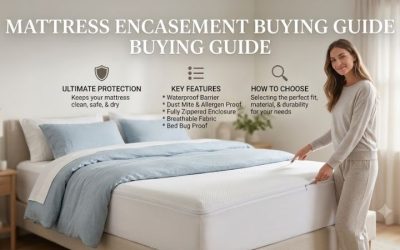
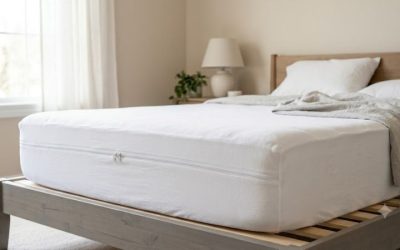
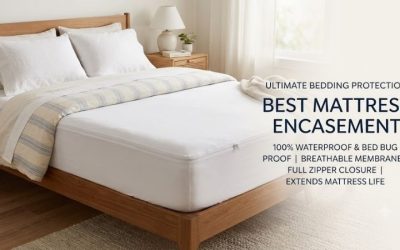
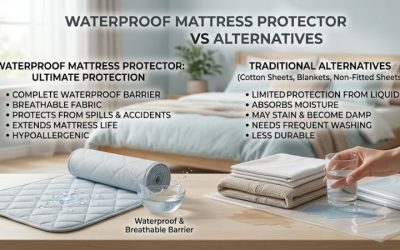
Choosing a mattress encasement for small spaces means finding reliable protection without making installation, cleaning, or bed access difficult. Whether you have a studio apartment, narrow bedroom, or compact guest room, the right encasement should fit securely, protect the entire mattress, and remain practical in tight quarters.
What Is a Mattress Encasement for Small Spaces?
A mattress encasement is a protective cover designed to surround a mattress on all six sides: the top, bottom, and four edges. Unlike a conventional fitted mattress protector, it generally uses a zipper to create a fully enclosed barrier.
For small bedrooms, the primary challenge is not the space occupied by the encasement itself. Most properly fitted encasements add minimal bulk. Instead, buyers must consider how easily the cover can be installed and maintained when a bed sits against walls, inside an alcove, or beneath a loft frame.
A suitable encasement should provide the required level of mattress protection while allowing the bed to function normally.
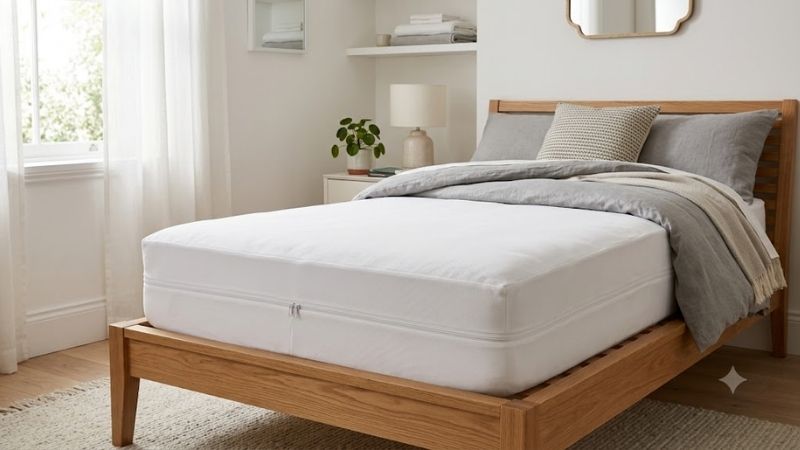
How a Mattress Encasement Differs From a Mattress Protector
Although these products have similar purposes, their designs and coverage differ.
| Feature | Mattress Encasement | Fitted Mattress Protector |
|---|---|---|
| Mattress coverage | All six sides | Usually top and sides |
| Closure | Typically zippered | Usually elastic skirt |
| Bed bug containment | Possible with a tested, properly sealed design | Generally not intended for containment |
| Spill protection | Depends on waterproof coverage | Depends on waterproof coverage |
| Installation | Usually requires lifting or maneuvering the mattress | Generally easier to install |
| Routine removal | More involved | Usually simpler |
| Best use | Comprehensive mattress protection | Everyday surface protection |
A fitted protector may be more convenient when the primary concern is occasional spills. A full encasement is more appropriate when protection against allergens, dust, or bed bugs is a priority.
However, shoppers should not assume that every zippered mattress cover is bed bug-proof or waterproof.
Why Encasement Design Matters in Small Bedrooms
A small bedroom can make basic mattress maintenance surprisingly difficult.
A bed positioned against two walls, for example, leaves limited space for reaching the back corners. If a cover has stiff fabric, poorly positioned openings, or a complicated closure, installation may require moving heavy furniture.
A well-designed encasement reduces these frustrations through flexible materials, accurate sizing, and a zipper system that can be operated without excessive force.
The best design depends on how much access the bed allows.
Who Benefits Most From a Full Mattress Encasement?
Full encasements are particularly useful for renters, apartment residents, families, and people who want a more complete mattress barrier.
They may also suit guest rooms where mattresses are used intermittently but still require protection from dust and accidental spills.
For households concerned about bed bugs, an appropriately tested encasement can contribute to a broader pest-management strategy. It cannot eliminate an infestation elsewhere in the bedroom.
For everyday moisture protection, buyers should instead prioritize verified waterproof construction and proper laundering.
How to Choose the Right Mattress Encasement for Small Spaces
The most important buying factors are fit, zipper access, protective coverage, fabric comfort, and ease of maintenance.
1. Measure Your Mattress Before Shopping
Mattress size is the first compatibility requirement.
A cover that is too small can place unnecessary strain on seams and zippers. One that is excessively loose may wrinkle, shift, or make it harder to maintain a smooth sleeping surface.
Common US mattress dimensions include:
| Mattress Size | Standard Width × Length |
|---|---|
| Twin | 38 × 75 inches |
| Twin XL | 38 × 80 inches |
| Full | 54 × 75 inches |
| Queen | 60 × 80 inches |
| King | 76 × 80 inches |
| California King | 72 × 84 inches |
These are nominal dimensions. Actual measurements can vary with mattress construction and manufacturer tolerances.
Measure the physical mattress rather than relying exclusively on its size label.
Pay particular attention to thickness, because two mattresses with the same width and length may require different encasement depths.
2. Match the Mattress Depth
Mattress depth describes its vertical thickness, from the bottom surface to the top.
Encasement manufacturers may offer fixed-depth designs or flexible pocket ranges.
For example, some Protect-A-Bed AllerZip encasement configurations are designed for mattress depths of 6–11 inches, while deeper configurations accommodate 11–18 inches.
These ranges are product-specific and should not be treated as universal.
A fitted cover should sit smoothly without excessively stretching the zipper or leaving large amounts of loose fabric.
Buying tip: If your mattress measures 10 inches thick, choose a cover whose published depth range includes 10 inches. Do not automatically purchase the deepest available option.
3. Choose a Zipper Design That Works With Your Room
Zipper accessibility is especially important in tight bedrooms.
Some encasements use a three-sided zipper arrangement that provides a relatively wide opening. Others have different zipper layouts intended to simplify insertion or improve closure security.
A wider opening can reduce the amount of bending and pulling required during installation, although the actual benefit depends on the mattress and product construction.
Before buying, check:
-
Whether the zipper opens along multiple sides.
-
Where the zipper begins and ends.
-
Whether the closure includes a secure end-stop or locking mechanism.
-
Whether the zipper can be accessed in your bed’s final position.
-
Whether the manufacturer’s installation instructions require additional clearance.
A zipper system that looks convenient online may still be difficult to use when positioned against a wall.
For a bed inside a narrow alcove, plan to install the encasement before moving the mattress into its final position.
4. Consider Flexible Fabric for Easier Installation
Stretchable materials can make a mattress encasement easier to position around corners.
Knitted polyester blends and other flexible constructions may accommodate minor differences in mattress dimensions within the manufacturer’s stated fit range.
This can be particularly useful when maneuvering a mattress is difficult.
However, stretch alone does not guarantee durability. Seam construction, zipper quality, fabric strength, and the fit around mattress corners also matter.
Avoid selecting an encasement based solely on descriptions such as “ultra-stretch” or “universal fit.”
Confirm the actual supported dimensions.
5. Evaluate Waterproof Coverage
Waterproof mattress encasements typically use a protective membrane bonded or laminated to a fabric layer.
Polyurethane-based membranes are common in mattress protection products, although material composition varies.
A waterproof surface can help prevent liquid from reaching the mattress, but the protection provided depends on where the barrier is installed.
Some products protect only the sleeping surface. Others advertise waterproof coverage across the top and sides, while certain models protect all six sides.
| Waterproof Configuration | Practical Benefit | Main Limitation |
|---|---|---|
| Top-only barrier | Helps protect against spills from above | Sides and underside may remain exposed |
| Top and side barrier | Extends protection to common spill paths | Bottom may not be waterproof |
| Six-sided barrier | Broader protection against liquid contact | May cost more and require more careful laundering |
For a small apartment where the mattress also serves as occasional seating, broader spill protection can be useful.
Even a waterproof encasement cannot protect a mattress from every moisture problem. Condensation, high humidity, and inadequate ventilation beneath the bed still need attention.
6. Look for a Secure Closure When Bed Bugs Are a Concern
A regular zipper is not automatically sufficient to prevent bed bugs from moving into or out of an encasement.
Products intended for bed bug containment should have documented barrier performance, including appropriate zipper and end-closure design.
Some manufacturers use zipper-end barriers, locking mechanisms, or sealed closure systems.
The important consideration is not the marketing name of the closure but whether the complete encasement has evidence supporting its intended function.
Choose an encasement specifically designed and tested for bed bug protection when this is your primary concern.
Inspect the fabric, seams, and zipper during installation and periodically afterward. Damage or an improperly closed zipper may compromise protection.
7. Consider Fabric Breathability and Noise
Mattress encasements can affect how the sleeping surface feels, particularly when they contain protective membranes.
Some fabrics allow water vapor to pass through while blocking liquid water. However, breathability varies according to material composition, membrane construction, and fabric thickness.
A product described as breathable is not necessarily cooler to sleep on.
Similarly, claims such as “silent” or “noise-free” should be evaluated cautiously.
Flexible fabric-backed membranes may feel less stiff than simple plastic-style barriers, but actual noise depends on the complete construction and how tightly the encasement fits.
For light sleepers, prioritize a soft textile surface, appropriate fit, and credible information about material construction.
8. Check Washing and Drying Requirements
Machine-washable encasements can simplify upkeep, but laundering instructions differ between products.
Certain waterproof membranes may be damaged by excessive heat, harsh cleaning chemicals, or inappropriate drying settings.
Check the manufacturer’s instructions for:
-
Permitted wash temperature.
-
Suitable detergent.
-
Whether bleach or fabric softener should be avoided.
-
Dryer temperature restrictions.
-
Whether air drying is recommended.
-
Whether regular removal is appropriate for the intended protection.
An encasement that requires frequent removal may not be the most convenient choice for a tightly positioned bed.
One practical arrangement is to keep the full encasement installed and use a removable fitted protector above it.
The fitted protector can handle routine spills and washing while the underlying encasement remains in place.
Best Mattress Encasement Types for Different Small Spaces
Different bedroom layouts create different installation and maintenance challenges.
Rather than focusing on a single universal design, match the encasement type to the way your bed is positioned and used.
| Small-Space Situation | Recommended Encasement Feature | Main Reason |
|---|---|---|
| Studio apartment | Waterproof, washable construction | Supports everyday mattress protection |
| Narrow bedroom | Wide zipper opening | Helps with installation in limited space |
| Twin bed against a wall | Flexible, accurately sized cover | Easier corner positioning |
| Loft bed | Secure closure and durable fabric | Reduces need for difficult removal |
| Compact guest room | Full enclosure with convenient care | Helps protect an infrequently used mattress |
| Storage bed | Low-bulk construction | Avoids unnecessary fabric bunching |
| Allergy-focused bedroom | Documented allergen barrier | Helps limit exposure to enclosed mattress allergens |
Best for Studio Apartments: Waterproof Encasements
Studio apartments often combine sleeping and living functions in one room.
A mattress may experience more everyday contact, especially when the bed doubles as informal seating.
In this situation, a waterproof encasement can help protect against accidental liquid spills.
Consider a cover with a soft fabric surface and a compatible fitted protector above it.
The additional fitted layer is easier to remove when washing is necessary.
Best choice: A correctly sized waterproof encasement with documented coverage and straightforward care instructions.
Best for Narrow Bedrooms: Wide-Opening Zipper Designs
When a bed occupies most of the available floor area, installation becomes a major consideration.
A wide-opening zipper design may allow the mattress to be inserted with less pulling than a more restricted opening.
However, the cover still needs sufficient working space for safe lifting and positioning.
Plan to install it before pushing the bed against the wall.
Best choice: A flexible encasement with a generously opening zipper and clear installation guidance.
Best for Loft Beds: Durable, Secure Encasements
Loft beds can save floor space, but their elevated position makes mattress maintenance more complicated.
An encasement with durable seams, accurate dimensions, and a secure closure can reduce the need for frequent replacement.
Keep the combined mattress and bedding arrangement within the loft-bed manufacturer’s mattress thickness and guardrail requirements.
Installing a mattress encasement does not eliminate the need to meet those requirements.
Best choice: A close-fitting, durable full encasement that does not require frequent removal.
Best for Compact Guest Rooms: Easy-Care Encasements
Guest beds may remain unused for extended periods.
An encasement can help prevent accumulated surface dust from directly contacting the mattress and provide a barrier against incidental spills.
If allergen protection is important, look for product-specific evidence of allergen-barrier performance rather than relying on broad “hypoallergenic” descriptions.
A removable outer protector also makes preparing the bed for visitors more convenient.
Best choice: A machine-washable encasement with appropriate barrier properties and uncomplicated maintenance.
Best for Storage Beds: Smooth, Low-Bulk Construction
Platform beds with drawers or lift-up storage mechanisms leave little room for bulky bedding around the mattress edges.
A properly fitted encasement should not significantly increase mattress dimensions.
Nevertheless, excess fabric around corners may bunch up or interfere with smooth placement.
Choose a design that closely matches your mattress depth.
Also confirm that the mattress and bedding configuration does not interfere with hinges, lifting hardware, or any moving components.
Best choice: An accurately sized, flexible encasement with minimal loose fabric.
Mattress Encasement Materials: What Should You Choose?
Material selection influences surface feel, moisture protection, cleaning requirements, and durability.
The following comparison describes common construction approaches rather than promising identical performance across every product.
| Material or Construction | Potential Advantages | Considerations |
|---|---|---|
| Polyester knit | Flexible, lightweight, often easy to care for | Performance depends on fabric weight and construction |
| Cotton-blend fabric | Textile feel and potential surface comfort | Not inherently waterproof |
| Polyurethane-laminated fabric | Can provide a liquid-resistant barrier | Heat tolerance and breathability vary |
| Polyethylene-based barrier | Can offer liquid protection | Feel and flexibility depend on construction |
| Stretch-knit fabric | Can accommodate a specified range of depths | Requires suitable seams and correct sizing |
Polyester Knit Encasements
Polyester knit fabrics are commonly used because they can combine flexibility with a lightweight construction.
This can help when fitting an encasement around the corners of a mattress in a confined bedroom.
However, polyester by itself does not guarantee waterproof or bed bug barrier performance.
Those properties depend on the full construction, including any membrane, zipper, and seams.
Cotton-Blend Encasements
Cotton-blend surfaces may appeal to shoppers who prefer a textile-like feel.
The percentage of cotton, fabric weave, and additional protective layers all influence the finished product.
Do not assume a cotton-rich cover will automatically sleep cooler than a polyester alternative.
Temperature perception also depends on sheets, room conditions, mattress construction, and individual preferences.
Waterproof Laminated Encasements
Laminated fabrics combine a surface textile with a moisture barrier.
They are appropriate when spills are a significant concern.
The trade-off is that a barrier membrane can change moisture-vapor transfer and fabric flexibility.
Choose a model with care instructions you can realistically follow, particularly when washing and drying facilities are limited.
How to Measure a Mattress in a Small Bedroom
Accurate measurements prevent many fit problems before installation begins.
Step 1: Measure the Width
Measure across the mattress from one side to the other at its widest point.
Avoid measuring only the bed frame, since frame dimensions may differ from those of the mattress.
Step 2: Measure the Length
Measure from the head to the foot of the mattress.
This is particularly important when distinguishing twin from twin XL or king from California king dimensions.
A mattress encasement designed for a 75-inch-long mattress should not be assumed to fit an 80-inch-long version.
Step 3: Measure the Thickness
Measure the mattress vertically, including integrated pillow-top layers.
Do not compress the mattress while measuring.
A removable topper requires separate consideration. Some manufacturers permit the topper to be enclosed together with the mattress, but others may not.
If the topper will be enclosed, confirm that the encasement is designed to accommodate the combined thickness and dimensions.
Step 4: Check Available Installation Space
Measure or assess the room around the bed.
Consider whether you can safely reach the corners, temporarily pull the bed away from the wall, or position the mattress elsewhere for installation.
Do not assume that a slim mattress encasement is automatically easy to install in a narrow room.
Step 5: Compare Measurements With the Product’s Fit Range
Check the exact manufacturer’s dimensions and supported depth range.
For example, a mattress measuring 60 × 80 × 12 inches requires a queen encasement that explicitly accommodates a 12-inch depth.
Select according to the published fit range, rather than estimating based on package photographs.
How to Install a Mattress Encasement in a Tight Bedroom
Installing a full mattress encasement requires more effort than fitting a conventional mattress protector.
Working carefully helps prevent damage to the zipper, fabric, or mattress.
Step 1: Prepare a Clear Working Area
Remove pillows, sheets, blankets, and any removable bedding accessories.
Clear objects from the immediate floor area.
If possible, move the bed slightly away from the wall to improve access.
Avoid attempting to maneuver a heavy mattress while standing on unstable furniture.
Step 2: Inspect the Encasement
Before installation, check that the fabric and zipper are intact.
Confirm the cover’s size and orientation.
Open the zipper according to the manufacturer’s instructions and identify the corners that should be positioned first.
Step 3: Position the Mattress
If practical, work with another adult when lifting or maneuvering a heavy mattress.
Do not fold a mattress unless its manufacturer permits that handling method.
Mattress constructions differ, and excessive bending may damage certain internal components.
If the mattress is too heavy or the working space is unsafe, obtain assistance rather than forcing the installation.
Step 4: Fit the Encasement Around the Corners
Follow the product’s instructions for positioning the mattress inside the cover.
Align the encasement corners with the mattress corners.
Pull the fabric gently into place without putting excessive tension on the seams or zipper.
Make sure the mattress sits fully within the cover before closing it.
Step 5: Close and Secure the Zipper
Close the zipper slowly, keeping loose fabric away from the teeth.
Never force the slider through an obstruction.
If the product includes a zipper-end barrier, locking mechanism, or additional closure, follow the instructions precisely.
For bed bug protection, correct closure is particularly important.
Step 6: Inspect the Finished Fit
Check that the encasement:
-
Covers the mattress completely.
-
Has no visible tears or open seams.
-
Lies reasonably smooth across the sleeping surface.
-
Has a fully closed zipper.
-
Does not interfere with bed-frame components.
Return the mattress to its normal position and confirm that it remains properly supported.
A fitted sheet or additional removable protector can then be installed above the encasement.
Common Mistakes When Buying Mattress Encasements
Buying Based Only on Standard Mattress Size
A shopper may select a queen encasement without checking mattress thickness.
Although the cover’s width and length may match, the zipper could be placed under excessive strain if the mattress is thicker than the supported range.
Better approach: Measure width, length, and thickness before choosing a specific encasement variant.
Confusing Water-Resistant With Waterproof
Water-resistant fabrics may repel limited moisture without preventing liquid penetration under all conditions.
Waterproof claims also need to be interpreted according to the areas covered.
Better approach: Check whether the manufacturer specifies waterproof protection for the top, sides, or all six surfaces.
Assuming Every Zippered Cover Blocks Bed Bugs
A zippered cover may enclose the mattress without having the barrier construction required for effective bed bug containment.
Better approach: Choose a product specifically designed for bed bugs and supported by appropriate testing documentation.
Overstretching an Undersized Cover
Stretchable fabric does not mean that the encasement can accommodate any mattress depth.
Overstretching may damage seams or place excessive tension on zipper components.
Better approach: Select a cover whose documented depth range includes the actual mattress thickness.
Ignoring Bed-Frame Clearance
Even a thin encasement may be difficult to install when the mattress sits inside a restrictive frame or elevated sleeping platform.
Better approach: Assess access around the bed and install the encasement before final positioning whenever practical.
Using an Encasement as a Substitute for Moisture Control
A waterproof encasement is not a solution for damp flooring, poor ventilation, or an actively wet mattress.
Enclosing retained moisture may contribute to ongoing moisture problems.
Better approach: Address leaks and humidity, allow the mattress to dry as appropriate, and follow the mattress manufacturer’s care instructions.
Mattress Encasement vs. Fitted Protector: Which Is Better for a Small Apartment?
The decision depends primarily on the protection required and how frequently the bedding needs to be removed.
| Buying Priority | More Suitable Option | Why |
|---|---|---|
| Easy routine washing | Fitted protector | Faster removal |
| Complete mattress enclosure | Full encasement | Covers all mattress surfaces |
| Tested bed bug containment | Purpose-built full encasement | Secure six-sided barrier |
| Occasional surface spills | Waterproof fitted protector | Accessible protection |
| Long-term allergen barrier | Suitable full encasement | Limits exposure to enclosed mattress material |
| Minimal installation effort | Fitted protector | Less mattress maneuvering |
For many small apartments, combining both products offers a practical balance.
The full encasement provides continuous underlying protection, while the fitted protector handles routine washing and minor accidents.
This arrangement can reduce the frequency with which the heavier mattress must be repositioned.
It also avoids relying on a full encasement as the only washable protective layer.
How Much Should You Spend on a Mattress Encasement?
The right budget depends on the required protection and the quality of the construction.
There is no reason to pay for features that do not serve your specific needs, but a low purchase price should not outweigh fit and closure reliability.
Budget Encasements
Basic models may be suitable for general dust protection or limited spill prevention.
Evaluate their exact coverage, zipper quality, and laundering requirements.
A budget cover that does not fit properly may be less useful than a simpler fitted protector.
Midrange Encasements
Midrange options may offer a broader selection of mattress depths, softer surface fabrics, and more specialized zipper construction.
These features can be valuable when mattress protection is intended for long-term use.
Still, price alone does not establish durability or barrier effectiveness.
Premium Encasements
Higher-priced designs may emphasize independently documented barrier performance, specialized closures, or more extensive waterproof protection.
Such features are worth considering when they directly match the household’s requirements.
For instance, a bed bug-focused encasement should be evaluated according to documented containment performance rather than luxury fabric descriptions.
Buying recommendation: Establish the required protection first, confirm accurate sizing second, and compare construction and maintenance features before deciding how much to spend.
Long-Term Maintenance in Small Living Spaces
A mattress encasement should protect the mattress without creating unnecessary cleaning difficulties.
Keep the Encasement Properly Closed
A full encasement should remain fully closed during normal use.
This is especially important when the product is intended as part of a bed bug management strategy.
Follow any specific recommendations regarding how long it must remain installed.
Wash According to the Care Label
Avoid assuming all encasements can tolerate high-temperature laundering.
Follow the manufacturer’s washing and drying instructions to reduce the risk of damaging the waterproof membrane or zipper components.
A removable fitted protector can help minimize unnecessary laundering of the full encasement.
Inspect Seams and Zippers
Periodically check the corners, seam areas, and zipper closure for wear.
These areas may experience additional tension when the mattress is moved.
Replace or address damaged protection according to the manufacturer’s guidance, particularly where bed bug containment is required.
Maintain Mattress Ventilation
Mattress protection and ventilation serve different purposes.
A waterproof encasement does not eliminate the need for suitable mattress support and moisture management.
Follow the mattress manufacturer’s foundation requirements and avoid placing a mattress directly on a damp surface.
In humid apartments, managing indoor moisture remains important even when the mattress is fully enclosed.
Replace the Encasement When Necessary
There is no universal replacement interval for every mattress encasement.
Its usable life depends on material quality, frequency of laundering, handling, and physical condition.
Visible tears, failing seams, damaged membranes, or an unreliable zipper may justify replacement.
For specialized barrier protection, follow the manufacturer’s inspection and replacement guidance.
Practical Buying Scenarios
Scenario 1: A Queen Bed in a Small Studio
A renter has a queen mattress positioned against two walls and wants protection against accidental spills.
The most practical arrangement is a correctly sized waterproof encasement combined with a removable fitted protector.
Installing the full cover before pushing the mattress into its final position reduces the need for repeated heavy lifting.
Scenario 2: A Twin XL Mattress in a Loft Bed
A loft-bed owner wants to protect the mattress without frequently removing it from the elevated frame.
A close-fitting, flexible encasement with a secure zipper is preferable to a loose design.
The buyer must also verify that the mattress and any added bedding layers remain compatible with the loft bed’s guardrail and thickness requirements.
Scenario 3: A Guest Bed in a Narrow Room
A homeowner keeps a full-size guest mattress in a bedroom with limited walking space.
An easy-care encasement can provide a long-term protective layer.
If dust mite allergens are the main concern, a cover with documented allergen-barrier properties is more appropriate than one marketed only as waterproof.
Scenario 4: An Apartment With Bed Bug Concerns
An apartment resident needs a mattress barrier because of suspected or confirmed bed bugs.
The appropriate choice is a bed bug-specific encasement with a secure closure and relevant testing documentation.
The resident should also address the wider infestation through an appropriate pest-management plan.
An encasement alone cannot eliminate bed bugs living in furniture, walls, frames, or other hiding places.
Frequently Asked Questions
Can I Use a Mattress Encasement on a Bed Against the Wall?
Yes. A properly fitted mattress encasement can remain on a bed positioned against a wall.
The main difficulty is installation rather than everyday use.
If possible, install the encasement before moving the bed into its final location. Confirm that the zipper is properly closed and that no fabric becomes trapped between the mattress and frame.
Does a Mattress Encasement Make a Bed Bigger?
Most fabric mattress encasements add very little thickness compared with the mattress itself.
They are not intended to change mattress size or firmness substantially.
However, a poorly fitted cover may produce loose fabric around the edges, while a cover that is too small can compress the mattress or place pressure on its seams.
Accurate sizing is especially important for storage beds and tight frames.
Is a Mattress Encasement Better Than a Waterproof Mattress Protector?
A full encasement offers more complete mattress coverage, but it is usually more difficult to remove.
A fitted waterproof protector is often sufficient when the primary goal is protecting the sleeping surface from spills.
If you need six-sided protection, consider a full encasement. For convenient cleaning, using a fitted protector above the encasement can provide additional flexibility.
Can a Mattress Encasement Prevent Bed Bugs?
A properly fitted and securely closed encasement that has been specifically designed and tested for bed bug protection can help prevent bed bugs from entering or escaping the enclosed mattress.
However, it cannot prevent bed bugs from entering the bedroom or living elsewhere in the home.
It should be used as part of a comprehensive pest-management approach, not as a standalone treatment.
Can I Put a Mattress Topper Inside an Encasement?
Some encasements can accommodate both a mattress and a topper, provided the combined dimensions fall within the product’s approved fit range.
However, this is not universally recommended by manufacturers.
Check the topper’s dimensions, the combined thickness, and the specific encasement instructions.
If the topper cannot be enclosed, a separately fitted protector may be more convenient.
Do Mattress Encasements Make You Sleep Hotter?
Some encasements may change the way heat and moisture move through the bedding system, especially when a waterproof membrane is present.
However, their effect varies by material and construction.
A breathable fabric-backed membrane may be more comfortable for some sleepers than a stiff plastic-style barrier, but marketing descriptions alone cannot establish cooling performance.
Consider the entire sleep setup, including mattress material, sheets, bedding thickness, and bedroom temperature.
Conclusion
The best mattress encasement for small spaces is one that fits your mattress accurately, offers the protection you actually need, and remains manageable in a restricted bedroom. Prioritize suitable depth, accessible zipper construction, flexible materials, and verified waterproof or bed bug barrier performance where required. For easier upkeep, pair a properly fitted full encasement with a removable mattress protector to protect your mattress without making everyday cleaning unnecessarily difficult.