Key takeaways
-
Capable residential pressure range.
-
Brushless motor.
-
Five included nozzles.
-
Long power cord and practical hose reach.
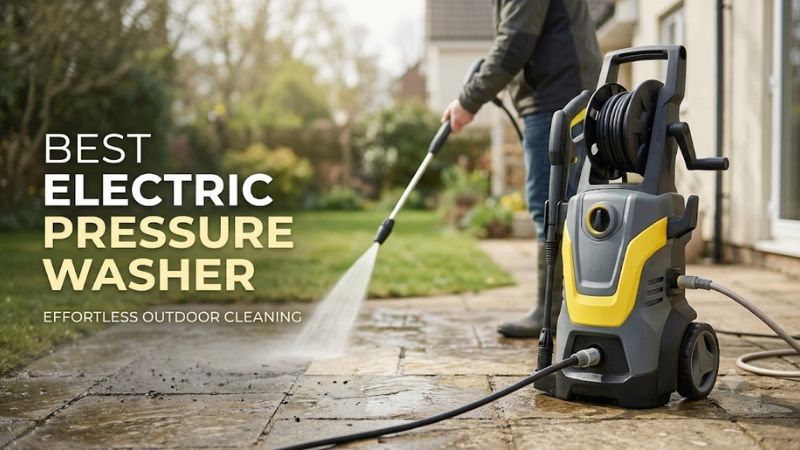
Choosing the best electric pressure washer involves more than finding the machine with the highest advertised PSI. Water flow, nozzle design, cleaning performance, hose quality, and storage requirements all affect everyday use. This guide compares seven electric pressure washers for washing vehicles, refreshing patios, cleaning outdoor furniture, and maintaining residential surfaces.
Quick Verdict: Which Electric Pressure Washer Is Best?
For homeowners who want one capable machine for a variety of outdoor jobs, the Greenworks GPW3002A is a strong overall choice. Its brushless motor, wheeled frame, generous hose and power-cord lengths, and included nozzle selection make it suitable for regular residential cleaning. Its advertised maximum pressure is 3,000 PSI, but that figure occurs at a lower flow rate than its advertised 2.0 GPM maximum.
The Westinghouse WPX3200e is worth considering for users who want a higher-pressure electric machine for demanding outdoor cleaning. Its specification distinguishes between maximum and rated pressure and flow, which is important when comparing it with other products.
For more moderate household cleaning, the CRAFTSMAN CMEPW2100 offers a practical combination of a 2,100-PSI maximum rating, removable soap tank, multiple nozzles, and integrated accessory storage.
The RYOBI RY1419MT is particularly attractive for portable light-duty cleaning. Its telescoping handle, wheels, and compact vertical storage design make it useful for smaller homes and garages.
The Westinghouse ePX3100v and Kärcher K1700 Cube are alternatives for users prioritizing compact storage, while the Kärcher K1800PS offers a conventional upright design with universal-style accessory compatibility.
The best choice depends on the size and sensitivity of the surface, available storage space, water supply, and how frequently you expect to clean.
Quick Comparison Table
| Model | Advertised pressure | Advertised flow | Best for | Main consideration |
|---|---|---|---|---|
| Greenworks GPW3002A | 3,000 max PSI | 2.0 max GPM | Best overall versatility | Peak ratings occur at different conditions |
| Westinghouse WPX3200e | 3,200 max PSI | 1.76 max GPM | Demanding residential cleaning | Rated figures are lower |
| CRAFTSMAN CMEPW2100 | 2,100 max PSI | 1.2 GPM | Household all-rounder | Moderate water flow |
| RYOBI RY1419MT | 1,900 PSI | 1.2 GPM | Portable light-duty work | Not intended for heavy commercial use |
| Westinghouse ePX3100v | 2,100 max PSI | 1.76 max GPM | Compact storage | Rated 1,800 PSI and 1.2 GPM |
| Kärcher K1700 Cube | 1,700 PSI class | Model-specific | Small garage storage | Limited heavy-cleaning capacity |
| Kärcher K1800PS | 1,800 PSI | 1.2 GPM | Routine home maintenance | Upright storage footprint |
Maximum pressure and maximum flow are not necessarily achieved simultaneously. Confirm rated performance, nozzle conditions, and exact model configuration before purchasing.
How We Evaluated These Electric Pressure Washers
An electric pressure washer is useful only when it can deliver appropriate cleaning performance without damaging the surface being washed.
A machine advertised at 3,000 PSI may appear more capable than one advertised at 2,000 PSI. However, those figures do not reveal how much water each machine delivers at its advertised pressure.
This matters because pressure and flow perform different roles.
Pressure helps loosen dirt from a surface. Flow helps carry loosened material away and rinse the cleaned area.
We considered both measurements, paying particular attention to manufacturers that publish different maximum and rated operating figures.
We also examined motor design, included nozzles, detergent systems, hose length, electrical requirements, accessory storage, portability, and warranty information.
Seven identifiable machines were selected to represent larger residential washers, conventional upright models, and compact designs.
The recommendations are based on manufacturer specifications and practical purchasing considerations. They are not presented as results from an independent laboratory test.
Actual cleaning performance varies according to water supply, nozzle selection, detergent, surface condition, and operator technique.
Best Electric Pressure Washer Reviews
Greenworks GPW3002A — Best Overall Electric Pressure Washer
The Greenworks GPW3002A is a second-generation 3,000-PSI-class electric pressure washer designed for more demanding residential cleaning. It uses a brushless motor and an open-frame chassis with large wheels, making it relevant for homeowners who regularly maintain patios, driveways, walkways, and outdoor equipment.
Best For: Frequent residential cleaning, hardscape maintenance, exterior surfaces, and homeowners seeking a capable electric alternative to a gas-powered washer.
Key Specifications
| Feature | Specification |
|---|---|
| Model | GPW3002A |
| Motor | 14-amp brushless |
| Maximum pressure | 3,000 PSI |
| Flow at 3,000 PSI | 1.1 GPM |
| Maximum advertised flow | 2.0 GPM at 100 PSI |
| High-pressure hose | 25 feet |
| Power cord | 35 feet |
| Included nozzles | 15°, 25°, 40°, soap, turbo |
| Wheels | 10-inch never-flat |
Why We Picked It
The Greenworks offers a useful combination of higher advertised operating pressure, multiple nozzle choices, and convenient mobility.
Its published performance details also help explain the relationship between pressure and flow. The machine can deliver a maximum 3,000 PSI at 1.1 GPM, while its maximum 2.0 GPM occurs at 100 PSI.
These are different operating points and should not be multiplied together as though they were simultaneous.
That distinction makes the specification more informative than an advertisement listing maximum values without their test conditions.
Features and Benefits
The brushless motor provides electronic control and eliminates conventional motor-brush maintenance.
A 25-foot kink-resistant high-pressure hose provides reasonable working reach around vehicles and outdoor structures.
The 35-foot power cord can help reduce how often the machine must be repositioned, although it does not eliminate the need for a suitable outdoor electrical outlet.
The five included nozzles offer flexibility across different cleaning tasks.
A wider spray pattern is generally a more conservative starting point for delicate surfaces, while narrower patterns concentrate force and require greater care.
Performance and Practical Use
For concrete and other appropriate hard surfaces, the Greenworks can help remove embedded outdoor dirt when paired with a suitable nozzle.
However, high pressure can damage mortar, older concrete, painted surfaces, and loose aggregate.
The turbo nozzle is not appropriate for every surface.
For vehicles, a wide fan spray, suitable distance, and automotive-approved detergent are preferable to aggressive close-range cleaning.
The washer’s large wheels improve movement around a driveway, but its open-frame design requires more storage room than a small cube-style model.
What Makes It Different
Its combination of brushless operation, strong residential specifications, and clearly disclosed pressure-flow conditions distinguishes it from many basic machines.
Pros
-
Capable residential pressure range.
-
Brushless motor.
-
Five included nozzles.
-
Long power cord and practical hose reach.
Cons
-
More expensive than light-duty models.
-
Larger storage footprint.
-
Peak pressure and maximum flow do not occur simultaneously.
Buy If: You regularly clean outdoor hardscapes and want a more capable electric machine.
Skip If: You primarily wash bicycles, patio furniture, or delicate painted surfaces and want a smaller unit.
Westinghouse WPX3200e — Best for Demanding Residential Cleaning
The Westinghouse WPX3200e is a corded electric pressure washer designed for cleaning substantial outdoor dirt and grime. It advertises a 3,200-PSI maximum pressure and a 1.76-GPM maximum flow, while its owner’s manual provides separate rated figures.
Best For: Driveways, garage floors, outdoor concrete, and larger residential cleaning jobs.
Key Specifications
| Feature | Specification |
|---|---|
| Maximum pressure | 3,200 PSI |
| Rated pressure | 2,700 PSI |
| Maximum flow | 1.76 GPM |
| Rated flow | 1.1 GPM |
| Electrical supply | 120V AC, 60Hz |
| Rated current | 14 amps |
| Water temperature | Cold water only |
Why We Picked It
The WPX3200e provides a relatively high rated pressure for a household electric model.
Its manual distinguishes rated operation from maximum figures. That matters because buyers can otherwise mistake short-duration or particular-test-condition values for continuous cleaning performance.
The washer is intended for more demanding outdoor tasks where a basic light-duty machine may be inconvenient.
Features and Benefits
The 120V electrical configuration is designed for an appropriate household power supply.
Its high-pressure system can help remove resistant dirt from suitable surfaces.
However, the machine requires the correct water supply, hose connections, and nozzle selection.
The owner’s manual warns against operating the pump without an adequate water supply.
This is particularly important because insufficient water can cause overheating and pump damage.
Performance and Practical Use
For garage floors, concrete walkways, and other suitable surfaces, higher rated pressure may help loosen difficult deposits.
However, cleaning oil and grease often requires an appropriate degreasing agent and adequate dwell time.
Pressure alone is not always enough.
The operator should test an inconspicuous area before applying concentrated spray to older concrete, painted surfaces, masonry joints, or wood.
For vehicle washing, the washer’s capacity is more than sufficient, but the pressure must be moderated through nozzle selection, distance, and technique.
What Makes It Different
Its clearly documented rated pressure and flow figures help buyers make a more informed comparison with other high-output electric washers.
Pros
-
High rated pressure.
-
Manufacturer documents both rated and maximum figures.
-
Suitable for demanding residential applications.
Cons
-
Greater risk of surface damage when used carelessly.
-
Not necessary for routine light-duty cleaning.
Buy If: You regularly maintain substantial outdoor hardscapes.
Skip If: You mainly wash cars and furniture in a small residential space.
CRAFTSMAN CMEPW2100 — Best All-Around Household Washer
The CRAFTSMAN CMEPW2100 is a corded electric cold-water pressure washer positioned for everyday home maintenance. It provides a maximum advertised 2,100 PSI and 1.2 GPM, with an integrated detergent tank, multiple included nozzles, and convenient accessory storage.
Best For: Cars, patios, sidewalks, outdoor furniture, and general residential cleaning.
Key Specifications
| Feature | Specification |
|---|---|
| Model | CMEPW2100 |
| Maximum advertised pressure | 2,100 PSI |
| Advertised flow | 1.2 GPM |
| High-pressure hose | 25 feet |
| Power cord | 35 feet |
| Wheels | 10 inches |
| Soap system | Removable integrated tank |
| Included nozzles | 15°, 25°, 40°, soap, turbo |
Why We Picked It
The CRAFTSMAN strikes a useful balance between cleaning capability and everyday convenience.
Its moderate output may be sufficient for many common household applications without requiring the size or cost of a higher-pressure machine.
The included nozzle assortment provides flexibility.
The removable detergent tank is useful when applying appropriate pressure-washer cleaning solutions.
Features and Benefits
The 25-foot hose allows the operator to work around a vehicle or outdoor area without moving the washer after every small section.
The 35-foot power cord provides additional placement flexibility.
The large wheels improve movement over driveways and similar surfaces.
Integrated storage for the hose, wand, nozzles, and cord can make it easier to keep a garage organized.
Performance and Practical Use
The washer is suitable for cleaning ordinary outdoor dirt from compatible surfaces.
Its 40-degree nozzle can be a reasonable starting point for more delicate applications, provided sufficient distance is maintained and the surface manufacturer permits pressure washing.
The 15-degree and turbo nozzles concentrate force and should be reserved for appropriate durable surfaces.
When cleaning vehicles, avoid directing concentrated spray at damaged paint, electrical connectors, seals, or vulnerable trim.
What Makes It Different
The complete accessory package and storage-oriented design make it particularly appealing as a household all-rounder.
Pros
-
Useful nozzle selection.
-
Removable detergent tank.
-
Long cord and hose.
-
Integrated accessory storage.
Cons
-
Less output than higher-capacity electric models.
-
Upright configuration occupies more floor space than compact cube units.
Buy If: You want one straightforward electric pressure washer for common outdoor maintenance.
Skip If: You regularly clean large areas of heavily stained concrete.
RYOBI RY1419MT — Best Portable Light-Duty Washer
The RYOBI RY1419MT is a 1,900-PSI, 1.2-GPM electric pressure washer designed for portable residential cleaning. Its telescoping handle, wheels, and vertical storage configuration make it practical for smaller garages and outdoor spaces.
Best For: Patio furniture, vehicles, small decks, boats, campers, and light outdoor cleaning.
Key Specifications
| Feature | Specification |
|---|---|
| Model | RY1419MT |
| Advertised pressure | 1,900 PSI |
| Advertised flow | 1.2 GPM |
| Power source | Corded electric |
| Transport | Wheels and telescoping handle |
| Included nozzles | 15°, turbo, soap |
| Accessory coupling | 1/4-inch quick connect |
| Storage | Compact vertical |
Why We Picked It
The RYOBI offers enough advertised output for many light-duty household jobs while emphasizing portability.
Its telescoping handle and wheels help when moving the machine between a garage, patio, and driveway.
The storage configuration is useful for homeowners who do not have a dedicated equipment area.
Features and Benefits
The quick-connect nozzle interface makes changing compatible spray tips more convenient.
The included turbo nozzle is intended for faster removal of certain resistant deposits, but it should not be used indiscriminately on delicate surfaces.
Onboard storage provides designated locations for the wand, hose, nozzles, and cord.
Performance and Practical Use
The RY1419MT is suitable for many routine cleaning applications.
It can help rinse patio furniture and remove road grime from suitable vehicle surfaces when used carefully.
However, it is not the ideal choice for extensive heavy-duty concrete restoration.
The moderate flow may require additional time when rinsing large surfaces.
A suitable cleaning solution and controlled technique can often improve results more effectively than using an unnecessarily aggressive nozzle.
What Makes It Different
Its lightweight-duty positioning and storage design make it particularly useful in compact homes.
Pros
-
Portable frame with telescoping handle.
-
Compact vertical storage.
-
Quick-connect nozzles.
-
Suitable for common light-duty cleaning.
Cons
-
Limited capacity for demanding large-area work.
-
Turbo nozzle may be inappropriate for delicate surfaces.
Buy If: You want a manageable washer for regular light cleaning.
Skip If: Most of your work involves large concrete driveways with heavy staining.
Westinghouse ePX3100v — Best Compact Handheld-Style Washer
The Westinghouse ePX3100v is a compact electric pressure washer with a built-in carrying handle. It is designed for users who want practical cleaning capability without a large wheeled frame.
Best For: Small garages, apartment storage, patio cleaning, and occasional vehicle washing.
Key Specifications
| Feature | Specification |
|---|---|
| Maximum pressure | 2,100 PSI |
| Rated pressure | 1,800 PSI |
| Maximum flow | 1.76 GPM |
| Rated flow | 1.2 GPM |
| Weight | Approximately 17.6 lbs |
| High-pressure hose | 20 feet |
| Included nozzles | 15°, 25°, turbo |
| Soap system | Detachable foam cannon |
Why We Picked It
The ePX3100v provides a compact alternative to conventional wheeled pressure washers.
Its manufacturer documents both rated and maximum performance figures, helping users avoid overestimating its sustained cleaning capability.
The detachable foam cannon is useful for applying appropriate cleaning solution.
Features and Benefits
The built-in carrying handle supports movement between storage and the work area.
The 20-foot hose provides reasonable reach for smaller projects.
A total-stop system shuts down the pump motor when the trigger is released under normal conditions.
This can reduce unnecessary operation and help manage heat, although it is not a substitute for turning off the machine before storage or maintenance.
Performance and Practical Use
The ePX3100v is a practical choice for cars, small patios, and outdoor household equipment.
It can be carried into locations where a larger wheeled model would be inconvenient.
However, the user still needs a suitable water connection and electrical outlet.
The shorter hose may require repositioning during larger cleaning jobs.
What Makes It Different
The combination of compact carrying design, documented rated output, and foam-cannon compatibility makes it useful for users with limited storage.
Pros
-
Compact housing.
-
Carrying handle.
-
Rated and maximum figures disclosed.
-
Included foam cannon.
Cons
-
Shorter hose than some larger models.
-
Less convenient for extensive large-area work.
Buy If: Storage space and portability matter more than maximum cleaning capacity.
Skip If: You regularly wash large driveways or want a high-output wheeled machine.
Kärcher K1700 Cube — Best for Small Storage Spaces
The Kärcher K1700 Cube is a compact electric pressure washer designed around a portable, toolbox-like form factor. Its smaller body makes it attractive to buyers who need an uncomplicated machine for occasional household cleaning.
Best For: Small garages, limited storage, patio furniture, and compact outdoor cleaning areas.
Key Specifications
| Feature | Specification |
|---|---|
| Pressure class | 1,700 PSI |
| Power source | Corded electric |
| Form factor | Compact cube |
| Transport | Integrated carrying handle |
| Intended use | Light residential cleaning |
| Accessory type | Model-compatible pressure-washer attachments |
Why We Picked It
Storage dimensions are a significant purchasing concern for many homeowners.
A compact washer may be more convenient than a larger upright machine when it must fit on a garage shelf or in a small utility area.
The K1700 Cube emphasizes portability and straightforward residential cleaning.
Features and Benefits
The carrying handle makes it convenient to move the machine between storage and use.
Its simplified housing minimizes the amount of floor space required.
The washer is intended for ordinary residential applications rather than heavy commercial cleaning.
Performance and Practical Use
The K1700 Cube is appropriate for routine dirt removal from compatible outdoor furniture, small patios, and similar surfaces.
However, buyers should verify the exact supplied nozzle assortment, hose length, and accessory connections for the current US-market package.
These details may differ among model generations or listings.
Do not assume its cleaning performance matches larger Kärcher machines solely because they share the same brand.
What Makes It Different
Its compact shape and ease of storage are the main reasons to consider it.
Pros
-
Compact storage footprint.
-
Convenient carrying handle.
-
Appropriate for routine residential cleaning.
Cons
-
Limited high-demand cleaning capacity.
-
Exact package specifications require model confirmation.
Buy If: You want a small washer that can be stored easily.
Skip If: You prioritize the highest available electric cleaning output.
Kärcher K1800PS — Best for Routine Home Maintenance
The Kärcher K1800PS is an upright electric pressure washer rated at 1,800 PSI and 1.2 GPM. It is intended for general home exterior cleaning and offers a removable detergent tank, standard-style accessory connections, and a practical wheeled configuration.
Best For: Sidewalks, patio furniture, routine exterior cleaning, and homeowners wanting a conventional upright washer.
Key Specifications
| Feature | Specification |
|---|---|
| Model | K1800PS |
| Advertised pressure | 1,800 PSI |
| Flow | 1.2 GPM |
| Voltage | 120V |
| Detergent tank | 40 ounces |
| Weight without accessories | Approximately 20.7 lbs |
| Dimensions | 17.5 × 16.5 × 33.1 inches |
| Water temperature limit | 104°F |
Why We Picked It
The K1800PS provides a manageable pressure-and-flow combination for routine residential work.
Its standard-style accessory compatibility may be attractive to buyers who want flexibility when replacing hoses or nozzles.
The removable detergent tank simplifies filling and cleaning.
Features and Benefits
The upright chassis allows the washer to be moved between work areas.
Its large wheels support practical outdoor mobility.
The water filter helps reduce the entry of certain debris into the pump.
Its detachable detergent tank provides a dedicated system for suitable cleaning solutions.
Performance and Practical Use
The K1800PS is suitable for many ordinary household cleaning tasks when paired with the correct nozzle and technique.
However, a 1.2-GPM flow rate can make large-area rinsing slower than with higher-flow equipment.
Pressure washing should not be used on every surface.
Old painted materials, loose mortar, fragile wood, and weathered siding may be damaged by concentrated spray.
What Makes It Different
The K1800PS focuses on consistent residential usability rather than maximum advertised output.
Pros
-
Practical household pressure range.
-
Removable detergent tank.
-
Universal-style accessory compatibility.
-
Maneuverable upright design.
Cons
-
Moderate flow for large areas.
-
Less compact than cube-style washers.
Buy If: You want a straightforward machine for periodic outdoor maintenance.
Skip If: You frequently clean extensive heavy-duty concrete surfaces.
How to Choose the Best Electric Pressure Washer
Understand the Difference Between PSI and GPM
PSI measures pressure in pounds per square inch.
GPM measures water flow in gallons per minute.
Pressure contributes to the force applied by the water jet, while flow helps rinse away loosened dirt.
Both affect cleaning performance.
A machine with high PSI but limited water flow may remove stubborn deposits from small areas yet take longer to rinse a large surface.
A higher-flow machine may rinse more efficiently, even when its advertised maximum pressure is lower.
Evaluate both specifications.
Why Maximum Ratings Can Be Misleading
Some manufacturers advertise maximum PSI and maximum GPM separately.
These values may occur at different nozzle settings or operating conditions.
For example, a machine may deliver its highest pressure at a relatively low flow rate.
Its maximum flow may occur at much lower pressure.
Multiplying the two maximum figures together can therefore create a misleading impression of available cleaning performance.
Look for rated operating figures and published test conditions.
Choose the Right Pressure for the Surface
Different materials tolerate different cleaning forces.
Durable concrete may withstand more aggressive cleaning than automotive paint, softwood, or aged siding.
However, no single PSI setting is universally safe for every surface in a category.
Distance, nozzle angle, exposure time, and material condition all matter.
Begin with a less aggressive nozzle and greater distance, then adjust cautiously according to the surface manufacturer’s instructions.
Understand Fan Nozzle Angles
A 40-degree nozzle produces a wider fan than a 15-degree nozzle.
The wider pattern spreads force over a larger area and is often a more conservative starting point.
A narrower nozzle concentrates cleaning force.
This can improve removal of certain stubborn deposits but also increases the risk of surface damage.
A zero-degree jet should not be used casually for household cleaning.
Never direct the spray at people, pets, or electrical equipment.
Know When to Use a Turbo Nozzle
A turbo nozzle typically produces a rapidly rotating concentrated jet.
It can improve cleaning of certain resistant deposits on appropriate hard surfaces.
However, it can damage painted finishes, softwood, siding, and other vulnerable materials.
Use it only when the washer and surface manufacturers approve the application.
Test carefully and maintain the recommended distance.
Evaluate Hose Length
A longer high-pressure hose allows the operator to move around a vehicle or patio without continually repositioning the washer.
However, hose quality also matters.
Kinks, damaged fittings, and incompatible extensions can reduce convenience or create safety hazards.
Use only hoses rated for the machine’s maximum pressure and approved connection system.
Never use a damaged high-pressure hose.
Consider Power-Cord Length
A longer electrical cord may help position the washer near a suitable outlet.
However, many pressure-washer manufacturers prohibit or restrict extension-cord use.
Follow the specific owner’s manual.
Use a properly grounded and GFCI-protected electrical supply as required.
Keep electrical connections away from standing water.
Evaluate Water-Supply Requirements
Electric pressure washers require adequate inlet water flow.
A machine cannot maintain proper operation if the supply is insufficient.
Low flow can cause cavitation, overheating, or pump damage.
Check the manufacturer’s inlet-pressure and flow requirements.
Inspect the garden hose for restrictions and ensure connections are secure.
Never allow the pump to run dry.
Choose the Right Detergent System
Some pressure washers include an integrated detergent tank.
Others use a removable foam cannon or downstream chemical injector.
These systems apply suitable cleaning solutions at the appropriate operating settings.
Use only detergents approved for pressure washers and the surface being cleaned.
Avoid household chemicals such as chlorine bleach unless the machine and detergent system specifically permit them.
Mixing incompatible cleaners can create hazardous reactions.
Understand Total Stop Systems
Many electric pressure washers automatically stop the motor when the spray-gun trigger is released.
This reduces unnecessary motor operation.
However, the system may remain pressurized.
The washer should still be switched off, disconnected according to its instructions, and depressurized before maintenance or storage.
Compare Motor Types
Electric washers may use universal motors or induction-style brushless motors.
Universal motors can offer compact construction and accessible pricing.
Induction motors are often used in more substantial machines and may provide advantages in noise, efficiency, or durability depending on design.
However, motor labels alone do not guarantee performance.
Pump construction, cooling, water flow, and quality of assembly also matter.
Think About Pump Durability
Pressure-washer pumps operate under demanding water-pressure conditions.
Their durability depends on water quality, lubrication design, manufacturing quality, temperature, and operating technique.
Avoid running a washer without sufficient water.
Use an inlet filter where required.
Follow the manufacturer’s winterizing and storage instructions.
Consider Storage Space
Compact cube-style washers are attractive when garage storage is limited.
Upright models may occupy less floor area than wide open-frame designs but require greater vertical clearance.
A larger machine may offer easier hose storage and stronger mobility.
Measure the available storage location before purchasing.
Evaluate Noise
Electric pressure washers generally avoid the combustion-engine noise associated with gas models.
However, they are not silent.
Pump operation, motor design, and spray impact generate noise.
Use appropriate hearing protection when required.
Consider neighbors and local noise restrictions when cleaning near residential properties.
Practical Cleaning Applications
Washing Cars
Use a gentle fan nozzle, suitable distance, and automotive-approved detergent.
Avoid concentrated spray near damaged paint, seals, sensors, and electrical connectors.
Rinse thoroughly and avoid allowing detergent to dry on the vehicle.
Cleaning Concrete Driveways
Concrete can often tolerate more cleaning force than delicate finishes.
However, weak joints, surface coatings, and damaged areas may be vulnerable.
Use appropriate technique and consider a surface-cleaner attachment when the washer supports it.
Cleaning Patios
The appropriate method depends on whether the patio consists of concrete, pavers, stone, or another material.
Loose joint sand and fragile surfaces can be damaged by pressure washing.
Follow the material manufacturer’s guidance.
Cleaning Vinyl Siding
High-pressure spray can force water behind siding or damage vulnerable sections.
Use approved low-pressure methods, suitable detergents, and proper spray direction.
Avoid spraying upward into overlaps.
Cleaning Decking
Wood and composite decking can be damaged by excessive pressure.
Use the cleaning method recommended by the decking manufacturer.
For weathered wood, excessive pressure may raise fibers or cause gouging.
Cleaning Outdoor Furniture
Begin with a gentle spray and test an inconspicuous area.
Painted metal, plastic, wicker, and wood have different tolerances.
Do not use pressure washing on furniture whose manufacturer prohibits it.
Common Mistakes When Buying an Electric Pressure Washer
Selecting Only the Highest PSI
Maximum PSI alone does not describe cleaning performance.
Consider flow rate, rated operating conditions, and intended applications.
Ignoring Water Supply
A restricted garden hose or inadequate faucet flow can reduce performance and damage the pump.
Check the inlet requirements.
Using Aggressive Nozzles on Delicate Surfaces
A turbo or narrow-angle nozzle can cause permanent damage.
Begin conservatively.
Assuming All Detergents Are Safe
Use only approved chemicals.
Never combine incompatible cleaning products.
Storing the Washer With Water Inside During Freezing Weather
Water expands when frozen and can damage pumps and fittings.
Follow the manufacturer’s winterization instructions.
Overlooking Electrical Protection
Pressure washers combine electricity and water.
Use the required GFCI protection and inspect electrical components before operation.
Frequently Asked Questions
How much PSI is enough for home cleaning?
Many routine residential jobs can be handled by electric washers in approximately the 1,700–2,300-PSI class, but safe pressure depends on the surface, nozzle, distance, and cleaning method.
Is higher GPM better than higher PSI?
Neither is universally better. Higher pressure can help loosen resistant deposits, while greater flow can improve rinsing and cleaning productivity.
Can an electric pressure washer clean a driveway?
Yes, provided the washer has suitable capability and the surface can tolerate the cleaning method. Large heavily stained areas may take longer with lower-flow machines.
Are electric pressure washers safe for cars?
They can be when used with appropriate nozzles, distances, and automotive-approved techniques. Concentrated spray can damage paint, seals, and trim.
Can I use hot water in an electric pressure washer?
Only if the exact machine permits it. Many residential electric washers are designed for cold water and have specific maximum inlet temperatures.
How long should an electric pressure washer last?
There is no universal lifespan. Durability depends on construction, water quality, maintenance, storage conditions, and operating frequency.
Conclusion
The best electric pressure washer for most demanding residential jobs is the Greenworks GPW3002A, while the Westinghouse WPX3200e offers another high-pressure option. The CRAFTSMAN CMEPW2100 is a versatile household choice, the RYOBI RY1419MT suits portable light cleaning, and compact Westinghouse or Kärcher models work well where storage is limited. Compare rated pressure and flow together, and choose the cleaning method appropriate for each surface.
More from Amazon
Programs that pair well with the guide above. Offers and eligibility are set by Amazon and may change.
Collect the home and kitchen items you want in one registry that guests can shop from.
Create a wedding registrySet up recurring deliveries of everyday items on eligible products. Terms and savings are set by Amazon.
Explore Subscribe & SaveFree shipping on eligible items, Prime Video and more. Eligible new members can start with a free trial.
Start a Prime free trialAudiobooks and podcasts to listen to on the go. Eligible new members can start with a free trial.
Try Audible freeAs an Amazon Associate we earn from qualifying purchases.