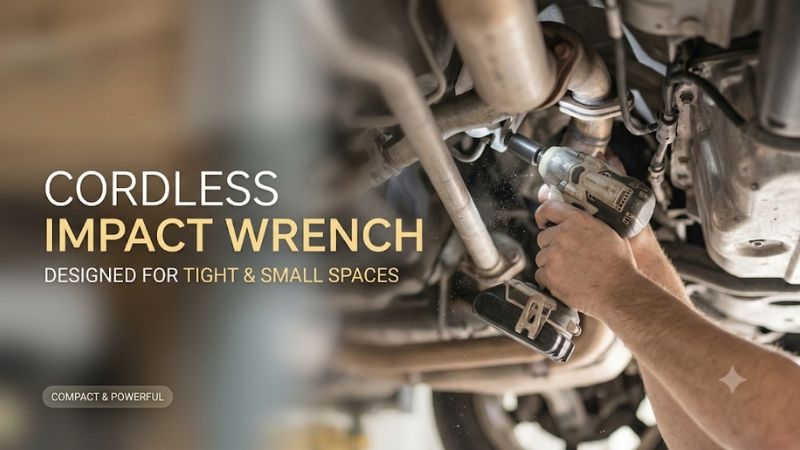
A cordless impact wrench for small spaces should fit comfortably around crowded components while providing enough torque for the intended fasteners. Compact housing dimensions, battery placement, socket length, and working clearance matter more than maximum power alone when repairing vehicles, equipment, or machinery in restricted areas.
Quick Answer: What Makes an Impact Wrench Suitable for Tight Spaces?
The ideal compact impact wrench combines a short front-to-back body, a manageable battery configuration, appropriate torque output, and access to sockets that fit the available working space.
A small housing alone does not guarantee accessibility. The battery may interfere with nearby components, the handle may be difficult to position, or the socket assembly may extend too far beyond the anvil.
For many automotive applications, a compact 3/8-inch or 1/2-inch impact wrench offers a useful compromise between physical size and fastening capability.
The Milwaukee M18 FUEL 2855-20 and Makita XWT14Z illustrate the compact approach, while the DEWALT DCF921 offers another option for users already invested in its battery platform.
These models have different torque capabilities and should not be regarded as interchangeable solely because they are compact.
Understand the Dimensions That Actually Matter
Head Length Determines Front-to-Back Clearance
Head length is one of the most important specifications for working in restricted mechanical spaces. It determines how much room is required between the fastener and the components immediately behind the tool.
A shorter housing can improve accessibility around suspension assemblies, engine compartments, brake hardware, and machinery.
However, manufacturers typically advertise bare-tool length. The actual clearance needed also depends on the socket, socket-retention mechanism, and the angle at which the wrench must approach the fastener.
For example, a 4.9-inch tool paired with a deep socket may require considerably more working room than its housing measurement suggests.
Measure the complete working arrangement whenever possible instead of relying exclusively on the manufacturer’s tool-length figure.
Battery Dimensions Affect Side and Bottom Clearance
A compact impact wrench with a large battery may be difficult to position around closely spaced mechanical components. Battery width and height can interfere with nearby brackets, hoses, structural members, or the work surface.
Smaller batteries can improve maneuverability, particularly when the handle must rotate into an awkward position. However, reduced battery capacity may also affect runtime and, depending on the tool, sustained power delivery.
Check the manufacturer’s battery recommendations before selecting a smaller pack merely to improve accessibility.
A practical configuration balances the required output with the smallest battery arrangement that reliably supports the intended work.
Socket Length Changes the Working Envelope
Socket choice can determine whether a compact wrench is usable in a particular location. Deep impact sockets are necessary for some recessed nuts or protruding studs, but they increase overall assembly length.
Shallow impact sockets may improve clearance when the fastener geometry permits their use.
Extensions and universal joints can improve access in certain situations, although they may change torque transmission, increase tool movement, and reduce control.
Only use impact-rated accessories compatible with the tool and application. Avoid unnecessarily long extensions when precise tool positioning is already difficult.
Choose the Right Compact Impact Wrench Type
Compact 3/8-Inch Impact Wrenches
Compact 3/8-inch impact wrenches are often suitable for smaller automotive fasteners and general mechanical maintenance. Their socket options can be physically smaller than comparable 1/2-inch drive arrangements.
This can make them attractive for work around engine accessories, smaller brackets, and serviceable assemblies.
However, drive size does not establish a tool’s actual output. A powerful 3/8-inch wrench may exceed the capability of a weaker 1/2-inch model, while a compact 3/8-inch tool may still lack sufficient breakaway torque for difficult fasteners.
Choose the tool based on fastener requirements, manufacturer specifications, and available clearance.
Compact 1/2-Inch Impact Wrenches
Compact 1/2-inch impact wrenches provide access to a broad selection of impact sockets commonly used in automotive maintenance.
They are particularly attractive for buyers who want one compact tool for multiple mechanical applications.
The DEWALT DCF921, for example, is rated by its manufacturer for up to 300 ft-lbs fastening torque and 450 ft-lbs breakaway torque.
The Milwaukee 2855-20 is shorter and has a lower advertised torque ceiling. The difference illustrates why the smallest wrench is not necessarily the most versatile.
Right-Angle Impact Wrenches
Right-angle impact wrenches position the drive differently from conventional pistol-grip tools. This configuration can provide access where the available space is narrow or the fastener orientation prevents a conventional wrench from approaching directly.
They may be particularly useful around suspension assemblies, underbody components, or mechanical installations.
However, the tool’s head dimensions, reaction behavior, and output remain important. A right-angle configuration does not guarantee that the wrench can safely reach every recessed fastener.
Evaluate the entire tool geometry rather than assuming a right-angle head automatically solves clearance problems.
Cordless Ratchets as an Alternative
A cordless ratchet can be more convenient than an impact wrench when fasteners are relatively easy to turn and access is severely restricted.
Its elongated form can reach locations where a pistol-grip wrench is cumbersome, especially when removing multiple previously loosened bolts.
However, many cordless ratchets provide substantially less torque than automotive impact wrenches.
A cordless ratchet should not be treated as a direct replacement when high breakaway capability is necessary.
Compact Impact Wrench Features Worth Prioritizing
Adjustable Speed and Torque Control
Multiple speed settings are especially valuable in confined areas because the operator has limited room to react if the socket slips or a fastener suddenly breaks free.
A lower setting can help reduce excessive rotation when engaging smaller fasteners, while higher settings are useful for more demanding removal work.
Electronic controls are not calibrated torque-limiting devices unless the manufacturer specifically documents that capability.
For precise tightening, use the procedure and torque specifications applicable to the fastener.
Automatic Bolt-Removal Modes
Bolt-removal control can improve handling when a loosened fastener begins turning freely. Certain impact wrenches automatically reduce speed after detecting breakaway behavior.
This can help limit the risk of a nut spinning off unexpectedly in a difficult-to-reach location.
However, electronic detection varies by tool and operating conditions. Operators must maintain control and should not depend exclusively on automatic functions to prevent dropped hardware.
Integrated LED Lighting
Mechanical compartments frequently have poor visibility, even in a well-lit garage. An integrated work light can help illuminate the fastener and improve socket alignment.
Lights positioned near the anvil may reduce shadows compared with lights placed farther down the housing.
An external inspection lamp may still be necessary for recessed areas. The integrated LED should be considered a helpful feature rather than a replacement for adequate workspace lighting.
Hog-Ring and Detent-Pin Anvils
Hog-ring anvils can make socket changes quicker, which is useful when alternating among several fastener sizes in restricted locations.
Detent-pin anvils provide a different retention mechanism that may be preferable when more deliberate socket retention is required.
Neither arrangement makes a tool universally safer or more effective.
Check compatibility and follow the manufacturer’s socket installation and removal instructions.
Practical Buying Scenarios
Working Inside a Crowded Engine Compartment
Engine compartments contain hoses, wiring, brackets, covers, and structural components that can interfere with tool placement. A compact impact wrench may help with appropriately sized accessible fasteners, but it is not always the right tool.
A small ratchet or hand tool may provide better control around sensitive components.
Before using an impact wrench, confirm that the fastener permits impact removal, that the socket seats completely, and that nearby components are protected from contact.
Removing Suspension Components
Suspension work often requires both physical access and substantial breakaway capability. A compact tool may fit around a fastener but still lack the torque necessary to loosen corrosion-affected hardware.
In other cases, a larger mid-torque wrench may provide adequate power but require a different access approach.
Evaluate whether the job calls for greater torque, a compact impact wrench, a suitable breaker bar, or approved component removal procedures.
Suspension hardware can be safety-critical. Follow the vehicle manufacturer’s repair and tightening instructions.
Working in a Small Home Garage
A compact impact wrench is valuable in a narrow garage because it is easier to store, transport, and maneuver around equipment.
However, working space around the vehicle often matters more than the tool’s housing length. The operator must have safe access to the fastener and sufficient room to maintain a stable stance.
Consider battery storage, charger placement, tool organization, and adequate lighting alongside tool dimensions.
Common Mistakes When Buying a Compact Impact Wrench
Choosing the Highest Torque Regardless of Size
High advertised torque can be attractive, but it does not help if the tool cannot reach the fastener.
A compact impact wrench with moderate output may be more useful for everyday maintenance than a bulky high-torque model.
Identify your actual fastening applications and available clearance before prioritizing maximum power.
Ignoring Battery Compatibility
A bare compact impact wrench can become an expensive purchase if it requires an entirely new battery platform.
Check the exact battery series, voltage system, charger compatibility, and whether the package includes batteries.
Do not assume that batteries from different manufacturers or incompatible generations are interchangeable.
Using Standard Chrome Sockets
Ordinary hand-tool sockets are not generally intended for impact loading and may fracture when used with an impact wrench.
Select impact-rated sockets and accessories designed for the applicable drive size and operating conditions.
Always inspect sockets for wear or damage before use.
Using Impact Power for Final Tightening
Impact wrenches are not substitutes for calibrated torque wrenches.
Even tools with automatic shutoff modes may not achieve the exact clamping force required by automotive manufacturers.
For safety-critical joints, use the specified tightening method and verify final torque correctly.
Frequently Asked Questions
What is the smallest useful cordless impact wrench?
There is no universal minimum size. The most useful wrench is one that fits the available space, accepts the required socket, and provides appropriate torque. Measure the complete tool-and-socket arrangement rather than relying only on bare-tool length.
Is a compact impact wrench powerful enough for lug nuts?
Some compact impact wrenches can remove properly installed lug nuts under favorable conditions. Others may struggle with corrosion or excessive tightening. Check the tool’s specifications and do not assume successful removal based solely on drive size.
Is a 3/8-inch impact wrench better for tight spaces?
It can be, particularly when smaller sockets improve clearance. However, the actual tool housing and battery dimensions are equally important. A compact 1/2-inch model may fit better than a larger 3/8-inch model.
Can an extension help in a narrow workspace?
An appropriate impact-rated extension may improve access, but it can also increase flex, reduce control, and change delivered impact performance. Choose the shortest suitable accessory and follow the tool manufacturer’s instructions.
Should I buy a compact impact wrench or cordless ratchet?
Choose a compact impact wrench when fastener removal requires impact capability. Choose a cordless ratchet when access, controlled rotation, and repetitive light-duty fastening are more important than high breakaway torque.
Conclusion
A cordless impact wrench for small spaces should be selected according to working clearance, socket configuration, battery dimensions, and realistic torque requirements. Compact models such as the Milwaukee 2855-20, Makita XWT14Z, and DEWALT DCF921 provide different balances of accessibility and power. Measure the available space, choose appropriately rated accessories, and prioritize safe control over maximum advertised torque.
More from Amazon
Programs that pair well with the guide above. Offers and eligibility are set by Amazon and may change.
Collect the home and kitchen items you want in one registry that guests can shop from.
Create a wedding registrySet up recurring deliveries of everyday items on eligible products. Terms and savings are set by Amazon.
Explore Subscribe & SaveFree shipping on eligible items, Prime Video and more. Eligible new members can start with a free trial.
Start a Prime free trialAudiobooks and podcasts to listen to on the go. Eligible new members can start with a free trial.
Try Audible freeAs an Amazon Associate we earn from qualifying purchases.