This cervical neck pillow buying guide explains contour height, sleeping position, memory foam, latex, firmness, neck support, and how to choose a comfortable fit.
Choosing a cervical neck pillow requires understanding how pillow height, contour, firmness, and mattress support affect the position of your head and neck during sleep. A pronounced neck roll may feel supportive to one sleeper but uncomfortable to another. This cervical neck pillow buying guide explains the major pillow designs, how to evaluate fit, which material differences matter, and what evidence does—and does not—support claims about neck pain relief.
What Is a Cervical Neck Pillow?
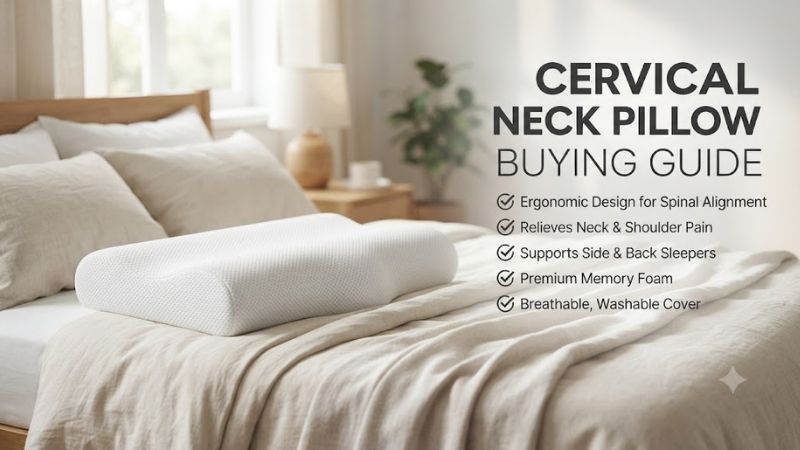
A cervical neck pillow is designed to provide support around the neck and head through its shape, filling, or adjustable construction.
Many products use an elevated neck roll and a lower head-support region.
Others have side-sleeping sections, dual-height contours, or removable foam inserts.
The main goal is comfortable positioning rather than forcing the neck into an exaggerated curve.
Cervical Support Versus Ordinary Pillow Support
An ordinary pillow can support the head and neck without having a specialized orthopedic shape.
A cervical pillow differs because its geometry is designed around particular contact areas.
However, a sculpted contour is not automatically better.
The correct choice depends on whether it fits the sleeper’s anatomy, mattress, and preferred sleeping position.
What Cervical Pillows Cannot Guarantee
A cervical pillow cannot guarantee pain relief, restore normal spinal curvature, or correct a structural condition.
Some people may experience improved comfort, but individual responses vary.
Claims of medical treatment or universal alignment should be evaluated carefully.
The Main Types of Cervical Pillows
| Design | How it supports the neck | Best starting use case | Main limitation |
|---|---|---|---|
| Contour memory foam | Raised neck roll and recessed head area | Back or side sleeping with suitable contour | Fixed shape |
| Dual-height contour | Two different neck-roll profiles | Buyers uncertain between two heights | Limited adjustment range |
| Structured fiberfill | Sewn support zones and compressible filling | Traditional cervical cushioning | Shape changes with compression |
| Adjustable shredded fill | User changes fill amount | Buyers needing customizable loft | Less precise fixed contour |
| Contour latex | Responsive molded support | Sleepers preferring quick rebound | Firmness and cost |
| Butterfly or winged contour | Multiple support areas | Some combination sleepers | Complex shape may not fit everyone |
Start With Sleeping Position, Not Material
The most important buying question is how you normally sleep.
A pillow can contain high-quality materials and still have an unsuitable shape.
Cervical Pillows for Back Sleepers
Back sleepers often need support beneath the neck while allowing the head to rest without excessive elevation.
A pronounced cervical roll may provide this separation.
However, the roll must not push the chin toward the chest or create uncomfortable pressure.
A pillow that is too tall can change the relationship between the head, neck, and upper back.
Cervical Pillows for Side Sleepers
Side sleepers have a different support requirement.
The pillow needs to occupy the space between the head and mattress while accounting for shoulder width.
A side sleeper with broader shoulders may need greater loft than someone with narrower shoulders.
However, the final height depends on how deeply the shoulder sinks into the mattress.
A contoured pillow’s side-sleeping region may be more appropriate than its central head recess.
Cervical Pillows for Stomach Sleepers
Stomach sleeping commonly involves sustained neck rotation.
A high, strongly contoured cervical pillow may increase discomfort.
A very low pillow or a different sleeping arrangement may be more appropriate.
Persistent pain should not be addressed solely through repeated pillow changes.
Cervical Pillows for Combination Sleepers
Combination sleepers may need support for more than one position.
A pillow with a central back-sleeping region and appropriately elevated side sections may provide versatility.
However, strongly sculpted designs can make movement less natural.
An adjustable conventional pillow may sometimes offer a better fit than a specialized contour.
How to Determine the Right Cervical Pillow Height
Pillow height is often called loft.
Manufacturers may list the unloaded height of a neck roll, the central head recess, or the full pillow.
These measurements are not interchangeable.
Unloaded Height Versus Height During Use
A foam pillow measuring four inches high when unloaded may compress beneath the head.
A different material with the same nominal height may retain more thickness.
The amount of compression depends on firmness, material, temperature, and the sleeper’s weight.
This is why choosing solely by stated height can be misleading.
Neck-Roll Height
The neck roll should provide comfortable contact beneath the neck.
It should not force the head into an uncomfortable position.
Head-Recess Depth
A deeper head recess can change how much of the pillow’s height supports the head.
Two pillows with the same outer dimensions may therefore feel substantially different.
Side-Sleeping Height
Some cervical designs have raised side sections.
These must suit the user’s shoulder width and mattress.
A side section that is too high may tilt the head away from the mattress.
A section that is too low may allow the head to fall toward it.
A Practical Fit Evaluation
A pillow cannot be evaluated perfectly through numbers alone, but several observations can help identify an unsuitable configuration.
Back-Sleeping Check
Lie in your normal back-sleeping position.
The pillow should support the head and neck without forcing the chin sharply toward the chest.
There should be no uncomfortable concentrated pressure beneath the neck.
Side-Sleeping Check
Lie on your side in a natural position.
The pillow should fill the space beneath the head without forcing an obvious sideways tilt.
Do not judge fit by shoulder width alone; consider the mattress compression.
Movement Check
Turn between your ordinary sleeping positions.
The pillow should allow comfortable movement.
If the shape consistently forces your head into a position you dislike, it may be unsuitable.
Comfort Over Time
A pillow may feel pleasant for several minutes and become uncomfortable later.
Consider normal overnight use when evaluating an eligible trial period.
Stop using a configuration that causes worsening pain, numbness, or other concerning symptoms.
How Mattress Firmness Changes Cervical Pillow Needs
This relationship is frequently overlooked.
Firm Mattresses
On a firm mattress, the shoulder generally sinks less.
A side sleeper may therefore need a higher pillow than on a softer surface.
Plush Mattresses
A shoulder can sink farther into a plush mattress.
This may reduce the gap the pillow needs to fill.
Mattress Toppers
A thick topper can alter shoulder sink and upper-body position.
If you change the mattress setup, a previously comfortable pillow may feel different.
Adjustable Beds
Raising the head section changes body orientation.
A cervical pillow that feels suitable on a flat mattress may behave differently when the bed is inclined.
Follow any medical positioning instructions and evaluate comfort in the actual sleeping arrangement.
Memory Foam Cervical Pillows
Memory foam is common in contoured orthopedic pillows.
It conforms under pressure and responds relatively slowly compared with some other materials.
Why Molded Foam Is Popular
Molded foam maintains a recognizable contour.
The raised neck roll and recessed head region remain positioned rather than shifting like loose filling.
This can be useful when a buyer knows the correct support height.
Limitations of Fixed Construction
The main disadvantage is adjustability.
If the neck roll is too tall, the user cannot simply remove foam unless the exact model includes an approved height-adjustment mechanism.
Temperature Behavior
Memory foam characteristics can change with temperature.
Some dense foam constructions may also feel warmer than more open alternatives.
Ventilation holes and fabric covers can influence comfort, but no foam shape guarantees cooling.
Who Should Consider Memory Foam?
Buyers who prefer contouring and consistent shape retention may appreciate molded memory foam.
Those uncertain about loft should compare adjustable models or products offering several sizes.
Latex Cervical Pillows
Latex typically rebounds relatively quickly after pressure is removed.
This creates a more responsive feel than slow-response memory foam.
Solid Latex Construction
Solid latex can provide consistent support.
Some models use molded contours or ventilation perforations.
Natural and Synthetic Latex
Latex products may use natural rubber latex, synthetic materials, or blends.
The exact composition should be identified.
Latex Allergies
People with known latex allergies should exercise appropriate caution and consider alternatives with medical guidance.
Potential Trade-Offs
Latex pillows can be relatively heavy or expensive.
They may also feel too responsive or firm for people who prefer a slow-sinking pillow.
Structured Fiberfill Cervical Pillows
Structured fiberfill designs use stitching, shaping, and filling distribution to create support zones.
They may provide a more familiar textile sensation than molded foam.
Advantages
Fiberfill can compress and adapt somewhat to the sleeper.
Some people prefer this sensation to solid foam.
Disadvantages
Filling can shift or flatten over time.
The original contour may become less distinct as the material wears.
Best Buyers
Fiber-filled cervical pillows may appeal to people who want a traditional pillow feel with dedicated neck-support areas.
However, they still require correct sizing.
Adjustable Cervical Pillows
Adjustable pillows allow the user to change support height or filling distribution.
Removable Foam Layers
Some products include layers or inserts that can be removed.
This changes the pillow’s height without altering its basic shape dramatically.
Shredded-Fill Adjustment
Other models use removable shredded foam or fiber.
This permits broader customization but may produce less precise support zones.
Why Adjustability Helps
Pillow fit is individual.
A product with adjustment options can reduce the risk of being locked into one unsuitable height.
Limitations
Adjustment requires experimentation.
Removed materials need storage, and the pillow may require occasional redistribution.
An adjustable pillow is not automatically better than a fixed model that already fits correctly.
Firmness: Why More Is Not Always Better
Cervical pillows are frequently marketed as firm, orthopedic, or therapeutic.
These words do not establish the best fit.
Soft Support
A softer pillow may compress easily.
This can be comfortable but may also allow the head to sink more deeply than intended.
Firm Support
A firm pillow retains more of its shape under pressure.
However, excessive firmness can create localized discomfort.
The Role of Pillow Height
Firmness and height interact.
A tall, firm pillow may feel very different from a low, firm pillow.
Avoid Comparing Brand Labels Directly
One manufacturer’s medium-firm rating may not match another’s.
Whenever possible, evaluate documented dimensions, material construction, and appropriate return conditions.
Cervical Pillows and Neck Pain: Understanding the Evidence
Pillows can influence sleeping posture and perceived comfort.
Research has investigated different pillow designs for people experiencing neck symptoms.
However, the evidence does not establish one universal pillow shape or material as the best treatment for all forms of neck pain.
Comfort Improvement Is Not a Cure
A suitable pillow may reduce uncomfortable positioning.
That does not mean it corrects degenerative changes, nerve conditions, or other underlying causes of pain.
Beware of Perfect Alignment Claims
Manufacturers sometimes suggest that a specific contour creates perfect alignment for everyone.
This overlooks differences in anatomy, mattress firmness, and sleeping position.
When to Seek Professional Evaluation
Persistent or worsening neck pain should be assessed appropriately.
Symptoms such as radiating arm pain, numbness, weakness, or concerning neurological changes require medical attention.
Sudden severe symptoms, particularly after an injury, warrant prompt evaluation.
How to Choose Between Two Cervical Pillows
When comparing products, use consistent criteria.
| Question | Why it matters | What to look for |
|---|---|---|
| Does the contour suit my sleep position? | Affects support geometry | Correct back and side regions |
| Is the height adjustable? | Reduces fit uncertainty | Dual profiles or removable layers |
| What material is used? | Influences response and feel | Foam, latex, or structured fiberfill |
| Does it compress substantially? | Changes effective loft | Construction and credible descriptions |
| Will it fit my mattress setup? | Mattress sink affects support | Consider firmness and topper |
| Can the cover be cleaned? | Affects hygiene | Clear care instructions |
| Are replacement covers available? | Supports long-term use | Compatible accessories |
| What is the return policy? | Fit is subjective | Clear trial and return terms |
Buyer Scenarios: Which Cervical Pillow Type Makes Sense?
Scenario 1: Back Sleeper With a Firm Mattress
A person who sleeps primarily on the back may consider a contoured pillow with a moderate neck roll and a lower central head area.
The goal is comfortable support rather than maximum elevation.
A fixed model may be suitable if the height is already known.
Scenario 2: Broad-Shouldered Side Sleeper
A side sleeper with broad shoulders and a relatively firm mattress may need a higher side-support region.
However, the appropriate height must be evaluated in the normal sleeping position.
A dual-height or adjustable design can be useful when the fit is uncertain.
Scenario 3: Combination Sleeper
Someone who alternates between back and side sleeping may benefit from a pillow with clearly differentiated zones.
If the sculpted shape restricts natural movement, an adjustable traditional pillow may be preferable.
Scenario 4: First-Time Cervical Pillow Buyer
A first-time shopper may not know whether a strong neck roll will feel comfortable.
A gentler contour, dual-height option, or suitable return policy can reduce purchasing risk.
Scenario 5: Sleeper Who Dislikes Memory Foam
A latex or structured fiber-filled cervical pillow may be more appropriate than another molded memory-foam design.
Cooling gel does not change the underlying feel of memory foam enough to make it suitable for everyone.
How Much Should You Spend on a Cervical Neck Pillow?
A higher price can reflect premium materials, more complex molding, multiple size options, or brand positioning.
It does not guarantee better support.
Budget Models
Budget pillows may offer basic molded foam or fiber-filled contours.
The important questions are height, material disclosure, and construction quality.
Midrange Models
Midrange pillows may include removable covers, dual-height support, or adjustable layers.
These features can be useful when selecting the correct fit is difficult.
Premium Models
Premium cervical pillows may use proprietary foam or specialized construction.
Their value depends on whether those features provide a comfortable, appropriate fit for the buyer.
Why Return Policy Matters
A pillow can have excellent published specifications but still be uncomfortable.
Look for return conditions that permit a realistic evaluation.
Avoid assuming that a premium product must be kept simply because of its price.
Cleaning and Maintaining a Cervical Pillow
Read the Care Instructions
Foam, latex, and fiber-filled pillows may require different cleaning methods.
Remove the Cover When Permitted
A removable washable cover simplifies routine maintenance.
Do Not Machine-Wash Unapproved Foam Cores
Immersion or machine agitation can damage some foam materials.
Dry Thoroughly
Never use or store a pillow while internal components remain damp.
Inspect the Shape
A molded pillow that becomes cracked or substantially deformed may no longer provide its intended support.
Evaluate Support Over Time
Fiber-filled pillows may flatten, and foam can deteriorate.
Replace the pillow when it no longer fits or supports comfortably.
Common Cervical Pillow Buying Mistakes
Choosing the Highest Neck Roll
A taller roll is not necessarily healthier or more comfortable.
Assuming Firm Means Orthopedic
Firmness alone does not establish appropriate support.
Ignoring Mattress Firmness
Pillow fit changes with shoulder sink.
Selecting Based on One Sleep Position When You Change Positions
A pillow must accommodate your actual sleeping habits.
Trusting Universal Pain-Relief Claims
A pillow is not a guaranteed medical treatment.
Buying Without Checking Dimensions
Exterior size, head recess, and neck-roll height all matter.
Forcing Yourself to Adapt to Pain
Discomfort that persists or worsens should not be ignored.
Frequently Asked Questions
What Is the Best Cervical Pillow for Side Sleepers?
Look for a design with an appropriate side-sleeping height that fills the space between the head and mattress. Shoulder width and mattress softness affect the fit.
Are Cervical Pillows Better Than Regular Pillows?
Not automatically. A well-fitting regular pillow can be comfortable and supportive, while an unsuitable cervical contour may cause discomfort.
Should a Cervical Pillow Be Firm or Soft?
It should provide adequate support without excessive pressure. Appropriate firmness depends on the pillow’s height, construction, and sleeper.
Can Cervical Pillows Help With Neck Pain?
They may improve positional comfort for some people, but they are not proven to treat every cause of neck pain.
How Long Does It Take to Adjust to a Cervical Pillow?
Some sleepers adapt quickly, while others need time to become familiar with a new shape. Do not continue using a pillow that causes persistent or worsening pain.
Is Memory Foam or Latex Better for Cervical Support?
Memory foam provides slower contouring, while latex generally feels more responsive. Both can provide suitable support when the shape and height fit the sleeper.
Conclusion
The best cervical neck pillow is one that supports your normal sleeping position without forcing uncomfortable head or neck movement. Back sleepers may prefer a suitable neck roll with a lower head recess, while side sleepers need enough height to accommodate their shoulders and mattress. Choose molded memory foam for consistent contouring, latex for responsive support, or adjustable construction when fit is uncertain. Prioritize actual comfort, appropriate dimensions, and realistic medical expectations over firmness labels or promises of perfect spinal alignment.