Comparing a magnetic tool holder vs alternatives starts with how you use the tools. A rail makes a few compatible hand tools easy to grab at the bench. Hooks, clips, drawers, and tool rolls handle different shapes and jobs. Use this guide to match your garage storage to access, space, transport, and upkeep.
Quick comparison
Use a magnetic rail for a small group of tools you return individually. Use hooks or clips for a mix of materials, a drawer for protected storage, and a tool roll for a set that travels. The practical differences come from what supports the item and how much room you need to put it away.
| Storage type | Best fit | Main advantage | Measure or verify |
|---|---|---|---|
| Magnetic rail | Flat steel hand tools used frequently | Open access from a narrow strip | Front contact, mount, projection, and rating |
| Pegboard hooks | Mixed tools displayed near a bench | Flexible layout across a larger area | Panel support, hook fit, and removal clearance |
| Slatwall accessories | A mix of tools, cases, and bins | Broader range of storage shapes | Panel and accessory compatibility, rated mounting |
| Fitted clips or cradles | Tools with awkward or nonmagnetic bodies | Support at predictable contact points | Grip size, clip opening, and removal motion |
| Drawer inserts or foam | Precision pieces and dense tool sets | Protection and visible inventory | Interior height, layout, and drawer rating |
| Portable tool roll or case | A set that travels together | Carry, protect, and count the set | Closed size, retention, and carry weight |
| Dedicated socket rail or bit tray | Complete small-component sets | Repeatable order with readable sizes | Drive size, retention type, and drawer height |
Magnetic tool holder vs pegboard
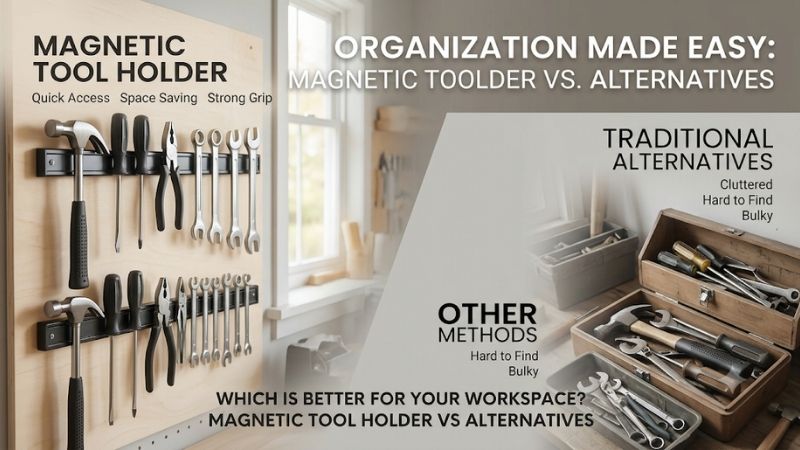
A magnetic bar supports exposed, magnetic contact areas along one narrow row. Pegboard supports tools through hooks and accessories mounted across a perforated panel. The larger area can accommodate more shapes, while a single strip can be easier to position when the most-used tools fit in a short stretch.
When the rail makes retrieval easier
At a compact bench, a rail can hold the drivers and wrenches that come off one at a time. It makes the routine very direct. You lift the chosen tool free and return it to the same spot afterward. If you have only a small gap beside the vise, a magnetic bar can use that wall without crowding the rest of the bench.
The critical check is how the tool sits on the face. A compact wrench with stable contact is a straightforward fit. A large round handle can stand away from the surface or lever the tool outward. Compare the actual tools before assuming one rail can replace every hook.
A magnet-backed bar also depends on rear contact. If every removal tugs it out of position, the easier-to-use solution may be a fixed rail or another support. A holder needs to work through the routine of taking tools down and putting them back, even when the bench is busy.
When hooks make better use of the wall
A pegboard can hold shears through a handle loop, give a tape measure its own hook or accessory, and support a small bin for parts. Tools made of aluminum or plastic can use suitably shaped hooks because the support comes from their shape. Check that clips, hooks, or holders match your board thickness and hole spacing.
Some hooks lift or rotate when a tool comes off, especially if the hook sits loosely. Check retention hardware or compatible locking hooks if your group of tools causes that problem. For any installation, follow the panel and accessory ratings and approved support. The wall and the hardware carry both the resting load and the forces of putting tools away.
If you already own a properly supported board, a few fitted hooks may cost less than installing a new mounting surface for a rail. A small magnetic strip can still complement the panel if the approved mounting supports it.
Magnetic tool holder vs slatwall and fixed clips
Slatwall uses compatible accessories on horizontal channels, while a fitted clip or cradle supports one particular tool shape. Both options can hold items whose bodies offer little magnetic contact. Choose according to how much variety you store, how often it changes, and what the wall or bench can accommodate.
Slatwall for changing mixes of tools and parts
A slatwall panel makes sense in a garage where hand tools share space with small cases, light supplies, and items that need baskets. Each approved accessory can move to another position. That flexibility helps when your interest shifts between bike maintenance, basic carpentry, and vehicle work over the year.
Plan around the depth of shelves and baskets. A slatwall panel may sit close to the wall and still project into a narrow aisle once accessories are installed. Check the complete setup with a vehicle door open or a workpiece on the bench. Observe the mounting and load limits for both the panel and its accessories.
A magnetic strip offers a simpler purchase if you want only a few steel drivers within reach. Slatwall becomes more useful when your storage needs change often and most tools would otherwise need separate holders.
Fixed clips for tools that slide or tilt
A clip supports a handle or tool body at a defined point. This helps where a magnetic rail would contact only a small edge. A dedicated clip can hold a tool in a consistent orientation and keep the handle from drifting into the space of the next tool.
Measure the part of the tool that goes into the clip. A clip that grips a narrow shaft may leave a larger textured handle awkward to remove. Rubber-coated or molded holders vary in shape. Check how the tool goes in and out before setting clips directly below a shelf or next to a cabinet lip.
Clips take more planning when the tool inventory changes. A magnetic rail lets you rearrange suitably shaped steel tools along the same face. Use a clip for an awkward tool you reach for often and a short magnetic row for a group that fits without custom holders.
Magnetic tool holder vs drawers and foam inserts
An open rail puts tools in sight. A drawer and fitted insert protect tools from bumps and allow dense organization on a horizontal surface. Compare the storage around where you work, especially when you need to protect edges or keep a full set together through many different projects.
Drawers for heavy and delicate items
A drawer supported for its intended load gives dense tools a stable resting place. A closed drawer can also shield calipers, small gauges, or cutting tools from some ordinary bench dust and contact. Use protective cases or fitted compartments when the tool’s instructions require them, and keep heavier equipment in appropriate lower storage.
Check the true interior dimensions with the drawer partly and fully open. Tall organizers can foul the cabinet frame. A wrench can fit inside and still catch at the front when you take it out. Use an actual mockup for the highest items and check the drawer’s approved load.
For tools used every few minutes, the need to open a drawer can add steps. An exposed row may work well for a short working group. Keep the bulkier pieces in the drawers and give the rail only the tools that sit securely and help you work faster.
Foam or fitted trays for complete sets
Fitted inserts help you see an empty slot immediately. That is useful if you clean up at the end of each job and must account for multiple pieces. A short rail can reveal missing individual tools too, but a fitted layout lets you give similar tools permanent positions and preserve their size order.
A fitted insert can waste space if you change tool brands or mix sets with very different shapes. Adjustable drawer dividers are easier to reconfigure. Choose according to whether your collection is stable. Some owners get the best result by fitting only their complete sets and leaving an adjustable drawer for tools that change frequently.
The trade-off between a rail and a fitted drawer is clearest with gloves on. Test whether the finger gap in the insert is enough to lift a tool out. Then compare it with the grip needed on a magnetic bar. Pick the layout you can use comfortably during real work.
Magnetic tool holder vs portable storage
A garage setup can use rails as a home base and still need a way to carry tools to the work. A roll, case, or closed tray moves a selected group as a unit. Portability matters most when you take tools across the driveway, to another floor, or between sites.
Tool rolls and cases when the set travels
A roll can keep related hand tools grouped and can be opened close to the work. A suitable closed case gives more protection to fragile or heavy items, according to its design. Measure the closed size and carry weight. Tools must fit securely and any sharp edges need appropriate protection.
A wall rail may be quicker while you work at the same bench. Traveling with exposed tools on magnetic strips introduces movement, impact, and shifting loads. Use systems approved for that environment and use positive retention for tools carried in a moving case or cart.
If your work shifts around the house, you may benefit from a small travel set. Fill it from a drawer or use a dedicated kit. Keep the tools you reach for constantly at the bench on a short rail and avoid buying duplicates until you know which items really need a second home.
Socket rails and bit trays for ordered small tools
Sockets are easier to locate when the holder keeps them in sequence. A dedicated socket rail can accept sockets on clips or positions dimensioned for the drive size. A magnetic base may hold the organizer to steel, while the individual sockets rely on a separate retention design. Verify how both features work.
Round sockets can roll or pivot if attached to an open bar by a small contact patch. A purpose-built holder can give you upright or side-on labels and help you carry a full set. Look at the highest socket and check that it clears the drawer or case lid. Confirm whether the holder retains sockets if turned.
Small bits can be fiddly on a strong flat magnetic face, especially when you need just one size. A labeled tray can be faster. An exposed rail earns the space back when you use it for tools with handles you can wrap your hand around directly.
Choose by workspace, tools, and time
Compare the term “convenient” against what happens during the work. Measure the time and motion to get one tool, put it back, and clear the area at the end. A storage format that works well by a fixed vise can be awkward beside a parked car or cumbersome for a kit carried upstairs.
Small garage with a parked car
Measure the garage with the nearest car door open and the shop set up as usual. A bar along the wall can preserve floor area, but a projecting handle can catch clothing or hit a passing box. A small row on the inward-facing side of a cabinet can avoid that interference when the steel and clearance suit it.
A recessed drawer or narrow wall panel may preserve the aisle better if the work includes bulky or irregular tools. If a drawer opens into the path of the vehicle door, compare which storage you can reach without moving the car. A portable tray can help when the driveway is where you actually perform repairs.
A budget comparison should include mounting as well as asking price. A single screw-mounted bar can fit an approved wall easily. If the only convenient support is a finished steel cabinet, a compatible removable strip may avoid the effort of adding a fixed mounting location.
Mixed-use bench with glue, dust, or metal work
On a bench used for several jobs, reserve exposed storage for everyday tools that tolerate the environment. A magnetic face can attract ferrous filings. Near a grinder, those particles can collect under tools or transfer to their working surfaces. Choose a placement that makes cleaning manageable.
Protect precision tools in suitable cases or drawers, especially when sanding and metal work share an area. For tools you want in sight, check how much dust or spray reaches the row in normal use. A pegboard attracts less ferrous grit at the tool contact because its hooks support mechanically, but exposed items still need ordinary cleaning.
A countertop-height storage choice also needs room for clamps or temporary lighting. Mock up the section with a typical workpiece on the bench. The organizer that leaves the best working movement may be a short fixed strip, a few carefully placed hooks, or a shallow drawer beside the work surface.
Shared garage or work area
A shared space benefits from visible homes for frequently borrowed tools and more controlled storage for sharp or specialized pieces. Visible rows on a bench can help everyone return a common wrench. Drawers or suitable closed storage can keep cutting tools and delicate equipment away from accidental contact.
Check height and access for everyone who uses the space. A rail positioned high enough for one adult may encourage another user to reach over the work. Choose a location with a clear approach. Secure the rack according to its instructions and keep the potential drop path away from people or vulnerable equipment.
For large or awkward tools, mechanical supports give a predictable landing position. A short strip can still make sense for specific shared items if people can return them safely. Clear labels on a drawer or fitted tool roll may do the same job with less exposed storage.
Garage rental with limited mounting permission
In a rental garage, start with the surfaces you already control. A flat steel cabinet can support a compatible magnetic holder without holes. A tool roll or drawer insert can organize an equivalent working set if the available cabinet panels are nonmagnetic or too textured for full rear contact.
Pegboard and slatwall need suitable structural support, and installation can leave holes the tenant may have to repair. A freestanding panel system designed for the intended load may satisfy a larger collection if you have the floor space. A very small collection usually benefits more from an organizer that fits a drawer or existing bench than from adding another structure.
For a short-term setup, consider how you will reverse the installation on moving day. A closed case can move as a unit. Unload an exposed magnetic strip before moving it and inspect the surface beneath it for collected grit. The time spent taking down and transporting the setup belongs in the cost comparison, especially if another move is likely.
Frequently asked questions
Most garages use more than one storage method because tools differ in size, access, and how often they travel. These questions address compatibility, garage layout, and whether a magnetic holder can take over part of an existing storage system without wasting space or making retrieval more awkward.
Which option makes a good first garage purchase?
For a small set of steel tools used at a fixed bench, a single rail is a manageable start if the intended mount is suitable. If you store several materials and shapes, a small pegboard or a few fitted hooks may give you more flexibility. Compare the exact support area available.
If the tools travel between rooms every week, a case or roll may be a better first purchase. The best first step follows where the tools already end up at the end of a job.
Can a magnetic strip make an existing drawer more useful?
A model approved for the mounting surface may help organize specific steel items horizontally. Measure clearance first, including the tool’s height and the travel of the drawer. A loose strip or a tool with weak retention can shift when the drawer closes.
A tray or fitted socket rail can do the same job for small ordered sets. Choose the arrangement that allows repeatable removal without catches or movement of nearby tools.
Do tools on a magnetic bar always stay where you put them?
Retention depends on tool shape, clean contact, and the forces that act on the tool. A long object can turn if its contact point is off center. On a steel cabinet, the bar can also move at the back. Check both surfaces and the recommended orientation.
Use an appropriate fitted holder for tools that need positive retention, particularly if the storage surface moves. A closing drawer or door can change conditions that seemed fine during a static check.
Can a magnetic bar replace a full pegboard?
A single rail can replace the part of a pegboard you use for compact, compatible steel tools. Keep the larger panel if you use multiple types of hooks, shelves, or bins. Draw the full outlines of the tools first so you can see how much usable face a rail would need.
Try a shared arrangement if the pegboard is crowded. Put the frequently grabbed tools on a short rail with suitable support and keep shaped or nonmagnetic items on compatible hooks.
Conclusion
Pick a magnetic rail when fast bench access matters and the tools make stable contact. Use pegboard or slatwall for a changing mix, fitted clips for awkward shapes, drawers for protection, and a roll or case when tools travel together. Match the holder to the task and the space your hand needs during removal.
More from Amazon
Programs that pair well with the guide above. Offers and eligibility are set by Amazon and may change.
Collect the home and kitchen items you want in one registry that guests can shop from.
Create a wedding registrySet up recurring deliveries of everyday items on eligible products. Terms and savings are set by Amazon.
Explore Subscribe & SaveFree shipping on eligible items, Prime Video and more. Eligible new members can start with a free trial.
Start a Prime free trialAudiobooks and podcasts to listen to on the go. Eligible new members can start with a free trial.
Try Audible freeAs an Amazon Associate we earn from qualifying purchases.