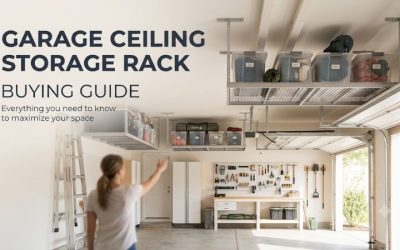
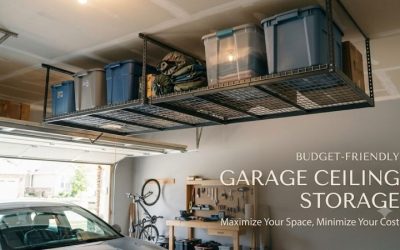
The best garage ceiling storage rack gives your seasonal gear a place without interfering with parking, door travel, or access to the garage. The Fleximounts GR48 Classic is a strong starting point for a full-size bay. A shallow HyLoft or narrow Husky may be easier to live with when clearance is the deciding factor.
The best garage ceiling storage rack for each layout
Start with the largest rectangle that fits the ceiling, then look at the smallest rack that meets your storage needs. The table compares seven models by deck size, which drop settings they offer, and where each design makes the most sense. The figures are published specifications for the models shown.
| Model | Published dimensions | Published height or drop | Published rack capacity | Best fit |
|---|---|---|---|---|
| Fleximounts GR48 Classic, GR48B listing | 4 × 8 ft. | 22–40 in. | 750 lb | Full-size bay for seasonal totes |
| Fleximounts GR36 Classic | 3 × 6 ft. | 22–40 in. | 450 lb | Shorter bay beside door equipment |
| HyLoft 00625 | 45 × 45 in. | 16–28 in. | 250 lb, evenly distributed | Compact location with limited drop |
| Husky ACR3296W-P | 97.5 × 32 in. overall | Adjustable, 43.75 in. listed overall height | 600 lb | Long, narrow ceiling strip |
| Gladiator GearLoft GALS44M2KW | 4 × 4 ft. | 23–37 in. | 500 lb, evenly distributed | Square bay for bins accessed from two sides |
| NewAge VersaRac 2.0 | 4 × 8 ft. | 21–38 in. | 600 lb | Full-size bay where anti-swivel bars are useful |
| NewAge VersaRac Pro | 4 × 8 ft. | 18.23 in. or 27.23–42.23 in. | 800 lb for one rack | Full-size deck with a distinct shallow setting |
How these models were selected
A rack earns its recommendation by solving a particular garage layout. The shortlist accounts for deck shape, published height settings, the exact model’s documentation, and foreseeable loading access. These are specification-based selections. No independent load, sway, or durability tests were conducted for this article.
Think of the capacity column as a product comparison under the manufacturers’ stated conditions. The ceiling carrying the rack has its own requirements. The suitability of its framing, the connection positions, and any existing loads must be established for the proposed installation. A rack rated for 750 pounds can still be a poor choice for a ceiling bay with unsuitable or undocumented support.
Access explains why both large and small racks made the list. A homeowner who can approach two edges can use much more of a 48-inch-deep platform. Someone who must load from a narrow strip beside a vehicle may get more practical use from a 32-inch-deep rack or a compact square. If the bins used most often end up in a rear row, the larger product adds storage you may seldom use.
Select a likely position before comparing the models. Draw the door and opener’s moving envelope, mark fixtures that need service access, and lay out the actual totes at floor level. Choose a preliminary drop based on the height of the bulkiest item and the headroom below. Those steps give you a shortlist based on what the garage can realistically accommodate.

Seven racks for different garage ceiling configurations
The leading choice depends on what limits the installation. A clear eight-foot bay leaves several options. A one-car garage may give you only one workable combination of width and drop. Start with the recommendation that describes your room and compare it with the next smaller size before you buy.
Fleximounts GR48 Classic for full-size seasonal storage
The Fleximounts GR48 Classic offers a 96-by-48-inch deck with a published 22-to-40-inch drop. The referenced black GR48B listing gives it a 750-pound rack rating. The wide deck makes it a practical starting point for owners who have several groups of seasonal gear and a verified, open ceiling bay.
The nominal 32 square feet can accommodate a substantial arrangement of totes. It is especially useful when you can reach the deck from adjacent sides. For example, winter decorations can face the near edge, while camping bedding and empty luggage can face an end. That lets you find individual items without reaching across the entire platform. The same footprint is less useful if one side is all you can safely approach.
Check the full product name. Fleximounts lists similarly named 4-by-8-foot models with different decks, accessories, and published specifications. Match the manual and label to the item you receive. The higher figure a manufacturer may quote for a load test is distinct from the rack’s stated operating capacity and should never be used as an operating limit.
Buy the GR48 when the deck suits a real inventory and its 22-inch minimum drop leaves all required room below. A larger deck is economical only if you can get the items back down. If the platform would sit across a ceiling light, serve only one narrow opening, or push your bins into an inaccessible rear row, the GR36 or Husky may be a better physical fit.
Fleximounts GR36 Classic for a shorter ceiling bay
The GR36 Classic measures 72 by 36 inches. Fleximounts lists a 22-to-40-inch drop and a 450-pound rack rating. The shorter rectangle is useful when the next two feet of ceiling belong to a light, opener assembly, access hatch, or area where you need to keep space above the vehicle clear.
Its 18-square-foot nominal deck is enough to create a useful row of medium totes in many households. Sketch a loading edge along the long side and arrange the containers so the labeled ends face it. If a portable item is shorter than the deck depth but has a wide lid, measure the opening between posts and account for the grip needed to maneuver it. These measurements matter more than a day-one estimate based on gallons per bin.
A shorter rack can help you fit around ceiling equipment, but the same minimum drop as the GR48 means the GR36 solves a horizontal problem first. If the door’s open position only leaves room for a substantially shallower installation, compare the HyLoft’s drop or another documented short configuration. Verify how the rack’s brackets fit the proposed structural members in the chosen orientation.
Buy the GR36 when six feet of usable run is sufficient and you want an organized row that feels approachable. The product makes sense in garages where a full-size rack would spend its last two feet on space you can scarcely reach. It also leaves ceiling area available for lighting or future changes to the garage.
HyLoft 00625 for a shallow drop and a compact footprint
The HyLoft 00625 offers a 45-inch-square deck, a 16-to-28-inch published height adjustment, and a 250-pound evenly distributed rack rating. Its appeal is the combination of a relatively shallow minimum drop and a platform small enough to fit in ceiling pockets that cannot accommodate a long rectangle.
Use this rack for a deliberately small inventory. A few lightweight totes of decorations, travel items, or soft gear may make good use of it. If the containers are tall, test them in the projected loading opening. Fifteen inches of tote height can be difficult to work with inside a nominal 16-inch drop once you account for the deck, a lip, and the motion needed to place a bin. The manufacturer’s dimensional drawing helps establish what the actual usable opening will be.
Its compact footprint also helps preserve the rest of the ceiling for door movement and maintenance. The square still extends 45 inches from an accessible side, so consider where a second row would go. You may prefer arranging the entire inventory around two adjacent edges or giving the deeper section to the things you retrieve least.
Buy this model when saving vertical clearance is important and your planned contents fit comfortably. Identify the exact SKU at checkout. The 00540 is the white 45-inch-square model, and its manufacturer listing specifies a 17-to-28-inch range. When a layout depends on an inch of clearance, confirm the product and mounting dimensions before committing.
Husky ACR3296W-P for a long, narrow ceiling strip
The white Husky ACR3296W-P is listed at 97.5 inches wide and 32 inches deep with adjustable height and a 600-pound rack rating. Look at it when you have nearly eight feet of uninterrupted length and a 48-inch-deep model would project into an important part of the garage.
A single accessible row is the strongest application. Set your actual containers on the floor, with all the handles facing the edge you will use. A narrower deck may keep every tote visible and avoid the temptation to put a second row behind the first. Measure the largest tote in its loading orientation, using the deck and post dimensions as well as the exterior width. Leave enough room to remove each container individually.
The long span means surveying more of the ceiling than you would for a square rack. Check each end for light fixtures, opener obstructions, required access, and tall things that move below. Compare approved attachment positions with the building structure from one end to the other. The published 43.75-inch overall height alone does not establish the actual range of usable installed settings. Review the exact manual when the height is important.
Buy the Husky for its long, shallow profile, particularly if the shorter depth preserves a route beside the vehicle or work zone. A compact garage can still have a suitable long wall-side strip. A garage with several interruptions along that strip will usually benefit from a shorter rack at a verified position.
Gladiator GearLoft GALS44M2KW for a square ceiling bay
The hammered-white Gladiator GALS44M2KW is a four-foot-square platform with a published 23-to-37-inch drop and a 500-pound evenly distributed rating. It comes with integrated decking and uses the brand’s EZ Connect assembly with locking pins. Its footprint is a good match for a single square bay with accessible edges.
A nominal 48-inch side gives the rack a little more room than a 45-inch square, which can be useful for bins with broad lids. Test the intended arrangement before buying. Two 23-inch-wide totes can leave little margin after allowing for posts, fingers, and a clear path out. If you use several smaller totes, arranging some to face the adjacent edge can make more of the deck available.
The most consequential distinction from the HyLoft 00625 is drop. With the GearLoft’s 23-inch minimum, you need room below for a deeper installation. In a taller garage, the range offers options to accommodate taller containers without changing the deck size. In a low bay over a tall vehicle, a rack with a short setting may preserve room the GearLoft would take up.
Buy this model when the true four-foot-square deck and its available height settings serve the items you plan to keep there. Check that all specified assembly and installation parts are present before putting it into service. The rack rating assumes correct assembly, attachment, and loading under its instructions.
NewAge VersaRac 2.0 for a full deck with anti-swivel bars
The NewAge VersaRac 2.0 has a 96-by-48-inch platform, a published 21-to-38-inch adjustment range, and a 600-pound rack rating. It includes anti-swivel bars that the manufacturer describes as reducing lateral movement. Consider it when those features fit a full-size garage layout.
NewAge documents compatibility with standard 16- and 24-inch on-center wood joist spacing and provides options for certain other layouts. Check the applicable diagram rather than assuming the rack can be positioned anywhere across the framing. The wood members still need to be suitable for the proposed loads and connections. Bracket compatibility and structural suitability are different checks.
Look at where the extra bars and supports sit in relation to your loading edge. An ordinary handled tote may come out easily. An extra-long case that must slide in from the end may need a clearer entry. Lay out both the stored positions and the route each large item would take. If the main reason for buying the rack is a single oversized piece of gear, a product designed to store that item can be easier to use.
Buy the VersaRac 2.0 when its adjustability and support design match your layout. Confirm the listing says “2.0.” The original VersaRac and VersaRac Pro have different published configurations. Compare instructions for the exact edition before using a general diagram from another product in the line.
NewAge VersaRac Pro for a full deck with a shallow setting
The four-by-eight-foot VersaRac Pro lists an 800-pound rating for a single rack. Its signature feature is an 18.23-inch shallow configuration plus a separate adjustment range of 27.23 to 42.23 inches. That provides a useful option when you want a large deck with relatively little height taken from the garage.
Think carefully about the gap between settings. A projected installation that needs a drop of about 24 inches may be a poor match even though that number lies between the lowest and highest advertised figures. If you need the shallow option, physically mock up the available opening above the deck. Choose slim totes whose lids and load paths work at that setting. A useful front row of low bins might serve you better than filling the entire platform.
Its higher rack rating matters only in the context of a suitable, verified structural installation. For many households, the planned load of lightweight seasonal bins will make the frame geometry, settings, and safe approach more consequential than a comparison of maximum ratings.
Buy the Pro if you have room for the full deck and one of its specific height configurations solves the clearance problem. Consider the VersaRac 2.0 or GR48 if your target drop falls between the Pro’s alternatives. If a 45-inch-square rack has a suitable setting and holds your existing totes, it may accomplish the job for less overhead space.
Three checks that can change the recommendation
Before ordering, confirm the model that fits your planning sketch also fits the installed garage. Check the lowest projection, the whole movement of the door system, and the route you will use to retrieve a container. A seemingly small difference in one dimension can make another model the better choice.
Check door travel and the lowest installed point
The garage door can occupy a different shape while moving than it does when fully open. Use the door information and observations from a safe position, or ask a qualified technician to confirm the moving envelope. Include opener components, fittings, the necessary room for service, and anything approved to hang below the rack.
For a planning example, a ceiling at 108 inches and a verified 23-inch drop to the lowest part leave 85 inches below the assembly. If a component reaches 87 inches above the floor in the same area, the outlines overlap. Even if they do not overlap, any required additional clearance still has to be honored. A rack alongside the door envelope can be a better fit than one placed directly above it.
Review the model and building as one installation
Get the installation instructions and identify the structural members that would support the rack. Have a qualified professional verify the proposed locations and loads when there is uncertainty, particularly with engineered framing, existing loads, or multiple racks. Unsupported drywall and unknown framing cannot establish a suitable connection.
If you are shopping secondhand, verify the model, condition, parts, and any applicable recall before considering it. Some recalls apply to a specific model or sale period. Use the identification and remedy given in the official notice. Take replacement hardware and any approved changes from the manufacturer’s documentation for the exact unit.
Give every tote a path back to the floor
Lay out the complete planned inventory. Make sure you can get one tote out without moving most of the others. Consider the positions from which the intended users can safely approach the rack, and choose light, manageable items with accessible handles. Use appropriate equipment and follow its instructions during retrieval.
If the only approach requires moving a vehicle, that may still work for seasonal storage. For anything that comes out each weekend, a nearer edge, wall shelf, or lower cabinet can save effort all year. Leave dense cases or awkward objects close to the floor. A full-size rack is most compelling when it gives you usable access as well as more deck.
Conclusion
Choose the Fleximounts GR48 Classic for a full-size seasonal storage bay, the GR36 for a shorter rectangle, or the HyLoft 00625 where a compact deck and shallow drop matter most. Compare the Husky for a long, narrow strip. Buy only after confirming structural suitability, full door travel, and safe access to the stored bins.
More from Amazon
Programs that pair well with the guide above. Offers and eligibility are set by Amazon and may change.
Collect the home and kitchen items you want in one registry that guests can shop from.
Create a wedding registrySet up recurring deliveries of everyday items on eligible products. Terms and savings are set by Amazon.
Explore Subscribe & SaveFree shipping on eligible items, Prime Video and more. Eligible new members can start with a free trial.
Start a Prime free trialAudiobooks and podcasts to listen to on the go. Eligible new members can start with a free trial.
Try Audible freeAs an Amazon Associate we earn from qualifying purchases.