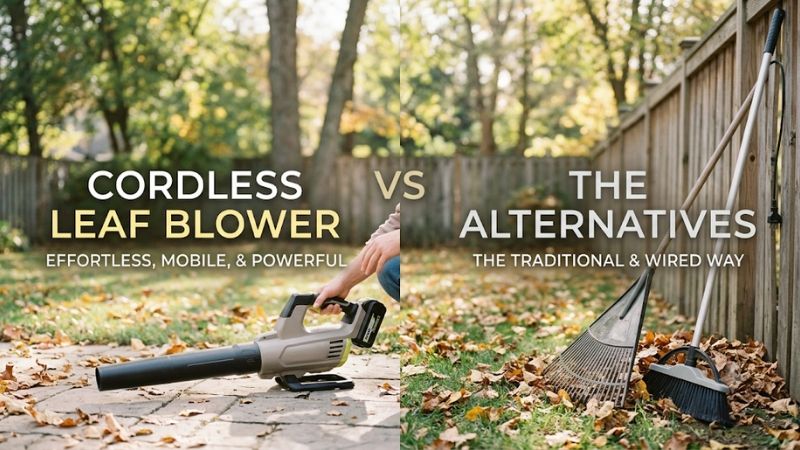
A cordless leaf blower vs alternatives comparison starts with how the debris needs to move. Battery power is convenient for leaves scattered across a drive. A rake can free a wet mat, a broom can collect debris at the door, and a corded blower can keep working near an outlet. Choose for the cleanup from start to finish.
Cordless leaf blower vs alternatives at a glance
Compare the whole task, from the moment you get the tool out to where the leaves finally go. A blower can move material quickly across an open area. A broom, rake, or vacuum can have more value when the last part of the job is collecting it or when air would send it where it should not go.
| Tool | Best task | Main limitation | What to compare |
|---|---|---|---|
| Cordless leaf blower | Frequent, mobile clearing of loose debris | Runtime and battery cost | Effective work time with the intended pack |
| Corded electric blower | Sustained work in an area with a safe cord route | Outlet placement and cord management | Usable reach and extension-cord requirements |
| Gas blower | Repeated longer sessions or heavy work on suitable properties | Fuel, upkeep, noise, and potential restrictions | Workload and local rules |
| Yard rake | Damp leaves, tight beds, and collecting a pile | Time and physical effort over broad areas | Surface, rake type, and disposal |
| Push broom and dustpan | Pavement, small patios, and accurate collection | Slower on turf or scattered debris over a large area | Surface and collection point |
| Leaf vacuum or blower-vac | Collecting suitable leaves with a portable machine | Pickup limitations, bagging, and clogging | Approved material and practical bag handling |
| Mulching mower or mower bagger | Routine leaves across mowable turf | Requires a suitable lawn and conditions | Leaf coverage, turf condition, and mower instructions |
Define the outcome before comparing tools
A clear work area and an empty yard-waste container are very different starting points from a lawn covered in damp leaves. Write down what counts as finished. You may want leaves moved into a bed where appropriate, collected for compost, or bagged and removed. Each outcome changes which tool saves the most time.
For example, using a blower can make the first half of the job fast. If the gathered leaves still have to be loaded into bags, collection may be what controls total time. A rake or appropriate vacuum can streamline that step. On pavement after mowing, the main job may be gathering clippings at one edge, making a cordless blower useful with very little follow-up.
Map the area as well as the endpoint. Locate any outlet, the vehicle, the route to the collection spot, and the edge of neighboring property. A tool can have enough output and still be inconvenient because the path requires it to be unplugged, carried, moved to another battery, or emptied halfway through. Compare those steps with the debris actually on the surface.
Finally, consider which parts of the process apply throughout the year. A large autumn cleanup can justify a different strategy from the one you use weekly. Combining tools often makes that division practical. You can keep the faster option for scattered leaves and use the more precise tool where collection or surface conditions matter.
When cordless is the best fit
A cordless blower makes the strongest case when the work is spread across several areas and you can finish on a battery plan you already have. The tool can go from drive to steps to a side yard without a cord route. Its value is most noticeable when the work is frequent enough that setup time affects whether you do it.
Battery power pays off on a short, repeated route
For a path, garage apron, or normal driveway, a battery blower can be ready as soon as you fit a charged pack and choose an appropriate setting. Move dry clippings toward a defined pickup point and finish the job. That convenience can matter more than peak power when most sessions are brief.
Consider a household that mows on Saturday and clears the driveway afterward. A cordless tool with one suitable pack can cover the pavement, walkway, and patio while you work around a parked car. A corded unit could do the same blowing job, but you need an appropriate outlet and a cord route. A rake or broom may be simpler if the area is very short. Compare the full routine, including putting the equipment away.
Cordless also works when several small tasks are separated by gates or paths. Move from one zone to another and use the trigger only when needed. A focused stream can help at an edge, and a lower steady output can deal with open pavement. Battery operation makes those changes straightforward when you have enough usable runtime.
The value drops if the process repeatedly outlasts your available batteries. Estimate how often you would have to wait for charging or change packs. A second battery can solve the problem, but it needs to be counted in the purchase. For an uninterrupted job next to a safe outlet, a corded model might give you the same useful work time for less.
A shared battery platform can change what it costs
Owning a suitable charged battery and charger can make a bare cordless blower an economical addition. You can gain a tool for brief cleanup without buying a complete new power system. Check the recommended battery and how much energy is left after any other compatible tools you use in the same session.
Someone who already has spare packs after mowing or trimming may be able to add a handheld blower at a low incremental cost. A buyer without compatible packs needs to price the kit realistically. A new battery platform can make sense if it will support other planned equipment. For a household that wants only one blower by the garage door, price the battery and charger along with simpler alternatives.
Even when packs are available, the actual tool weight matters. A large battery can provide more stored energy and often weighs more. For several minutes of pavement work, carrying it may simply be less comfortable. If you already own several sizes, choose a compatible recommended option appropriate to the task you do most often.
Take care with runtime comparisons. A battery blower can handle a broad yard if you have multiple packs and switch at reasonable points. The label’s minimum or maximum voltage does not determine endurance by itself. Compare mode-specific runtimes and your access to a ready spare. That produces a clearer answer than categorizing every cordless tool as suited only to small properties.
How the alternatives compare on specific tasks
Think about the tool you would actually reach for in each part of the cleanup. A rake handles leaves differently from a vacuum, and the corded model solves a different problem from gas. The examples below show where each tool saves effort when matched to a particular surface, debris condition, and finishing method.
Cordless leaf blower vs corded electric blower
A corded blower can keep running as long as power is available and it is operated according to its instructions. It is a strong option for a long driveway or a backyard within practical reach of an outlet. The purchase decision depends on the safe cord route and how often you need to move beyond it.
Map a route from the outlet to the farthest part of the job. The relevant distance is the path the cord can follow without getting pinched, crossing unsafe areas, or interfering with people and vehicles. Use the cord type and gauge specified for outdoor use, the equipment load, and the required length. Follow the blower’s electrical instructions and use the appropriate power protection for the location.
If the job is one broad, contained area, the ability to work without battery swaps can be valuable. A corded blower can also avoid the cost of buying and replacing packs. If the job hops across gates, shared paths, vehicles, or separate garden areas, cord handling can take away the benefit. The most useful difference is whether you will routinely manage the cord without interrupting the work.
Choose corded for stable access to a suitable outlet and extended operation in a defined area. Choose cordless if the route regularly changes or already takes you beyond a practical safe cord length. The two tools can have overlapping clearing ability, so make the decision with the power source and route in view.
Cordless leaf blower vs gas blower
A gas blower can be useful where long sessions or multiple properties make fuel-based operation worthwhile and the equipment is permitted. It also brings fuel handling, exhaust, engine upkeep, and noise. A cordless blower shifts that work to batteries and charging. Compare the full workload and conditions rather than matching voltage against engine size.
For many homeowners, fall cleanup is a few rounds of work that can be broken into zones. A strong cordless blower and a charged spare may cover it without managing fuel. For someone who clears a large area repeatedly and needs to keep working for a long time, evaluate the number of packs and chargers required. Compare that cost and work pattern against gas and any suitable corded option.
Check current rules where you will operate. Some places place restrictions on equipment types, operating hours, or use in certain locations. Gas exhaust is another practical factor, and equipment operation must follow the manufacturer’s instructions. Battery models still produce noise and can move dust, so compare suitable settings, work practices, and any required protection whichever power you choose.
Choose gas when the sustained work, refueling logistics, and permitted use justify it. Choose cordless for brief or segmented residential work if the batteries can keep up. The best comparison is the length and intensity of the real session, including the cost of refueling or recharging and storing each system.
Cordless leaf blower vs rake
A rake is particularly useful for damp leaves, tangled material, and spots where you need precise control. It can loosen material while gathering it into a pile and does not rely on a charged battery. A cordless blower is often faster for scattered dry leaves across open ground once you have a suitable place to move them.
For a patch of leaves pressed into wet turf, use a suitable rake gently and in a manner appropriate to the lawn. A blower may need repeated high-speed passes, and the heaviest material can still stay in place. Loosening it first can reduce battery use. On a broad dry area where leaves easily slide over the surface, the blower can do more of the initial gathering.
Rakes are also useful around delicate planting beds. You can pull one group out of a corner without sending soil or chips across the patio. The manual work can take more time on a large area. Pick a rake style and width that match the surface and consider the effort you can comfortably put into a session.
Choose a rake for dense wet patches and direct collection. Choose a cordless blower for frequent loose material across an open area. Together they cover different stages of the same task. Free the heavy patches first, then move the loose leaves to the collection point with the blower. Finish by picking the pile up with the appropriate hand tools.
Cordless leaf blower vs push broom
A push broom can make short work of a stoop, patio, or contained pavement area where you want precise collection. A compact cordless blower can move loose debris along a longer, open surface quickly. The deciding factor is what happens to the debris and how tightly the cleaned area is bounded by other people or property.
If you need to clear a doorstep or narrow balcony, a broom and dustpan let you collect the material immediately. A blower can send that material into corners, through a railing, or onto an adjacent path if there is no suitable collection area. In an open driveway with scattered dry clippings, the blower can gather them far more conveniently before you use the dustpan for pickup.
Consider the cleaning material. An appropriate method that captures dust is preferable where blowing would send fine or potentially hazardous particles into the air. For ordinary dry leaves, both options can work well. Choose between a short sweeping action and a wider stream based on the location and the way neighbors or pedestrians use it.
Choose the broom where control and direct capture outrank the time it takes to cover a few extra feet. Choose a compact blower where the clear route is longer, you can work in a safe direction, and the material is suitable. Keeping both near the garage can make the transition from gathering to collection faster.
Cordless leaf blower vs leaf vacuum or blower-vac
A leaf vacuum collects approved debris in a bag, while a dedicated blower moves it toward a destination. A combination unit can do both when the manufacturer’s configurations and intake limits match the work. It is especially useful when scattered light leaves still need to be picked up after you gather them.
The important comparison is what the vacuum can reliably take in. Read the manual for the debris it accepts and the conditions in which it may clog. Wet leaves, sticks, stones, and other material can cause trouble or be unsuitable for the model. If your cleanup includes a mix of leaves and large debris, separate the material using an appropriate method first.
Consider the bag as part of working weight. It gets heavier as it fills and has to be emptied. On a short path with a small amount of suitable leaves, this may be simpler than raking them into a separate bag. Across a large yard the time spent emptying can add up. Look at where the bag will be emptied and whether the process is comfortable.
Choose a vacuum or blower-vac when direct collection is the main reason the current routine takes too long. Choose a blower when you mainly need to gather material quickly across a broad area. A blower and a rake can do the same job in two stages for some properties. A compatible collection machine can save steps on others.
Cordless leaf blower vs a mulching mower or bagger
A mower can handle light, suitable leaf coverage on mowable turf according to its instructions. Mulching can reduce the need to transport leaves where lawn conditions allow it, and a bagger can collect suitable material. A cordless blower is more useful around walls, planting beds, walks, and other areas the mower cannot reach.
Evaluate the depth and condition of the leaf layer. If the material is too thick or wet for your mower and lawn conditions, a rake or another suitable method may be required. In a regular maintenance routine, clearing leaves before they settle into a dense layer can make the turf easier to manage. Use the mower according to the type of material and conditions its manufacturer permits.
A combined route can save effort. Use an appropriate mower strategy across the open lawn, then clear stray leaves off pavement and away from the garage. If you want to collect leaves instead of mulch them, compare bag capacity, the time needed to empty the bag, and the conditions the mower can handle. A blower still has a place where directing a few loose leaves is faster than turning the mower around.
Choose the mower method if the bulk of the job is regular light leaf cover on suitable turf. Choose a blower if the hard parts are along the driveway, under bushes, or beside the house. For mixed properties those tools serve different sections and can reduce the total work together.
Compare the total effort and ownership cost
Price tools that can do the whole job, including power, required accessories, and the collection step. Compare how much time you spend setting them up, moving debris, and restoring the space afterward. The best value changes when a task happens every week or only once in fall and when suitable equipment is already available.
Count the steps from storage to disposal
For each eligible choice, write the steps you take. A cordless setup might require charging, installing a pack, gathering debris, then packing it away. A corded setup adds the power route and putting the cord away. A rake may spend more time gathering, then make it easier to collect the pile from a single patch.
Suppose you spend twelve minutes blowing leaves and fifteen bagging them. A faster blower might save three minutes, while a different collection arrangement could save more of the whole task. If the slow part is moving a dense pile repeatedly, extra airflow or a closer destination might earn the saving. These figures are illustrative. Measure the parts that slow your actual cleanup.
Use the busiest routine for the main purchase. A homeowner who clears a driveway weekly can value a three-minute reduction that repeats across the season. Someone who handles one seasonal clean-up may reasonably use a rake and avoid a new battery platform. The recurring movement reveals which tool will be used after the first outing.
Compare the equipment you already own
If you own a compatible battery and charger, calculate the cost of the blower you would add. If you already have a suitable outdoor extension cord that meets the equipment requirements, include that in the corded comparison. With a mower and a bagger already available, consider the remaining pavement and edges before deciding how much blower you need.
Count consumables and maintenance relevant to each choice. Cordless equipment may require replacement batteries over its ownership life. A gas model brings fuel and engine maintenance. A vacuum requires you to manage its bag and approved operating conditions. A manual option can have a simpler cost profile but take more effort on a broad area.
End with a simple purchase decision. If a powered option changes a recurring, time-consuming part of the job, it can be worth buying. If the only unresolved need is precisely gathering a handful of leaves near a door, a smaller or manual tool may be enough. Focus on what the finished yard or driveway will require from you each time.
Conclusion
Choose cordless for frequent, mobile clearing of loose debris, corded for longer work with a suitable power route, and gas when repeated sustained work and local rules justify it. Use a rake for damp buildup, a broom for precise pickup, or a suitable vacuum when collection is the step you need to improve.
More from Amazon
Programs that pair well with the guide above. Offers and eligibility are set by Amazon and may change.
Collect the home and kitchen items you want in one registry that guests can shop from.
Create a wedding registrySet up recurring deliveries of everyday items on eligible products. Terms and savings are set by Amazon.
Explore Subscribe & SaveFree shipping on eligible items, Prime Video and more. Eligible new members can start with a free trial.
Start a Prime free trialAudiobooks and podcasts to listen to on the go. Eligible new members can start with a free trial.
Try Audible freeAs an Amazon Associate we earn from qualifying purchases.