An electric pressure washer for small spaces should deliver enough cleaning capability for patios, bicycles, outdoor furniture, and vehicles without occupying excessive garage storage. Compact dimensions are useful, but hose management, electrical access, water supply, and safe spray control matter just as much. This buying guide explains how to choose a practical washer for smaller homes.
What Makes an Electric Pressure Washer Suitable for Small Spaces?
A small pressure washer is useful when its body, hose, power cord, and spray gun can be stored and operated conveniently in a limited area.
Compactness is not determined by machine dimensions alone.
A washer with a small housing may still require considerable storage room if its hose and wand cannot be organized efficiently.
A larger upright machine may use less floor space when stored vertically, even though its overall height is greater.
The ideal configuration depends on whether the machine will be stored on a garage shelf, inside a utility closet, beneath a workbench, or in a narrow outdoor storage cabinet.
For light residential cleaning, a machine rated around 1,700–2,100 PSI may provide sufficient performance. However, those values do not establish universal suitability for any specific surface.
The Westinghouse ePX3100v is a useful compact example. Its carrying-handle design, approximately 17.6-pound weight, and 20-foot hose emphasize portability.
The Kärcher K1700 Cube is another storage-oriented option, while the RYOBI RY1419MT uses wheels and a telescoping handle to combine movement with compact vertical storage.
Choosing among these formats requires balancing cleaning capability against storage and working clearance.
Understanding the Space Requirements
Storage Footprint
Storage footprint is the amount of floor or shelf area occupied by the machine.
A cube-style pressure washer may fit beneath a workbench or on a sturdy shelf.
An upright washer may occupy less floor area but require more vertical clearance.
A cart-style machine can be convenient to move but may require a dedicated parking space.
Measure the available storage location before purchasing.
Include space for hoses, nozzles, detergent accessories, and any required pump-protection supplies.
Avoid storing a machine in a location where it may freeze or be exposed to unsuitable environmental conditions.
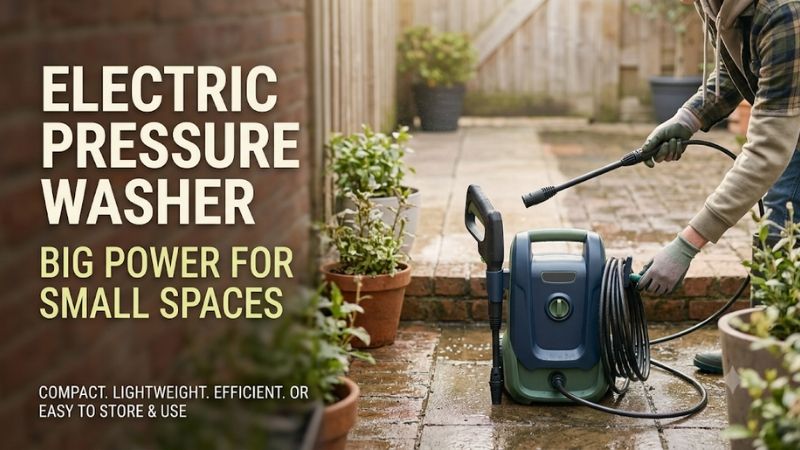
Working Clearance
A pressure washer normally remains stationary while the operator moves with the spray gun.
This means the machine itself does not need to fit into every cleaning location.
A sufficiently long hose can allow the unit to remain safely positioned on a driveway while the operator cleans a nearby patio.
However, the high-pressure hose must not be stretched tightly around sharp corners or dragged against abrasive edges.
A compact machine with a short hose may require more frequent repositioning.
Consider the entire cleaning area before deciding that the smallest housing is the best choice.
Water Supply Access
Most corded electric pressure washers require a suitable garden-hose connection.
The supply must provide enough water to satisfy the machine’s inlet requirements.
A compact washer cannot compensate for an inadequate water source.
If the available faucet is far from the cleaning area, the garden hose may determine the practical setup more than the washer’s dimensions.
Check the manual for inlet-flow, pressure, and hose requirements.
Do not operate the machine dry.
Electrical Outlet Placement
Electric pressure washers require a suitable electrical supply.
Many US-market residential units are designed for 120V household outlets and incorporate GFCI protection.
However, the specific requirements vary.
An outlet near standing water, a damaged cord, or an unsuitable extension can create serious electrical hazards.
Follow the manufacturer’s instructions concerning extension cords.
Do not assume that a small machine can safely use any convenient outlet or power strip.
Drainage and Runoff
Small patios and narrow driveways may have limited drainage.
Pressure washing can displace dirt, detergent, and other contaminants into nearby areas.
Before cleaning, determine where the water will flow.
Avoid directing runoff toward building entrances, electrical equipment, or neighboring properties.
Local rules may restrict discharge into storm drains.
Collect or manage contaminated wash water as required.
Types of Compact Electric Pressure Washers
Cube-Style Models
Cube-style washers use low, compact housings with carrying handles.
They are attractive for users who want to place the machine on a storage shelf or carry it short distances.
The Kärcher K1700 Cube illustrates this design.
Its compact body makes it useful for occasional light residential cleaning.
However, users must verify hose length, nozzle options, and exact package details for the current model.
A compact housing does not necessarily provide large integrated storage compartments.
Some accessories may need to be kept separately.
Handheld-Style Portable Units
Some compact electric washers use a small body with an integrated carrying handle.
The Westinghouse ePX3100v is an example.
It offers 2,100 maximum PSI, 1,800 rated PSI, and a 1.2-GPM rated flow, according to the manufacturer.
Its advertised maximum flow of 1.76 GPM is not necessarily delivered at maximum pressure.
This distinction matters when comparing small units.
A portable body can be convenient for carrying the machine between a garage and a patio.
However, the user still needs a garden hose, power supply, and safe storage for the spray gun.
Vertical Telescoping Models
Vertical washers use an upright configuration to reduce the area occupied during storage.
Some include retractable or telescoping handles.
The RYOBI RY1419MT combines a wheeled frame with a telescoping transport handle.
It is designed for routine residential tasks and compact vertical storage.
This format can be convenient when the washer is moved regularly across a driveway or garage floor.
However, the wheels and handle may increase overall height.
Conventional Wheeled Units
A conventional upright washer may offer more integrated accessory storage than a very small cube.
The CRAFTSMAN CMEPW2100, for example, provides onboard storage for the wand, hose, cord, and nozzles.
Its 25-foot hose and 35-foot cord offer reasonable reach.
However, the chassis requires more space than some portable alternatives.
This design can be preferable when organized storage matters more than minimum housing size.
Portable Battery-Powered Cleaners
Battery-powered portable cleaners are different from conventional corded electric pressure washers.
Some operate at substantially lower pressures and may draw water from a bucket or container, depending on the model.
They can be useful for rinsing bicycles, shoes, and outdoor equipment where electricity or a hose connection is inconvenient.
However, they may lack the output required for demanding patio or concrete cleaning.
Do not assume that a cordless power cleaner and a mains-powered pressure washer offer equivalent performance.
How Much Pressure Do You Need?
Cleaning Outdoor Furniture
Outdoor furniture often has delicate finishes, plastic joints, woven components, or weathered surfaces.
A moderate-pressure washer can help remove loose dirt, but aggressive spray may cause damage.
Begin with a wide fan nozzle and an appropriate distance.
Check the furniture manufacturer’s recommendations.
Hand washing may be preferable for fragile materials.
Washing Bicycles
A pressure washer can dislodge dirt from suitable bicycle components, but concentrated spray can force water into bearings and seals.
Avoid directing high-pressure jets at hubs, bottom brackets, suspension seals, or electrical components.
A gentle hose or low-pressure rinse is generally preferable for sensitive parts.
If using a pressure washer, follow the bicycle manufacturer’s cleaning guidance.
Cleaning Cars
A compact electric washer can be practical for vehicle washing.
The key is controlled cleaning, not maximum PSI.
Use a suitable fan nozzle and keep the spray at an appropriate distance.
Avoid directing concentrated water at damaged paint, sensors, wiring, trim, or seals.
Use automotive-approved detergent and rinse thoroughly.
Cleaning Small Patios
A compact washer can clean small concrete patios and compatible pavers.
However, older concrete, loose joints, and certain decorative finishes may be vulnerable to aggressive spray.
A wider fan nozzle is a sensible starting point.
For large or heavily contaminated surfaces, a higher-flow washer may complete the work more efficiently.
Cleaning Outdoor Walls
Siding, painted walls, and masonry require careful selection of pressure and technique.
Water forced behind siding can damage building materials.
Do not spray upward into overlaps or openings.
Follow the surface manufacturer’s recommendations and use appropriate low-pressure cleaning methods where required.
PSI and GPM in Compact Machines
What PSI Tells You
PSI measures water pressure.
Higher pressure can help loosen resistant deposits, but it can also increase the risk of surface damage.
The advertised maximum figure may not represent continuous operating pressure.
Compare rated performance where available.
Why GPM Matters
GPM measures the volume of water delivered each minute.
Flow helps carry loosened dirt away from a surface.
A low-flow washer may perform adequately on small areas but take longer to rinse large surfaces.
For a compact home, lower flow can be acceptable if cleaning tasks are short and infrequent.
Maximum and Rated Specifications
The Westinghouse ePX3100v provides a useful example of why these specifications should be separated.
Its maximum advertised pressure is 2,100 PSI, while rated pressure is 1,800 PSI.
Its maximum advertised flow is 1.76 GPM, while rated flow is 1.2 GPM.
Buyers should avoid assuming that both maximum figures occur together.
Choosing Enough Cleaning Power
For routine furniture, vehicle, and small-patio cleaning, a moderate-output machine is often sufficient.
The correct pressure depends on the surface and nozzle.
Higher PSI is not automatically better.
Choose the least aggressive cleaning method that accomplishes the task effectively.
Hose Length and Storage
Why Hose Length Matters
A longer hose can reduce the number of times the washer must be repositioned.
This is useful when moving around vehicles or narrow patios.
However, long hoses may be harder to store.
They can also kink if poorly designed or wrapped too tightly.
Hose Material and Flexibility
High-pressure hoses vary in flexibility and abrasion resistance.
A stiff hose may be inconvenient in narrow working areas.
A more flexible compatible hose can improve handling.
However, flexibility does not establish pressure rating.
Use only hoses approved for the washer.
Integrated Hose Storage
Some machines provide hooks, reels, or onboard brackets.
These can help organize a small garage.
However, a reel is not automatically preferable.
Poorly designed reels can make hose management cumbersome.
Evaluate the actual storage arrangement.
Replacement Hose Compatibility
Hose fittings may differ between brands.
A replacement hose must have appropriate pressure ratings and compatible connections.
Avoid makeshift adapters that do not meet the manufacturer’s requirements.
Power-Cord Management
Long Cords
A longer cord can provide useful placement flexibility.
However, it must remain dry and protected from damage.
Do not pull the machine by its cord.
Extension-Cord Restrictions
Many pressure-washer manuals restrict extension cords.
Follow the specific requirements.
Do not connect the machine to an undersized extension, unapproved adapter, or ordinary indoor power strip.
GFCI Protection
GFCI protection is designed to interrupt power under certain electrical fault conditions.
It is especially important when operating equipment around water.
However, it does not eliminate all electrical risks.
Inspect the cord and plug before every use.
Keeping Connections Dry
Keep electrical connections away from standing water.
Do not operate damaged equipment.
Disconnect power according to the manufacturer’s instructions before maintenance.
Nozzle Selection for Small Areas
Wide Fan Nozzles
A wide fan nozzle distributes water over a larger area.
It is often a more conservative starting point for household cleaning.
However, safe use still depends on distance and surface condition.
Narrow Nozzles
A narrow nozzle concentrates cleaning force.
It may be useful for certain resistant deposits on durable materials.
However, it can damage paint, wood, mortar, and other surfaces.
Use only when appropriate.
Turbo Nozzles
Turbo nozzles can increase cleaning aggressiveness.
They may be useful on suitable hard surfaces.
Avoid using them on delicate finishes or surfaces not approved for pressure washing.
Soap Nozzles
A soap nozzle or low-pressure detergent setting is designed for applying compatible cleaners.
Follow the manufacturer’s dilution and application instructions.
Do not use concentrated spray to compensate for inadequate detergent dwell time.
Detergent Systems and Compact Storage
Integrated Soap Tanks
An integrated tank can reduce the number of separate accessories required.
However, it also needs cleaning after use.
Follow the manufacturer’s flushing instructions.
Detachable Foam Cannons
A removable foam cannon can be convenient for automotive washing.
However, foam appearance does not guarantee cleaning effectiveness.
Use appropriate chemistry and follow the vehicle care instructions.
Separate Detergent Bottles
Storing detergent separately may be convenient in a small garage.
Keep chemicals in labeled containers.
Never mix incompatible products.
Chemical Compatibility
Not every cleaner is safe for pressure-washer pumps, hoses, or seals.
Use products specifically approved for the machine and intended surface.
Avoid corrosive or flammable solutions unless expressly permitted.
Noise and Residential Use
Electric Motor Noise
Electric washers typically operate without the combustion noise of gas engines.
However, pump and spray noise remain substantial.
Actual noise varies by model and operating conditions.
Neighbor Considerations
Small homes may be close to neighbors.
Limit cleaning to appropriate hours and follow local noise restrictions.
Vibration and Surface Contact
Place the washer on a stable surface.
Avoid allowing the housing to vibrate against finished walls or furniture.
Indoor Use Restrictions
Pressure washing inside a house or enclosed utility room is generally inappropriate because of electrical hazards, water damage, and runoff.
Use equipment only in suitable environments.
Maintaining a Compact Electric Washer
Inspect the Inlet Filter
Check and clean the water inlet filter according to the manual.
Debris can restrict flow and affect pump operation.
Flush Detergent Residue
After using cleaning chemicals, flush the system as instructed.
Residue can obstruct components or damage seals.
Depressurize Before Storage
Turn off the washer and water supply as instructed.
Release trapped pressure through the approved procedure before disconnecting hoses.
Prevent Freezing
Water left in the pump can freeze and damage internal parts.
Store the washer in a protected location.
Use approved pump-protection procedures where required.
Inspect Hoses and Fittings
Look for cracking, abrasion, leaking, or damaged connections.
Replace defective high-pressure components.
Do not attempt makeshift repairs to pressurized hoses.
Common Mistakes in Small-Space Buying
Choosing the Smallest Body Regardless of Hose Reach
A very compact machine may require frequent repositioning.
Consider the working radius.
Ignoring Storage for Accessories
The wand and hose can occupy more space than expected.
Measure the complete storage arrangement.
Buying Excessive Pressure for Delicate Tasks
High output can create unnecessary risk.
Select according to actual cleaning needs.
Overlooking Drainage
Small patios can accumulate runoff.
Plan water disposal before cleaning.
Using the Wrong Electrical Supply
Follow GFCI and extension-cord requirements.
Do not improvise electrical connections.
Frequently Asked Questions
What size electric pressure washer is best for a small home?
A compact unit in approximately the 1,700–2,100-PSI class can be suitable for many routine tasks, depending on surface compatibility and cleaning method.
Can I store a pressure washer in a closet?
Only when it is clean, dry, depressurized, and stored according to the manufacturer’s instructions. Avoid unsuitable indoor storage, freezing temperatures, and chemical leakage.
Is a cube-style pressure washer powerful enough for cars?
It may be, provided the model offers adequate flow and the operator uses an appropriate gentle cleaning technique.
Do small pressure washers use less water?
Many have relatively modest flow rates, but actual water use depends on operating time and nozzle configuration.
Can I use an electric pressure washer without a garden hose?
Most conventional units require an adequate hose-fed water supply. Some specialized portable cleaners support alternative water sources, but compatibility must be confirmed.
Is a foam cannon necessary?
No. A foam cannon is convenient for some cleaning methods, but suitable detergent and correct technique matter more than foam volume alone.
Conclusion
An electric pressure washer for small spaces should balance compact storage, manageable hose reach, suitable water flow, and controlled cleaning performance. The Westinghouse ePX3100v and Kärcher K1700 Cube suit portable storage needs, while the RYOBI RY1419MT offers a wheeled vertical design. Choose according to the complete working setup, not housing dimensions alone, and prioritize safe electrical connections and gentle cleaning methods for vulnerable surfaces.
More from Amazon
Programs that pair well with the guide above. Offers and eligibility are set by Amazon and may change.
Collect the home and kitchen items you want in one registry that guests can shop from.
Create a wedding registrySet up recurring deliveries of everyday items on eligible products. Terms and savings are set by Amazon.
Explore Subscribe & SaveFree shipping on eligible items, Prime Video and more. Eligible new members can start with a free trial.
Start a Prime free trialAudiobooks and podcasts to listen to on the go. Eligible new members can start with a free trial.
Try Audible freeAs an Amazon Associate we earn from qualifying purchases.