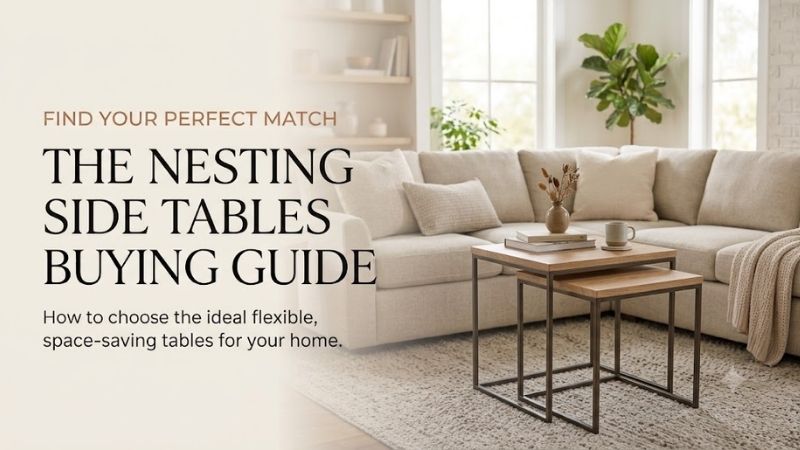
A nesting side tables buying guide should help you determine whether a compact table set truly improves your room. Nesting geometry, individual tabletop heights, materials, and base construction influence how the pieces work together. This guide explains practical measurements, storage configurations, cleaning requirements, and ownership trade-offs before you buy.
What Are Nesting Side Tables?
Nesting side tables are two or more coordinated tables designed so that at least one smaller piece can fit partly or substantially beneath another.
The main purpose is to offer multiple surfaces without requiring all of them to occupy separate floor space permanently.
However, the category includes different designs.
Some nesting tables are tall enough to serve as sofa-side furniture. Others are low and wide, making them more similar to coffee tables. Decorative sets may overlap rather than fitting fully underneath one another.
Therefore, the word nesting does not guarantee one specific storage arrangement.
Compare the Main Nesting Table Types
| Type | Main benefit | Main limitation |
|---|---|---|
| Square nesting tables | Efficient tabletop area | Corners and wider footprint |
| Round nesting tables | Softened edges and compact placement | Less area within the same width |
| Rectangular nesting tables | Works along sofas and walls | Can be long |
| Three-piece nesting sets | Multiple surfaces | More pieces to manage |
| Metal-frame nesting tables | Open appearance | Frame clearance affects nesting |
| Solid-wood or veneer sets | Natural-looking material | Higher cost or finish care |
| Partially overlapping sets | Decorative arrangement | Less compact storage |
| Nesting tables with shelves | Extra organization | More structural bulk |
Step 1: Decide What You Need the Tables to Do
Start with the practical use rather than the desired material or shape.
Everyday Sofa-Side Surface
If one table will stay beside a sofa every day, its height is important.
It should hold the intended objects while remaining within comfortable reach.
The smaller table can provide a temporary extra surface when needed.
Guest Seating
A nesting set can be useful when guests need a place to put a drink or book.
However, the smaller table must be stable and positioned without obstructing the room.
Reading Corner
A table beside a reading chair may support a lamp, book, or cup.
The tabletop should be wide enough for the intended arrangement.
An 11.6-inch round surface may be suitable for one or two small objects but restrictive for a large lamp and several books.
Decorative Display
Nesting tables may also support plants and decorative items.
However, the load rating and moisture resistance must be considered.
Step 2: Measure Every Piece
Nesting-table listings sometimes emphasize the size of the larger table without clearly describing the smaller piece.
That can lead to buying a set whose secondary surface is too short, too narrow, or difficult to reach.
Record the width, depth, and height of every table.
Example: IKEA LACK
The larger unit measures 21.625 inches square and 17.75 inches high.
The smaller unit measures 13.75 inches square and 13.75 inches high.
The four-inch height difference allows the smaller piece to be positioned beneath the larger one.
However, the larger unit’s broad footprint remains even when the set is nested.
Example: Nathan James Lula
The larger table has an 18-inch diameter and stands 22 inches high.
The smaller has an 11.6-inch diameter and stands 18.8 inches high.
This set occupies a smaller primary footprint but offers less tabletop area.
The correct choice depends on the available room and the items the tables will hold.
Step 3: Examine the Nesting Clearance
A nesting set functions only when its structure permits the intended overlap.
Vertical Clearance
The smaller table must fit beneath the larger tabletop without contacting structural rails or other components.
The relevant clearance may be lower than the published height of the larger piece.
Horizontal Clearance
Legs and frames determine how far the smaller table can slide under the larger one.
A decorative base may restrict nesting more than a simple four-leg arrangement.
Partial Overlap
Some premium nesting sets deliberately overlap their tabletops instead of completely concealing one piece.
This can look attractive but may be less suitable for extreme space saving.
IKEA STOCKHOLM is an example of a design where users should not expect full concealment.
Check the Intended Configuration
Do not alter leg positions or remove supporting components simply to make a set nest more tightly.
Follow the supplied assembly design.
Step 4: Compare Tabletop Shape and Area
Shape changes how usable a tabletop feels.
Square
A square provides substantial area within a fixed width and depth.
For example, a 20-inch square provides 400 square inches.
This can accommodate several small household objects.
Round
A 20-inch-diameter circle has approximately 314 square inches of area.
It has no projecting corners but provides less total surface than a square of the same maximum width.
Rectangular
A narrow rectangular table may work along a sofa arm or wall.
For example, a 27.5 × 15.75-inch surface provides approximately 433 square inches.
However, its length may complicate placement in a tight corner.
Irregular Shapes
Leaf-shaped or asymmetrical tables can create attractive arrangements.
However, the usable area and nesting geometry are less predictable.
Step 5: Choose the Right Height
Table height influences comfort and practical use.
Sofa-Side Use
A side table is often convenient when it sits near the height of the sofa arm.
However, there is no universally correct height.
Measure the actual sofa and consider how the occupant reaches toward the surface.
Low Coffee-Table Use
A lower nesting pair may be suitable in front of the sofa.
However, the user may have to reach downward more than with a conventional side table.
Bedside Use
A bedside surface should be accessible from the bed.
Nesting tables can be used in this position, but they may lack drawers or enclosed storage.
Mixed-Height Arrangements
Some sets create a stepped visual effect through different heights.
This can be decorative and functional.
However, the smaller table should still be useful at its own height.
Step 6: Understand Frame and Base Construction
Four-Leg Tables
These can be straightforward to assemble and position.
However, the leg arrangement influences how the smaller table fits underneath.
C-Shaped and Open Frames
An open-sided structure can permit additional overlap.
However, the base may extend beneath nearby furniture, requiring floor clearance.
Pedestal and Drum Designs
These provide a different visual appearance.
However, the solid-looking base can limit the nesting arrangement.
Metal Frames
Metal offers many structural and decorative possibilities.
However, the quality of welds, fasteners, and leveling supports matters.
Do not assume a metal frame automatically supports more weight than a properly designed wood frame.
Step 7: Compare Materials
Engineered Wood
Particleboard, MDF, and fiberboard are common in budget nesting tables.
They can provide affordable surfaces but differ in moisture resistance and repairability.
Honeycomb Construction
Certain lightweight tables use a honeycomb paper structure inside engineered panels.
IKEA LACK is an example.
This reduces furniture weight but does not make the top equivalent to solid hardwood.
Wood Veneer
Veneer is a thin wood surface over a supporting core.
It can provide natural grain and warm appearance.
However, it may have different refinishing and damage-repair limitations from solid wood.
Solid Wood
Solid wood can be attractive and repairable depending on the species and finish.
However, it can respond to humidity and may increase weight or price.
Glass
Glass offers visual openness but requires appropriate handling and cleaning.
Tempered glass is not unbreakable.
Metal
Metal tables vary by coating, material thickness, connections, and design.
Protect finishes from unsuitable cleaners.
Step 8: Evaluate Load Ratings and Stability
Each table should support only its intended loads.
A larger tabletop may have a different maximum load from the smaller one.
Why Separate Ratings Matter
A nesting set may be advertised with a general maximum load.
However, the buyer must determine whether the number applies to each piece, the primary table, or the overall configuration.
For example, IKEA VITTSJÖ publishes a 22-pound maximum tabletop load, while IKEA SONHULT lists a 44-pound maximum.
These numbers should not be transferred between products or interpreted outside the manufacturer’s instructions.
Stability During Use
A small table may be moved frequently.
Its legs and joints should remain tight and level.
Check for excessive wobble after assembly.
Children and Pets
Do not allow children to climb onto nesting tables.
A table is not a step stool, even if its surface is thick.
Keep heavy or fragile objects away from edges where accidental contact could dislodge them.
Step 9: Consider Floor Protection
Nesting tables often move between positions.
That increases contact with flooring.
Check the manufacturer guidance for feet, glides, or approved floor-protection accessories.
Avoid installing slippery pads that make the table unstable.
On uneven floors, adjustable feet can be helpful when provided.
Do not compensate for a damaged or warped frame by placing random objects beneath its legs.
Step 10: Compare Cleaning and Long-Term Ownership
Glass
Shows smudges and fingerprints readily.
Requires suitable cleaning and impact precautions.
Wood Veneer
Needs appropriate protection from water, abrasive treatment, and excessive heat.
Laminate and Melamine
May be straightforward to wipe but remain vulnerable at damaged edges.
Metal Finishes
Powder-coated surfaces require suitable cleaning.
Avoid products that damage the finish.
Hardware Maintenance
Fasteners can loosen over time when tables are moved frequently.
Follow the manufacturer’s inspection and tightening instructions.
Buying Checklist
| Criterion | What to check |
|---|---|
| Number of tables | Two or three usable pieces |
| Primary footprint | Fits everyday position |
| Expanded footprint | Fits when separated |
| Nesting depth | Fully nested or partially overlapping |
| Individual heights | Comfortable for intended use |
| Top area | Holds required objects |
| Frame | Stable, correctly assembled |
| Materials | Maintenance matches household |
| Load rating | Applicable to each surface |
| Floor contact | Appropriate protection |
| Assembly | Instructions and tools |
| Warranty | Relevant coverage and exclusions |
Frequently Asked Questions
Are Nesting Side Tables Worth Buying?
They can be useful when a household needs extra surfaces occasionally but prefers a compact arrangement during normal use. If both pieces remain permanently separated, independent side tables may be equally practical.
Do All Nesting Tables Fit Completely Under One Another?
No. Some fully nest, while others overlap only partly. Confirm the exact design before buying.
Is a Two-Piece Set Enough?
It is sufficient for many households. A three-piece set may be worthwhile when several temporary surfaces are regularly needed.
What Is the Best Material for Nesting Tables?
It depends on budget, cleaning preferences, appearance, and loading. Engineered wood, veneer, solid wood, glass, and metal all have different trade-offs.
Can Nesting Tables Be Used as Nightstands?
They can provide bedside surfaces, but they may lack drawer storage and the exact height required for comfortable access.
Do Nesting Tables Save Space?
They can reduce the floor area occupied by unused tables when nested. The actual saving depends on the stored footprint and how completely the smaller pieces fit beneath the larger ones.
Conclusion
A nesting side tables buying guide should lead to a decision based on real dimensions, useful table heights, reliable nesting clearance, and appropriate construction. Compare each table separately and together, then evaluate materials, load ratings, stability, cleaning, and price. A well-chosen set provides extra surfaces without permanently cluttering the room, but it must work in both its compact and expanded configurations.