Key takeaways
- Nesting side tables are most useful when you need more than one tabletop occasionally but do not want every surface occupying a separate permanent position.
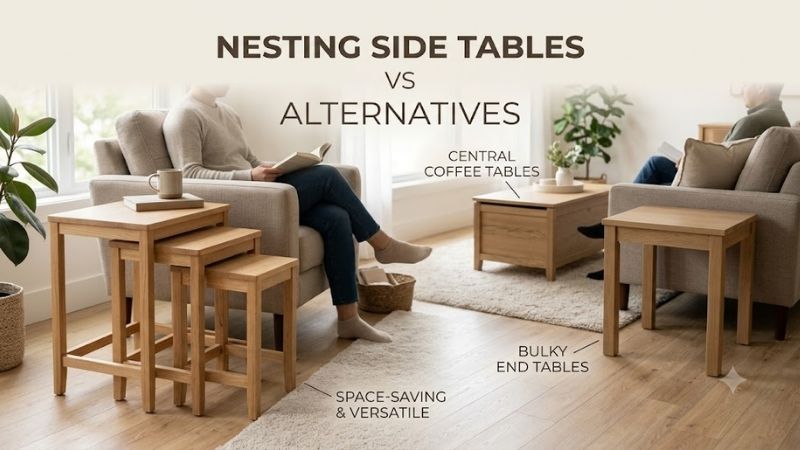
Nesting side tables vs alternatives compares space-saving table sets with traditional end tables, C-shaped sofa tables, coffee tables, folding trays, and storage furniture. Nesting sets offer multiple surfaces that can be combined, but they do not always save more space. This guide explains differences in room fit, table height, stability, convenience, and ownership cost.
Quick Verdict: Are Nesting Side Tables Worth It?
Nesting side tables are most useful when you need more than one tabletop occasionally but do not want every surface occupying a separate permanent position.
They can work well in smaller living rooms where guests sometimes need extra places for drinks, books, or accessories.
However, a conventional end table may be more practical when the surface will never move.
A C-shaped sofa table can bring one surface close to the occupant, while a coffee table provides a larger shared area.
Folding tray tables offer compact storage outside the living room, and a storage end table provides drawers or shelves that most basic nesting sets lack.
The best option depends on how frequently the furniture needs to change position.
Quick Comparison Table
| Furniture type | Main advantage | Main limitation | Best use |
|---|---|---|---|
| Nesting side tables | Extra temporary surfaces | Must fit and be moved | Flexible living rooms |
| Fixed end table | Stable everyday position | Does not shrink or combine | Permanent sofa-side use |
| C-shaped sofa table | Surface close to the seated person | Requires compatible under-sofa clearance | Personal laptop or drink surface |
| Coffee table | Larger shared surface | Uses central floor space | Family living rooms |
| Folding tray table | Can be stored away | Setup and stability vary | Occasional meals |
| Storage end table | Drawers or shelves | Greater structural bulk | Organized sofa-side storage |
| Nesting coffee tables | Expandable central surface | Can be too low for sofa-side use | Flexible center-table arrangement |
| Wall-mounted shelf | Preserves floor area | Fixed installation and limited loading | Very narrow spaces |
Nesting Side Tables vs Fixed End Tables
A fixed end table is generally intended to remain beside a sofa or chair.
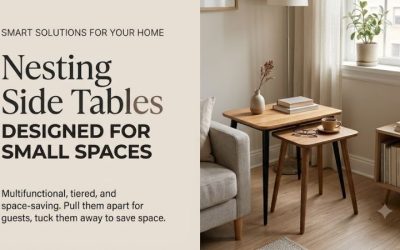
A nesting set introduces an additional surface that can be separated and repositioned.
Everyday Convenience
If a lamp, remote, and other accessories remain on one surface permanently, a conventional end table may be simpler.
There is no need to move or nest furniture.
A nesting set becomes more useful when the household regularly needs a second temporary table.
Floor Space
A single compact end table may occupy less floor space than a relatively large nesting set.
However, when two independent end tables would otherwise be needed, a nesting set can reduce the footprint of the unused second piece.
The comparison should consider the complete furniture arrangement.
Storage
Traditional end tables often include drawers or shelves.
Most simple nesting sets provide only tabletops.
If concealed organization is important, a storage end table may offer greater value.
Which Is Better?
Choose a fixed end table for permanent everyday use.
Choose nesting tables when the extra surface will be deployed and stored regularly.
Nesting Side Tables vs C-Shaped Sofa Tables
A C-shaped sofa table has a base that extends beneath a compatible sofa or chair, bringing the tabletop closer to the occupant.
This solves a different problem from nesting.
Reach
A C-shaped table can position a laptop, book, or drink conveniently near the user’s lap.
A conventional nesting side table generally remains beside the chair.
It may require reaching sideways.
Sofa Clearance
The C-shaped base requires enough clearance under the furniture.
A sofa with a low solid base may prevent the table from sliding into the intended position.
Nesting side tables do not necessarily require under-sofa space, but their own nesting frame must still fit.
Surface Capacity
C-shaped tables can have relatively small tops.
They are generally better for one person’s accessories than for serving several people.
A nesting set provides separate surfaces, which may be more useful for guests.
Which Is Better?
Choose a C-shaped table for a personal surface close to a seated user.
Choose nesting tables when separate temporary surfaces are the main priority.
Nesting Side Tables vs Coffee Tables
A coffee table generally occupies the center of a seating area.
Nesting side tables may be placed beside chairs or separated around the room.
Shared Reach
A coffee table can serve several people from one location.
However, occupants at the far ends of a long sofa may find a small central table inconvenient.
Separate nesting side tables can be positioned closer to individual seats.
Surface Area
A broad coffee table may provide more continuous space for board games, books, snacks, and accessories.
Smaller nesting tables divide that area across multiple surfaces.
This may improve flexibility but reduce the room available for larger objects.
Floor Layout
A coffee table remains a central obstacle.
Nesting side tables can sometimes be positioned along the edges of a room.
However, a deployed group of nesting tables may occupy more combined space than expected.
Which Is Better?
Choose a coffee table for one substantial shared surface.
Choose nesting side tables when flexible individual surfaces are more useful.
Nesting Side Tables vs Folding Tray Tables
Folding tray tables provide temporary surfaces that can often be stored in a closet or against a wall.
They offer a different type of compactness.
Storage
A folding tray table can be removed from the room entirely.
A nesting set usually remains visible as a piece of furniture.
If the living room must be cleared completely after an activity, folding tables may be more practical.
Appearance
Nesting tables often look more like permanent living-room furniture.
Folding trays may emphasize functional portability.
However, the actual style varies by product.
Stability
Both categories require appropriate construction and loading.
A folding mechanism introduces hinges or locks that must be correctly engaged.
A nesting table may have a more fixed frame but still depend on sound joints and assembly.
Which Is Better?
Choose folding trays when the table should disappear between uses.
Choose nesting sets when the room benefits from an attractive permanent primary table and an occasional second surface.
Nesting Side Tables vs Storage End Tables
A storage end table may include drawers, shelves, or cabinets.
It emphasizes organization rather than movable surfaces.
Concealed Storage
Drawers keep chargers, remotes, and accessories out of view.
Most nesting side tables cannot offer comparable concealed capacity.
Multifunctionality
A nesting set provides two or more surfaces but may add no internal storage.
A storage table offers one main surface plus compartments.
The decision depends on whether the household needs more places to put objects or fewer visible objects.
Cleaning and Maintenance
Drawer slides, doors, and other mechanisms can require maintenance.
Nesting tables generally have simpler surfaces, although moving them frequently may loosen hardware over time.
Which Is Better?
Choose a storage end table when clutter organization is the main objective.
Choose nesting side tables when temporary surface availability is more important.
Nesting Side Tables vs Nesting Coffee Tables
These products overlap in many retail catalogs, but their dimensions can create different uses.
Height Difference
A tall nesting side table may work beside a sofa arm.
A low nesting coffee-table set may be suitable in front of the sofa.
For example, Nathan James Lula includes a 22-inch-high larger table.
IKEA STOCKHOLM has a maximum table height of approximately 14.125 inches.
These are not interchangeable seating relationships.
Footprint
Coffee-table nesting sets can be wider and longer.
They may provide more shared surface but occupy more central floor area.
Side-table sets can be smaller and taller.
Which Is Better?
Choose nesting side tables for surfaces near individual seats.
Choose nesting coffee tables when the arrangement belongs in the center of the room.
Nesting Side Tables vs Wall-Mounted Shelves
A wall-mounted shelf does not occupy the same floor space as a table.
For extremely narrow rooms, this can be appealing.
Floor-Space Efficiency
A small shelf can hold appropriate lightweight accessories while leaving the floor below open.
However, its usefulness depends on wall structure, installation, and allowed loading.
Flexibility
Nesting tables can be moved between rooms.
A wall shelf remains attached to one location unless removed and reinstalled.
Installation
Shelves require appropriate anchors and a suitable mounting surface.
The correct hardware depends on the wall material and product.
Improper installation can create significant hazards.
Which Is Better?
Choose wall-mounted storage when floor area is extremely limited and the surface can remain fixed.
Choose nesting tables when portability and flexible placement matter more.
Quantitative Comparison: One Surface or Two?
Consider a simple living-room example.
A single 20-inch-square end table provides 400 square inches of tabletop area.
Two such tables provide 800 square inches across separate surfaces.
However, keeping both permanently separated also requires two furniture positions.
A nesting pair allows some of the secondary surface to be stored beneath the primary one.
The amount of floor area saved depends on nesting geometry.
For example, IKEA LACK combines a larger 21.625-inch-square table with a 13.75-inch-square secondary table.
The larger top has approximately 468 square inches of surface area, while the smaller offers about 189 square inches.
When separated, the set supplies approximately 657 square inches across both tabletops.
When nested, the smaller table does not create another independent floor position, although the total usable tabletop area is reduced.
This illustrates the actual advantage of nesting: temporary expansion rather than magically increasing available room area.
Best Furniture Choice by Household Scenario
| Situation | Strong starting option | Main reason |
|---|---|---|
| Guests occasionally need drinks surfaces | Nesting side tables | Deploy extra table only when needed |
| One fixed lamp beside sofa | Fixed end table | Simple permanent placement |
| Laptop use beside one seat | Suitable C-shaped table | Brings surface closer |
| Board games and shared snacks | Coffee table | Larger continuous area |
| Occasional TV meals | Folding tray table | Can be stored separately |
| Remotes and accessories need hiding | Storage end table | Drawers or compartments |
| Need a flexible central arrangement | Nesting coffee tables | Expandable living-room surface |
| Almost no floor space | Properly mounted shelf | Uses wall space |
Cost and Long-Term Value
A basic nesting set can be inexpensive.
For example, IKEA LACK is listed at $26.98 for two tables.
A premium design such as IKEA STOCKHOLM can cost several hundred dollars.
However, comparing only the number of included tables is misleading.
The materials, dimensions, finish, assembly, and intended use differ considerably.
A $30 nesting set may offer excellent value for lightweight occasional surfaces.
A premium walnut-veneer set may appeal to someone who values distinctive styling, but the price premium is not automatically justified by additional functionality.
A fixed storage end table may be a better purchase when the household would otherwise need a separate organizer.
Long-term value depends on the complete furniture system, not the lowest advertised price.
Common Comparison Mistakes
Assuming Nesting Tables Always Save More Space
A large nesting set may occupy more room than one compact fixed table.
Confusing Extra Surfaces With Extra Storage
Nesting tables usually provide tabletops rather than enclosed compartments.
Choosing a C-Shaped Table Without Checking Sofa Clearance
The base may not fit beneath the intended seating.
Using a Low Nesting Coffee Table Beside a Tall Sofa
The height may be inconvenient for everyday use.
Ignoring Load Limits
A movable table is not suitable for sitting or standing simply because it feels substantial.
Frequently Asked Questions
Are Nesting Side Tables Better Than Regular End Tables?
They are better when extra surfaces are used occasionally. A fixed end table can be more practical when the furniture will remain in one position.
Do Nesting Tables Save More Space Than a Coffee Table?
Sometimes, particularly when a central table is unnecessary. However, the actual answer depends on the dimensions and arrangement of the furniture.
Is a C-Shaped Table Better for Laptop Use?
It can be more convenient when the base fits beneath the sofa and the top reaches a comfortable position. Neither design automatically creates an ergonomic workstation.
Are Folding Tray Tables Cheaper Than Nesting Tables?
Some are, but prices vary. Compare the complete purchase price, construction, loading, and storage requirements.
Can Nesting Side Tables Replace Nightstands?
They can provide bedside surfaces but may not offer the drawers or enclosed storage of conventional nightstands.
Are Nesting Tables Better for Small Apartments?
They can be when the smaller surfaces are stored compactly between uses. However, a single appropriately sized fixed table may occupy less floor space overall.
Conclusion
Nesting side tables are valuable when a household needs extra tabletops without permanently dedicating separate floor areas to each one. Fixed end tables offer simpler everyday placement, C-shaped tables improve personal reach, and coffee tables provide larger shared surfaces. Folding trays, storage tables, and wall-mounted shelves serve different needs. Choose by actual measurements, height, storage requirements, loading, and how frequently the furniture arrangement changes.