Key takeaways
- A wall-mounted media console is worth considering when you want the floor beneath the cabinet to remain accessible and prefer a clean entertainment-wall arrangement.
Wall mounted media console vs alternatives compares floating media cabinets with conventional TV stands, floating shelves, entertainment centers, and other storage solutions. Wall-mounted furniture can free floor space and create a modern appearance, but it requires appropriate structural support. This guide explains how different designs compare for equipment storage, installation, flexibility, and overall value.
Quick Verdict: Is a Floating Media Console Worth It?
A wall-mounted media console is worth considering when you want the floor beneath the cabinet to remain accessible and prefer a clean entertainment-wall arrangement.
It can be particularly effective in apartments where visual openness is important.
However, a floor-standing TV stand may be simpler to install and easier to relocate.
A narrow floating shelf can provide less expensive equipment storage, while a large entertainment center may accommodate more devices and decorative objects.
A conventional media cabinet may be preferable for renters who cannot install substantial wall-mounted furniture.
The best choice depends on wall structure, storage needs, TV placement, and the likelihood of moving.
Quick Comparison Table
| Furniture type | Main advantage | Main limitation | Best use |
|---|---|---|---|
| Wall-mounted media console | Accessible floor and modern design | Structural mounting | Permanent media wall |
| Floor-standing TV stand | Easier relocation | Occupies floor area | Flexible living room |
| Floating AV shelf | Minimal appearance | Limited storage | One or two devices |
| Entertainment center | Extensive storage | Large footprint | Family media room |
| Standard media cabinet | Enclosed organization | Fixed floor space | Multiple electronics |
| Modular shelving system | Flexible arrangement | Can become complicated | Custom media wall |
| Wall-mounted TV with sideboards | Independent TV position | Two installations | Modern interiors |
| Projector shelf or cabinet | Different display arrangement | Equipment-specific requirements | Projection setup |
Wall Mounted Media Console vs Floor-Standing TV Stand
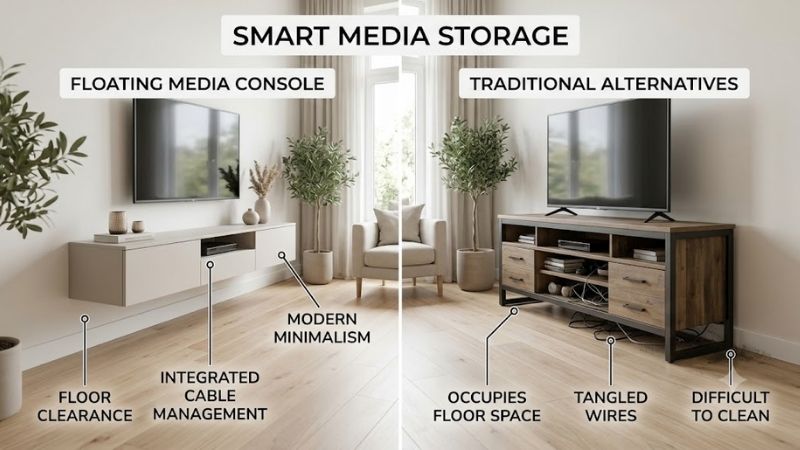
The main difference is how the furniture carries its weight.
A floating console transfers the supported load through the wall-mounting system.
A floor-standing TV stand transfers most of its load through legs or a base to the floor.
Installation
A conventional TV stand often requires furniture assembly and appropriate anti-tip anchoring.
A floating console requires structural wall attachment.
Both have safety considerations, but the installation process differs substantially.
Moving the Furniture
A floor-standing cabinet can generally be repositioned more easily.
A floating cabinet may leave mounting holes and require a new structural installation when relocated.
This can matter to renters and households that rearrange furniture frequently.
Floor Cleaning
A floating cabinet leaves the floor below its body accessible.
A floor-standing stand may have legs or a solid base that complicates cleaning.
Which Is Better?
Choose a floating console for a permanent media-wall arrangement when the wall can support it.
Choose a floor-standing stand for simpler relocation.
Wall Mounted Media Console vs Floating AV Shelf
A floating AV shelf is typically smaller than a full media console.
It may support a streaming device, small receiver, or other permitted accessory.
Storage
A media console can provide several compartments.
A single floating shelf usually offers much less organized storage.
Installation
Both require appropriate mounting.
A smaller shelf may have different loading and fastening requirements, but it still needs proper structural support.
Appearance
A floating shelf can produce a minimal visual effect beneath a wall-mounted TV.
A full cabinet may provide a more substantial horizontal design element.
Which Is Better?
Choose a floating shelf when only a few accessories need storage.
Choose a media console when multiple devices and cable organization are important.
Wall Mounted Media Console vs Entertainment Center
An entertainment center is usually larger furniture with several storage levels, sometimes extending around the television.
Storage Capacity
An entertainment center can accommodate books, media devices, speakers, and decorative objects.
A wall-mounted console generally offers less vertical storage.
Room Footprint
A large entertainment center can occupy much more floor and wall space.
However, it may eliminate the need for additional bookshelves or display cabinets.
Flexibility
Some entertainment centers are modular.
Others are substantial fixed arrangements.
A floating console may provide a simpler visual composition but less storage.
Which Is Better?
Choose an entertainment center when extensive storage is the main requirement.
Choose a floating console for a cleaner, less visually bulky arrangement.
Wall Mounted Media Console vs Standard Media Cabinet
A standard media cabinet usually emphasizes enclosed storage for electronics and accessories.
It may include doors, drawers, and adjustable shelves.
Equipment Protection and Access
Cabinet doors conceal equipment and clutter.
However, the storage compartments must still provide suitable ventilation.
A floating console can also offer doors, but its space and load limits may be more restrictive.
Installation
A floor-standing cabinet may be easier to position initially.
However, anti-tip anchoring may still be required.
A floating cabinet requires appropriate structural mounting.
Ownership
A conventional cabinet can be easier to sell, move, or replace without wall work.
A floating cabinet can create a more built-in appearance.
Which Is Better?
Choose a floor-standing media cabinet when enclosed storage and relocation matter.
Choose a floating console when accessible floor space and wall-integrated design matter more.
Wall Mounted Media Console vs Modular Shelving System
A modular shelving system allows users to combine cabinets, shelves, drawers, and different finishes.
IKEA BESTÅ illustrates how a coordinated storage system can support different media-wall arrangements.
Customization
Modular furniture offers flexibility in storage layout.
However, complexity can increase as additional pieces are added.
Cost
A basic frame may appear inexpensive.
A finished arrangement with doors, internal shelves, and hardware can cost significantly more.
Structural Requirements
Wall-mounted modules require approved fastening systems.
Do not assume every frame or rail in the same product family is interchangeable.
Which Is Better?
Choose modular shelving when customization is a priority.
Choose a dedicated floating media console when a defined, simpler storage arrangement is sufficient.
Wall Mounted Media Console vs Wall-Mounted TV and Sideboard
A sideboard is a broader storage cabinet usually positioned against a wall.
When a television is wall-mounted above it, the result can resemble a floating-media arrangement visually.
However, the sideboard still rests on the floor.
Screen Position
The TV wall bracket allows independent screen placement.
The sideboard provides storage beneath it.
Storage
Sideboards may offer drawers and larger compartments than some floating consoles.
However, device ventilation must still be considered.
Floor Footprint
A floor-standing sideboard occupies floor space.
A floating media console leaves the area beneath it open.
Which Is Better?
Choose a sideboard when furniture storage and relocation are priorities.
Choose a floating console for a more minimal media-wall look.
Wall Mounted Media Console vs Projector Shelf
A projector setup can use a wall shelf, ceiling mount, or dedicated storage cabinet.
This arrangement differs fundamentally from television furniture.
Display Equipment
A projector needs appropriate placement relative to the projection surface.
Its throw distance, ventilation, alignment, and power routing must be considered.
Storage
A small shelf may be sufficient for certain projector designs but provide little space for other media devices.
A larger console can store additional equipment.
Installation
Projection hardware may require ceiling or wall mounting.
A TV console is not automatically suitable for the projector’s required position.
Which Is Better?
Choose projector-specific furniture when building a projection setup.
Choose a floating media console when organizing equipment beneath a conventional television.
Quantitative Space Comparison
Consider a 60-inch-wide media cabinet measuring 16 inches deep.
Its rectangular horizontal projection is:
A floor-standing cabinet of those dimensions occupies a comparable floor footprint.
A wall-mounted cabinet of the same dimensions projects over a similar horizontal area but leaves the floor directly beneath it accessible.
This illustrates the key difference.
A floating cabinet does not erase its physical volume. It changes how that volume interacts with the room.
The result may feel more open and simplify cleaning, but it does not automatically create an unobstructed passage at body height.
Which Option Is Best for Different Households?
| Situation | Strong starting option | Reason |
|---|---|---|
| Wants clean floor beneath TV | Floating media console | No cabinet legs |
| Rents and moves frequently | Floor-standing TV stand | Easier relocation |
| Has one streaming device | Floating AV shelf | Minimal storage |
| Needs books and extensive display | Entertainment center | More compartments |
| Wants concealed electronics | Media cabinet | Doors and drawers |
| Needs a customized wall layout | Modular shelving system | Flexible configuration |
| Wants substantial general storage | Sideboard | Larger compartments |
| Uses a projector | Projector-specific mounting | Correct equipment positioning |
Compare Long-Term Costs
A floating console may have a relatively low retail price but require additional installation expenses.
A conventional TV stand can often be assembled and placed with fewer wall-mounted components, though anti-tip precautions may still apply.
A large entertainment center may cost more upfront but replace other storage furniture.
A floating AV shelf may be the least expensive choice when only one or two devices need a surface.
Installation Labor
Mounting a heavy cabinet into appropriate structural support may require professional assistance.
Hardware
Fasteners, TV brackets, and other components may be sold separately.
Repair
A floating cabinet may need hinge, shelf, or mounting-system maintenance.
Relocation
Moving a wall-mounted cabinet can create additional repair and reinstallation costs.
Safety Differences
Wall-Mounted Furniture
Requires approved structural anchoring, appropriate loading, and adherence to the cabinet’s installation instructions.
Floor-Standing Furniture
Requires stable assembly and anti-tip anchoring where specified.
Entertainment Centers
May be tall or heavy, making proper stabilization especially important.
Floating Shelves
Must not be overloaded merely because they are small.
Projector Mounts
Require proper alignment, structural support, and equipment-specific ventilation.
None of these categories is inherently safe regardless of installation.
Common Comparison Mistakes
Assuming Floating Cabinets Can Automatically Support a TV
A separately wall-mounted TV may need its own mount.
Assuming Floor-Standing Furniture Needs No Anchoring
Some conventional cabinets also require anti-tip attachment.
Choosing a Minimal Shelf for Too Much Equipment
The shelf may lack sufficient capacity, depth, or ventilation.
Ignoring the Cost of Wall Work
Installation can materially change the final budget.
Confusing Visual Space With Actual Clearance
A floating console still projects from the wall.
Frequently Asked Questions
Is a Wall Mounted Media Console Better Than a TV Stand?
It can provide a cleaner appearance and accessible floor area. A floor-standing stand may be simpler to relocate and install.
Are Floating Consoles Worth the Extra Installation Cost?
They can be when the appearance, floor access, and permanent media-wall arrangement are important. The value depends on actual installation costs.
Is a Floating Shelf Enough for TV Equipment?
It may be sufficient for a small number of compatible devices. Larger setups may need a full cabinet.
Which Option Is Best for Renters?
A properly stabilized floor-standing media cabinet is often more convenient because it can be moved without reinstalling a heavy wall-hung unit.
Do Floating Cabinets Have Less Storage?
Not always, but some prioritize a slim appearance over capacity. Compare actual compartments.
Can a Wall Mounted Console Hold Gaming Consoles?
Yes, when the installation supports their weight and the compartments provide appropriate airflow.
Conclusion
A wall mounted media console is a strong choice for a permanent entertainment wall when floor access, clean styling, and organized storage matter. Conventional TV stands are easier to relocate, floating shelves suit minimal setups, and entertainment centers provide greater capacity. Sideboards and modular systems offer additional flexibility. Choose according to actual equipment needs, wall structure, safety, total cost, and how often the room layout may change.