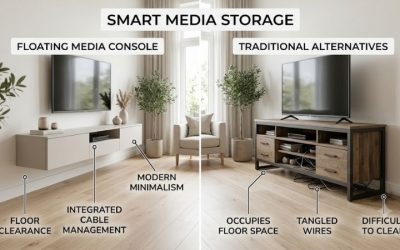
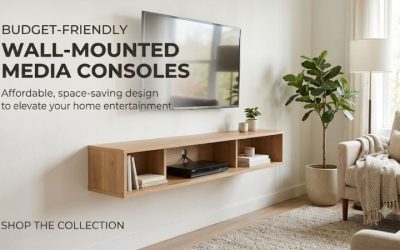
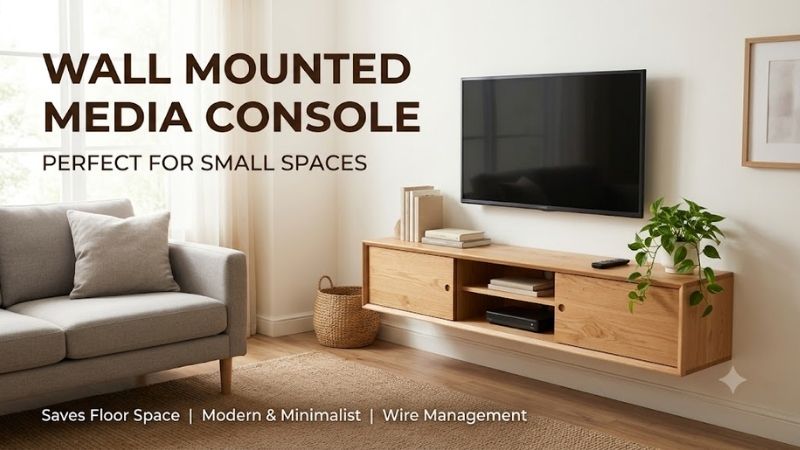
A wall mounted media console for small spaces can create an organized entertainment area without occupying the floor beneath the cabinet. Yet floating furniture still projects into the room and requires reliable structural support. This guide explains how to choose appropriate dimensions, plan installation, manage electronics, and determine whether a floating cabinet is genuinely the best use of limited space.
Why Floating Media Consoles Work in Compact Rooms
A conventional TV stand rests on the floor and occupies a fixed furniture footprint.
A wall-mounted cabinet eliminates the legs or base beneath the storage compartments.
This can make the room appear more open and simplify cleaning under the unit.
However, the cabinet’s actual width and depth remain.
A 16-inch-deep floating console still projects approximately 16 inches into the room, even though the floor below it is accessible.
The most valuable benefit is therefore a combination of visual openness, accessible floor space, and convenient storage rather than a magical reduction in the cabinet’s dimensions.
Which Console Size Works Best?
| Width category | Practical use | Main consideration |
|---|---|---|
| Under 40 inches | Minimal accessories | Limited storage |
| 40–50 inches | Bedroom or compact apartment | Often easier to position |
| 50–60 inches | Standard sofa-oriented media wall | More device space |
| 60–72 inches | Larger entertainment arrangement | Long wall span and heavier installation |
| Over 72 inches | Broad custom media wall | Greater installation complexity |
The appropriate width depends on available wall space and equipment needs rather than the television size alone.
Step 1: Measure the Entire Wall
Record the clear wall width between doors, windows, architectural features, and other furniture.
Then identify electrical outlets, cable terminals, and the intended television position.
Include Door Movement
A cabinet must not obstruct a door’s swing or a person’s access to the room.
Even when mounted above the floor, a protruding cabinet can interfere with movement.
Consider Nearby Furniture
Measure the space between the front of the console and the sofa or coffee table.
A relatively shallow cabinet may preserve more usable space than a deeper design.
Check the Available Mounting Area
An appropriate wall location must provide the structural support required by the manufacturer’s mounting system.
The ideal visual position is not necessarily a permissible mounting location.
Step 2: Choose an Appropriate Depth
Cabinet depth determines how far the media console projects into the room.
Consider two examples.
| Cabinet depth | Projection from wall |
|---|---|
| 12 inches | 12 inches |
| 16 inches | 16 inches |
| 18 inches | 18 inches |
A four-inch difference can matter in a narrow apartment.
However, thinner cabinetry may not accommodate larger electronics.
Device Depth
A media receiver may need extra rear space for HDMI cables, ventilation, and power connections.
A cabinet with a 16-inch exterior depth may have significantly less usable interior depth.
Check internal dimensions before ordering.
Cable Bending
Thick HDMI cables and power connectors may require clearance behind a device.
Do not bend cables sharply to force equipment into an undersized compartment.
Front Access
If doors are installed, they must open without hitting nearby furniture.
Step 3: Compare Real Compact Models
| Model | Width | Depth | Height |
|---|---|---|---|
| IKEA BESTÅ compact | 47¼ in | 15¾ in | 15 in |
| South Shore City Life compact | 49½ in | 16¼ in | 11½ in |
| Prepac Altus | 58 in | 16 in | 16 in |
| IKEA BESTÅ wide | 70⅞ in | 15¾ in | 15 in |
The BESTÅ compact frame can be attractive when a broad cabinet is unnecessary.
South Shore’s lower 11½-inch profile may suit a room where preserving wall space beneath the TV is important.
Prepac offers more overall width but also needs a larger supported wall area.
Step 4: Plan the Vertical Arrangement
A floating cabinet can be mounted at different heights within its manufacturer’s installation requirements.
However, height should be selected based on both television viewing comfort and access to the cabinet.
Television Above the Cabinet
If the television is separately wall-mounted, its viewing position should be planned first.
Do not automatically raise the screen simply to create decorative space between the TV and console.
Cabinet Access
A cabinet mounted too high may be awkward to use.
A cabinet mounted very low can interfere with cleaning equipment or other furniture.
Children and Pets
Avoid placements that invite climbing or allow a child to pull heavily on the cabinet.
Correct structural mounting remains essential at every height.
Step 5: Understand Wall Types
This is the most important safety consideration.
Wood-Stud Walls
Many floating cabinets require fasteners secured into structurally suitable wood studs.
The location and spacing of the studs may limit where the cabinet can be installed.
Masonry and Concrete
Installation may require compatible masonry fasteners and suitable substrate conditions.
The correct equipment depends on the wall and manufacturer instructions.
Hollow-Wall Construction
An ordinary drywall panel should not be assumed capable of supporting a heavy floating console.
A qualified installer may need to assess suitable structural backing or another approved method.
Professional Installation
Professional assistance is appropriate when the wall structure is uncertain, the unit is heavy, or the mounting instructions cannot be followed as written.
Do not improvise a mounting method merely to achieve a preferred visual position.
Step 6: Distinguish Console Load From TV Load
A floating media console and a wall-mounted television may be supported by separate installations.
If the television is on its own wall mount, the cabinet generally needs to support its own weight and permitted contents.
If a product is designed to support a television directly on the cabinet, its specifications must expressly allow that configuration.
For example, IKEA BESTÅ lists a 35-pound television rating for the compact frame’s specified supported arrangement.
However, IKEA also states that the maximum load of a wall-hung unit depends on the wall material.
Do not use a floor-standing top rating as an unrestricted floating-cabinet rating.
Step 7: Choose Storage That Matches Your Devices
Open Compartments
Open shelves make devices and cables easier to access.
They can be useful for gaming consoles, receivers, or routers when the dimensions and ventilation requirements are suitable.
Closed Compartments
Doors can create a cleaner appearance.
However, heat-producing electronics need adequate airflow.
Do not prioritize visual concealment over device ventilation.
Adjustable Shelves
Adjustable shelving is helpful when devices have different heights.
The supported load also matters.
Small Accessories
Remote controls, game controllers, chargers, and accessories may fit in small containers or drawers.
But adding organizers reduces usable interior volume.
Step 8: Plan Cable Management Before Mounting
Cable management can determine whether a floating media setup looks clean or cluttered.
Locate Outlets
An outlet placed behind the cabinet may conceal plugs.
However, it must remain accessible in accordance with electrical requirements.
Route Data Cables
HDMI, network, and audio cables should have sufficient length and avoid sharp bends.
Do Not Conceal Ordinary Power Cords Improperly
Standard appliance power cords should not simply be run inside walls.
Use wiring methods and equipment approved for the installation and comply with applicable electrical codes.
Keep Heat Sources Clear
Receivers, game consoles, and other electronics release heat.
Do not pack cables tightly around their ventilation openings.
Example: A 10-by-12-Foot Living Room
Consider a room measuring 120 by 144 inches.
A sofa projects 36 inches from one wall.
A media console projects 16 inches from the opposite wall.
The horizontal distance remaining between those furniture edges is:
If the console is wall-mounted, the floor directly below its footprint is available for cleaning and certain movement.
However, the console still projects into the room at its installed height.
The clear path must be evaluated where people actually walk, not only at floor level.
Step 9: Assess Maintenance and Cleaning
A floating cabinet can simplify floor cleaning because it has no legs beneath the main storage body.
However, cleaning around electrical cables and underneath a heavy cabinet still requires attention.
Engineered-wood finishes should be protected from prolonged water exposure.
Hinges and shelf fasteners should be checked periodically.
Do not allow cleaning equipment to strike or lift the cabinet.
Common Buying Mistakes
Assuming Floating Means Weightless
The wall still carries the cabinet and contents.
Buying Without Checking Stud Locations
The desired location may not provide suitable structural support.
Choosing a Cabinet Too Shallow for Gaming Equipment
Actual interior depth is smaller than the exterior measurement.
Forgetting Access to Power Connections
A visually hidden outlet may become difficult to reach.
Installing Too High
The cabinet and television can become inconvenient to use.
Frequently Asked Questions
What Is the Best Wall Mounted Media Console for a Small Apartment?
A compact 47–50-inch cabinet is a practical starting point when the wall and equipment permit it. IKEA BESTÅ and South Shore City Life offer different storage arrangements.
Is a Floating Media Console Better Than a TV Stand?
It can improve floor access and create a cleaner appearance, but requires suitable structural mounting.
How High Should a Floating Console Be?
Height depends on the television position, device access, room layout, and mounting requirements. There is no universal height suitable for every home.
Can I Mount a Media Console on Drywall?
Only using a method approved for the cabinet and actual wall structure. Heavy units may require structural studs, blocking, masonry, or other suitable support.
Can Gaming Consoles Be Stored Inside?
Yes, when the compartment supports their size, weight, and required ventilation.
Do Floating Consoles Hold the TV?
Many are designed to sit below a separately mounted television. Check whether the specific cabinet is actually approved to support a TV.
Conclusion
A wall mounted media console for small spaces should provide useful storage and accessible floor area without compromising structural support or equipment ventilation. Measure the wall, cabinet depth, interior compartments, and television arrangement before ordering. Then confirm installation requirements and electrical access. A compact floating cabinet can work very well in an apartment, but safe mounting is more important than appearance.