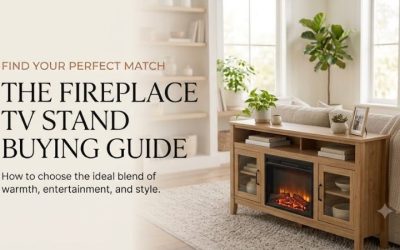
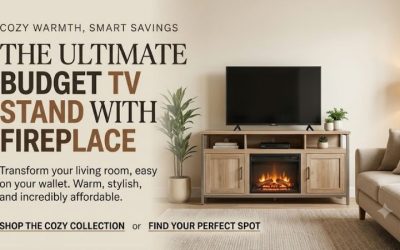
A TV stand with fireplace buying guide should explain how to choose a cabinet that safely supports your television while providing useful supplemental warmth. Screen size alone is not enough: TV weight, base dimensions, heater ventilation, electrical requirements, and cabinet construction all influence the purchase. Use this guide to evaluate those details before ordering.
What Is a TV Stand With Fireplace?
A fireplace TV stand is a media cabinet that incorporates an electric fireplace insert.
Depending on the model, the insert may provide simulated flames, electric resistance heating, thermostat control, and a timer.
The surrounding cabinet supports an appropriate television and provides storage for media accessories.
These products combine furniture with an electrical heating appliance, so both systems must be assessed.
A model with attractive flame effects is not necessarily suitable for a large television.
Likewise, a sturdy-looking cabinet may have a relatively low published tabletop capacity.
Step 1: Measure Your Television Properly
Television manufacturers generally advertise screen size by diagonal measurement.
That figure does not establish the television’s full width, weight, or foot spacing.
TV Weight
Find the weight of the television with its tabletop stand attached.
Compare it with the fireplace cabinet’s maximum permitted television load.
For example, the reviewed Ameriwood Hendrix supports 120 pounds, while the Costway 58-inch adjustable-shelf model supports 66 pounds.
Both advertise compatibility with TVs up to 65 inches, but they do not have equivalent loading allowances.
Foot Spacing
Measure the distance between the outside edges of the TV’s feet.
Make sure both feet rest completely on the approved support surface.
A screen may be narrower than the wall while still having a stand configuration incompatible with the cabinet.
Base Depth
Measure front-to-back depth.
Some televisions have deep central stands that can overhang a narrow cabinet.
Wall Mounting
If the TV is mounted to the wall, use an appropriate wall mount installed according to its instructions.
Do not assume the cabinet provides support to an independently mounted television.
Step 2: Choose the Right Cabinet Dimensions
The cabinet must fit the room without restricting everyday movement.
| Cabinet size | Example | Practical implication |
|---|---|---|
| 48 × 16 × 30 in | Costway compact model | Shorter wall span but taller profile |
| 58 × 16.06 × 23.23 in | Ameriwood Hendrix | Moderate height and depth |
| 58 × 16 × 25 in | Costway adjustable-shelf | Enclosed storage and mid-height top |
| 59.61 × 15.79 × 18.7 in | Ameriwood Noble | Lower television positioning |
| 58 × 16 × 32 in | Costway LED model | Taller entertainment-center appearance |
Width
Choose a cabinet compatible with the television and available wall.
Depth
A shallower cabinet can preserve floor space.
However, it must still accommodate television feet, cable connections, and storage requirements.
Height
A taller stand positions the TV higher when the screen rests on top.
Check the seated viewing angle before purchasing.
Step 3: Understand Heater Wattage
Watts measure electrical power.
Electric-resistance heating converts most of the electrical input into heat within the room.
A basic conversion is:
| Rated power | Approximate full-power heat output |
|---|---|
| 1,000 W | 3,412 BTU/h |
| 1,200 W | 4,095 BTU/h |
| 1,400 W | 4,777 BTU/h |
| 1,500 W | 5,118 BTU/h |
Actual published heater output may differ slightly because of specification methods and rounding.
Does Higher Wattage Mean Better Heating?
Higher electrical input generally means more maximum resistance-heating output.
However, it does not necessarily mean better comfort or lower operating cost.
A thermostat, heater location, airflow, insulation, and outside temperature affect the result.
Understanding Room Coverage
A manufacturer may advertise coverage of 350 or 400 square feet.
This should not be interpreted as a guaranteed result for every room.
A poorly insulated space may require substantially more heating.
Step 4: Compare Fireplace Features
Flame-Only Mode
This allows decorative flames to operate without active heat.
It is especially useful in warmer weather.
Thermostat
A thermostat can cycle the heating element to maintain an approximate temperature setting.
However, precision varies by product.
Timer
A timer may shut off the heater after a selected interval.
It does not replace proper supervision.
Remote Control
A remote makes it easier to adjust the fireplace from a sofa.
Not every model includes one.
Flame Colors
Colored flame options are decorative rather than measures of heating effectiveness.
Avoid paying more for lighting effects unless you actually want them.
Step 5: Evaluate Electrical Safety
This is a core part of the buying decision.
Use the Correct Wall Connection
A heating appliance draws substantial current.
Follow the manufacturer’s instructions and use an appropriately rated wall outlet.
Do not use an ordinary extension cord or power strip to operate the heater.
Avoid Overloaded Circuits
Other high-demand appliances can create problems when connected to the same electrical circuit.
Check the home’s electrical conditions and consult a qualified electrician if necessary.
Inspect Cords and Plugs
Do not use equipment with a damaged power cord, broken plug, loose connection, or signs of overheating.
Turn Off Heating When Appropriate
Follow the manufacturer’s instructions for supervision and shutdown.
Do not leave supplemental space heating operating unattended or during sleep contrary to safety guidance.
Step 6: Check Ventilation and Required Clearances
The electric insert needs unobstructed air intake and discharge.
A fireplace may sit inside approved cabinetry while requiring specific clearance around its hot-air outlet.
Do Not Block the Heater
Keep furniture, blankets, papers, curtains, and accessories clear of designated vents.
Follow Insert-Specific Instructions
General portable-heater guidance commonly recommends keeping combustible items at least three feet away.
Purpose-built fireplace inserts have their own manufacturer installation specifications. Those specific requirements govern the approved cabinet and vent arrangement.
Avoid Unapproved Modifications
Do not replace the insert with a different heater or change cabinet panels unless the manufacturer explicitly approves the modification.
Such changes can affect airflow and safety.
Step 7: Evaluate Media Storage
A fireplace usually occupies the central portion of the cabinet.
The remaining space may include open shelves, side cabinets, or drawers.
Game Consoles
Gaming systems may generate considerable heat.
Check their required ventilation clearance before placing them in cabinet compartments.
AV Receivers
Receivers can be comparatively large and may need ventilation above their housings.
Measure the equipment rather than assuming it will fit any standard shelf.
Routers and Modems
These devices may also produce heat and require a suitable operating environment.
Weight Limits
The cabinet’s main top and individual shelves can have different capacities.
Never apply the TV-top rating to a small internal shelf.
Step 8: Compare Cabinet Materials
MDF and Particleboard
These engineered materials are common in affordable fireplace TV furniture.
They can work well in properly designed cabinets but should be protected from moisture, particularly around exposed edges.
Laminates and Paper Finishes
Wood-look surfaces may be laminates or decorative paper finishes.
They should not be described as solid wood.
Glass Shelves and Doors
Glass components require appropriate handling.
Even tempered glass can break under unsuitable impact or loading.
Metal Hardware
Fasteners, shelf supports, brackets, and heater-mounting components need correct installation.
A visually attractive cabinet can still become unstable if important hardware is missing.
Step 9: Assess Tip Resistance
The combination of a television, cabinet, and electric insert creates a substantial furniture arrangement.
Use manufacturer-supplied anti-tip hardware where required.
Do not let children climb or pull on the cabinet.
Keep the stand on a stable, suitable floor.
A television should not be placed on a cabinet outside the manufacturer’s approved loading or placement conditions.
Step 10: Evaluate Assembly
Fireplace TV stands often arrive flat-packed.
Some require two adults to assemble them safely.
Check All Components
Confirm the furniture panels, fasteners, fireplace insert, remote, and electrical components match the package contents.
Follow the Assembly Sequence
Install structural supports and heater components only as instructed.
Do not power the insert during incomplete installation.
Inspect the Completed Stand
Make sure the cabinet is level, doors operate properly, shelves are secure, the insert is correctly installed, and no power cords are damaged or pinched.
Step 11: Calculate Electricity Costs
Energy use is measured in kilowatt-hours:
For a 1,400-watt heater operating at full input for five hours:
At an illustrative electricity rate of $0.20 per kWh:
This is a full-power example. Thermostat cycling may reduce actual heating-element operating time.
Flame-only mode generally uses much less energy than active heating, but exact consumption depends on the product.
Step 12: Compare Warranty and Repairability
A fireplace TV stand contains furniture components and an electrical insert.
The two systems may have different service requirements.
Check whether the manufacturer offers replacement heater inserts, remotes, or cabinet hardware.
A replaceable insert can improve repair options, but only when compatible parts remain available.
Read warranty exclusions before using the warranty length as a major purchasing reason.
Buying Checklist
| Criterion | What to verify |
|---|---|
| TV size | Within supported diagonal class |
| TV weight | Under approved tabletop limit |
| TV base | Feet fully supported |
| Cabinet size | Fits wall and viewing height |
| Heater wattage | Appropriate supplemental output |
| Heat clearance | Matches insert instructions |
| Power | Suitable direct outlet |
| Storage | Equipment fits and can ventilate |
| Stability | Required anchoring installed |
| Assembly | Correctly completed |
| Warranty | Cabinet and insert coverage |
| Replacement parts | Available for selected model |
Common Buying Mistakes
Buying by Screen Diagonal Alone
TV weight and foot spacing are equally important.
Assuming Every 1,500-Watt Fireplace Heats 400 Square Feet
Heating conditions vary significantly.
Using a Household Power Strip
High-power heating devices require appropriate electrical connections.
Covering Heater Vents
The approved heating and airflow paths must remain open.
Ignoring the Height of the Television
A tall fireplace console may raise the screen more than desired.
Choosing Decorative Features Before Compatibility
Flame colors and LED shelves are secondary to the cabinet’s intended structural and electrical use.
Frequently Asked Questions
How Do I Choose the Right TV Stand With Fireplace?
Start by checking TV weight, base dimensions, and cabinet size. Then verify heater specifications, electrical requirements, ventilation, storage, and assembly instructions.
How Many Watts Should the Fireplace Have?
Many models use around 1,400–1,500 watts. The suitable output depends on room conditions and intended supplemental heating.
Are Electric Fireplace TV Stands Energy Efficient?
Electric-resistance units convert most electrical input into heat, but that does not mean they are the least expensive heating method. Cost depends on electricity prices and alternatives.
Can the Fireplace Be Used All Year?
Models with flame-only operation can provide decorative ambiance without active heating.
Can I Replace the Heater Insert?
Only when a compatible replacement is supported by the manufacturer.
Is an Electric Fireplace TV Stand Safe Around Children?
Proper installation and supervision are essential. The heat outlet can become hot, and the furniture must not be climbed or pulled.
Conclusion
A TV stand with fireplace should be selected as both a media cabinet and an electrical heating appliance. Confirm television weight and dimensions, then evaluate heater power, operating clearances, electrical safety, and media storage. Compare construction, assembly, anti-tip requirements, warranty, and running costs before choosing. Correct compatibility and safe installation matter more than decorative flame effects.