Key takeaways
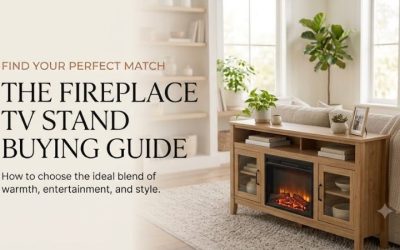
- A fireplace TV stand makes sense when the household wants a television cabinet and electric flame display in the same location.
TV stand with fireplace vs alternatives compares integrated fireplace media cabinets with conventional TV stands, separate electric heaters, wall fireplaces, and other living-room solutions. A combined unit can provide attractive flames and supplemental warmth, but it limits furniture flexibility. This guide explains practical differences in installation, heating cost, television support, storage, and long-term value.
Quick Verdict: Which Option Is Better?
A fireplace TV stand makes sense when the household wants a television cabinet and electric flame display in the same location.
It can also provide supplemental heating without requiring an additional freestanding fireplace mantel.
However, a conventional TV stand may provide more media storage, while a separate electric heater allows more flexible placement.
A wall-mounted fireplace can create a distinctive feature wall, and a wall-mounted television with a standard media cabinet may offer more control over viewing height.
The best choice depends on whether the priority is decorative ambiance, heating, equipment storage, or compact furniture placement.
Comparison Table
| Option | Main advantage | Main drawback | Best use |
|---|---|---|---|
| Fireplace TV stand | Combines cabinet, flame effect, and heating | Fixed heater location | Coordinated living room |
| Standard TV stand | Simple media storage | No integrated heater | Everyday entertainment |
| TV stand plus separate heater | Flexible heating placement | Two separate products | Changing room needs |
| Wall-mounted electric fireplace | Independent feature-wall styling | Installation and clearances | Custom living room |
| Fireplace mantel console | Traditional fireplace appearance | Often substantial size | Decorative focal point |
| Wall-mounted TV and media cabinet | Flexible screen position | Wall-mounting requirements | Modern media wall |
| Flame-only media unit | Ambiance without heat | No supplemental warmth | Warm climates |
| Media cabinet with LED lighting | Decorative color options | Lighting does not provide heat | Gaming and entertainment |
Fireplace TV Stand vs Standard TV Stand
A regular TV stand focuses on television support and media equipment.
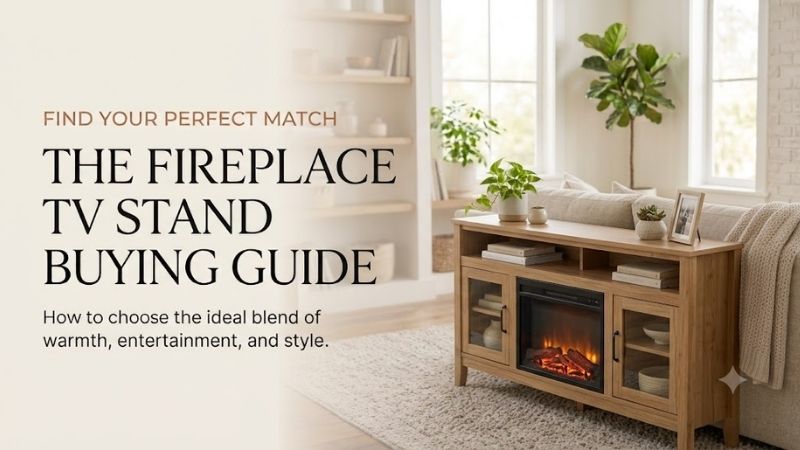
An integrated fireplace stand dedicates part of its cabinet to a heating insert.
Storage Capacity
A conventional media cabinet may provide more shelves and drawers within the same external dimensions.
A fireplace stand sacrifices some central storage space to accommodate the insert.
This matters for buyers with multiple gaming systems, receivers, consoles, and accessories.
Furniture Complexity
A standard cabinet does not contain heating controls, fans, or flame-effect electronics.
It may therefore involve fewer serviceable components.
However, its construction can still vary widely in quality.
Heating and Appearance
A fireplace TV stand offers visual flames and supplemental warmth.
A standard TV cabinet offers neither unless separate equipment is added.
Which Is Better?
Choose a conventional TV stand when storage and straightforward media support are the main needs.
Choose a fireplace TV stand when heating and ambiance are important enough to justify the additional equipment.
Fireplace TV Stand vs TV Stand With Separate Heater
This comparison is about flexibility.
A combined unit places the television and heater in a fixed relationship.
A separate heater can be positioned independently, according to the appliance’s own instructions.
Heating Placement
A separate portable electric heater may serve different rooms when moved appropriately.
However, it must remain on a suitable surface and maintain its required clearance from combustibles.
An integrated fireplace cabinet is generally intended to remain in its media location.
Electrical Consumption
If both appliances use ordinary electric-resistance heating and draw the same power for the same duration, their electrical energy consumption is comparable.
An integrated flame display does not create a special energy advantage.
Purchase and Repair Costs
A separate heater may be easier to replace without changing the media cabinet.
A combined unit can look more coordinated but may require compatible replacement inserts.
Which Is Better?
Choose a separate heater when heating flexibility matters.
Choose a fireplace TV stand when coordinated furniture appearance is the main priority.
Fireplace TV Stand vs Wall-Mounted Electric Fireplace
A wall-mounted electric fireplace creates a different layout.
Instead of placing the heater inside a television cabinet, it installs on or within a suitable wall assembly.
Installation
Wall-mounted units require correct structural support and adherence to the fireplace’s installation instructions.
Some may require professional installation or additional electrical work.
A freestanding fireplace TV stand generally arrives as furniture requiring assembly.
However, it still needs proper electrical access and stabilization.
Television Placement
A separate wall fireplace allows more design flexibility.
But a television mounted above it must comply with both devices’ clearance requirements.
The apparent elegance of a feature wall does not remove potential heat exposure.
Storage
The wall fireplace provides little or no media storage.
Additional cabinets may be necessary.
Which Is Better?
Choose a wall-mounted fireplace for a custom feature-wall design.
Choose an integrated fireplace TV stand for a more unified cabinet-and-heater arrangement.
Fireplace TV Stand vs Fireplace Mantel Console
A fireplace mantel console emphasizes a traditional hearth appearance.
Some mantels support televisions, but others are decorative heater surrounds only.
Design
A mantel may create a stronger traditional focal point.
It can suit farmhouse, rustic, or classic interiors.
However, it often occupies more wall width or floor depth.
TV Support
A decorative mantel should not automatically be used as a television stand.
Only purpose-built, appropriately rated designs should support a TV.
Storage
Mantels may provide less media organization than dedicated fireplace TV cabinets.
Which Is Better?
Choose a mantel-style fireplace when appearance is the priority.
Choose a fireplace TV stand when television support and media organization are essential.
Fireplace TV Stand vs Wall-Mounted TV and Media Cabinet
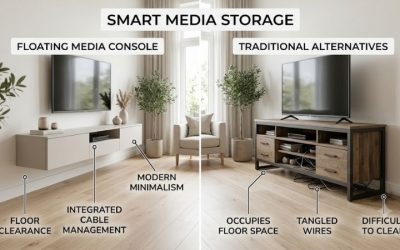
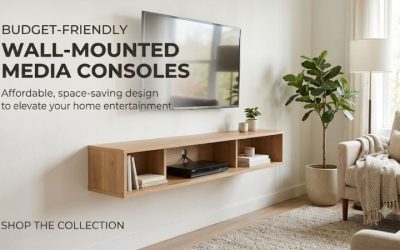
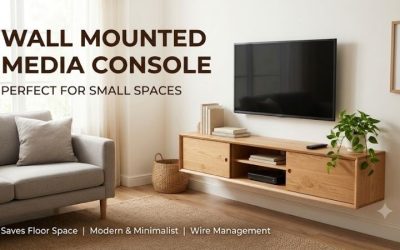
A wall-mounted television does not rest directly on the media cabinet.
This gives the buyer more flexibility when choosing cabinet height.
Viewing Position
A properly installed wall mount can position the television independently of the cabinet.
However, placing the screen too high may create an uncomfortable viewing angle.
Equipment Storage
A conventional cabinet can dedicate its internal space to media devices.
It may provide more room than a fireplace console of similar width.
Installation Requirements
Wall mounting requires proper anchors, brackets, and structural support.
A fireplace TV stand supporting a television on top requires appropriate furniture loading and stability.
Which Is Better?
Choose wall mounting for greater screen-position flexibility.
Choose a fireplace TV stand when an integrated heating centerpiece suits the room.
Fireplace TV Stand vs Flame-Only Media Unit
Some decorative media units create simulated flames without delivering meaningful room heating.
These may appeal to people who live in warm climates.
Appearance
A flame-only unit can provide a cozy visual effect without activating a resistance heater.
Certain full fireplace TV stands also offer flame-only operation.
Operating Cost
LED flame effects typically consume substantially less electricity than a 1,400- or 1,500-watt heating element.
However, the exact wattage varies by model.
Ownership Trade-Off
A decorative-only unit avoids heating functions but may still include lighting electronics.
It does not help warm the room.
Which Is Better?
Choose a flame-only unit when decorative ambiance is the only goal.
Choose a fireplace TV stand when supplemental heat will actually be used.
Fireplace TV Stand vs LED Media Cabinet
An LED media cabinet emphasizes decorative lighting around shelves or the cabinet structure.
It may be popular in gaming rooms and contemporary living spaces.
Entertainment Atmosphere
LED lighting can provide different colors and brightness levels.
However, it does not substitute for supplemental heating.
Simplicity
A lighting-only media cabinet may have fewer high-power components than a fireplace heater console.
It still requires electrical care and proper cable management.
Cost
The absence of a heater does not automatically make an LED cabinet cheaper.
Materials, design, size, and branding influence price.
Which Is Better?
Choose an LED cabinet for decorative lighting without heating.
Choose a fireplace TV stand when the flame and heater are desired.
Compare Heating Costs With a Real Example
Consider an integrated electric fireplace and a separate portable electric heater, each rated at 1,500 watts.
If both operate continuously at full input for three hours:
At an illustrative electricity rate of $0.20 per kWh:
Each unit would cost approximately $0.90 for that period.
The integrated cabinet does not automatically consume less electricity simply because the heater is built into furniture.
Actual energy use may vary with thermostats, fan settings, and operating cycles.
Which Option Should You Choose?
| Household situation | Strong starting option | Reason |
|---|---|---|
| Wants TV storage and heat together | Fireplace TV stand | Combined function |
| Already has adequate room heating | Standard TV stand | Avoids unnecessary heater |
| Needs heat in different rooms | Separate suitable heater | More flexible placement |
| Creating a decorative feature wall | Wall-mounted electric fireplace | Independent design |
| Prefers traditional hearth styling | Fireplace mantel | Decorative emphasis |
| Needs a precise screen position | Wall-mounted TV | Independent height |
| Lives in a warm climate | Flame-only media unit | Decorative appearance |
| Wants colored media lighting | LED entertainment cabinet | Ambient effects |
Space and Layout Comparison
A combination fireplace TV stand may reduce the need for another large decorative heater cabinet.
However, it may not be the most compact arrangement.
A wall-mounted television and narrow media shelf can occupy less visible floor area.
A conventional TV stand may be smaller and offer more storage because there is no fireplace insert.
A separate heater adds another object to the room, but it allows heat to be located more appropriately for the occupants.
Therefore, total room efficiency depends on the complete layout rather than the number of products.
Safety Comparison
Each category has different requirements.
Integrated Fireplace Stands
Require compatible TV loading, safe heater ventilation, appropriate electrical power, and furniture stability.
Portable Electric Heaters
Require safe placement, suitable wall power, and separation from combustible objects.
Wall-Mounted Fireplaces
Require correct mounting, clearance, and electrical installation.
Conventional TV Furniture
Requires sufficient TV weight capacity, stable construction, and anti-tip measures where specified.
Decorative LED Cabinets
Require suitable electrical connections but generally do not have high-output heating elements.
There is no universally safe category regardless of installation. Correct use is essential.
Common Comparison Mistakes
Assuming a Combined Unit Always Saves More Space
It may be wider than a conventional media cabinet.
Assuming an Electric Fireplace Is Cheaper to Run Than a Separate Heater
Similar resistance-heating power generally produces similar electricity consumption.
Buying a Mantel Without a TV Rating
Not all fireplace furniture supports televisions.
Ignoring Wall-Mount Installation Costs
Hardware, labor, and electrical work may change the total purchase cost.
Confusing Flame Effects With Heating Performance
Decorative lighting and heater output are different specifications.
Frequently Asked Questions
Is a TV Stand With Fireplace Better Than a Regular TV Stand?
It is better when supplemental heat and decorative flames are important. A regular stand may offer simpler construction and more equipment storage.
Is a Wall-Mounted Fireplace Better?
It offers different design flexibility but requires appropriate installation and clearance.
Does a Fireplace TV Stand Save Electricity?
Not inherently. Heating cost depends on actual electrical input and running time.
Can Any Fireplace Mantel Support a Television?
No. Use only furniture explicitly approved for the television’s size, weight, and base.
Is a Fireplace TV Stand Worth Buying in a Warm Climate?
It may be worthwhile for flame-only ambiance, but a simpler media cabinet could provide better practical value.
Which Alternative Is Best for a Small Apartment?
That depends on whether heating is necessary. A compact conventional TV stand may be sufficient, while a correctly sized integrated fireplace cabinet can combine two functions.
Conclusion
A fireplace TV stand is a good choice when the household wants supplemental warmth, media storage, and decorative flames in one location. Conventional TV furniture offers simpler storage, separate heaters improve placement flexibility, and wall-mounted fireplaces provide more design options. Decorative flame-only and LED cabinets may suit homes without heating needs. Compare installation, TV compatibility, actual energy use, safety, storage, and total cost before deciding.